
Glendale employees are generally entitled to compensation for off-the-clock work if they are nonexempt and the employer knew or should have known they were performing that work. Early arrival or late departure alone may not prove employer knowledge, so employees should preserve facts showing the employer directed, observed, required, or benefited from the work. An employer must compensate nonexempt employees for off-the-clock work if it knows or should have known the employees were working, but early arrival or late departure alone is not enough by itself to establish constructive knowledge. If this sounds like your situation, start documenting now: a contemporaneous time log, saved paystubs and schedules, relevant messages, and witness names all matter. From there, possible paths may include a DLSE administrative claim, a private wage lawsuit, or, in appropriate cases, a PAGA representative action; an attorney can help evaluate which route fits the facts, deadlines, arbitration issues, and available evidence.
TL;DR:
- Small amounts of off-the-clock work, such as pre-shift preparations or post-shift tasks, can add up and justify wage claims if regularly documented.
- California courts have rejected the federal de minimis doctrine for California wage claims, but whether very irregular or brief activities must be compensated can still depend on the facts. Troester held the federal de minimis doctrine does not apply to California wage-and-hour claims, while leaving open whether some wage claims involving irregular or brief activities may be too minimal to require compensation.
- Effective documentation, including time records, communications, witnesses, and personal logs, is crucial to support a wage claim in case of disputes or retaliation.
- Filing a claim with the Labor Commissioner offers a faster, less costly route for clear, individual cases, while lawsuits and PAGA actions may be appropriate for broader or prolonged violations.
- Acting early and maintaining organized records can strengthen a wage claim and reduce evidentiary problems in wage disputes.
Table of Contents
- Common Examples of Off-the-Clock Work in Glendale Workplaces
- How California Law Defines Compensable Hours Worked
- Documenting Off-the-Clock Violations: What to Collect and How
- Comparing Your Remedies: DLSE Claims, Private Lawsuits, and PAGA Actions
- When to Consult an Employment Attorney in Glendale
- What We See in Glendale Wage Cases
- If You Need Help With a Glendale Wage Claim
- FAQ
- Sources
Common Examples of Off-the-Clock Work in Glendale Workplaces
Off-the-clock work often hides in routine tasks that feel too small to mention but add up fast. Recognizing the pattern is the first step toward understanding whether the time may be compensable.
- Pre-shift preparation: changing into required gear, gathering necessary tools, or booting up required computer systems before the clock starts, where those tasks are required or integral to the job.
- Security screenings: mandatory bag checks or exit inspections that happen after you have already clocked out.
- Closing duties: locking up, counting a register, or finishing paperwork once your shift has technically ended.
- Unpaid side tasks: a supervisor asking you to “just finish this one thing” off the clock.
- Time-rounding errors: timekeeping practices or missed punches that understate actual work time, including rounding practices that are not neutral in practice.
These patterns show up differently depending on the industry. A retail associate might lose a few minutes each closing shift to register counts performed after clock-out. A restaurant worker might change into a required uniform before the point-of-sale system logs them in. A healthcare aide might wait unpaid for a shift handoff to finish. A warehouse, manufacturing, or retail employee might spend unpaid time in a required security screening or exit inspection after clocking out. None of these feel significant in isolation, but repeated daily, they can represent real unpaid wages.
How California Law Defines Compensable Hours Worked
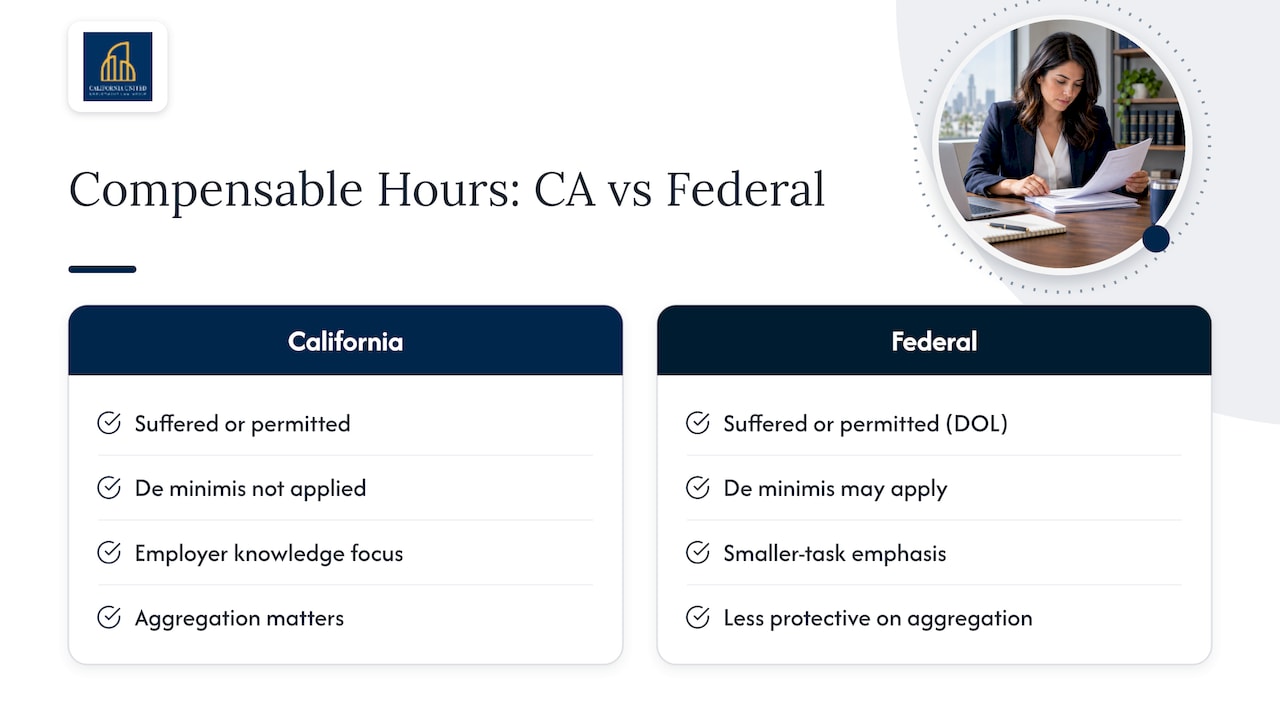
California wage law generally asks whether the employee was subject to the employer’s control, or whether the employee was suffered or permitted to work. If the answer is yes, the time is generally compensable, regardless of whether a timeclock captured it.
The California Supreme Court addressed small amounts of off-the-clock work in Troester v. Starbucks Corp. (2018) 5 Cal.5th 829, holding that the federal de minimis doctrine does not bar California wage claims merely because the unpaid time is small. The Ninth Circuit later applied that principle in Rodriguez v. Nike Retail Services, Inc. (9th Cir. 2019) 928 F.3d 810, a case involving brief post-shift exit inspections. Together, these cases support careful review of repeated, short unpaid tasks rather than automatic dismissal of them as too minor. Rutter cites Troester v. Starbucks Corp. (2018) 5 Cal.5th 829 and Rodriguez v. Nike Retail Services, Inc. (9th Cir. 2019) 928 F.3d 810 for the California rule rejecting the federal de minimis doctrine in California wage-and-hour claims. Employer knowledge remains important in off-the-clock cases: the employee should be able to show the employer knew or had reason to know the work was being performed. Rutter states that off-the-clock work must be compensated when the employer knows or should have known employees were working those hours. A Ninth Circuit decision applying this standard, Rodriguez v. Nike Retail Services, reversed a lower court’s dismissal of claims involving brief, repeated exit inspections, reinforcing that courts will look closely at aggregation and recordkeeping rather than dismissing small amounts automatically.
Even small amounts of unpaid time can accumulate into a meaningful wage claim over an extended period of employment, which is the practical lesson courts have drawn from Troester. California wage-and-hour rules may also create related claims, including overtime, minimum wage, meal or rest break, waiting-time penalty, pay-stub, interest, attorney-fee, and cost remedies, depending on the facts and claim type. CACI includes Labor Code instructions for nonpayment of wages, minimum wage, overtime, proof of overtime hours, and waiting-time penalties. Rutter lists available wage-dispute remedies as wages due and owing, other compensation, penalties, interest, attorney fees and costs, and injunctive and declaratory relief. Federal guidance from the U.S. Department of Labor describes similar “suffered or permitted” language at the federal level, but California’s approach after Troester tends to be more protective of employees, so state standards generally govern wage claims arising here.
Documenting Off-the-Clock Violations: What to Collect and How
Strong evidence is what helps turn a concern into an actionable wage claim. Before raising the issue anywhere, start gathering the following:
- Pull your own records first: timecards, paystubs, posted schedules, written policies, and any timekeeping edits or missed-punch notes you can access.
- Save communications: texts, emails, or messaging app threads where a supervisor asks you to work before or after your shift.
- Note the setting: device login timestamps, security screening times, building access records, or other neutral time markers that may show when work actually started or stopped.
- Identify witnesses: coworkers who saw or experienced the same off-the-clock tasks, along with approximate dates and times.
- Keep a personal log: short, factual daily entries noting the date, the task, and the time spent, written in neutral language rather than speculation about wrongdoing.
Employees claiming unpaid overtime generally must prove they performed uncompensated work, but if employer records are inaccurate or incomplete, reasonable evidence can support an approximate calculation. Rutter explains that an employee claiming unpaid overtime bears the burden of proving uncompensated overtime work, and where employer records are inaccurate or incomplete, evidence supporting a just and reasonable inference may shift the burden of production to the employer.
If your employer keeps records you cannot access directly, a formal written request for your personnel and time records is a reasonable next step, as outlined in our discussion of employer liability for inaccurate timesheets. Original records tend to carry more weight in a DLSE claim, while a private lawsuit often allows broader discovery to obtain records an employer did not voluntarily produce.
Pro Tip: Screenshot messages and emails as soon as you see them, since some platforms allow messages to be edited or deleted later; where possible, preserve the original file or device rather than relying on a screenshot alone.
Comparing Your Remedies: DLSE Claims, Private Lawsuits, and PAGA Actions
Several possible paths may exist for unpaid wage issues, and each fits a different situation.
- DLSE administrative claim: Filed with California’s Labor Commissioner, this route is generally accessible without an attorney and may result in unpaid wages, interest, and applicable penalties; it may be a practical route for individual disputes with clear records.
- Private wage and hour lawsuit: Filed in court, this option allows broader discovery to uncover employer records, and may allow broader discovery and may include attorney-fee claims, class claims, or related representative claims when the facts support them, though timelines are typically longer.
- PAGA representative action: Under the Private Attorneys General Act, an aggrieved employee may pursue civil penalties on behalf of the State of California and other aggrieved employees, subject to procedural requirements, allocation rules, and possible arbitration issues. Rutter states that PAGA allows an aggrieved employee to bring a civil action to recover Labor Code penalties on behalf of the state and other aggrieved employees. Rutter states that 75% of PAGA civil penalties are remitted to the State of California and 25% to aggrieved employees.
Timing matters across all three routes. PAGA is not the same as a claim for individual unpaid wages; California authority recognizes limits on recovering underpaid wages as PAGA civil penalties. Rutter explains that civil penalties recoverable in PAGA actions do not include the amount sufficient to recover underpaid wages under Labor Code section 558, although a successful PAGA action may help prove Labor Code violations supporting a separate wage claim. Wage claims carry different filing windows depending on the legal theory, including potentially different periods for written contract, oral contract, statutory wage, UCL, penalty, and PAGA-related claims. Rutter states that California wage-and-hour limitations periods may include four years for written contract claims, two years for oral contract claims, three years for wage liabilities created by statute, and four years for UCL claims. Choosing between these paths often depends on how much is at stake, whether coworkers share your experience, and how complete your documentation already is.
When to Consult an Employment Attorney in Glendale
Legal counsel may be especially useful when unpaid time has accumulated over months, records are incomplete or contradictory, retaliation follows a complaint, coworkers report the same practice, or the employer raises arbitration, exemption, or classification issues. If any of these apply to you, bringing organized documentation to a consultation makes the evaluation far more useful.
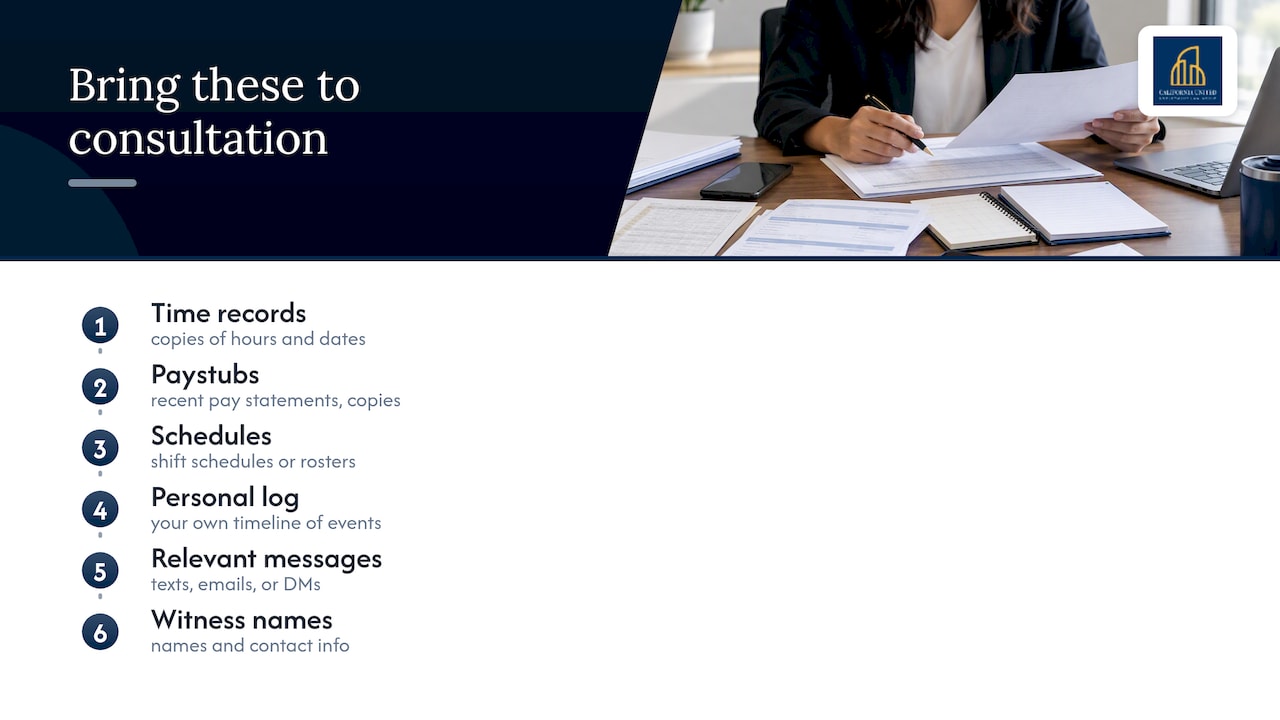
Bring copies of your time records, paystubs, schedules, your personal log, relevant messages, and the names of any witnesses. An initial case evaluation may consider whether the employer knew or should have known about the work, whether the employee was nonexempt, whether the time was compensable, whether deadlines remain open, and which remedy path fits the evidence. This article is general educational information and does not create an attorney-client relationship or substitute for individualized legal advice, because employment law outcomes depend on the specific facts, documents, deadlines, and applicable wage order.
Common Issues in Glendale Wage Cases
One common problem in wage disputes is delay: employees wait months to document anything, by which point schedules have changed and messages have disappeared. Small daily unpaid minutes may not feel worth raising on their own, but repeated over time they can justify a serious conversation with counsel. Employees who act early and keep clear records are often better positioned to evaluate and prove a wage claim.
If You Need Help With a Glendale Wage Claim
If you believe you have been working off the clock, California United Law Group handles wage-and-hour matters for California employees, including unpaid overtime, PAGA representative actions, and class claims when the facts support them.
- We offer employment law representation across wrongful termination, retaliation, and wage violations, among other claims.
- Consultations are available to review your documentation and discuss possible remedy paths based on your facts.
- Reach out through our contact page and, if available, bring copies of your time records, paystubs, schedules, messages, and any notes you have kept so far.
This article provides general information only, does not create an attorney-client relationship, and is not a substitute for advice from a qualified lawyer about your own facts.
FAQ
Can my employer fire me for raising an off-the-clock wage issue?
California employers generally may not retaliate against an employee for raising a good-faith wage complaint, but whether a termination or discipline is unlawful retaliation depends on the facts, timing, protected activity, employer knowledge, and stated reason for the action.
Can an employer require tasks after clock-out?
If an employer requires, directs, or knowingly permits work after clock-out, that time may be compensable rather than personal off-duty time. If your employer is directing tasks after clock-out, that time may actually be compensable work rather than truly “off the clock.”
Is it illegal to work off the clock in California?
Requiring or knowingly permitting unpaid off-the-clock work by a nonexempt employee generally can violate California wage law when the employer knew or should have known the work was being performed. Whether a specific situation violates the law depends on the facts, including what work was performed, whether the employer controlled or permitted it, and what the records show.
What evidence is most useful in an off-the-clock wage claim?
Documented, contemporaneous evidence is often the most useful evidence in a wage dispute because dated records, saved messages, and consistent witness accounts can help establish what work occurred and whether the employer knew or should have known about it.
Sources
- Troester v. Starbucks Corp., 2018
- Off-the-clock work | U.S. Department of Labor | Wage and Hour Division
- Rodriguez v. Nike Retail Services, Inc. (9th Cir. 2019) 928 F.3d 810
- Morillion v. Royal Packing Co. (2000) 22 Cal.4th 575
- ZB, N.A. v. Superior Court (Lawson) (2019) 8 Cal.5th 175
- Adolph v. Uber Technologies, Inc. (2023) 14 Cal.5th 1104