
Wrongful termination in Pasadena is defined as a firing that violates California or federal law, including dismissals based on discrimination, retaliation, whistleblowing, or the exercise of protected employee rights. California follows an at-will employment doctrine, meaning employers can generally end employment for any reason. However, that rule has significant legal exceptions. The California Fair Employment and Housing Act (FEHA), federal statutes like Title VII and the Americans with Disabilities Act (ADA), and the California Labor Code all create protected categories and activities that employers cannot legally use as grounds for termination. Understanding where those boundaries fall is the first step toward knowing whether your situation warrants a legal claim.
What laws govern wrongful termination claims for Pasadena employees?
Pasadena employees are protected by a layered framework of state and federal employment laws. Knowing which law applies to your situation determines where you file, how long you have, and what remedies are available.

California FEHA is the primary state law governing discrimination and retaliation claims. FEHA prohibits employers from firing based on protected characteristics such as race, sex, age, disability, pregnancy, sexual orientation, religion, and national origin. FEHA applies to employers with five or more employees and is enforced by the California Civil Rights Department (CRD), formerly known as the Department of Fair Employment and Housing (DFEH). Note that this five-employee threshold applies to discrimination and retaliation claims; FEHA’s harassment protections apply to employers of any size.
Federal anti-discrimination laws add another layer of protection for Pasadena workers:
- Title VII of the Civil Rights Act prohibits discrimination based on race, color, religion, sex, and national origin.
- The Age Discrimination in Employment Act (ADEA) protects workers aged 40 and older.
- The Americans with Disabilities Act (ADA) prohibits discrimination against qualified individuals with disabilities.
- The Pregnancy Discrimination Act (PDA) extends Title VII protections to pregnancy and related conditions.
California Labor Code §1102.5 is one of the most protective whistleblower statutes in California. It prohibits employers from retaliating against employees who report suspected violations of state or federal law to a government agency, a supervisor, or even internally within the company. This protection applies broadly and covers Pasadena employees across most industries.
At-will employment exceptions are the legal foundation of most wrongful termination claims. California courts recognize several exceptions, including the public policy exception established in Tameny v. Atlantic Richfield Co. (1980) 27 Cal.3d 167, which allows employees to sue for wrongful termination in violation of public policy even without a written contract. California courts have steadily expanded these protections since the 1980s. As early as 1959, the California Court of Appeal recognized a cause of action for discharging an employee who refused to commit perjury. (Petermann v. International Brotherhood of Teamsters, Chauffeurs, Warehousemen & Helpers of America, Local 396 (1959) 174 Cal.App.2d 184, 189–190.) Subsequent landmark decisions reinforced and broadened these protections: Foley v. Interactive Data Corp. (1988) 47 Cal.3d 654, established that an implied-in-fact contract can limit an employer’s right to terminate, and Guz v. Bechtel National, Inc. (2000) 24 Cal.4th 317, remains the leading California Supreme Court case defining the boundaries of at-will employment and the circumstances under which implied contracts arise. Together, these decisions make clear that while California is an at-will state, that status is far from absolute.
A “protected activity” is any legally recognized action an employee takes that an employer cannot legally punish. Reporting harassment, requesting medical leave, filing a workers’ compensation claim, or refusing to participate in illegal conduct all qualify. Firing someone for engaging in a protected activity is the core of most unlawful termination claims.
What are common examples of wrongful termination in Pasadena?
Recognizing the specific pattern of your termination matters because different fact patterns trigger different legal protections. The following scenarios represent the most common categories Pasadena employees encounter.
Discrimination-based termination occurs when an employer fires someone because of a protected characteristic. Examples include:
- A Pasadena warehouse worker terminated after disclosing a disability to HR
- A female employee let go shortly after announcing her pregnancy
- An older worker replaced by a younger hire with less experience and no documented performance issues
Retaliation is one of the most frequently litigated categories. Retaliation after a complaint occurs when an employer fires an employee for reporting harassment, discrimination, or safety violations. The timing of the termination relative to the protected activity is often the most telling piece of evidence.
Whistleblower terminations involve employees fired for reporting illegal conduct, regulatory violations, or fraud. Under California Labor Code §1102.5, this protection extends to reports made internally, not just to government agencies. A Pasadena healthcare worker who reports billing fraud to a supervisor, then gets fired two weeks later, has a potential whistleblower claim. California courts have confirmed that the causal nexus between the protected report and the termination is an essential element of any whistleblower claim. (See Ferrick v. Santa Clara University (2014) 231 Cal.App.4th 1337, 1357 [whistleblower retaliation claims may not succeed where a plaintiff ‘cannot demonstrate the required nexus between his reporting of alleged statutory violations and his allegedly adverse treatment’].)
Family and medical leave retaliation is another recognized category. Both the federal Family and Medical Leave Act (FMLA) and California’s California Family Rights Act (CFRA) prohibit employers from terminating employees for taking qualifying leave. Firing someone the week they return from approved medical leave is a textbook example.
Constructive discharge is a less obvious but legally recognized form of wrongful termination. It occurs when an employer makes working conditions so intolerable that a reasonable person would feel forced to resign. Courts treat a forced resignation under these circumstances the same as a direct firing.
Pro Tip: If you were terminated within a few weeks of engaging in a protected activity, such as filing an HR complaint or requesting FMLA leave, document the exact dates of both events. That timeline is often the strongest evidence in a retaliation claim.
What are the filing deadlines for wrongful termination claims in Pasadena?
Deadlines in employment law are not flexible. Missing a filing deadline can permanently bar your claim, regardless of how strong the underlying facts are.
Here is a structured overview of the key deadlines Pasadena employees need to know:
- CRD administrative complaint deadline. Before filing a FEHA civil lawsuit, you must first file a complaint with the California Civil Rights Department (CRD). Under California Government Code § 12960, Pasadena employees have three years from the date of the unlawful act to file this administrative complaint. This three-year window is substantially longer than the federal EEOC deadline. Filing with the CRD also satisfies administrative exhaustion requirements for federal Title VII claims, so most California employees do not need to file separately with the EEOC.
- EEOC filing deadline (optional for most California employees). For federal discrimination claims, the standard deadline is 180 days from the discriminatory act. Because California is a deferral state, employees in Pasadena typically have 300 days to file with the EEOC. However, because timely filing with the CRD also satisfies federal exhaustion requirements, filing with the EEOC separately is generally not required for most California employees.
CRD right-to-sue notice. Before filing a FEHA claim in California Superior Court, you must obtain a right-to-sue notice from the California Civil Rights Department. Missing this notice is a jurisdictional defect, meaning the court will dismiss your case. You can request an immediate right-to-sue notice without waiting for the CRD to complete an investigation.
FEHA statute of limitations. Once you receive a right-to-sue notice, you have one year to file your civil lawsuit in California Superior Court.
Tameny public policy claims. These common law wrongful termination claims generally carry a two-year statute of limitations under California Code of Civil Procedure §335.1.
Labor Code claims. Retaliation claims under California Labor Code §1102.5 have a three-year statute of limitations for civil actions, though administrative filing requirements may apply.
Contract-based claims. If your termination violates an employment contract, the statute of limitations is typically four years for written contracts and two years for oral contracts.
| Claim Type | Filing Deadline |
|---|---|
| CRD administrative complaint (FEHA) | 3 years from unlawful act (Gov.C. § 12960) |
| EEOC federal discrimination charge | 300 days (California deferral state) |
| CRD right-to-sue notice required | Before filing FEHA civil lawsuit |
| FEHA civil lawsuit after right-to-sue | 1 year from notice |
| Tameny public policy claim | 2 years from termination |
| Labor Code §1102.5 retaliation | 3 years from retaliatory act |
One procedural mistake that costs employees their cases: signing a severance agreement before consulting an attorney. Severance releases can waive claims even when deadlines are still open. Never sign a severance agreement without having it reviewed first.
How do you gather evidence for a wrongful termination case in Pasadena?
Building a credible wrongful termination case depends on the quality and completeness of your documentation. Courts and agencies look for patterns, timing, and inconsistencies in employer conduct.
The most useful types of evidence include:
- Personnel files and performance reviews. Positive reviews followed by sudden termination, especially after a protected activity, undermine an employer’s stated reason for firing you.
- Emails and written communications. Preserve any messages that show discriminatory comments, retaliatory intent, or inconsistent explanations for your termination.
- HR communications. Records of complaints you filed, responses you received, and any disciplinary notices are all relevant.
- Witness statements. Colleagues who observed discriminatory treatment or heard comments from supervisors can provide supporting accounts.
- Termination documentation. The written reason your employer gives for your termination is a critical piece. Inconsistencies between that reason and prior communications are significant.
Timing matters as much as content. Courts pay close attention to the gap between a protected activity and a termination. A firing that occurs days or weeks after you filed an HR complaint, requested leave, or reported a legal violation creates a strong inference of retaliation.
Documenting events and communications as early as possible, ideally before you are terminated, gives you the most complete picture. If you suspect your job is at risk, start keeping a personal log of incidents, dates, and the names of people involved.
Pro Tip: Request a copy of your personnel file from your employer. Under California Labor Code §1198.5, employees have the right to inspect and receive a copy of their personnel records. This file often contains performance reviews, disciplinary records, and other documents that become central to a wrongful termination claim.
What options and damages are available after wrongful termination in Pasadena?
Understanding what you can recover, and what the process looks like, helps you make informed decisions about how to proceed.
Potential damages in wrongful termination cases include:
- Lost wages and benefits. This covers back pay from the date of termination and, in some cases, front pay for future lost earnings.
- Emotional distress damages. FEHA claims allow recovery for the psychological harm caused by discriminatory or retaliatory conduct.
- Punitive damages. Available in cases involving malicious or oppressive employer conduct, punitive damages are designed to deter future misconduct.
- Attorney’s fees. Under FEHA, a prevailing employee can recover attorney’s fees, which makes legal representation more accessible even when out-of-pocket costs are a concern.
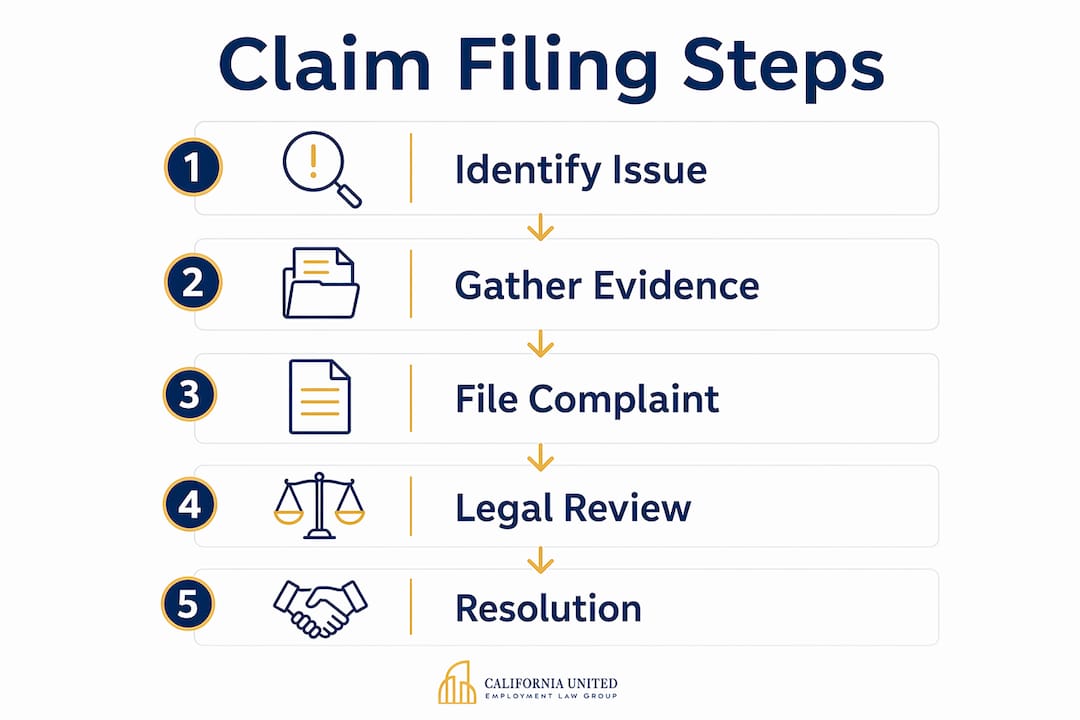
The path to recovery runs through either administrative agencies or civil courts, and sometimes both. Filing with the EEOC or CRD is often a required first step before you can sue in court. The agencies may investigate, attempt mediation, or issue a right-to-sue notice. If the agency does not resolve the matter, civil litigation becomes the next option.
Legal outcomes vary widely depending on the specific facts, the applicable law, and the strength of the evidence. No outcome can be guaranteed. What an experienced Pasadena employment attorney can do is evaluate your specific situation, identify the strongest legal theories, and help you avoid procedural mistakes that would otherwise end your case before it begins. Learning more about how to fight wrongful termination in California is a practical starting point.
Key Takeaways
Wrongful termination in Pasadena requires proving your employer fired you for a reason prohibited by California or federal law, not simply that the firing was unfair or unexpected.
| Point | Details |
|---|---|
| At-will employment has limits | California’s at-will rule does not protect employers who fire for discriminatory or retaliatory reasons. |
| FEHA is the primary state law | FEHA covers discrimination and retaliation and requires a CRD right-to-sue notice before filing suit. |
| Deadlines are strict | Pasadena employees have 300 days for EEOC charges and one year to file a FEHA civil lawsuit after receiving a right-to-sue notice. |
| Severance agreements can waive claims | Never sign a severance agreement without legal review, as it may permanently release your right to sue. |
| Evidence and timing are critical | Document protected activities, communications, and termination dates as early as possible to support your claim. |
What I’ve Learned About Wrongful Termination Cases In Pasadena
After working through employment law matters involving Pasadena employees, the pattern I see most often is not a lack of valid claims. It’s a lack of timely action. Employees spend weeks or months trying to resolve things internally, or simply processing what happened, while deadlines quietly expire in the background.
The second most common problem is the severance agreement. Employers often present these quickly, sometimes within days of termination, and the pressure to sign feels real. But signing without legal review can permanently close the door on a valid claim. That is not a hypothetical risk. It happens regularly.
The “at-will” misunderstanding also runs deep. Many Pasadena employees believe that because California is an at-will state, they have no recourse. That belief is incorrect and costly. At-will employment means an employer does not need a good reason to fire you. It does not mean an employer can fire you for an illegal reason. Those are two very different things, and the distinction is where most wrongful termination claims begin.
My consistent observation is that early consultation with a California employment attorney, even just to understand whether a claim exists, is the single most protective step an employee can take.
How Calunitedlaw Supports Pasadena Employees Facing Wrongful Termination
California United Law Group, P.C. represents employees in Pasadena and throughout California in wrongful termination, discrimination, retaliation, and labor law disputes. The firm handles FEHA claims, Labor Code violations, and whistleblower cases at every stage, from pre-litigation through trial.
If you were recently terminated and are trying to understand whether your employer acted illegally, the first step is getting a clear picture of your rights and deadlines. Calunitedlaw’s team works directly with Pasadena employees to evaluate claims and explain options without pressure.
Learn more about your rights on the wrongful termination California page, or connect directly with an employment lawyer in Pasadena to discuss your specific situation.
FAQ
What qualifies as wrongful termination in Pasadena?
Wrongful termination is defined as a firing for illegal reasons, including discrimination, retaliation, whistleblowing, or violation of labor rights. Being fired unfairly or without a good reason does not automatically qualify as wrongful termination under California law.
How long do I have to file a wrongful termination claim in California?
The deadline depends on the type of claim and which agency you are filing with. For FEHA claims in California, you must file an administrative complaint with the California Civil Rights Department (CRD) within three years of the unlawful act (Gov.C. § 12960). Once you receive a CRD right-to-sue notice, you then have one year to file your civil lawsuit in California Superior Court. Separately, for federal EEOC charges, Pasadena employees generally have 300 days as a deferral state — though filing with the CRD typically satisfies both state and federal administrative exhaustion requirements. Because deadlines vary by claim type and individual circumstances, consulting an attorney promptly is strongly recommended.
Can I still file a claim if I signed a severance agreement?
Possibly, but it depends on the specific language in the agreement. Severance releases may waive your right to bring a wrongful termination claim, which is why legal review before signing is strongly recommended.
What is the difference between unfair termination and wrongful termination?
Unfair termination means your employer made a poor or unjust business decision. Wrongful termination means your employer fired you for a reason that violates a specific law or public policy. California’s at-will doctrine permits unfair firings. It does not permit illegal ones.
Do I need an attorney to file a wrongful termination claim in Pasadena?
You are not legally required to have an attorney, but the procedural requirements, including CRD filings, right-to-sue notices, and strict deadlines, make legal guidance highly practical. An employment attorney can assess whether your facts support a viable claim and help you avoid errors that would otherwise end your case.