
If you work at a Torrance restaurant, cafe, bar, salon or hotel and suspect your tips are being taken or split unfairly, California law gives you real protections. Tip pools themselves are often legal. What matters is who takes part, who is kept out, and whether anyone in management is getting a share. When a pool crosses that line, you may be able to report it to the state and seek the money back, and California law generally protects you from retaliation for speaking up.
This article explains the rules in plain terms. It is general education, not legal advice. Employment law is fact-specific, and outcomes vary from case to case.
TL;DR
- California generally allows a mandatory tip pool if it is fair and reasonable, but owners, and managers or supervisors who act as the employer’s agent, generally cannot be paid from it.
- Under Labor Code section 351, tips belong to the employees they were left for, and an employer cannot count them toward your wages.
- Torrance employees can file a wage claim with the Labor Commissioner’s office (the DLSE), and may also speak with an employment attorney about other options.
- Section 351 itself does not let employees sue in court, but other court claims may be available.
- Deadlines apply, so it helps to understand the time limits early.
- Retaliation for raising a tip complaint is a separate violation with its own filing window.
Table of Contents
- What California law says about tip pools
- What makes a tip pool unlawful
- Information to gather if you suspect a problem
- Your options as a Torrance employee
- Deadlines that may apply
- Retaliation protections
- Our perspective
- Talk to us about your tips
- FAQ
- Sources
What California law says about tip pools
The starting point is Labor Code section 351. It provides that a gratuity is the sole property of the employee or employees to whom it was paid, given or left. An employer or its agent may not collect, take or receive any part of it, and may not deduct tips from wages or require you to credit them against what you are owed, according to the California Labor Code.
That does not mean every pool is illegal. The Labor Commissioner’s guidance explains that California allows involuntary tip pooling when the policy is fair and reasonable and the participants are employees who provide direct table service or sit in the chain of service with a relationship to the customer’s overall experience. In practice, that can include servers, bussers, bartenders and food runners. Depending on the workplace, it may reach other staff who contribute to the customer’s service.
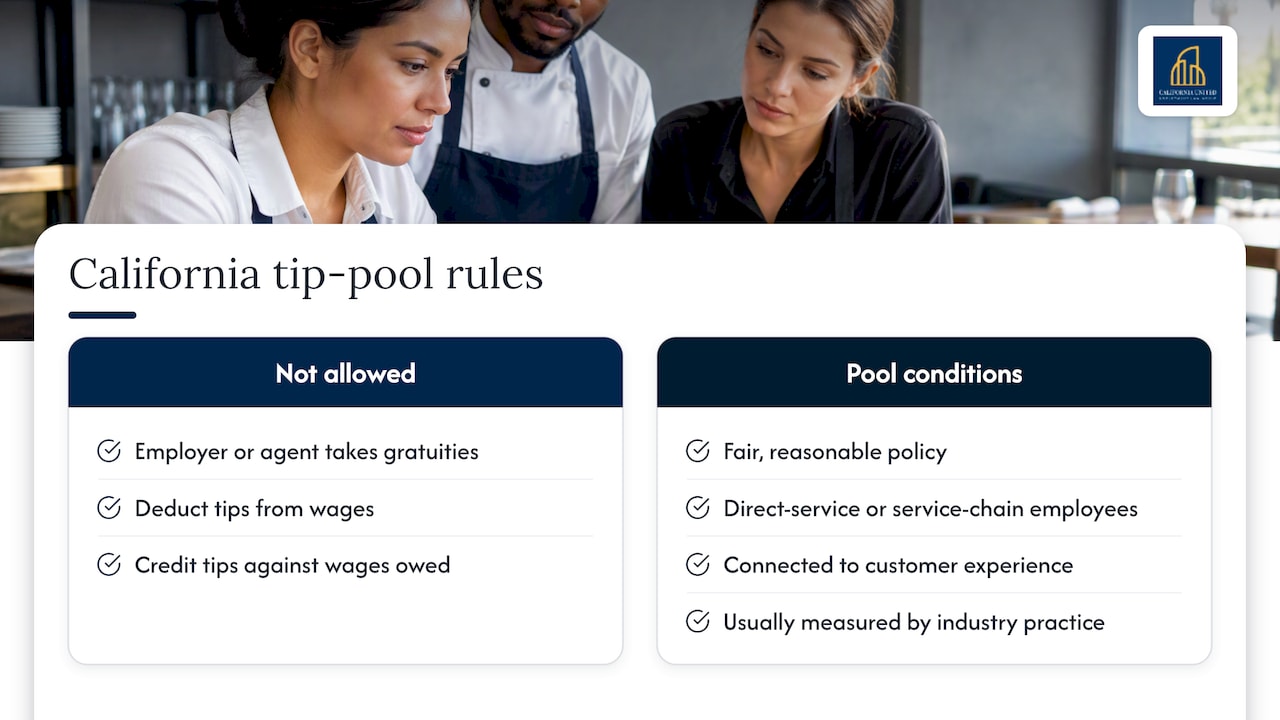
The Labor Commissioner has also taken the position, in an opinion letter on a tip pool policy, that a pool should be fair and equitable, usually measured against prevailing industry practice. Whether a particular arrangement meets that standard is a question of facts, which is why two Torrance workplaces with similar pools can reach different answers.
Who can and cannot share in the pool
| Position | Generally allowed in a mandatory pool? |
|---|---|
| Servers and other direct table service staff | Yes |
| Bussers, food runners, bartenders in the chain of service | Generally yes, if the pool is fair and reasonable |
| Owners | No |
| Managers and supervisors | Generally no if they have authority to hire, fire, supervise or direct employees; courts have allowed limited exceptions |
| The business itself (as a cut or fee) | No |
The Labor Commissioner states that a mandatory pool may not be used to compensate owners, managers or supervisors, even if they provide direct table service. That point is one of the most common sources of disputes.
California courts have shaped these rules. The Labor Code defines an employer’s “agent” as anyone other than the employer who has authority to hire or discharge employees or to supervise, direct or control their work. In Jameson v. Five Feet Restaurant, Inc. (2003) 107 Cal.App.4th 138, a restaurant floor manager who supervised servers, scheduled their stations, hired employees and recommended discharges was found to be the employer’s agent, so the manager could not share in pooled tips. By contrast, in Chau v. Starbucks Corp. (2009) 174 Cal.App.4th 688, the court held that shift supervisors who worked on the service team with baristas could share in a collective tip box. Courts have also upheld mandatory pools in decisions such as Leighton v. Old Heidelberg, Ltd. (1990) 219 Cal.App.3d 1062, Budrow v. Dave & Buster’s of California, Inc. (2009) 171 Cal.App.4th 875, which involved bartenders in the chain of service, and Etheridge v. Reins International California, Inc. (2009) 172 Cal.App.4th 908, which involved kitchen staff and dishwashers who provide indirect service. Whether a particular manager or supervisor may take part depends on that person’s actual duties.
What makes a tip pool unlawful
Based on the statute and the Labor Commissioner’s published guidance, these are the situations that most often raise concern:
- An owner, manager or supervisor receives part of the pool. This is one of the most common problems, especially when that person has authority to hire, fire, supervise or direct other employees.
- The employer keeps a portion of tips for itself, whether called an administrative fee, a shortage cover or something else.
- Tips are credited against wages. Unlike under federal rules, California employers cannot use tips to meet their minimum-wage obligation.
- Card tips are reduced by processing costs. An employer that accepts credit card tips must pay the full amount the customer indicated, with no deduction for processing fees, no later than the next regular payday.
- The pool is not distributed on time or not fully distributed. Federal regulations, for instance, say an employer that collects and redistributes tips must pay them out by the regular payday for the relevant period, or as soon as practicable if amounts cannot be determined beforehand. For credit card tips specifically, California law requires payment no later than the next regular payday.
- Workers outside the service chain are included in a way that shrinks your share, with no reasonable connection to customer service.
Not every one of these will amount to a violation in every workplace. A pool that looks unfair may still be lawful, and one that looks routine may not be. The details matter.
A Torrance example
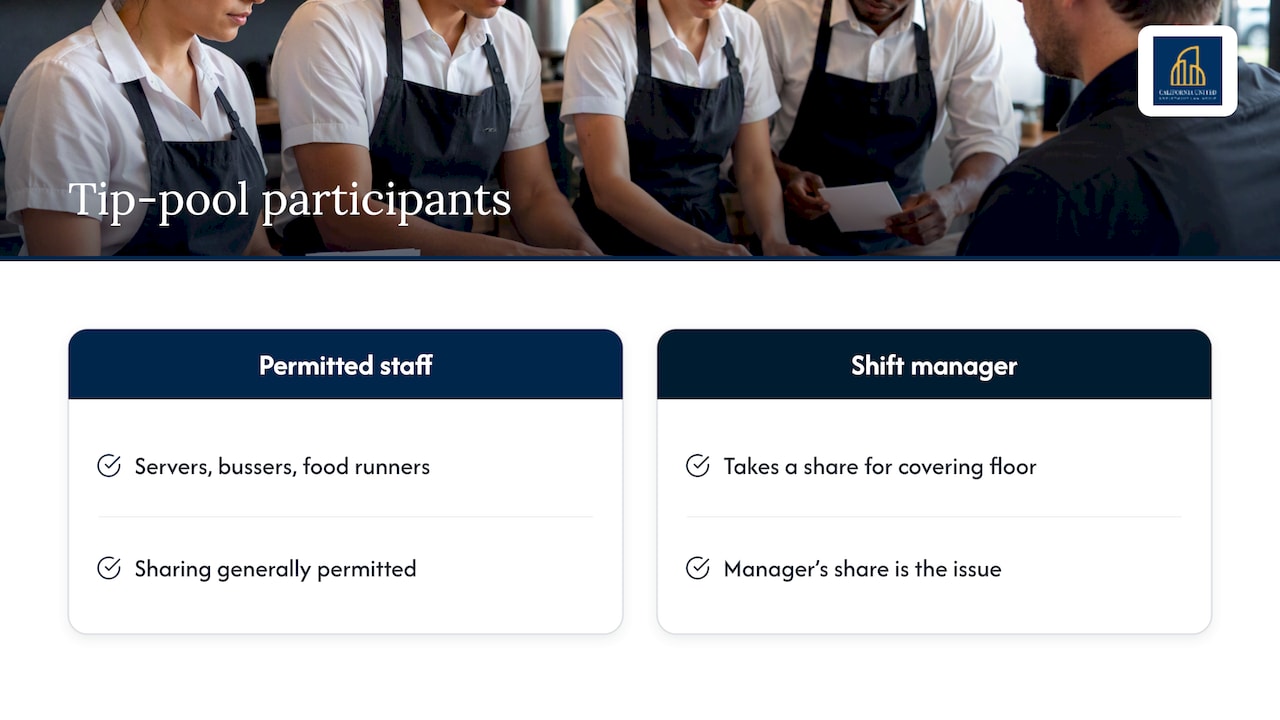
Imagine a server at a Torrance restaurant whose employer requires a pool shared with bussers and food runners. The pool is divided by hours worked, and the shift manager takes a share for “covering” the floor. The sharing with bussers and runners is the kind of arrangement California generally permits. The manager’s share is the issue. This is a hypothetical illustration, not a real case, and a real situation would turn on its own facts.
Information to gather if you suspect a problem
You do not need a perfect paper trail to bring a wage claim. The DLSE’s claim-processing policies say records are not required to file, but if you have them, you can submit your own time records, paychecks, pay stubs and any notice of employment information. You will also be asked for the employer’s legal name, location and business status.
Things workers commonly find helpful to have on hand:
- Pay stubs and any tip reports shown on them
- Your schedule or hours records
- Written tip-sharing policies, handbook pages or posted notices
- Texts or emails about how tips are divided
- The names of the owners and managers who work the floor
- Your own notes on dates, shifts and what you were told
Employers, for their part, must keep accurate records of gratuities received, and those records must be open for inspection by the Department of Industrial Relations. That means the state can look at how the pool was handled even if you do not hold every document yourself.
If you are also tracking hours because your pay may be off in other ways, our article on recording hours and unpaid overtime claims explains why good records matter.
Your options as a Torrance employee
There is no single path. Workers generally look at the following options, and an attorney can explain which may fit a particular situation.
Raise the concern internally
Some workers ask a manager or payroll to explain how the pool works. This can clarify whether there is a misunderstanding. It is optional, and you are not required to do it before filing with the state. Whatever you decide, California law generally protects you from retaliation for asserting wage rights (see below).
File a wage claim with the Labor Commissioner
An employee or former employee can file an individual wage claim to recover unpaid wages or unauthorized deductions from paychecks. According to the DLSE’s procedures, the process begins with an Initial Report or Claim (DLSE Form 1) submitted to a local office to start an investigation. The claim may go on to a settlement conference, a hearing, or dismissal. Employees are directed to file at the DLSE office nearest to where they worked.
If you prevail at a Labor Commissioner hearing and the employer neither pays nor appeals, the DLSE may enter the award as a court judgment with the same force as any other money judgment.
For a closer look at how Form 1 filings work in the South Bay, see our guide for Torrance workers on filing DLSE Forms 1 and 55 for meal and rest break pay. Tip claims and break claims are different, but the filing process has similarities.
Report to the state for investigation
The statute authorizes the Labor Commissioner to investigate and to issue a citation or file a civil action for gratuities taken or withheld in violation of section 351. An employer that violates the article may also be guilty of a misdemeanor. Whether and how the state pursues a given complaint is up to the agency.
Speak with an employment attorney
A lawyer can review your pay records, assess whether the pool is lawful, and explain whether a claim might be pursued through the Labor Commissioner, in court, or in another forum. In Lu v. Hawaiian Gardens Casino, Inc. (2010) 50 Cal.4th 592, the California Supreme Court held that section 351 does not give employees a private right to sue their employer to recover misappropriated tips. Other remedies may still be available. For example, California’s civil jury instructions include a claim for wrongful conversion of tip pool money, and the Private Attorneys General Act allows aggrieved employees, after meeting statutory prerequisites, to sue for civil penalties for Labor Code violations. Tip problems rarely come alone. They often appear alongside unpaid overtime, missed breaks or inaccurate pay stubs, and those issues may be considered together. For related background, see our overview of paystub violations under Labor Code section 226.
You can also learn how a wage claim and civil lawsuit can work together, including waiting-time penalties.
Deadlines that may apply
Time limits depend on what your claim is based on. The DLSE explains that:
- Claims based on an oral agreement must generally be filed within two years of the alleged violation.
- Claims based on a written agreement must generally be filed within four years.
- Claims based on a violation of a statute, including unpaid overtime, minimum wages, and generally tips taken in violation of Labor Code section 351, must generally be filed within three years.
These periods are described on the DLSE’s guide to filing a claim. Which one applies to your tips can depend on how your pay arrangement and the violation are characterized, so it is wise not to wait. Some claims may also be brought under California’s Unfair Competition Law, which has a longer limitations period but limits recovery to restitution and injunctive relief. Claims for civil penalties, by contrast, can be subject to a one-year limitations period. Our article on deadlines to recover unpaid wages goes into the general time limits in more depth.
Retaliation protections
Workers sometimes hesitate because they fear losing shifts, being moved to a worse section or being fired. California law generally treats retaliation for asserting wage rights as its own violation. In most cases, an employee, former employee or applicant must file a retaliation complaint with the Labor Commissioner’s Office within one year of the adverse action.
Examples of adverse actions can include termination, a sharp cut in hours, demotion or discipline that follows soon after a complaint. If that has happened, document it and consider getting advice promptly because of the one-year window. If you have been let go, our page on California employee termination rights outlines the protections that may apply.
Our perspective
We represent employees only, and we focus on California Labor Code and FEHA claims. Several of our attorneys have prior employer-side experience, which helps us see how a business is likely to explain its own tip policy and what records it keeps.
In our view, most tip disputes start with a simple question: who got a share and why? Workers often tell us they never saw the formula, or that the answer changed from week to week. A fair pool should be understandable. If nobody can explain how your share is calculated, that alone is a reason to ask questions and, if the answers do not hold up, to get an independent opinion.
We also encourage workers to look at the whole paycheck. Tip problems frequently sit beside off-the-clock work, rounding, or missing wage statement details. Looking at everything together gives a more accurate picture than looking at tips alone.
Every situation is different, and we do not promise outcomes. What we can do is explain your rights clearly and help you decide on next steps.
— California United Law Group
Talk to us about your tips
We represent California employees in wage and hour matters, including tip-related disputes, and we offer free consultations. We handle wage and hour cases on a contingency fee basis, so you pay no attorney fees unless we recover money for you. Your written fee agreement explains how case costs are handled.
👉 Learn about our wage and hour practice, or contact our team to discuss your situation in confidence.
FAQ
Can a manager take money from the tip pool in California?
Generally, no. The Labor Commissioner says a mandatory tip pool cannot be used to compensate owners, managers or supervisors, even if they serve customers directly. Courts look at the person’s actual duties, and one appellate decision allowed shift supervisors who worked on the service team to share in a collective tip box. An employer or its agent also may not keep any portion of your tips.
Can my Torrance employer make me share tips with kitchen staff?
Possibly. California permits involuntary pools when they are fair and reasonable and include employees in the chain of service. A California appellate court upheld a pool that included kitchen staff and dishwashers who provide indirect service. Whether a given pool qualifies depends on the workplace and how tips are divided, so the specifics matter.
Do I need receipts or records to file a tip complaint?
No. The DLSE does not require you to keep records to file a wage claim, though submitting pay stubs, time records and any employment notices can help. You will also need to identify your employer by legal name and location.
Can my employer take credit card processing fees out of my tips?
California law requires employers who allow card tips to pay the full amount the customer indicated, without deductions for processing fees, no later than the next regular payday. If your card tips look reduced, it may be worth having your pay reviewed.
What if I was punished for asking about tips?
Retaliation for asserting wage rights can be a separate violation. A retaliation complaint generally must be filed with the Labor Commissioner within one year of the adverse action, so consider seeking guidance soon.
Sources
- California Labor Code, Labor Code section 351 and related provisions (Legislative Information)
- California Labor Code, gratuity provisions, full text
- Labor Commissioner’s Office, Tips and gratuities
- DLSE opinion letter on a tip pool policy
- DLSE policies and procedures for wage claim processing
- DLSE guide to filing a wage claim
- Labor Commissioner’s Office retaliation complaint form
- 29 CFR 531.54, Tip pooling (eCFR)