
For Pasadena employees, constructive discharge issues can arise across Los Angeles County workplaces, including healthcare, education, hospitality, retail, professional services, and small businesses. If you work in Pasadena and resigned because your job became unbearable, California law may treat that resignation as a firing. That is the idea behind constructive separation, which courts call constructive discharge. That is the idea behind constructive discharge. Because constructive discharge is the legal term used by California courts and jury instructions, this article uses that term below. To prove it, you generally must show that your employer intentionally created or knowingly permitted working conditions so intolerable that a reasonable person in your position would have had no reasonable alternative except to resign.
That is a high bar. This guide explains the legal test, the kinds of evidence that tend to matter, and the deadlines that apply. It is general education, not legal advice. Employment cases are fact-specific, and outcomes vary.
TL;DR
- Constructive discharge means a resignation the law treats as an involuntary termination because the employer’s conduct effectively forced you out.
- The test is objective: would a reasonable person in your position have felt compelled to resign? Your own frustration, however real, is not enough on its own.
- Conditions must generally be unusually aggravated or form a continuous pattern, and the employer must have created them or knowingly permitted them.
- Documentation of what happened, and of what the employer knew and did about it, often shapes how a claim is viewed.
- Many FEHA-based claims require filing a complaint with the California Civil Rights Department (CRD) before filing a civil lawsuit. The CRD generally states that employment complaints must be filed within three years of the last alleged unlawful act. If possible, talk to an employment attorney before you resign.
Table of Contents
- What constructive discharge means under California law
- The legal test: what you have to show
- What does not usually qualify
- Evidence that tends to matter for Pasadena employees
- Timing: resigning too early or too late
- Deadlines for Pasadena employees
- Where Pasadena workers typically encounter these issues
- Our perspective at California United Law Group
- How we can help
- Questions to ask yourself before you speak with an attorney
- FAQ
- Sources
What constructive discharge means under California law
Constructive separation is not a separate lawsuit you file on its own. It is a doctrine that answers one question in a wrongful termination or discrimination case: did you really quit, or were you pushed out?
The California Supreme Court explained in Turner v. Anheuser-Busch, Inc. (1994) 7 Cal.4th 1238 that constructive discharge occurs when the employer’s conduct effectively forces an employee to resign. Although you may say “I quit,” the employment relationship is treated as ended involuntarily by the employer’s actions. In Turner, the Court also emphasized that the proper focus is whether the resignation was coerced, not whether quitting was simply one rational option for the employee.
The doctrine exists so that an employer cannot avoid laws governing termination by deliberately creating, or knowingly failing to remedy, objectively intolerable working conditions that force the employee to resign. If you were pushed out because of discrimination, harassment, retaliation, or another unlawful reason, the resignation can be treated like a termination for that reason.
So your claim usually has two layers:
- The underlying wrong, such as disability discrimination, harassment, retaliation, failure to accommodate, or a whistleblower violation.
- The forced resignation, which is what constructive discharge addresses.
Both layers need support. Proving that conditions were bad does not by itself prove you were constructively discharged.
The legal test: what you have to show
California’s standard jury instruction, CACI No. 2510, reflects the same framework that courts apply. In plain language, the employee must show:
- The employer, through its officers, directors, managing agents, or supervisory employees, intentionally created or knowingly permitted the working conditions.
- Those conditions were so intolerable that a reasonable person in the employee’s position would have had no reasonable alternative except to resign.
- The employee resigned because of those working conditions.
The standard is a preponderance of the evidence, meaning more likely than not. The key word is “objective.” The question is not whether you felt you had to leave. It is whether a reasonable person in your situation would have. The employee’s subjective belief that resignation was necessary is not enough by itself.
What “intolerable” means
No single formula defines it. The jury instruction explains that adverse conditions must be unusually aggravated or amount to a continuous pattern. In general, single, trivial, or isolated acts of misconduct are not enough. Turner recognized that a single incident may be sufficiently aggravated in unusual circumstances, such as a crime of violence against an employee by an employer or an ultimatum that the employee commit a crime.
In practice, courts tend to look at the whole picture rather than one event. Examples of the kinds of facts that might be relevant include:
- Repeated harassment that continued after you reported it.
- A pattern of treatment connected to a protected characteristic, such as disability, pregnancy, race, age, or sex.
- Retaliatory changes after a complaint, such as stripped duties or schedule changes.
- A refusal to engage in the interactive process or provide a reasonable accommodation, combined with other pressure.
These are illustrations of what may be considered, not predictions of how any case will turn out.
What “knowingly permitted” means
If the employer did not create the conditions itself, you generally need to show that someone with authority knew about them and failed to take reasonable corrective action. The Turner decision frames this as the employer’s awareness and failure to act. Coworker conduct that management never learned about can be much harder to use as the basis for a constructive discharge claim.
This is why internal reports matter so much, as discussed below.
What does not usually qualify
Many people assume that any bad job situation justifies quitting and suing. It does not. Conditions that are often not enough by themselves include:
- A demanding supervisor or a heavy workload.
- A poor performance review.
- Ordinary workplace stress, disagreements, or personality conflicts.
- A single rude comment or isolated incident, unless the incident is unusually aggravated.
- Dissatisfaction with pay, hours, or a transfer, without more.
The California Supreme Court stated in Mullins v. Rockwell International Corp. (1997) 15 Cal.4th 731 that constructive discharge occurs only when the employer terminates employment by forcing the employee to resign. A resignation that is merely a reaction to difficult conditions, without that coercive element, falls outside the doctrine.
This does not mean mistreatment is lawful. Harassment, discrimination, and retaliation can be actionable even if you never quit. It means that the extra step of treating a resignation as a termination requires its own proof.
Evidence that tends to matter for Pasadena employees
Because employers rarely announce that they want someone to resign, constructive discharge claims often depend on circumstantial evidence. Here is how the evidence generally lines up with each part of the test.
| What you need to show | Examples of evidence that may be relevant |
|---|---|
| The conditions existed and were serious | Emails, texts, schedules, written warnings, notes you wrote at the time, photos of postings or messages |
| They were a pattern, not a one-off | Dated records of repeated incidents, witness names, similar treatment of coworkers |
| The employer knew | Complaints to a supervisor, HR, or an ethics line, and the replies you received |
| The employer did not fix it | Absence of follow-up, no investigation outcome, continued conduct after your report |
| A reasonable person would have quit | Medical or safety impacts documented by your own providers, the severity and duration of the conduct, lack of reasonable alternatives, and the employer’s response or lack of response |
| You resigned because of the conditions | Your resignation message, timing close to the last incident or refusal to act |
Records created at the time
Notes written when events happen are generally viewed as more reliable than memories reconstructed later. Dates, locations, who was present, and what was said all help. Keep copies of documents you are lawfully entitled to possess, such as your own pay records, performance reviews, schedules, written complaints, responses, and policies you received. Be careful about taking confidential company files or recording conversations, because California has rules on both. An attorney can tell you what is appropriate in your situation.
Reports to the employer
The employer’s actual knowledge is central unless the employer, through its decision makers or supervisors, created the intolerable conditions itself. A written complaint to a manager or human resources, with a date, creates a clear record that the company was on notice. Without a documented report, an employer may argue that it lacked notice, that it had no chance to correct the problem, or that you simply chose to leave. Verbal complaints can matter too, but they are harder to prove, so many employees follow them with an email summarizing the conversation.
Circumstantial evidence of intent
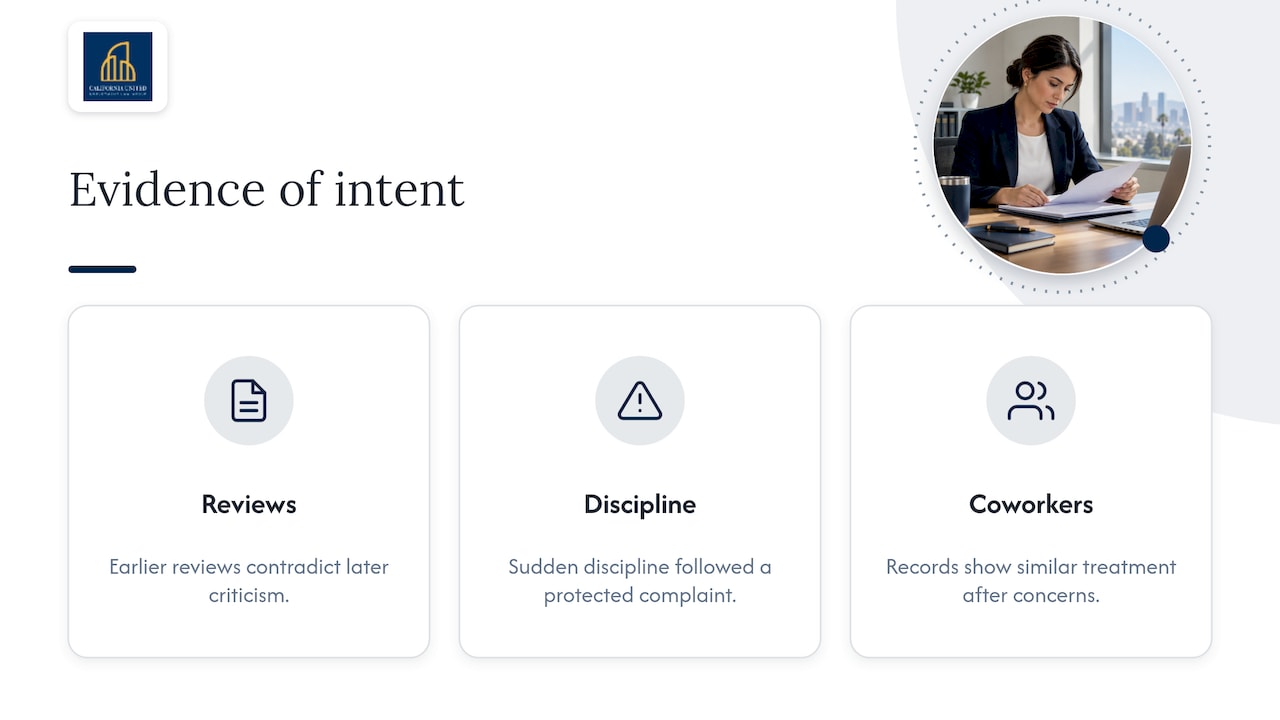
Employers seldom state their intent to force someone out. Evidence that can point toward it includes performance reviews that contradict later criticism, sudden discipline following a protected complaint, records of similar treatment of coworkers who raised concerns, or evidence that the employer ignored repeated complaints. These are the kinds of facts attorneys look for, but each case is different.
Evidence connected to the underlying claim
If harassment is the reason you left, the proof of harassment matters as much as the proof of the resignation. Our guides on how to prove workplace harassment in California and what counts as workplace harassment under California law explain that side in more detail.
Timing: resigning too early or too late
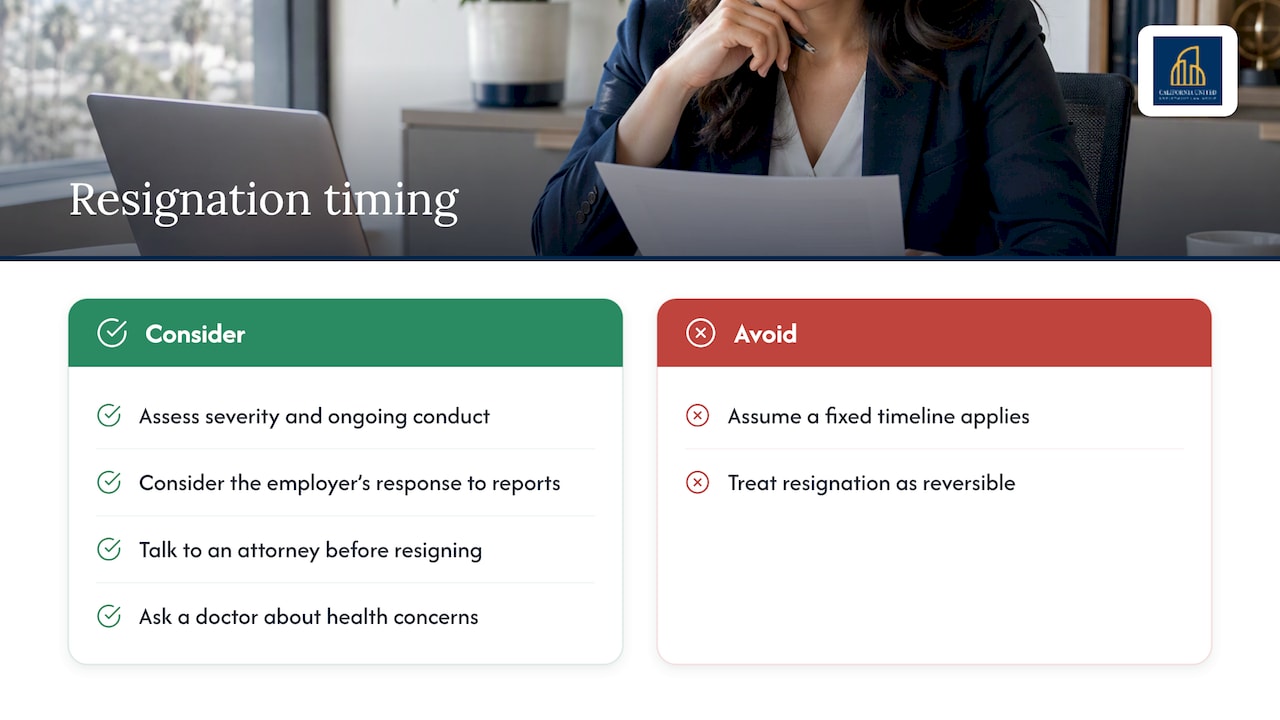
Timing is one of the hardest parts of these cases. Resign too soon, and an employer may argue that you did not give it a chance to fix the problem, or that conditions had not yet become intolerable. Wait too long, and an employer may argue that the conditions could not have been intolerable if you tolerated them for months. California authority recognizes that the length of time an employee stayed on the job may be relevant, but it is not always dispositive.
Neither extreme is automatically fatal, and there is no fixed number of days or incidents that works for everyone. The right moment depends on the facts, including how severe the conduct is, whether it is continuing, how the employer responded to your reports, whether reasonable alternatives exist, and your own health and safety.
That is why speaking with an employment attorney before you hand in a resignation is worth considering. Once you have resigned, you cannot undo it, and some options available while you are still employed may be gone. If your situation involves your health, a doctor is the right person to advise you on that part. A lawyer cannot and should not answer medical questions for you.
Deadlines for Pasadena employees
Many constructive discharge claims are brought under the California Fair Employment and Housing Act (FEHA), especially when the forced resignation is tied to discrimination, harassment, or retaliation. For most FEHA claims, the Civil Rights Department states that an employee must file a complaint with the CRD and obtain a Right-to-Sue notice before filing a civil lawsuit.
The CRD’s employment page also explains the timing: the filing window is three years from the date of the last alleged unlawful act, and after you receive a Right-to-Sue notice you generally have one year to file a civil lawsuit. For a constructive discharge theory, the resignation date can be important, but the last alleged unlawful act may be a different date depending on the claim, so it helps to record both precisely.
A few cautions:
- These deadlines generally apply to FEHA claims. Other claims, such as certain Labor Code violations, contract claims, or federal claims, can have different and sometimes shorter deadlines.
- Your employer may have asked you to sign an arbitration agreement or a severance agreement. Those documents can affect where and how a claim proceeds, so have them reviewed before signing anything new.
- Deadlines and procedural requirements can change. Confirm the current rules with the CRD or an attorney.
If you want to understand how a case moves from the first complaint through court, see our overview of the employment lawsuit process in California. For the CRD’s own explanation of what happens after you file, its complaint process page describes how it evaluates and may investigate a case.
Where Pasadena workers typically encounter these issues
Pasadena has a varied employment base, including healthcare and research institutions, schools and colleges, offices, restaurants, hotels, and retail. Whatever the setting, California employment law generally applies statewide, including to workers in Pasadena, though local facts and procedures can still matter. What changes from one workplace to another is the facts: the size of the employer, the policies it has, who you reported to, and how the company handled complaints.
If you work for a larger employer, there may be a formal HR process and written policies that become part of the evidence. In a small business, the owner may be the decision maker, and there may be no HR department at all. Both situations can support a claim or make one difficult, depending on the details. Civil lawsuits arising from Pasadena employment disputes may be filed in the Los Angeles County Superior Court system when venue and jurisdiction are proper, though arbitration agreements, administrative exhaustion requirements, and federal claims can affect where and how a case proceeds.
Our perspective at California United Law Group
We represent employees, and our employment practice focuses on California Labor Code and FEHA claims. Constructive discharge questions come up often, and many employees who contact us are exhausted, worried about money, and unsure whether leaving will affect their rights.
Here is how we think about it.
- Resignation is a major decision. When possible, we would rather talk with you before you resign than after. Early conversations let us look at the facts, the documents, and the deadlines while you still have options.
- A paper trail matters, but it is not everything. A written complaint can help show that the employer knew about the conditions. It does not guarantee anything about how a case will end.
- We are candid about the standard. The legal threshold is high, and some situations that are miserable do not meet it. We tell people that directly, because you may be relying on our analysis for real-world decisions.
- Some of our attorneys have employer-side experience, which can help us evaluate how a company may respond and what records it may rely on.
We cannot predict results or promise outcomes, and nothing in this article is a substitute for advice based on your specific facts.
— California United Law Group
How we can help
Constructive discharge is one of the matters we handle within our employment law practice, alongside wrongful termination, harassment, discrimination, retaliation, and whistleblower claims. We handle many employment matters on a contingency fee basis, meaning attorney’s fees are paid from a settlement or award if there is a recovery. Case costs and fee terms depend on the written fee agreement, and we explain them before representation begins. We offer free consultations and case evaluations.
👉 Contact us to talk through your situation before you resign, if you can do so safely.
If you have already left your job, you can still ask us to review your circumstances. Our overview of California employee termination rights may also help you understand your protections.
Questions to ask yourself before you speak with an attorney
These prompts can help you organize your thoughts for a consultation. They are not a legal test.
- What specifically happened, and on what dates?
- Did it continue after you told someone?
- Whom did you tell, and how? Did anyone respond?
- Is there a connection to your disability, pregnancy, race, age, sex, a complaint you made, or a legal violation you reported?
- Has the employer changed your pay, duties, or schedule?
- Have you signed any arbitration agreement, release, or severance offer?
- Are you still employed, and what is your realistic timeline?
FAQ
Is constructive discharge the same as constructive discharge?
Constructive discharge is the legal term California courts and jury instructions use. Some employees and online resources may describe the same issue as forced resignation or constructive separation. Constructive discharge is the term California courts and jury instructions use. It describes a resignation that the law treats as an involuntary termination because the employer forced it. Some people also call it a forced resignation.
Can I prove constructive discharge if I only complained once or experienced one incident?
It depends on the facts. Courts generally look for conditions that are unusually aggravated or form a continuous pattern, and single, trivial, or isolated acts are usually not enough. The jury instruction does recognize that in some circumstances one intolerable incident may qualify, so an attorney should review the details.
Do I have to report the problem to HR first?
The law does not use a simple checklist, but the employer’s knowledge is a central issue. When conditions are created by coworkers or lower-level supervisors, a report can help show that the employer knew and failed to act. If reporting is unsafe or futile in your situation, discuss that with an attorney.
What is the deadline to file a claim in California?
For most FEHA claims, the CRD states that the complaint must be filed within three years of the last alleged unlawful act, and a lawsuit generally must be filed within one year after a Right-to-Sue notice. Other claims can have different deadlines, so confirm yours with an attorney or the CRD.
Should I quit before I contact a lawyer?
If you can do so safely, consider speaking with an employment attorney before resigning. Resigning is hard to reverse, and the timing can affect how your claim is viewed. If the situation is harming your health, see a medical professional as well.
Sources
- Turner v. Anheuser-Busch, Inc. (1994), California Supreme Court
- Mullins v. Rockwell International Corp. (1997), California Supreme Court
- CACI No. 2510, Constructive Discharge Explained
- California Civil Rights Department: Employment
- California Civil Rights Department: Complaint Process