
This article is for general informational purposes only and does not constitute legal advice or create an attorney-client relationship. Outcomes depend on the specific facts and circumstances of each case.
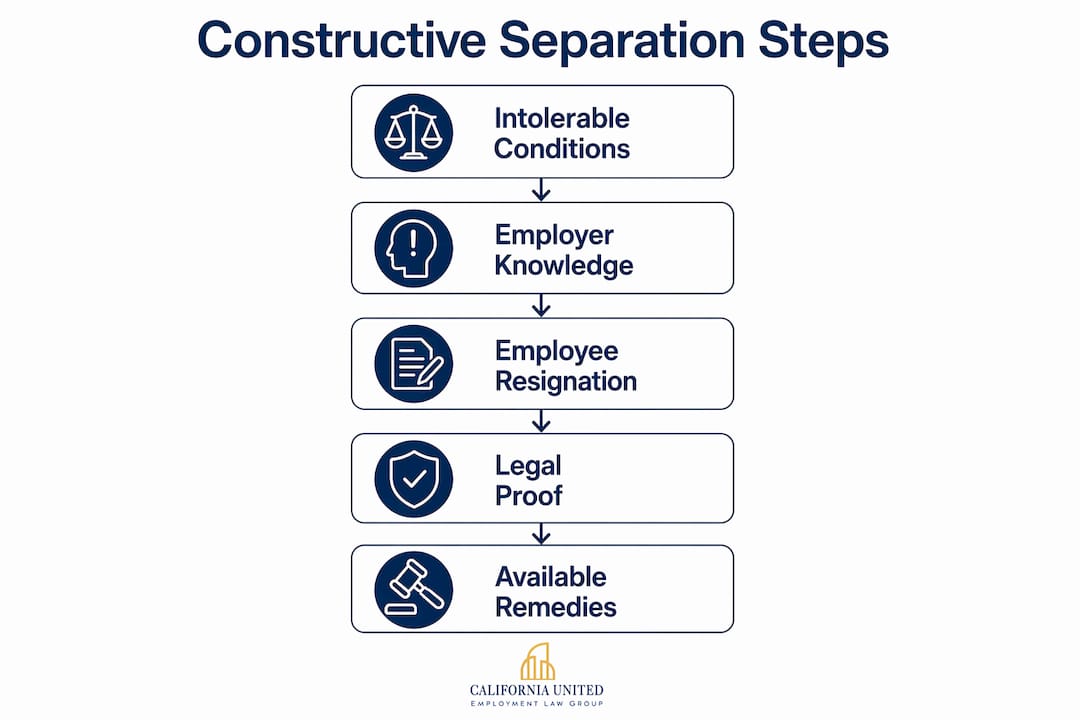
Constructive separation is defined as a situation where an employer intentionally creates or knowingly permits intolerable working conditions that force a reasonable employee to resign, making that resignation legally equivalent to a termination. For Torrance employees, this distinction matters enormously. Under California law, the landmark case Turner v. Anheuser-Busch, Inc. (1994) 7 Cal.4th 1238 established that courts apply an objective standard: whether the employer intentionally created or knowingly permitted working conditions so intolerable that a reasonable employer would realize a reasonable person in the employee’s position would be compelled to resign. The California Fair Employment and Housing Act (FEHA) adds another layer of protection, particularly when the intolerable conditions stem from discrimination or retaliation. Understanding how constructive separation works under California and Torrance employment law is the first step toward protecting your rights.
What conditions legally qualify as constructive separation under California law?
Constructive separation, also called constructive discharge or constructive dismissal, does not apply to every difficult or unfair workplace experience. California courts set a deliberately high legal standard that demands aggravated or continuous intolerable conditions rather than isolated disputes or minor frustrations.

The Turner v. Anheuser-Busch framework requires two core elements. First, the working conditions must be objectively intolerable, meaning a reasonable person in the same position would also feel compelled to resign. Second, the employer must have intentionally created or knowingly permitted those conditions. Your personal distress alone is not sufficient. Courts apply an objective test, not a subjective one.
Conditions that typically do NOT meet the legal threshold include:
- A single negative performance review
- One isolated argument with a supervisor
- A temporary reassignment to a less desirable role
- General workplace tension or personality conflicts
Conditions that courts have recognized as potentially meeting the threshold include:
- Ongoing racial, gender, age, or disability-based harassment
- Repeated retaliation after reporting safety violations or discrimination
- Deliberate exclusion from work assignments combined with public humiliation
- Unsafe physical working conditions that management refuses to address
- Systematic reduction of hours or pay designed to force a resignation
California courts have applied these principles in concrete situations. In Ortiz v. Dameron Hospital Ass’n (2019) 37 Cal.App.5th 568, a supervisor who singled out Filipino employees, falsely accused them of sleeping on the job, and transferred the plaintiff to a unit without training was found sufficient to support a constructive discharge claim—a reasonable fact finder could conclude the conditions were “so intolerable that a reasonable person in her position would have felt compelled to resign.” In Thompson v. Tracor Flight Systems, Inc. (2001) 86 Cal.App.4th 1156, a supervisor’s extended course of yelling, harsh criticism, and threats to fire the employee, left uncorrected by management, was held to constitute objectively intolerable conditions. Conversely, in Turner v. Anheuser-Busch, Inc. itself, a poor performance rating alone—even combined with reassignment—did not rise to the level of intolerable conditions.
FEHA protects Torrance employees against treatment based on protected characteristics including age, gender, race, disability, and retaliation for whistleblowing. When the intolerable conditions connect to one of these protected categories, your claim gains additional legal grounding under state law.
Pro Tip: If you are unsure whether your situation meets the legal threshold, document every incident with dates, names, and descriptions before taking any action. This record becomes the foundation of any future claim.
How must Torrance employees prove constructive separation and employer knowledge?
Proving a constructive separation claim requires more than showing that your workplace was difficult. You must demonstrate that your resignation was a direct result of intolerable conditions that the employer caused or knowingly allowed to continue. Courts also scrutinize whether the employer had a genuine opportunity to fix the problem before you resigned.
Here is what California courts generally expect you to establish:
The conditions were objectively intolerable. A reasonable person in your position would have felt compelled to resign, not merely uncomfortable or dissatisfied.
The employer knew or should have known. Employer liability requires that supervisory personnel or company officers were aware of the intolerable conditions. Complaints made only to coworkers, without reaching management or HR, weaken this element significantly.
You notified someone with authority. Courts require that employees report intolerable conditions to a supervisor, manager, or HR officer with authority to act — not merely to coworkers. While an employer’s failure to respond after notice strengthens your claim, courts assess notice as part of the overall employer-knowledge inquiry, not as a standalone prerequisite that bars your claim if omitted in every circumstance.
Your resignation was caused by the conditions. The connection between the intolerable environment and your decision to leave must be clear and direct. A resignation letter that states the specific reasons is far more persuasive than a generic notice.
Pro Tip: Although not a formal legal element, a documented paper trail—including written complaints, emails, witness statements, and records of incidents—gives courts and agencies the concrete evidence they need to evaluate your claim. Begin documenting as early as possible.
Pinpointing which supervisors knew about the conditions, and when, is often the most difficult part of any constructive discharge case. Courts look at whether knowledge reached a corporate officer or someone with authority to act. A complaint buried in a low-level HR inbox that was never escalated may not satisfy this requirement.
Pro Tip: Send any complaint about workplace conditions in writing, even if you also speak to someone verbally. An email or written memo creates a timestamp and a record that the employer received notice.
What legal protections and remedies are available to Torrance employees?
When constructive separation involves discrimination, retaliation, or a breach of contract, it can form the basis of a wrongful termination claim even for at-will employees. California law recognizes several distinct legal pathways for affected workers in Torrance.
Key protections and remedies include:
Wrongful termination claims. Constructive separation transforms a resignation into a legal firing, but a wrongful termination claim requires an additional showing: that the constructive discharge also breached an employment contract (express or implied), violated a statutory right, or was carried out in violation of public policy — such as retaliation for protected activity or discrimination based on a protected characteristic. At-will status does not eliminate these protections.
FEHA claims. The California Fair Employment and Housing Act covers employers with five or more employees and prohibits constructive discharge based on race, gender, age, disability, religion, national origin, and other protected categories. FEHA also covers retaliation against employees who report violations or assist in investigations.
Unemployment benefits. Employees who resign for “good cause,” such as unlawful harassment or unsafe conditions, may qualify for unemployment benefits through the California Employment Development Department (EDD). The EDD treats a resignation under these circumstances as effectively involuntary.
Damages. Successful claims can result in back pay, front pay, compensation for emotional distress, and in some cases punitive damages where employer conduct was particularly egregious.
Here is a summary of the general time limits that apply to constructive separation claims in California:
| Claim Type | General Time Limit |
|---|---|
| Common-law tort (wrongful termination) | 2 years from resignation date |
| FEHA claim — file administrative complaint with CRD | 3 years from the unlawful act |
| FEHA civil lawsuit — file in court after receiving right-to-sue notice | 1 year from CRD right-to-sue notice |
| Breach of written contract | 4 years from breach |
| Breach of oral contract | 2 years from breach |
These time limits vary by claim type, and missing a deadline can permanently bar your right to pursue relief. For FEHA claims, these are two separate deadlines: you must first file a complaint with the California Civil Rights Department within three years, and then — after receiving a right-to-sue notice from the CRD — file your civil lawsuit in court within one year of that notice. Missing either deadline can bar your claim. Acting promptly after a resignation under intolerable conditions is not just advisable. It is legally necessary.
One additional caution: avoid signing any separation agreement or release of claims without first understanding what rights you may be waiving. Premature signing of releases can extinguish your right to pursue a constructive discharge claim entirely, even if you have a strong case.
How do constructive separation claims relate to labor disputes in Torrance?
Torrance is home to a wide range of industries, including aerospace and defense manufacturing, healthcare, retail, logistics, and professional services. Workers in these sectors face workplace disputes that can escalate into constructive separation scenarios, particularly in high-pressure environments where supervisory misconduct or systemic discrimination goes unaddressed.
Common situations in Torrance workplaces that lead to constructive separation claims include:
- Harassment in manufacturing or warehouse settings, where power imbalances between supervisors and floor workers create conditions for sustained mistreatment. Understanding what counts as workplace harassment under California law helps workers recognize when a pattern crosses the legal threshold.
- Retaliation after reporting safety violations, which is particularly relevant in industrial and logistics environments where workers may report OSHA violations or wage theft. Recognizing signs of employer retaliation early gives employees a stronger foundation for any future claim.
- Discrimination in professional or corporate settings, where subtle but persistent exclusion, demotion, or hostile treatment based on a protected characteristic can accumulate into a legally cognizable constructive discharge. In Colores v. Board of Trustees of California State Univ. (2003) 105 Cal.App.4th 1293, a supervisor’s extended campaign to invent documentation supporting termination, combined with frequent reorganization of the employee’s duties and demands to process unlawful orders, was found sufficient when the employee’s medical condition was exacerbated by stress — the court held that “an abusive employer has [no] right to orchestrate how its employee exits her employment.”
- Unsafe physical conditions that management ignores despite repeated complaints, which can support both a constructive separation claim and a separate workplace safety complaint.
Local Torrance employees also have access to state-level agencies including the California Civil Rights Department (CRD), formerly the Department of Fair Employment and Housing, and the California Labor Commissioner’s Office. These agencies handle administrative complaints that often precede civil litigation. Filing with the CRD is a required step before pursuing a FEHA lawsuit in court, so understanding the administrative process matters as much as understanding the underlying law.
Torrance workers should also be aware that California employee termination rights extend beyond what most employers communicate at the time of separation. Knowing your rights before you resign, not after, puts you in a far stronger position.
Key Takeaways
Constructive separation in California requires proof of objectively intolerable conditions, employer knowledge, and a resignation directly caused by those conditions, making documentation and timely action the two most critical factors for any Torrance employee considering a claim.
| Point | Details |
|---|---|
| Legal standard is objective | Courts apply the Turner v. Anheuser-Busch reasonable person test, not your personal feelings. |
| Employer knowledge is required | Supervisors or officers must have known about the conditions for liability to attach. |
| Notice and documentation matter | Notify HR or management in writing and keep records of every incident and complaint. |
| Multiple legal remedies exist | FEHA, wrongful termination, and unemployment benefits may all apply depending on the facts. |
| Time limits are strict | FEHA claims require an administrative complaint with the CRD within three years of the unlawful act, followed by a civil lawsuit within one year of receiving a right-to-sue notice. Common-law tort claims have a two-year limit from the resignation date. |
What I’ve Learned About Constructive Separation Cases In California
After working through employment law content for years, the pattern I see most often is this: employees wait too long to document, and then they wait too long to act. By the time someone realizes their situation may qualify as constructive separation, weeks or months of undocumented incidents have already passed. Courts notice that gap, and employers use it.
The second thing I’ve observed is that the employer knowledge requirement genuinely surprises people. Many employees assume that because something happened at work, the company is automatically responsible. California law does not work that way. If your complaint never reached a supervisor with authority to act, the employer can argue it had no opportunity to fix the problem. That argument succeeds more often than it should.
The third reality is that at-will employment creates a false sense of powerlessness. Many Torrance workers believe that because California is an at-will state, they have no recourse when conditions become unbearable. That belief is incorrect. At-will employment does not permit employers to hide wage violations or create discriminatory conditions and then claim the resignation was voluntary. The law sees through that.
My honest perspective: if you are experiencing conditions that feel intolerable, the most useful thing you can do right now is write down what happened, when it happened, and who was present. That record, started today, is worth more than any action you could take after the fact.
Get Legal Support For Your Torrance Workplace Situation
If you are a Torrance employee dealing with intolerable workplace conditions, understanding your rights is only the first step. California United Law Group, P.C. represents employees across California in wrongful termination, constructive discharge, discrimination, harassment, and retaliation cases. The firm focuses on California Labor Code and FEHA claims and works with employees at every stage of a dispute.
If your situation may involve constructive separation or wrongful termination, explore your legal options with California United Law Group. You can also review the wrongful termination overview to understand how California law applies to your specific circumstances. Early consultation gives you the clearest picture of what your options are before deadlines pass.
FAQ
What is constructive separation under California law?
Constructive separation, also called constructive discharge, occurs when an employer intentionally creates or knowingly permits intolerable working conditions that force a reasonable employee to resign. California courts treat this resignation as legally equivalent to a termination.
Does constructive separation apply to at-will employees in Torrance?
Yes. At-will employment does not protect employers from constructive discharge claims when the resignation results from discrimination, retaliation, breach of contract, or violations of public policy under California law.
How long do I have to file a constructive separation claim in California?
The time limit depends on the type of claim. FEHA claims generally allow three years from the unlawful act, while common-law tort claims typically carry a two-year limit from the date of resignation.
Can I collect unemployment benefits if I resigned due to intolerable conditions?
Possibly. California’s EDD may treat a resignation caused by unlawful harassment, discrimination, or unsafe conditions as involuntary, which can make you eligible for unemployment benefits despite having resigned.
Should I sign a separation agreement before consulting an attorney?
No. Signing a separation agreement or release of claims before speaking with an attorney can permanently waive your right to pursue a constructive discharge or wrongful termination claim, even if you have strong evidence supporting your case.