
Yes. If you work in Monterey Park, California law protects you from discrimination and harassment because of your religion, and it requires most employers to accommodate your sincerely held religious practices. The main law is the California Fair Employment and Housing Act (FEHA). Federal law adds a second layer of protection. Whether you have a viable claim depends on your facts, and this article is general education, not legal advice. For a failure-to-accommodate claim, California jury instructions require proof that the employee had a sincerely held religious belief or observance, that it conflicted with a job requirement, that the employer knew of the conflict, and that the employer failed to reasonably accommodate or explore available alternatives.
TL;DR
- Yes, the claim exists. FEHA prohibits religious creed discrimination, harassment and retaliation by private employers with 5 or more employees and by public employers.
- Protection is broad. It covers belief, observance and practice, including religious dress and grooming, and it does not depend on belonging to a well-known religion.
- Accommodation is a duty. Employers must reasonably accommodate known religious beliefs or observances that conflict with job requirements unless they can show undue hardship, and they generally must explore available reasonable alternatives first.
- Deadlines matter. In employment cases, you generally have three years from the last harm to submit an intake form to the California Civil Rights Department (CRD).
- Facts decide outcomes. Every situation is different, and results vary.
Table of Contents
- Who is protected from religious discrimination in Monterey Park
- What counts as religion under California law
- Common forms of religious discrimination at work
- How religious accommodation works
- Do you have a claim? Questions to consider
- Deadlines and where claims go
- Does it matter that your employer is a religious organization?
- Our perspective at California United Law Group
- Talk to an employment lawyer about your situation
- What you can expect from the process
- FAQ
- Sources
Who is protected from religious discrimination in Monterey Park
Monterey Park sits in Los Angeles County, but the rules that apply to your job are state and federal, not local. That is good news: you get the same strong protections as employees anywhere else in California.
According to the California Civil Rights Department’s guidance on religious discrimination and accommodations, California law protects job applicants, employees, interns and volunteers from discrimination and harassment based on their actual religious creed, or the creed someone believes they have. That last point surprises many people. You can be protected even when a supervisor is simply wrong about your beliefs.
Coverage depends on the type of employer:
| Employer type | Main law | Size threshold |
|---|---|---|
| Private employer in California | FEHA | 5 or more employees, per the CRD guidance |
| Public employer (city, county, school district) | FEHA | Generally covered as public employers; confirm coverage based on the specific entity. |
| Larger employers | Title VII of the Civil Rights Act | 15 or more employees |
The federal threshold comes from Title VII, which the U.S. Department of Labor describes as prohibiting religious discrimination in employment and requiring reasonable accommodation. Because FEHA reaches smaller employers, it often matters most for workers at small Monterey Park businesses such as restaurants, shops, clinics and offices.
The City of Monterey Park publishes its own personnel rules with an equal employment opportunity section, which is a useful reference if you work for the city itself.
What counts as religion under California law
California uses the term “religious creed.” The CRD explains that it covers belief, observance and practice, including religious dress and grooming. Examples include:
- Wearing a hijab, turban, yarmulke, cross or other religious garb
- Keeping a beard or uncut hair for religious reasons
- Observing a Sabbath or holy days
- Taking time for daily prayer
- Following dietary rules
- Holding sincere moral or ethical beliefs that function as religion for you
You do not have to belong to an organized group. The central question is whether the belief is sincerely held and occupies a place of importance parallel to traditionally recognized religions. Atheism and non-belief may also be protected, so an employer generally should not pressure employees to participate in religious activity.
Religion is one of many protected categories. The CRD’s employment page lists them, including race, color, ancestry, national origin, age (40 and over), disability, sex, gender identity, sexual orientation, and military or veteran status. If your situation overlaps with another category, such as ancestry or national origin, you may want to read about ancestry discrimination claims in Monterey Park or national origin discrimination in Monterey Park workplaces.
Common forms of religious discrimination at work
Religious discrimination is not always a firing. It can appear in any term of employment: hiring, pay, scheduling, promotion, discipline, benefits and termination. In religious accommodation cases, the issue is often not whether the belief is common, but whether the belief is sincere, whether it conflicts with a job requirement, what the employer knew, and whether a reasonable accommodation was available.
Treating you differently because of your faith
Examples include refusing to hire someone who wears religious dress, passing over an employee for promotion after they mention their beliefs, or assigning less desirable shifts to people of a certain religion.
Failing to accommodate a religious practice
Under California law, an employer must reasonably accommodate an applicant’s or employee’s known religious belief or observance that conflicts with a job requirement unless the employer can show undue hardship. Typical accommodations include:
- Schedule changes or shift swaps for a holy day
- Break time for prayer
- Exceptions to a dress or grooming policy
- Reassigning a task that conflicts with your beliefs
A reasonable accommodation is one that eliminates the conflict between the religious practice and the job requirement, and if more than one accommodation is reasonable, the employer may satisfy its duty by selecting one in good faith.
Religious harassment
Harassment can include mocking your beliefs, repeated comments about your clothing or practices, or pressuring you to take part in religious activity. The CRD’s guidance covers harassment based on actual or perceived religious creed. A hostile environment may involve coworkers, supervisors or, in some cases, non-employees such as customers.
Retaliation
It is also unlawful to retaliate or otherwise discriminate against a person for requesting accommodation for a religious practice, regardless of whether the request is granted. Retaliation can be an independent claim. In some cases, the retaliation evidence may be stronger than the evidence supporting the underlying discrimination claim, but that depends entirely on the facts.
How religious accommodation works
The accommodation analysis usually focuses on whether a reasonable accommodation was available, whether the employer explored available alternatives, and whether the employer can prove undue hardship.
The interactive process
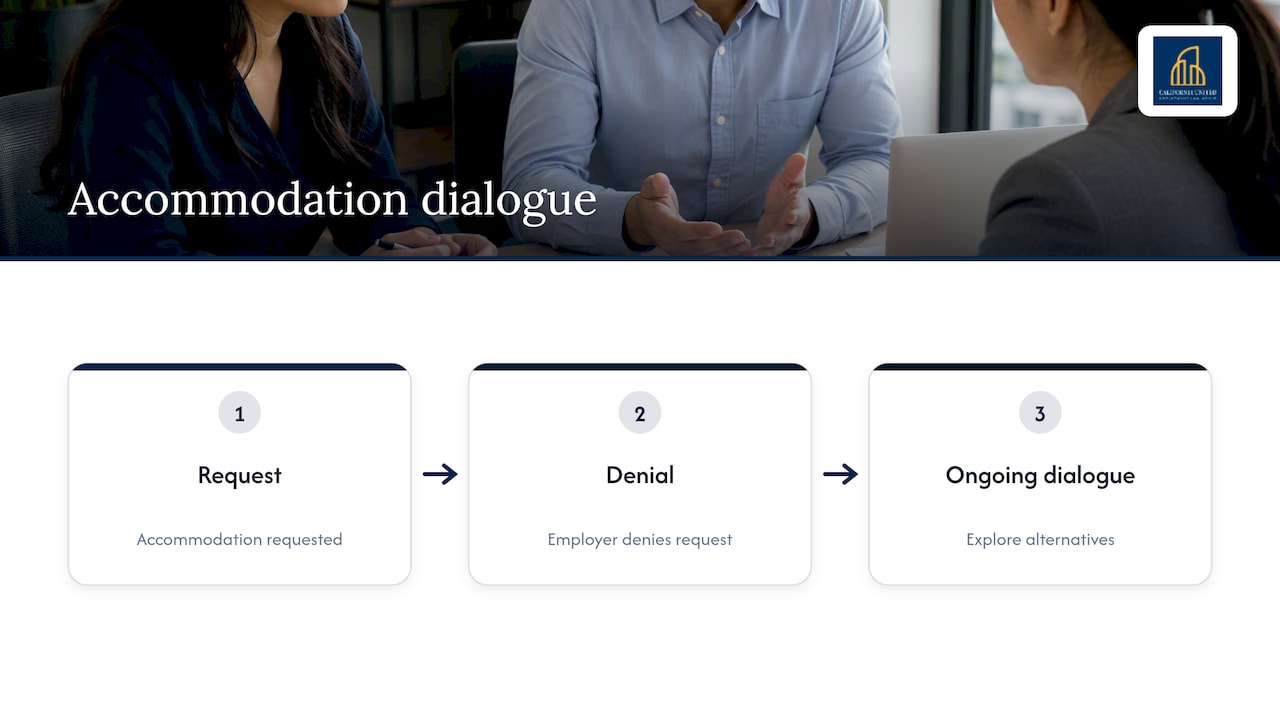
The CRD says employers who deny a request are expected to engage in an ongoing dialogue to explore alternatives. An employer that denies a request without exploring available reasonable alternatives may create legal risk, even before a court decides whether the requested accommodation itself was required.
What undue hardship means
Under FEHA, undue hardship turns on significant difficulty or expense, considering factors such as the nature and cost of the accommodation, the employer’s overall resources, the size and structure of the business, and the relationship between facilities. Inconvenience alone usually is not enough, but the analysis is case-specific and may include costs, staffing, operations, safety, civil rights obligations, and the impact on other employees. Relevant factors include the size of the employer, the nature of the accommodation and how the business operates. A large company with many staff to cover a shift faces a different analysis than a three-person shop.
Federal law has its own Title VII undue-hardship standard, and the U.S. Supreme Court clarified that standard in Groff v. DeJoy; if both FEHA and Title VII apply, a lawyer can explain how the standards interact. If your employer is large enough to be covered by both laws, a lawyer can explain how they interact.
Training, events and workplace religion
Employees often ask about mandatory trainings, including diversity or DEI sessions. Employers generally may require attendance at workplace trainings, but an accommodation issue may arise if a program requires an employee to affirm or participate in conduct that conflicts with a sincerely held religious belief. This area is complex and fact-specific.
The reverse also matters. California and federal cases recognize that religious discrimination can also involve pressure on employees who do not share an employer’s religious beliefs.
Why CFRA leave is not the answer
Some people ask whether they can use California Family Rights Act (CFRA) leave for a religious reason. CFRA leave is for specific family care and medical purposes, so it is a different track. A religious accommodation request is its own process and should be raised as one.
Do you have a claim? Questions to consider
No article can tell you whether you have a viable case. These questions help you see what a lawyer will want to understand:
- Is your employer covered? Five or more employees for FEHA, or any public employer.
- Is the belief or practice sincerely held? It does not need to be mainstream.
- Did your employer know about the conflict? For a FEHA failure-to-accommodate claim, the employer’s knowledge of the conflict between the religious belief or observance and the job requirement matters.
- What happened afterward? A denial, discipline, a schedule change, a demotion, a firing or a hostile environment.
- Was there a conversation? Did your employer discuss alternatives or just refuse?
- Did you experience anything after complaining or asking? That could point to retaliation.
Keeping a written record is widely recommended. The CRD’s materials and many employment lawyers emphasize that dated notes, emails and messages about your request, the response and any follow-up conversations can help show what was said and done.
Deadlines and where claims go
In most FEHA cases you start with the CRD. According to the state’s page on how to file a discrimination complaint, in employment cases you must submit an intake form to the CRD within three years of the date you were last harmed. The CRD can be reached at 800-884-1684. The same page notes the department generally has up to one year after a complaint is filed to complete its initial investigation, but agency processing timelines can vary.
A few practical points:
- The three-year period is generally measured from the last harmful act, and different situations can raise different timing questions.
- Federal claims run through a different agency and have shorter deadlines, so do not assume the state’s three years covers every route.
- Some claims, such as retaliation or wage issues, may follow different rules.
Because timing can decide whether a claim survives, speaking with an employment attorney sooner rather than later is sensible, especially if your job is already affected.
Does it matter that your employer is a religious organization?
Sometimes. Religious organizations have certain exemptions, and the details depend on the role and the organization. Religious organizations may have exemptions or defenses depending on the organization, the role, and the claim, but those rules are not unlimited. If you work for a faith-based organization in Monterey Park, get individual advice before assuming either way.
Our perspective at California United Law Group
We represent only employees, and our practice centers on California Labor Code and FEHA claims. Several of our attorneys have employer-side experience, so we understand how companies evaluate these issues.
What we see most often with religious creed questions is hesitation. People worry their belief is too unusual, or that asking for a schedule change will mark them as difficult. The law was written to protect exactly those conversations. A request for accommodation for a religious practice is protected under FEHA, regardless of whether the request is granted.
We also encourage a calm view of the facts. Not every uncomfortable comment is unlawful, and not every denial is a violation. That is why a careful review of what happened, when, and what your employer knew matters more than any general rule. Outcomes vary, and we do not promise results.
If you are weighing your options, you can learn about our Monterey Park employment practice. Related protections we write about include pregnancy discrimination, sexual orientation discrimination and race discrimination claims and the CRD filing deadline.
— California United Law Group
Talk to an employment lawyer about your situation
We handle wrongful termination, discrimination, harassment, retaliation and failure to accommodate matters for California employees, from pre-litigation through litigation. We work on a contingency fee basis, meaning attorney’s fees are paid from a settlement or award if there is a recovery. Case costs and fee terms depend on the written fee agreement. Consultations are free.
👉 Review our employment law services or contact us to discuss your situation.
What you can expect from the process
Every matter is different, but religious discrimination cases often involve the same building blocks:
- A review of your timeline, your communications with the employer and any written policies
- An assessment of which law applies, based on employer size and type
- Possible administrative filing with the CRD, which is a typical route for FEHA claims
- Negotiation, mediation, arbitration where a valid agreement requires it, or litigation where appropriate
In 2026, the CRD highlighted a new resource aimed at preventing religious discrimination in the workplace. It restates that employers may not use an employee’s religious beliefs to make employment decisions. It is a good sign of how seriously the state treats the subject.
California courts have applied these principles in real cases. In Soldinger v. Northwest Airlines, Inc., the court explained that once an employee shows a bona fide religious belief known to the employer that conflicts with a job requirement, the employer must show good-faith accommodation efforts or that accommodation was not possible without undue hardship. In California Fair Employment & Housing Commission v. Gemini Aluminum Corp., the employer violated FEHA by refusing time off for a Jehovah’s Witness convention without initiating a good-faith accommodation effort. Federal law is also relevant in some cases, including EEOC v. Abercrombie & Fitch Stores, Inc., which addressed religious accommodation in hiring, and Groff v. DeJoy, which clarified the federal undue-hardship standard under Title VII.
FAQ
Can my Monterey Park employer fire me for my religion?
Generally, no. FEHA prohibits an employer from firing, demoting or otherwise treating you worse because of your religious creed, and the same protection covers hiring and promotion. If you were fired after asking for an accommodation or complaining, retaliation may also be involved. Whether a specific termination was unlawful depends on the facts.
Does my employer have to let me wear religious clothing at work?
Generally, religious dress and grooming are covered by California’s definition of religious creed. An employer must accommodate them unless doing so would cause a genuine undue hardship, such as a real safety problem that cannot be solved another way. A dress code alone usually is not enough to justify refusal, but the answer depends on whether a reasonable accommodation would eliminate the conflict without undue hardship.
Do I need to prove I belong to an established religion?
No. California protects sincerely held beliefs, practices and observances, even if they are not part of an organized group. The key question is sincerity, not how widely known the belief is.
How long do I have to file a religious discrimination complaint in California?
In employment cases, you generally have three years from the date you were last harmed to submit an intake form to the CRD. Federal claims and some other routes can have shorter deadlines. Because your own dates matter, consider getting legal advice early.
Can my employer require me to attend a religious event?
An employer should not make your pay, job standing or treatment depend on taking part in a religious activity. If you are being pressured this way, you may have a potential discrimination or harassment claim depending on the facts.
Sources
- Religious Discrimination and Accommodations at Work (California Civil Rights Department)
- Employment protections (California Civil Rights Department)
- Workforce Discrimination Resources by State (U.S. Department of Labor)
- Cal. Code Regs. Tit. 2, § 11062, Reasonable Accommodation (Cornell LII)
- File a discrimination complaint (State of California)
- CRD highlights new resource on religious discrimination, May 20, 2026
- Religious Liberty Protection Kit for Religious Employees (First Liberty)
- Personnel Rules and Regulations (City of Monterey Park)
This article is for general educational purposes only and is not legal advice. Employment law is fact-specific, and outcomes vary.