
If your paystub in Santa Monica is missing hours, shows the wrong rate, or hides who your employer is, you can challenge it. Start by documenting the error and asking for your payroll records in writing. From there, California Labor Code section 226 gives you a path to recover penalties and attorney’s fees, and Santa Monica’s local minimum wage ordinance adds protections of its own. At California United Law Group, we represent employees in wage and hour disputes on a contingency fee basis, which means we collect attorney’s fees only if we recover money for you. How case costs are handled is explained in your written fee agreement.
This guide walks you through what a paystub must show, how to spot a problem, what evidence to keep, and what happens when you push back.
TL;DR
- California law requires nine specific items on your wage statement, and a missing or wrong item can be a violation.
- Keep every paystub and write down your own daily hours, then compare the two.
- You can ask your employer for your payroll records, and it has 21 calendar days to respond.
- Statutory damages under Labor Code section 226 can reach $4,000 per employee if the violation was knowing and intentional, and a prevailing employee can also recover attorney’s fees and costs.
- Retaliation for raising a pay complaint is illegal, and Santa Monica law presumes retaliation when action follows within 90 days.
- Results depend on the facts of each case, and no outcome is guaranteed.
Table of Contents
- What your Santa Monica paystub must show
- How to spot an error or omission
- Step 1: Document what really happened
- Step 2: Ask for your payroll records
- Step 3: Raise it with your employer in good faith
- Step 4: Choose your route
- What you can recover
- Deadlines to keep in mind
- How we can help
- Our perspective
- FAQ
- Sources
What your Santa Monica paystub must show
A paystub is legally called an itemized wage statement. Under Labor Code section 226(a), it generally has to include:
- Gross wages earned
- Total hours worked (with limited exceptions)
- Piece-rate units and rates, if you are paid that way
- All deductions
- Net wages earned
- The dates of the pay period
- Your name and the permitted identifier (usually the last four digits of your Social Security number or an employee ID)
- The name and address of the legal entity that is your employer
- Every applicable hourly rate during the period and the hours worked at each rate
The state’s own worker booklet from the Department of Industrial Relations lists the same core contents and tells workers to compare their paystubs against their own record of hours and pay.
How to spot an error or omission
Most problems fall into a few patterns. Go line by line through a recent stub and check for these:
- Hours that do not match your schedule. Missing overtime, unrecorded early starts, or hours rounded down every shift.
- The wrong rate. If you work in Santa Monica, your hourly rate must at least meet the city’s minimum wage under Chapter 4.62 of the Santa Monica Municipal Code, which applies to work performed in the city.
- Deductions you do not recognize. Unexplained fees, equipment charges, or “adjustments.”
- A vague or wrong employer name, such as an unregistered brand name or a parent company listed instead of the legal entity that employs you. A registered fictitious business name may be enough. In Savea v. YRC Inc. (2019) 34 Cal.App.5th 173, the court held that an employer’s use of its registered fictitious business name on wage statements did not violate section 226(a).
- No hours at all. Salaried non-exempt workers sometimes get stubs that list only a dollar amount. Courts look at substance as well as form. In Morgan v. United Retail Inc. (2010) 186 Cal.App.4th 1136, a stub that listed regular and overtime hours separately, without adding them together, was found to show total hours worked.
- No paystub. Some employers skip them entirely, which is its own violation.
The law has a practical test for whether an omission matters. Under section 226(e)(2), injury is deemed to exist when required information is missing or wrong and you cannot promptly and easily work out the correct figures from the stub alone. If you would need to dig through other documents or do guesswork to figure out your hours, rates, or employer, that is the kind of gap the statute is aimed at.
👉 Not sure whether what you see is a violation? We offer free consultations and case evaluations for California employees.
Step 1: Document what really happened
Your own records are the backbone of any challenge. The Labor Commissioner’s wage claim guidance says to keep your paystubs and to record:
- Daily start and end times
- Meal and rest breaks
- Total hours worked each day
- Time spent on each job or piece, if you are paid by contract or piece rate
- Your employer’s name and address, and the names of your supervisors
A simple notes app on your phone works. Record entries the same day, because a log made at the time carries more weight than a reconstruction months later. Photograph or save every paystub, and keep screenshots of any scheduling app, text messages about shifts, or timekeeping system entries.
A worked example
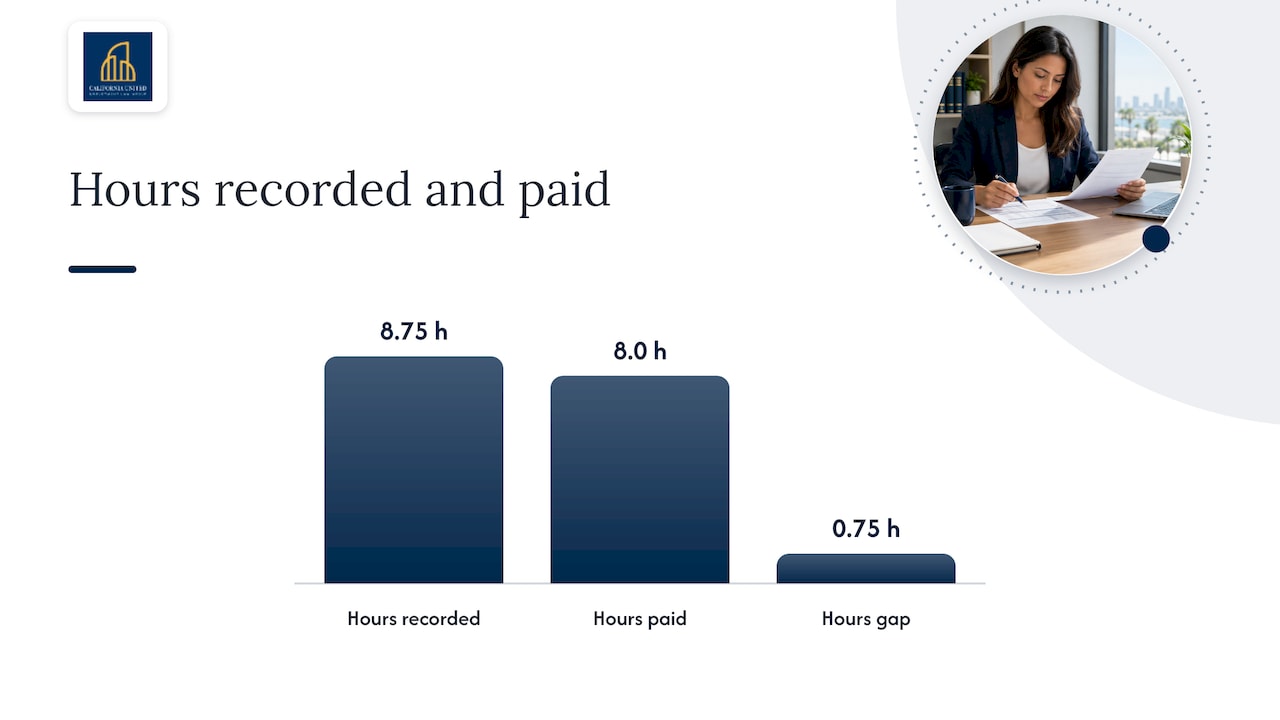
Suppose you work at a Santa Monica restaurant. Your notes show you clocked in at 10:30 a.m. and out at 7:15 p.m. on Friday, with no meal break, for a total of 8.75 hours. Your stub shows 8.0 hours at your regular rate and no overtime or break premium line. The 0.75-hour gap and the missing premium are exactly what you would circle. Repeat that over several pay periods and you have a pattern with numbers, not just a feeling that something is off.
Step 2: Ask for your payroll records
Current and former employees have a legal right to see their records. Under section 226(b) and (c), you can request to inspect or receive copies of your payroll records, and the employer must comply within 21 calendar days. It may charge only the actual cost of copying. Failure to comply carries a $750 penalty that you or the Labor Commissioner can recover under section 226(f).
Make the request in writing, by email or letter, and keep a copy. State the pay periods you want and say you are asking under Labor Code section 226. A dated written request is useful later if the employer ignores it.
In Santa Monica, the city’s ordinance also requires every employer to keep payroll records for each employee for at least three years, so records for recent periods should exist.
Step 3: Raise it with your employer in good faith
The state’s worker booklet advises workers to tell the employer, in good faith, if they believe they are not getting what they are owed. Keep the message factual: name the pay period, the item that looks wrong, and what you believe is correct. Many errors are payroll software settings that can be fixed fast.
You are protected when you do this. The same booklet notes that retaliation for such a complaint is illegal. Santa Monica’s ordinance goes further: adverse action against a person within 90 days of exercising rights under the minimum wage chapter creates a rebuttable presumption of retaliation, meaning the employer must show the action was not retaliatory. The City’s enforcement guidance says that firing, cutting hours, or threatening to contact immigration authorities over a wage complaint is unlawful retaliation.
If you have already been disciplined, demoted, or let go after speaking up, see our guide on Santa Monica whistleblower rights, reinstatement, and filing deadlines.
Step 4: Choose your route
Once you have your records and your own log, you have several paths. Often they can be combined.
Hire an employment attorney
A wage statement claim is a statutory claim, and an attorney can value it, tie it to related violations such as unpaid overtime and missed breaks, and pursue it in court or arbitration. Because the statute allows recovery of costs and reasonable attorney’s fees for a prevailing employee, these cases fit a contingency arrangement. Our wage and hour practice handles unpaid overtime and related paystub violations for California employees.
Our attorneys exclusively practice employment law for employees, and the firm includes attorneys with prior employer-side experience. In a paystub dispute, that means we understand how payroll systems and HR departments are set up to answer a claim.
File a wage claim with the Labor Commissioner
The law gives an administrative route to the Labor Commissioner’s Office, which is part of the process for unpaid wages. According to the state’s wage claim page, you can file online, by email, by mail, or in person. The office investigates, schedules a settlement conference, and, if the matter does not resolve, a hearing before a hearing officer. We can prepare the documents and evidence for that process when it is the right fit for your claim.
Santa Monica’s local enforcement
If your problem is that you are paid less than Santa Monica’s minimum wage, the City contracts with the Los Angeles County Department of Consumer and Business Affairs (DCBA) to take complaints and conduct the first investigation. The City’s employee enforcement guide lists the DCBA wage enforcement line at (800) 593-8222, notes the service is free, and says DCBA does not ask about or report immigration status. According to DCBA’s enforcement presentation, it investigates unpaid minimum wages, retaliation, and failure to allow access to or keep payroll records, and complaints can be filed anonymously. The City’s FAQ adds that questions and complaints are treated as confidential.
DCBA’s work can reach beyond one person. Its 2018-19 annual report describes two Santa Monica hotel cases in which the employer paid $23,705.54 in restitution to 23 employees and $9,210 in fines to the City, after DCBA reviewed payroll records for all employees rather than only the complainant.
Representative claims under PAGA
When a paystub problem affects many coworkers, a claim under the Private Attorneys General Act (PAGA) lets an employee act on behalf of the state and other aggrieved employees. Before filing suit, the employee must give written notice to the Labor and Workforce Development Agency through its online portal, which has a $75 filing fee that can be waived for financial hardship, and to the employer by certified mail. If the agency does not investigate, or does not finish within the statutory period, the employee may proceed. For notices filed on or after June 19, 2024, 35% of recovered penalties go to aggrieved employees, up from 25%. Since the 2024 reform, a PAGA plaintiff must also have personally experienced each violation alleged, which is one reason an early review of your own stubs matters. If many coworkers are affected, we also handle class and representative actions.
What you can recover
The main remedies for inaccurate paystubs look like this:
| Remedy | Source | Amount |
|---|---|---|
| Statutory damages for a knowing and intentional failure | Labor Code 226(e)(1) | Greater of actual damages or $50 for the first violating pay period, then $100 for each later period, up to $4,000 |
| Costs and attorney’s fees | Labor Code 226(e)(1) | Reasonable fees and costs for a prevailing employee |
| Failure to provide records within 21 days | Labor Code 226(f) | $750 |
| Injunctive relief | Labor Code 226(h) | Court order requiring compliant stubs |
| PAGA civil penalty for a 226(a) violation | Labor Code 2699(f), effective January 1, 2026 | $100 per aggrieved employee per pay period, with reduced or increased tiers depending on the facts |
| Santa Monica minimum wage violations | Municipal Code 4.62.110 | Back wages, penalties up to $100 per person per day, reinstatement, fees and costs, and treble amounts for willful violations |
The PAGA tiers matter to the size of a claim. Under the 2024 PAGA amendments, the per-period penalty drops to $25 where you could promptly and easily determine the accurate information from the stub alone, rises to $200 where the same practice was already found unlawful within five years or the conduct was malicious, fraudulent, or oppressive, and is $50 for an isolated, nonrecurring event. This is why the “can you easily tell” test from section 226(e)(2) keeps coming back: a stub that leaves you unable to verify your hours or your employer generally supports a higher penalty.
What you need to show
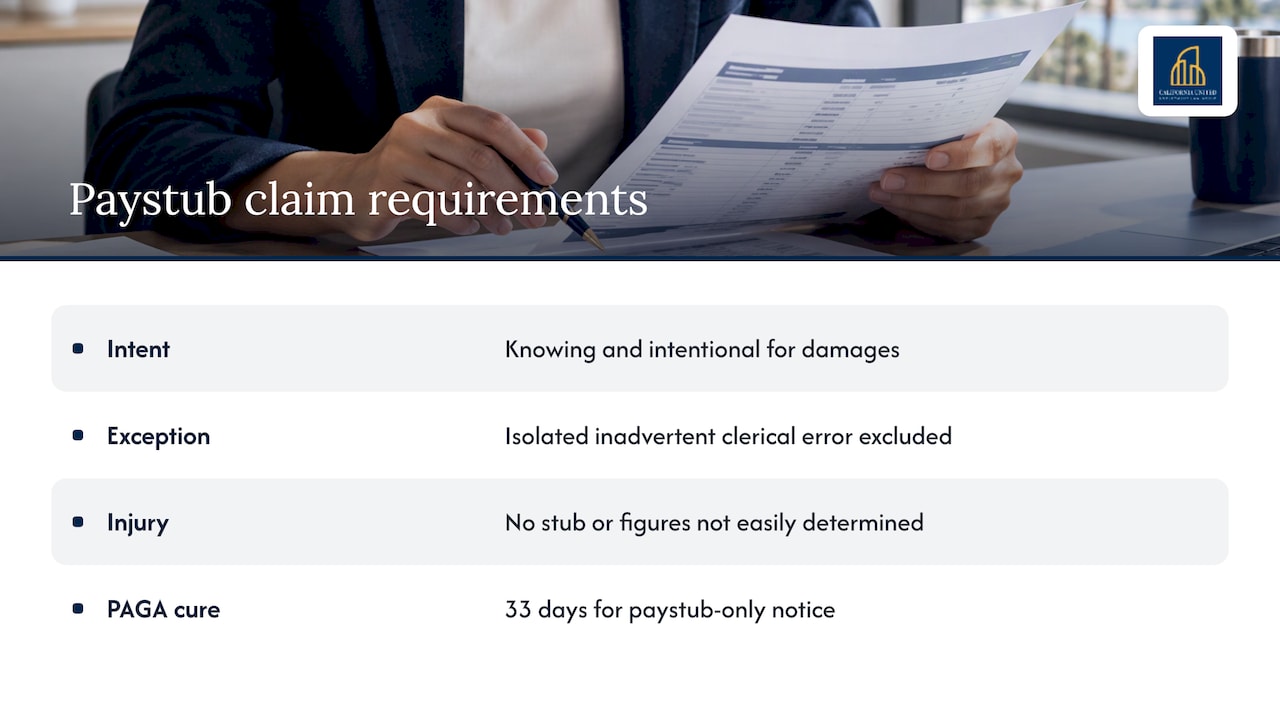
Two points shape most paystub cases. First, the failure must be “knowing and intentional” for statutory damages. The statute says this does not include an isolated, unintentional payroll error caused by a clerical or inadvertent mistake, and a factfinder may consider whether the employer had adopted and followed compliant policies. A pattern across pay periods, a requested correction that was ignored, or a missing field that never appears on any stub all point away from an innocent slip. Courts have also looked at whether the employer believed in good faith that its pay stubs were lawful. The Court of Appeal in Naranjo v. Spectrum Security Services, Inc. (2023) 88 Cal.App.5th 937 applied a “good faith” test that would relieve an employer of liability for wage statement violations if it had a good faith belief its practices were lawful, and the California Supreme Court later reviewed that question. Because an employer’s reasonable, good faith position can defeat a claim for statutory damages, the facts around how and why your stubs were wrong matter. Second, you must show injury, which the statute deems to exist when no stub is provided or you cannot easily determine the required information from the stub itself.
On cure: certain wage statement violations alleged in a PAGA notice can be cured within 33 days after the notice is postmarked, but only if the employer gives each affected employee a fully compliant wage statement for every pay period in the three years before the notice. An employer can use this cure option for the same wage statement violations only once in a 12-month period. That is one reason to have the full picture of your pay problems reviewed before a notice goes out, since paystub errors often sit alongside overtime, break, and minimum wage issues that are separate claims.
Deadlines to keep in mind
The Labor Commissioner’s page lists a one-year deadline for penalties involving failure to provide access to or copies of payroll or personnel records, and a three-year deadline for minimum wage, overtime, break, sick leave, illegal deduction, or reimbursement violations. Statutory damages for inaccurate wage statements and PAGA penalty claims are generally subject to a one-year limitations period, so paystub claims can expire sooner than unpaid wage claims. Santa Monica’s ordinance requires prosecution or citation to begin within three years after discovery of the offense. Because different claims run on different clocks, do not wait for a perfect file. Send your records request now and talk to an attorney about which deadline applies to your facts. For a broader look at timing, see our guide on deadlines to recover unpaid wages.
How we can help
A paystub problem often points to larger pay violations. If you worked off the clock, our guide to Santa Monica off-the-clock violations explains how those claims connect to inaccurate stubs. If you received no paystub at all, see our article on the two key tests for a section 226 claim and the walkthrough of challenging paystub violations under section 226.
California United Law Group represents employees in wage and hour matters, including unpaid overtime, from pre-litigation through litigation. We work on contingency, so we collect attorney’s fees only if we recover money for you, and your written fee agreement explains how costs are handled. 👉 Contact us for a free consultation and bring your last several paystubs and your own notes.
Our perspective
Paystub violations rarely come alone. When an employer cuts hours from a stub, the same practice often shows up as unpaid overtime, missed breaks, or a wage rate below what the law requires. We look at the whole pay record, not just the line you noticed.
Our firm exclusively represents employees, and our attorneys include people with prior employer-side experience. We have seen what a payroll department will say in response to a demand, and we prepare your claim around that. You do not need to know which statute applies when you call. You need your stubs, your notes, and your questions.
We also believe in making the first step easy. Consultations are free, and because we work on contingency, you owe no attorney’s fees unless we recover money for you. If you are worried about speaking up, remember that retaliation for a wage complaint is illegal, and we can help you protect your position while the claim moves forward.
California United Law Group
FAQ
Can a payroll mistake really affect my paycheck?
Yes. Payroll errors can shortchange hours, rates, or deductions, and the stub is how you find out. An isolated, unintentional clerical error is treated differently from a knowing and intentional failure under section 226, but a repeated or uncorrected error is worth challenging, and you are entitled to the back pay owed either way.
Do I need a lawyer to challenge an inaccurate paystub?
There is no rule that you must have one, but the claim involves statutory tests, deadlines, and often related wage violations. An attorney can evaluate all of them together. At our firm the consultation is free, and attorney’s fees are paid from a recovery only if we obtain one.
What if my employer retaliates after I complain?
Retaliation for a good-faith pay complaint is illegal in California. In Santa Monica, action taken within 90 days of exercising minimum wage rights is presumed retaliatory. Write down dates, who said what, and any change in your schedule or duties, then contact us promptly.
How long does my employer have to give me my payroll records?
Once you make a reasonable request, the employer has 21 calendar days under Labor Code section 226. It may charge only the actual cost of copying. Failure to comply carries a $750 penalty.
Does my immigration status affect my right to a correct paystub?
The City of Santa Monica’s guidance says the county wage enforcement unit does not ask for or report a worker’s immigration status. Wage statement rights apply to employees regardless of immigration status, and threatening to report a worker over a wage complaint is a form of retaliation.
This article provides general information and is not legal advice. Reading it does not create an attorney-client relationship. Past results do not guarantee a similar outcome.
Sources
- California Labor Code section 226
- DIR: All Workers in California Have Rights
- DLSE: How to File a Wage Claim
- Santa Monica Municipal Code Chapter 4.62: Minimum Wage
- City of Santa Monica: Minimum Wage Enforcement Guide for Employees
- City of Santa Monica: Minimum Wage FAQ, 2023
- LA County DCBA: Enforcement presentation, 2020
- LA County DCBA: Annual Report 2018-19
- California LWDA: PAGA Frequently Asked Questions
- California Labor Code section 2699