
If you work in Alhambra and you are 40 or older, California law forbids your employer from treating you worse because of your age. That covers hiring, pay, promotions, layoffs and firing. It also covers harassment about your age and retaliation for speaking up. Two laws apply at once, California’s Fair Employment and Housing Act (FEHA) and the federal Age Discrimination in Employment Act (ADEA), and the filing clocks are different. Understanding both early helps protect your options.
We represent California employees in age discrimination matters, and we handle them on a contingency basis, which means you pay no attorney’s fees unless we recover money for you. Your written fee agreement explains how case costs are handled. This guide explains your rights in plain terms and what to do next. For our Alhambra-specific overview, see Alhambra age discrimination in the workplace. This guide is general information, not legal advice, and reading it does not create an attorney-client relationship.
TL;DR
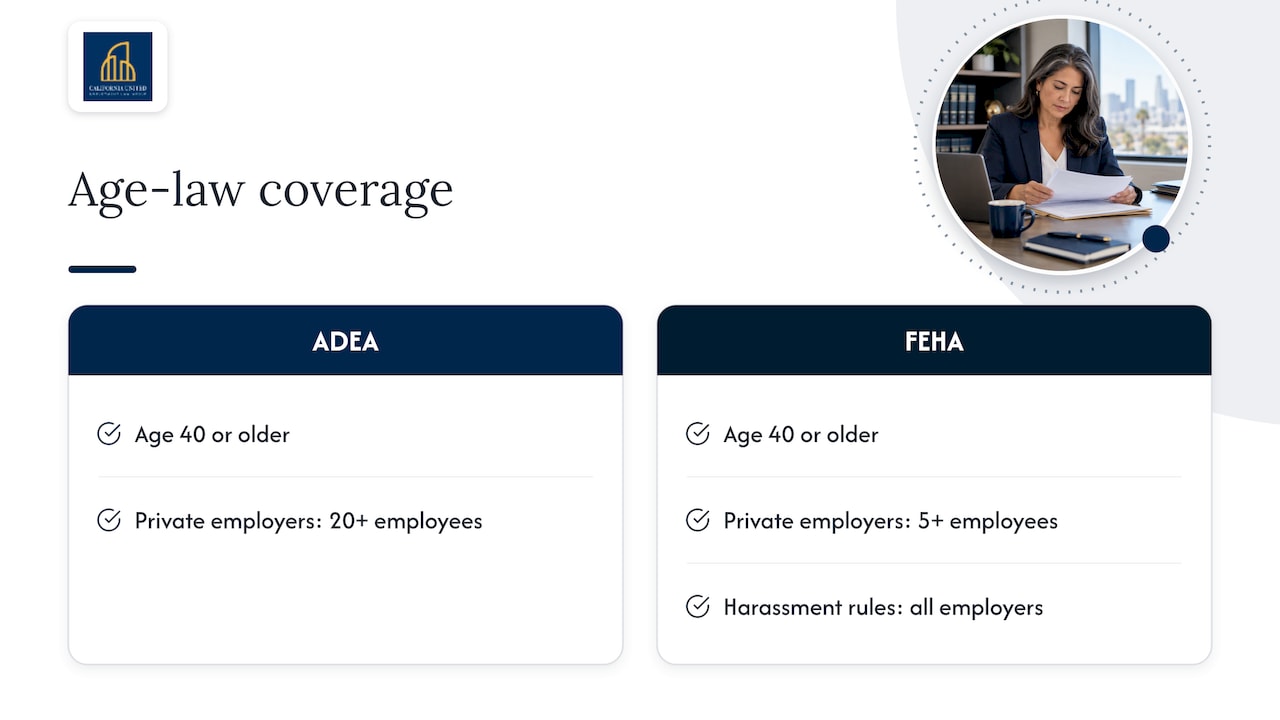
- FEHA protects job applicants and employees 40 and older, and applies to private employers with 5 or more employees and to public employers.
- The federal ADEA also protects workers 40 and older, but it covers private employers with 20 or more employees.
- Age discrimination includes biased hiring, lower pay, denied promotions, targeted layoffs, forced retirement and age-based harassment that creates a hostile work environment.
- You generally have three years to file with California’s Civil Rights Department (CRD), and after you get a Right-to-Sue notice you generally have one year to file a lawsuit. The federal EEOC deadline is much shorter, so do not wait.
- Dates, messages, reviews and witnesses are the core of your proof. Start saving them now.
Table of Contents
- Who is protected: federal and California law
- What counts as age discrimination at work
- How courts evaluate age discrimination claims
- Retaliation is a separate violation
- How to document age discrimination
- Deadlines: California and federal clocks
- What happens when you file with the CRD
- What remedies may be available
- If you were fired, laid off or pushed to resign
- How we help Alhambra employees
- Our perspective
- FAQ
- Sources
Who is protected: federal and California law
The federal ADEA forbids age discrimination against people age 40 or older. It does not protect workers under 40, and it covers private employers with 20 or more employees. Its reach also extends to state and local governments, employment agencies, labor organizations and the federal government, according to the EEOC’s fact sheet on age discrimination.
California’s protection is broader in who it reaches. The California Civil Rights Department explains in its May 2025 guide on age discrimination that FEHA protects applicants and employees aged 40 and older. It also protects you if your employer wrongly believes you are 40 or older, or if you are targeted because you are associated with someone who is. Discrimination rules apply to private employers with 5 or more employees and to public employers. Harassment rules apply to all employers.
What does that mean in Alhambra? An office with eight employees on Main Street is outside the ADEA but inside FEHA. A larger employer in the San Gabriel Valley is covered by both. The CRD’s employment page adds that FEHA applies to public and private employers, labor organizations, apprenticeship programs, employment agencies and licensing boards, and that harassment is prohibited even in a workplace with a single employee.
If you are 38 and being pushed out, age is not your claim. Other protections may apply, such as disability, sex or retaliation, and our employment law practice covers those too.
What counts as age discrimination at work
The EEOC describes it as treating an applicant or employee less favorably because of age, in any term or condition of employment. The CRD guide gives California examples. In an Alhambra workplace, they look like this:
- Hiring: refusing to consider candidates who are 40 or older, or asking for your age or date of birth before an offer.
- Job ads: wording that signals a preference for younger people. The EEOC notes that the ADEA generally bars age preferences or limits in job notices, with a narrow exception when age is a bona fide occupational qualification.
- Pay: paying workers 40 and older less for equivalent work.
- Promotions: passing over an experienced employee for a younger, less qualified one.
- Layoffs: using “downsizing” or “restructuring” as cover to remove older workers.
- Forced retirement: pressing you to retire at a particular age over 40.
- Policies that hurt older workers: a rule applied to everyone can still be unlawful if it disproportionately harms workers 40 and older and is not based on a reasonable factor other than age, the EEOC explains.
- Harassment: repeated “Okay, Boomer!” remarks, mocking you as old-fashioned, or refusing to train you on new technology because of your age, when it creates a hostile, intimidating or offensive work environment.
Harassment is judged by degree. The EEOC says it becomes illegal when it is frequent or severe enough to create a hostile or offensive work environment, or when it leads to a firing or demotion. The person doing it can be a supervisor, a co-worker, or a non-employee such as a customer. California law can be more protective. Under Government Code section 12923, a single incident of harassing conduct may be enough to create a triable issue of a hostile work environment. In Beltran v. Hard Rock Hotel Licensing, Inc. (2023) 97 Cal.App.5th 865, the Court of Appeal reversed summary judgment for an employer and noted that harassment cases are rarely appropriate for disposition on summary judgment.
How courts evaluate age discrimination claims
Most age cases are proved with circumstantial evidence. The California Supreme Court held in Guz v. Bechtel National, Inc. (2000) 24 Cal.4th 317 that California uses a three-stage burden-shifting test for age discrimination claims. The court also explained that evidence that significantly younger workers were retained or treated more favorably may support an inference of age discrimination. In Sandell v. Taylor-Listug, Inc. (2010) 188 Cal.App.4th 297, the Court of Appeal described the usual starting showing: the worker was over 40, suffered an adverse employment action, was performing satisfactorily, and was treated in a way that suggests discrimination, such as being replaced by someone significantly younger. To win, the worker must prove that age was a substantial motivating reason for the employer’s decision.
When age can lawfully be a factor
California law allows age to matter in limited cases, such as mandatory retirement in certain professions or a true bona fide occupational qualification. The CRD’s example is a production company setting an age range for a role written for a child. These exceptions are narrow. Explanations like “we need fresh energy” or “a better cultural fit” generally do not fall within these exceptions, and comments like these can be evidence of age bias.
Retaliation is a separate violation
You are also protected for standing up. Both FEHA and the ADEA prohibit retaliation for opposing age discrimination or taking part in a complaint, charge, investigation or lawsuit. That includes complaining to HR, backing a co-worker’s complaint or filing a charge.
A retaliation claim can stand on its own, even if the underlying discrimination claim is not proven. A write-up that appears a week after you raise a concern, a sudden schedule cut or a termination soon after a complaint all deserve attention. Our guide to workplace retaliation in California explains how these claims are built.
How to document age discrimination
You do not need a confession. Age cases are usually proved with a pattern. Begin collecting evidence while you are still employed, using only information you are already allowed to see.
- Write a timeline. Record dates, who said or did what, who was present and what happened next. Notes made soon after an event are easier to rely on than memory a year later.
- Save written statements. Keep emails, texts, chat messages and review comments that mention age, retirement, “energy,” “fresh blood” or “long-timers.”
- Keep your performance record. Reviews, awards, commendations and raises show you were doing well before the adverse action.
- Note who replaced you. If a younger, less experienced person took your role or your duties, write down who and roughly when.
- Identify witnesses. Name co-workers who heard the comments or saw the treatment, including others over 40 who were treated the same way.
- Record your complaints. If you reported the problem to HR or a manager, keep the date, the method and any reply.
- Store copies safely. Keep personal copies of your own records in a place your employer cannot reach. Do not take confidential company files without asking an attorney first.
An early attorney review can help you organize your evidence. We can look at your timeline, identify what may be missing and explain which pieces may matter most. 👉 Talk to us about your situation
Deadlines: California and federal clocks
Two systems, two timelines. This is where many workers lose options.
| Agency | What you file | Deadline |
|---|---|---|
| California Civil Rights Department | Intake form for a FEHA claim | Within three years of the last harm |
| EEOC | Charge of discrimination under the ADEA | Generally 180 days, extended to 300 days where a state agency enforces a state age discrimination law |
The EEOC explains that the 300-day extension for age claims applies only where a state law, not just a local one, prohibits age discrimination and a state agency enforces it. California has FEHA and the CRD, but the safest approach is to treat the shorter period as your outer limit if you want a federal claim. Do not count on the longest number. On the California side, if the CRD issues a Right-to-Sue notice, you generally have one year from the date of that notice to file a FEHA lawsuit in court.
With the EEOC, a charge is a signed statement that an employer engaged in discrimination. The EEOC states that, apart from the Equal Pay Act, the laws it enforces require a charge before you can sue. Under the ADEA, you may sue 60 days after filing a charge, but no later than 90 days after the EEOC gives notice that it has finished its work.
What happens when you file with the CRD
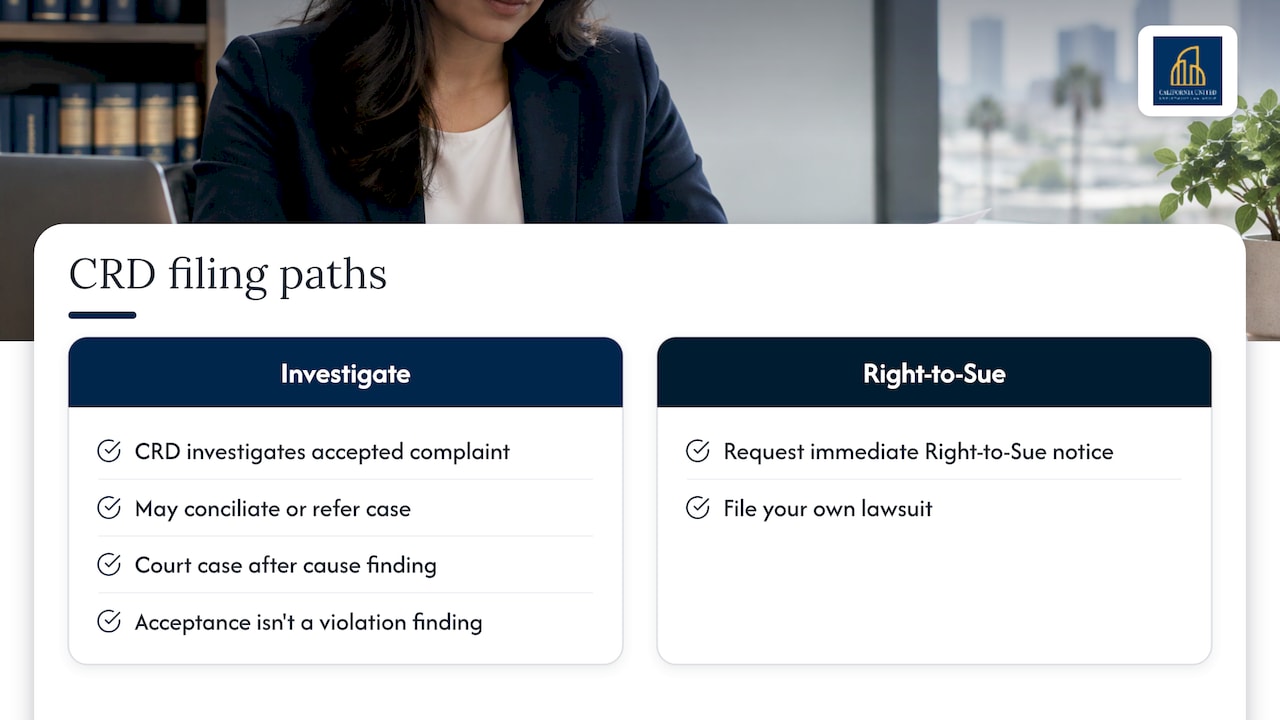
The CRD’s complaint process offers two main paths. You can ask it to investigate. It may conciliate, refer the case to its Dispute Resolution Division, or bring a court case after a reasonable-cause finding, usually after mediation. Or you can request an immediate Right-to-Sue notice, which lets you file your own lawsuit.
Two points from the CRD are worth knowing. If your complaint is accepted for investigation, that does not mean the CRD has decided a law was broken. It only means the allegations are preliminarily covered by a law the CRD enforces. And if it is not accepted, that is not because the CRD disbelieves you. It means the complaint, even if proven, would not violate the laws the CRD enforces.
Which path fits depends on your facts, your timeline and your goals. A lawyer can choose the route with you and prepare the filing so the allegations are framed correctly from day one. For a walkthrough of what comes after, see our employment lawsuit process overview.
What remedies may be available
The EEOC lists remedies that may include back pay, hiring, promotion, reinstatement, front pay and reasonable accommodation, plus attorneys’ fees, expert witness fees and court costs. Remedies differ between the two laws. Under the ADEA, compensatory and punitive damages are generally not available, but liquidated damages may be available for willful violations. Under FEHA, a successful plaintiff may recover damages that can include lost wages, emotional distress damages, punitive damages in appropriate cases, and attorney’s fees.
Every case is different, and no lawyer can honestly promise an outcome. What we can do is evaluate the facts, explain which remedies may apply and pursue them on your behalf.
If you were fired, laid off or pushed to resign
Many age cases begin with a termination. A layoff that removes mostly older employees deserves a closer look. So does a “voluntary” retirement offer that came with pressure, or a severance agreement presented with a short deadline. Do not sign a separation agreement before you understand what rights you would be giving up. We review severance and separation agreements for California employees.
For background on what the law protects when employment ends, read our guide to California employee termination rights. If layoffs at a large employer are behind your situation, our article on age discrimination concerns after Honda and Toyota layoffs shows how these patterns appear in practice.
The same California law protects workers throughout Los Angeles County and beyond. If you work or live elsewhere in Southern California, you may find our pages for Culver City, Long Beach and West Hollywood useful.
How we help Alhambra employees
California United Law Group practices employment law for employees across California. Our age discrimination work sits alongside wrongful termination, retaliation, harassment, disability discrimination and wage claims, and we represent clients from pre-litigation through litigation. Our attorneys include lawyers with prior employer-side experience, which helps us anticipate how a company will respond.
Consultations and case evaluations are free. We work on a contingency basis, so you pay no attorney’s fees unless we recover money for you, and your written fee agreement explains how case costs are handled. 👉 See our employment law services or contact us for a free consultation.
Our perspective
Age discrimination rarely arrives with a clear statement. More often it is a pattern: a promotion that goes to someone younger, a role that quietly shrinks, comments about “keeping up,” and then a layoff described as a business decision.
We focus on employment law for employees, and that focus matters here. Age cases turn on small facts, on timing, and on understanding how an employer will explain its decisions. Our attorneys with employer-side experience know how those explanations are built, and we use that knowledge to test them for our clients.
We also believe that no one should have to choose between their rights and their finances. That is why we work on a contingency basis, and you pay no attorney’s fees unless we recover money for you. If you are 40 or older and something at work feels wrong, an early conversation can help you protect your rights before important deadlines pass.
California United Law Group
FAQ
Does age discrimination law protect me if I am under 40?
Not under the ADEA or FEHA’s age provisions, which protect people 40 and older. You may still have other claims, such as disability, sex, race, pregnancy or retaliation. An attorney can look at the full picture.
Can a small Alhambra employer be liable for age discrimination?
Yes. FEHA’s discrimination rules apply to private employers with five or more employees, and its harassment rules apply to all employers. The federal ADEA applies only to private employers with 20 or more employees, so California law matters most for smaller workplaces.
How long do I have to file an age discrimination claim in California?
You generally have three years from the last harm to submit an intake form to the CRD. After the CRD issues a Right-to-Sue notice, you generally have one year to file a lawsuit. A federal EEOC charge has a much shorter window, generally 180 days or up to 300 days in some situations. Because the two differ so much, speak with an attorney as soon as you suspect a problem.
What proof do I need to show age discrimination?
You do not need a single smoking gun. Dated notes, messages that mention age, strong performance reviews, the age and experience of the person who replaced you and the names of witnesses may all support your case. An attorney can tell you which items carry the most weight.
Does it cost anything to talk to a lawyer about my case?
At California United Law Group, consultations and case evaluations are free. If you hire us on a contingency basis, you pay no attorney’s fees unless we recover money for you. Your written fee agreement explains how case costs are handled.
Sources
- Age Discrimination, U.S. Equal Employment Opportunity Commission
- Fact Sheet: Age Discrimination, EEOC
- How to File a Charge of Employment Discrimination, EEOC
- Federal Laws Prohibiting Job Discrimination Questions and Answers, EEOC
- California Law Protects Workers From Age Discrimination, California Civil Rights Department, May 2025
- Employment, California Civil Rights Department
- Complaint Process, California Civil Rights Department