
If you work in Inglewood and were fired, demoted or pushed out after speaking up, you prove retaliation by showing three things: you did something the law protects, your employer took an adverse action against you, and the protected activity was a substantial motivating reason (under FEHA) or a contributing factor (under the Labor Code whistleblower statute) for that action. Most of the work is evidence: dates, documents and a clear comparison between how you were treated before and after you spoke up.
That applies whether you work at an office, a warehouse, a hotel, a restaurant or a venue near the stadium district. California law covers all of them. At California United Law Group we represent employees only, and we handle retaliation matters on a contingency basis: you pay no attorney’s fees unless we obtain a recovery for you. Costs and other terms are explained in our written fee agreement. This guide explains what you need to prove, what evidence carries weight, how to answer an employer’s “legitimate reason,” and which deadlines you cannot miss.
TL;DR
- A California retaliation claim has three elements: protected activity, an adverse action, and a causal link between them. Your employer must also have known about your protected activity.
- Timing, documents, performance history and how similar coworkers were treated are the strongest ways to show the link.
- Under Labor Code § 98.6, an adverse action within 90 days of protected activity creates a rebuttable presumption in your favor for the types of protected activity that section covers.
- FEHA complaints generally go to the Civil Rights Department within three years. After you receive a Right-to-Sue notice, a separate deadline to file a lawsuit applies. Labor Commissioner retaliation complaints generally have a one-year window.
- Start documenting now, before you are terminated if possible, and speak with an employment attorney early.
Table of Contents
- The three things you have to prove
- Evidence that proves retaliation
- How to keep evidence safely
- When your employer gives another reason
- A worked example
- Deadlines that apply
- What a successful claim can recover
- Why having an attorney matters
- Perspective: what we tell Inglewood employees first
- Talk to us about your retaliation concern
- FAQ
- Sources
The three things you have to prove
The California Civil Rights Department (CRD), the state agency that enforces the Fair Employment and Housing Act (FEHA), explains in its June 2025 retaliation fact sheet that an employee must show:
- Protected activity. You did something the law protects.
- Adverse action. You suffered a work-related harm.
- Causation. Your employer knew about the protected activity, and that activity was a substantial motivating reason for the harm under FEHA (CACI No. 2505), or a contributing factor under Labor Code § 1102.5.
Each element needs its own evidence. People often have a strong story on one and assume the rest follows. It does not. A manager who never knew about your complaint cannot have retaliated because of it, and a bad schedule that has nothing to do with your complaint is not retaliation.
Element 1: protected activity
Protected activity is broader than most employees expect. According to the CRD fact sheet, it includes:
- Filing a complaint with, or seeking advice from, the CRD
- Speaking out against harassment or discrimination you reasonably believe is illegal
- Encouraging a coworker to complain
- Taking part in an investigation
- Contacting an advocacy group or a law firm
- Requesting a disability or religious accommodation
- Taking protected leave, such as CFRA family leave or pregnancy disability leave
- Taking time off for a court appearance or to seek a restraining order
The CACI No. 2505 jury instruction adds that retaliating for an accommodation request is unlawful whether or not the request was granted.
Wage and safety complaints are protected too. Labor Code § 98.6 protects employees who file complaints with the Labor Commissioner or exercise their Labor Code rights, and it is the section many unpaid-wage retaliation claims rest on. Reporting suspected violations of law by your employer is covered by the whistleblower statute, Labor Code § 1102.5.
The practical point: you do not need a lawyer’s words or a formal filing. A text to your manager saying “I wasn’t paid for the overtime last week” can be protected activity. What matters is that you can show when you said it, to whom and how.
Element 2: adverse action
Firing is the obvious one. It is not the only one. The CRD fact sheet gives examples that include:
- Firing someone who refused a discriminatory order
- Passing someone over for promotion after a harassment complaint
- Cutting a schedule after an employee encouraged an accommodation request
- Threatening to contact immigration authorities
- Transfers, refusals to hire and exclusion from professional development
In practice, demotions, pay cuts, shift changes that cost you tips or hours, sudden write-ups and exclusion from meetings needed to do your job can all qualify when they materially affect the terms, conditions or privileges of your employment.
The California Supreme Court held in Yanowitz v. L’Oreal USA, Inc. (2005) 36 Cal.4th 1028 that an adverse action must be reasonably likely to impair a reasonable employee’s job performance or prospects for advancement. Minor or trivial slights do not count. The court also held that a series of retaliatory acts can be considered together. They do not have to land as one swift blow. If conditions became so intolerable that you felt forced to resign, that can count as a constructive discharge, which the California Supreme Court in Mullins v. Rockwell Internat. Corp. (1997) 15 Cal.4th 731 described as legally regarded as a firing rather than a resignation.
If you are unsure whether what happened to you counts, our guide to the signs of employer retaliation in California walks through the common patterns.
Element 3: the causal link
This element is often the most contested. The CRD fact sheet says causation can be shown with direct evidence, such as a verbal threat or a statement tying the action to your complaint, or with circumstantial evidence: the timing of events, job performance that does not match the harm, and comparison with similarly situated workers who did not engage in protected activity.
Direct evidence is rare. Employers seldom announce that they are retaliating. So most cases are built from the circumstantial pieces, which is why records matter so much.
Evidence that proves retaliation
Think in terms of a timeline. You want a document for each link in the chain: what you reported, when the employer learned of it, what happened next, and what your record looked like before.
Timing
A short gap between your complaint and the adverse action is persuasive. Labor Code § 98.6 goes further: if the employer takes a prohibited action within 90 days of protected activity covered by that section, a rebuttable presumption arises in the employee’s favor. “Rebuttable” means the employer can still try to prove another reason, but it has to do the work.
A longer gap does not end your claim. Retaliation sometimes waits for a slow season, a reorganization or the end of a probationary period. In that case, you look for a pattern: the first cold shoulder, the first write-up, the first schedule change after your complaint.
Your performance history
Performance reviews, commendations, bonuses, raises and positive emails from supervisors all help if your employer says you were fired for performance. A clean record followed by sudden discipline after a complaint is one of the clearest circumstantial patterns.
Save what you are legally entitled to see. Current and former employees may request their personnel file under Labor Code § 1198.5, their payroll records under Labor Code § 226, and copies of documents they signed under Labor Code § 432. Your personnel file can show whether a negative entry was added after you complained.
Communications
Emails, texts, chat messages and voicemails from the people involved can show that the employer knew about your complaint and how they reacted. Keep:
- Your own complaint, in writing if you made it that way
- Any reply, including a reply that ignores it
- Messages changing your duties, hours or pay
- Messages mentioning your complaint, leave or accommodation request in a negative light
Comparators
A comparator is a coworker in a similar position, often reporting to the same supervisor or subject to the same decision-maker. If they had similar attendance or performance problems and were not disciplined, while you were, that suggests the stated reason is not the real one. Write down names, roles, dates and what you saw, and note who else witnessed it.
Witnesses
Coworkers who saw the complaint, heard a comment or watched your treatment change can corroborate your timeline. Write down who they are while memories are fresh. Current coworkers may be reluctant to get involved, so do not pressure them. Your attorney can approach them properly.
A simple evidence log
| What to record | Why it matters | Example |
|---|---|---|
| Date and method of your complaint | Proves protected activity and starts the clock | Email to HR sent on a specific date |
| Who knew about it | Proves employer awareness | Supervisor copied on the email |
| First negative change | Shows timing | New write-up three weeks later |
| Prior performance | Undercuts a performance excuse | Last two reviews, both positive |
| Treatment of coworkers | Shows unequal treatment | Colleague with same late arrivals, no discipline |
How to keep evidence safely
Gather evidence the right way, so it helps rather than hurts.
- Keep your own materials. Notes, your own messages, pay stubs, schedules and your reviews are yours to keep.
- Write a dated journal. Record events the same day: what was said, who was present, what changed.
- Request your records. Ask in writing for your personnel file (Labor Code § 1198.5) and payroll records (Labor Code § 226).
- Be careful with company files. Do not copy confidential business documents, customer data or anything you are not authorized to take. Ask an attorney before you move anything off company systems.
- Do not secretly record conversations. California has strict rules on recording confidential communications. Talk to a lawyer before you record anyone.
- Keep working professionally. Continue to do your job well and avoid angry messages. Calm, factual communication reads well later.
When your employer gives another reason
Employers rarely say “we fired you for complaining.” They say performance, restructuring, attendance or a policy violation. Proving retaliation usually means showing that reason is incomplete or untrue.
For whistleblower claims under Labor Code § 1102.5, the California Supreme Court explained in Lawson v. PPG Architectural Finishes (2022) how the burdens work under Labor Code § 1102.6. You first show that your protected activity was a contributing factor in the action. The burden then moves to the employer to show, by a preponderance of the evidence, that it would have taken the same action for legitimate, independent reasons anyway. You do not have to prove the employer’s stated reason was fake before the employer has to defend it. For FEHA retaliation claims, the jury decides whether your protected activity was a substantial motivating reason for the adverse action.
Ways employees show that a stated reason does not hold up:
- Shifting explanations. The reason given at termination differs from the reason given later, or from what HR wrote down.
- No earlier warnings. The “long-standing problem” never appeared in a review, warning or message before your complaint.
- Unequal enforcement. Others broke the same rule without consequences.
- Odd sequence. The investigation of you started only after your complaint, or the decision-maker knew about the complaint before deciding.
- Skipped process. The company ignored its own progressive-discipline steps for you alone.
These are patterns, not guarantees. Each case depends on its facts, and an attorney can tell you how strong yours is.
A worked example
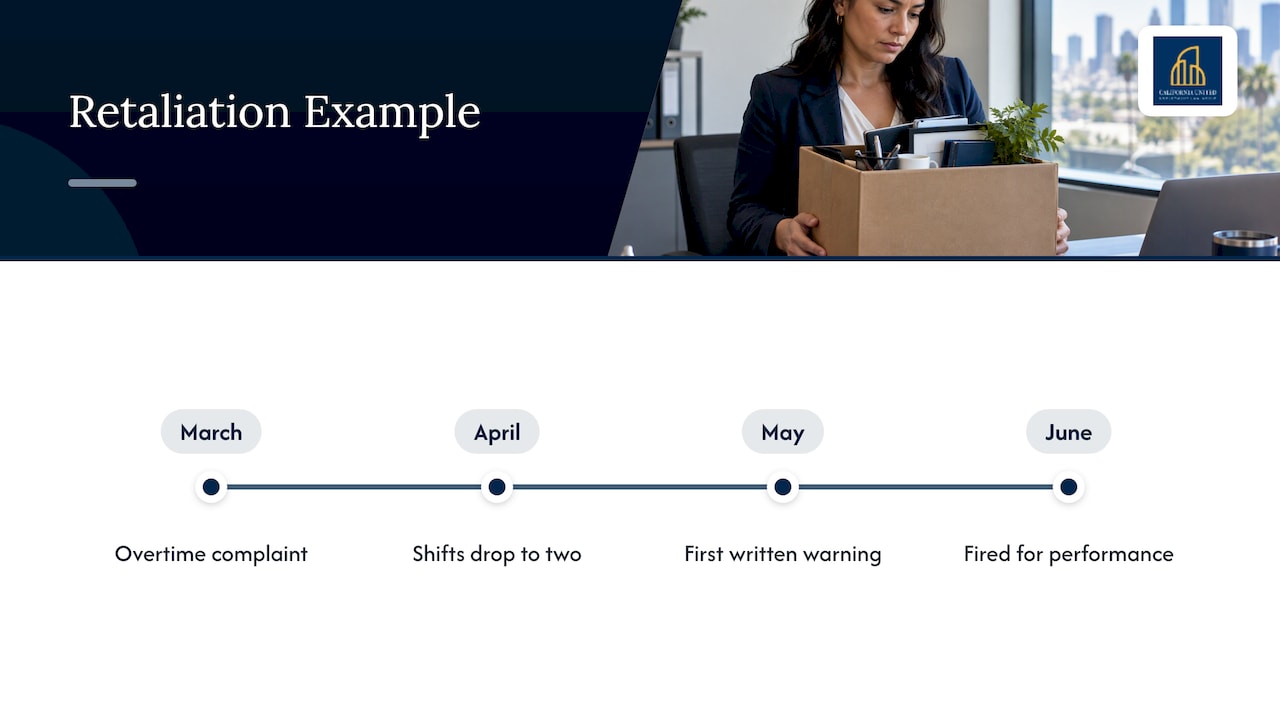
Suppose a banquet server in Inglewood emails her manager in March that she has not received overtime pay for several weeks. She has two consecutive “meets expectations” reviews. In April, her shifts drop from five to two a week. In May she receives her first-ever written warning for “attitude.” In June she is let go for “performance.” Coworkers with similar performance records and no complaints still have full schedules.
Here the protected activity is the wage complaint, the adverse actions are the cut in hours, the warning and the termination, and the causation evidence is the timing, her clean prior record, the missing warnings and the comparators. Her March email also sits inside the 90-day window of Labor Code § 98.6 for the first adverse action. This is an illustration, not a prediction: outcomes always depend on the complete record.
Deadlines that apply
Deadlines depend on which law and which agency are involved. These are the main ones, and you should check the official pages for any recent changes.
| Claim route | General deadline | Source |
|---|---|---|
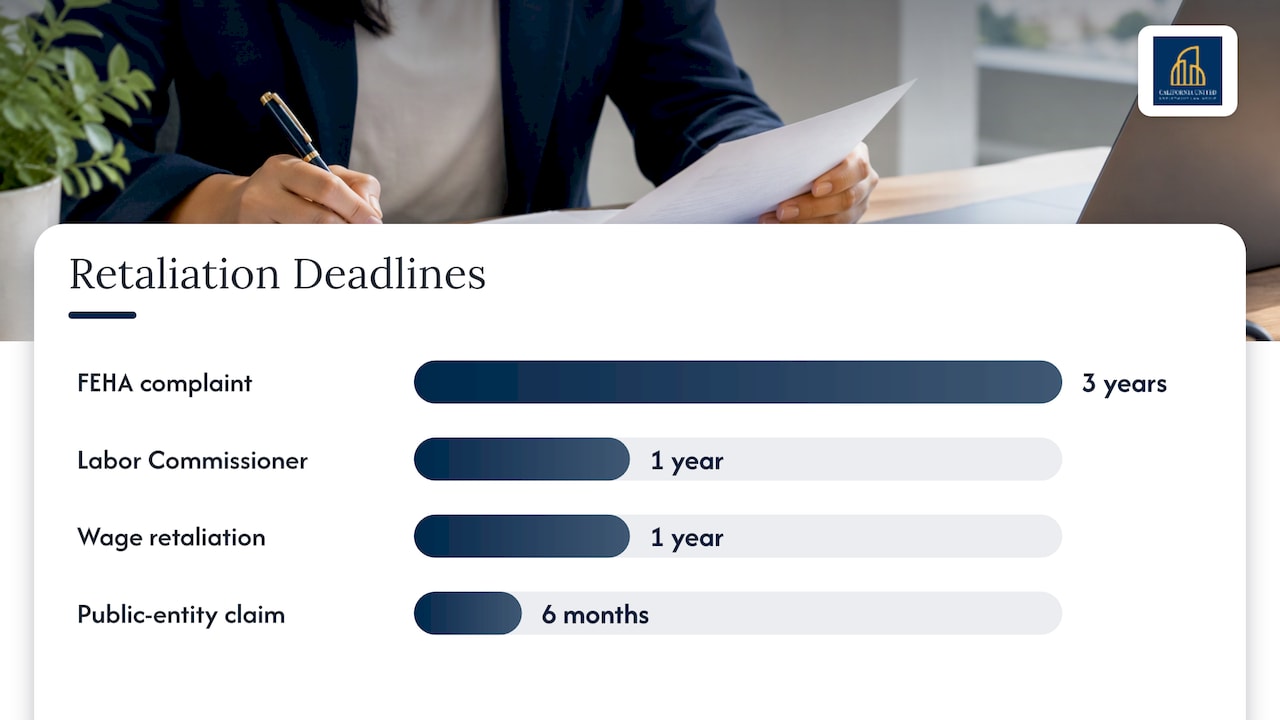
| FEHA retaliation (CRD complaint) | Generally three years from the last act of harm. You must obtain a Right-to-Sue notice, and then generally file suit within one year of that notice. | CRD complaint process |
| FEHA, extensions | Limited extensions apply in certain situations, such as late discovery of facts; SB 477 amended the statute effective January 1, 2026 | Gov. Code § 12960 |
| Labor Commissioner retaliation complaint | Generally one year from the adverse action | DLSE retaliation complaint procedure |
For FEHA claims, the CRD says a complaint must be filed with it even if you intend to sue in court, and you must obtain the Right-to-Sue notice first. For wage-related retaliation, Labor Code § 98.7 allows a complaint within one year of the violation, extendable for good cause.
Whistleblower claims against a public employer carry a separate trap. A State Bar magazine article on Labor Code § 1102.5(b) notes that the six-month Tort Claims Act window can apply to claims against public entities. If you work for a city, school or other government body, ask an attorney about this quickly.
Because the right deadline depends on the facts, do not wait to find out which applies. For the court steps that follow, see our employment lawsuit process overview.
What a successful claim can recover
There is no standard payout, because remedies depend on the law used, your lost pay, the evidence and the employer’s conduct. What the statutes provide is more useful to know.
Under Labor Code § 98.6, an employee subjected to adverse action for protected conduct is entitled to reinstatement and reimbursement for lost wages and work benefits, plus a civil penalty of up to $10,000 per employee per violation. The Labor Commissioner’s process can also lead to removal of negative personnel-file reports and posting of a notice.
For § 1102.5(b) whistleblower claims filed in court, the State Bar article states that compensatory and general damages are available, and punitive damages may be available where the legal standard for them is met, and a 2021 amendment added a one-way attorney’s fees provision for employees. FEHA retaliation claims can also allow recovery of economic and emotional distress damages and, in the court’s discretion, reasonable attorney’s fees and costs. Punitive damages are available where the legal standard is met.
Why having an attorney matters
Retaliation cases turn on how evidence is organized and which law fits. The same facts may support a FEHA claim, a Labor Code claim, or both, and each has its own agency, deadline and remedies. Picking the wrong route can risk missing a deadline.
Our attorneys practice employment law for employees across California, and some of them previously worked on the employer side, so we know how employers build their defense. That perspective shapes how we gather and present evidence.
Perspective: what we tell Inglewood employees first
Most people come to us after the termination. The better moment to call is when the first negative change appears, because that is when the timeline is easiest to document.
We build retaliation claims the way an employer’s lawyer will try to take them apart. We look at what you reported, who knew, what changed and what the file says about your work before you spoke up. Several of our attorneys have worked on the employer side, so we are familiar with the explanations employers commonly give and the records that can test them.
Our focus is employment law for California employees, including wrongful termination, discrimination, harassment, retaliation, whistleblower and wage and hour matters. We take these cases on contingency: you pay no attorney’s fees unless we obtain a recovery for you. A consultation costs you nothing, and it can help you understand where your evidence stands.
California United Law Group
Talk to us about your retaliation concern
If you work in Inglewood and believe you were punished for speaking up, we can review your timeline, your documents and your options at no cost. We handle wrongful termination, retaliation, whistleblower claims and related employment matters for California employees, and wage-related retaliation sits alongside our wage and hour work.
👉 Contact California United Law Group to schedule your free consultation. Contacting us or reading this article does not create an attorney-client relationship. This article is general information, not legal advice for your situation.
If you were let go after reporting misconduct, our page on employee rights after reporting misconduct in Los Angeles covers a closely related situation.
FAQ
How hard is it to prove workplace retaliation?
It depends on your documents. Direct proof is uncommon, so most cases rely on timing, performance records and comparison with coworkers. Claims with a written complaint, a clean record and a clear sequence of events are much easier to present than those built on memory alone.
What are the three elements of a retaliation claim?
You must show protected activity, an adverse action, and a causal link between them (a substantial motivating reason under FEHA, or a contributing factor under Labor Code § 1102.5). The CRD fact sheet also notes the employer must have been aware of what you did.
How do I prove I was fired for retaliation and not for the reason my employer gave?
Show that the reason does not fit the record: no earlier warnings, good past reviews, shifting explanations, or coworkers who broke the same rule without penalty. For whistleblower claims, once you show your protected activity contributed to the firing, the employer must prove, by clear and convincing evidence, that it would have fired you anyway for legitimate, independent reasons.
Is there an average payout for a retaliation lawsuit?
No. Recovery depends on the statute, your lost wages and benefits, the strength of the evidence and the employer’s conduct. Statutes allow remedies such as reinstatement, lost pay, civil penalties and, in some claims, other damages, but each case is evaluated on its own facts.
Does the 90-day presumption mean I lose if I wait longer?
No. The 90-day presumption in Labor Code § 98.6 helps only when the adverse action falls within 90 days of protected activity covered by that section. Retaliation outside that window can still be proven through other circumstantial evidence, as long as you file within the applicable deadline.
Sources
- CRD: Workplace retaliation is against the law fact sheet (June 2025)
- CACI No. 2505, Retaliation: Essential Factual Elements
- California Labor Code § 98.6
- California Labor Code § 226
- Lawson v. PPG Architectural Finishes, California Supreme Court
- CRD complaint process
- California Government Code § 12960
- DLSE retaliation complaint procedure
- California Labor Code § 98.7
- State Bar Advocate: Labor Code section 1102.5(b)