
If you work in Long Beach and your employer punished you after you spoke up, you may have a retaliation claim. California law forbids an employer from taking an adverse action against you because you exercised a protected right. Under California’s Fair Employment and Housing Act (FEHA), your protected activity must have been a substantial motivating reason for the employer’s action. Employees can challenge retaliation by filing a complaint with a government agency, such as the Labor Commissioner’s Office or the California Civil Rights Department (CRD), or by pursuing a claim through an attorney. Which route fits depends on the facts of your situation.
This article is for general educational purposes only and is not legal advice. Employment law is fact-specific, and outcomes vary from case to case.
TL;DR
- Retaliation means an employer took an adverse action against you because you used a legally protected right (under FEHA, your protected activity must be a substantial motivating reason for the action), such as reporting harassment, asking for an accommodation, or raising a wage or safety concern.
- Adverse actions go beyond firing. California’s Civil Rights Department lists demotion, reduced pay or hours, negative evaluations, worse working conditions, and threats to report you to immigration authorities.
- Retaliation can often be shown with circumstantial evidence, such as timing, unequal treatment, and shifting explanations.
- Complaints filed with the Labor Commissioner’s Office generally must be filed within one year of the retaliatory act, so timing matters.
- FEHA retaliation complaints with the Civil Rights Department generally must be filed within three years, and a lawsuit must follow within one year of the right-to-sue notice.
- A Long Beach employment attorney can review your situation and explain which agency or court may be the right forum.
Table of Contents
- What counts as employer retaliation in California
- What activity is protected
- Examples of retaliation after a complaint
- Can an employer still discipline or fire you after you complain?
- How retaliation is proven
- Where Long Beach employees can bring a retaliation complaint
- Why deadlines deserve early attention
- What may be recoverable in a retaliation case
- What retaliation can look like in Long Beach workplaces
- Our perspective
- Talk to a California employment attorney
- FAQ
- Sources
What counts as employer retaliation in California
Retaliation happens when an employer takes an adverse action against an employee at least in part because the employee exercised a legally protected right. That is how the California Civil Rights Department fact sheet on workplace retaliation frames it. In general, three things must be shown: you did something the law protects, your employer took an action that harmed you, and there is a causal link between the two. Under FEHA, the protected activity must be a substantial motivating reason for the action. Under Labor Code section 1102.5, the whistleblower statute, it must be a contributing factor. Federal Title VII claims require “but-for” causation.
The same fact sheet lists adverse actions that may be unlawful retaliation in California:
- Firing or refusing to hire
- Demotion or suspension
- Reduction in pay or hours
- Cutting benefits
- Negative performance evaluations
- Worsening working conditions
- Threats to report you to immigration authorities
The federal standard is broad too. The EEOC’s enforcement guidance on retaliation explains that the law reaches actions likely to deter a reasonable person from complaining. That conduct does not have to be a formal termination or demotion. It can happen at work or outside work, and it can lack a direct tangible effect on your job.
In practice, a Long Beach employee might see this as a sudden schedule cut after a harassment complaint, or as a first-ever written warning a week after asking for a disability accommodation. Whether any particular event legally counts as retaliation depends on the full set of facts.
What activity is protected
Protected activity is the first element of any retaliation claim. Under California’s Fair Employment and Housing Act (FEHA), the Civil Rights Department says protected activity includes:
- Speaking out against harassment, discrimination, or practices you reasonably believe are illegal
- Filing a complaint with the CRD, or encouraging others to file
- Requesting a reasonable accommodation for a disability or religious belief
- Taking time off to testify in court
Federal law adds its own protections. According to the EEOC, protected activity includes filing an EEO charge, communicating with management about discrimination or harassment, answering questions during an investigation, resisting sexual advances, and asking co-workers about salary to uncover potential wage discrimination.
Protection does not depend on being proven right about the underlying problem. The CRD describes protected activity as including opposing practices a person reasonably believes are illegal. That is why a retaliation claim can exist even where the original complaint is still being sorted out.
Other California laws protect workers who raise wage or safety concerns. If your situation involves those topics, our pages on Long Beach workers reporting safety violations and Long Beach port workers reporting safety concerns explain how the protections apply locally.
Examples of retaliation after a complaint
Real enforcement cases show what retaliation can look like. Both examples below come from EEOC announcements about lawsuits. They are allegations in other states, not California outcomes, and they are included only to illustrate patterns.
- In an EEOC lawsuit against Piggly Wiggly, two clerks reported repeated sexual comments and advances. The agency alleged that the employer cut one clerk’s hours and later fired both after they submitted a written complaint.
- In an EEOC suit against Market America, the agency alleged that a warehouse associate was fired within days of complaining about unwanted physical contact from a co-worker.
Both cases involve a close connection in time between a complaint and a negative job action. That is one of the patterns courts look at. If you are worried about harassment-related retaliation in particular, see our overview of Long Beach sexual harassment rights.
Can an employer still discipline or fire you after you complain?
Yes, in some circumstances. The EEOC explains that an employee may be disciplined or terminated for nonretaliatory, nondiscriminatory reasons that would otherwise lead to that result. What an employer may not do is punish you for asserting your rights.
That distinction is why these claims are so fact-driven. A legitimate performance or conduct problem is treated differently from a reason that appears to have been invented or applied unevenly after you spoke up. The EEOC’s guidance for employers on preventing retaliation recommends treating the employee as if they had never reported discrimination, applying workplace rules consistently, and making sure negative decisions follow past practice or can be justified.
If you are asking whether a specific write-up, schedule change, or termination crossed the line, that is the kind of question an employment attorney can evaluate after reviewing your documents. Our article on signs of employer retaliation lists common patterns workers report.
How retaliation is proven
Many employees worry that they need a confession or a smoking-gun email. Usually that is not the case. California courts have ruled that retaliation can be proven with circumstantial evidence. In Mathews v. Happy Valley Conference Center, the court recognized evidence such as:
- Timing: how close the adverse action came to your protected activity
- Disparate treatment: harsher treatment than similar coworkers who did not complain
- Pretext: evidence that the reason your employer gives is not the real reason
Timing alone has limits. California courts have held that a close connection in time can get a claim started, but once an employer offers a legitimate reason, timing alone may not be enough to show that reason is false (McRae v. Department of Corrections & Rehabilitation (2006) 142 Cal.App.4th 377). In Mendoza v. Western Medical Center Santa Ana (2014) 222 Cal.App.4th 1334, however, evidence that an employer fired an excellent long-term employee shortly after he reported sexual harassment supported a jury’s finding that his report was a substantial motivating reason for the firing. The California Supreme Court in Harris v. City of Santa Monica (2013) 56 Cal.4th 203 adopted the substantial motivating factor standard for FEHA claims and confirmed that either direct or circumstantial evidence may be used.
This is why records are important. Pay stubs, time sheets, performance evaluations, schedules, emails, texts, and your own dated notes can all show what changed and when. The California Department of Industrial Relations suggests that employees document changes in their employment conditions following protected activity and gather records such as pay stubs, time sheets, personnel evaluations, and personal notes. For whistleblower retaliation under Labor Code section 1102.5, the California Supreme Court held in Lawson v. PPG Architectural Finishes, Inc. (2022) 12 Cal.5th 703 that once an employee shows retaliation was a contributing factor, the employer must prove by clear and convincing evidence that it would have taken the same action for legitimate, independent reasons.
Two cautions apply here. First, keep your records limited to materials you are lawfully entitled to have. If you are unsure whether a document is fair to keep, ask an attorney before you do anything with it. Second, nothing here is a guarantee of how a case will turn out. Evidence is evaluated case by case.
Where Long Beach employees can bring a retaliation complaint
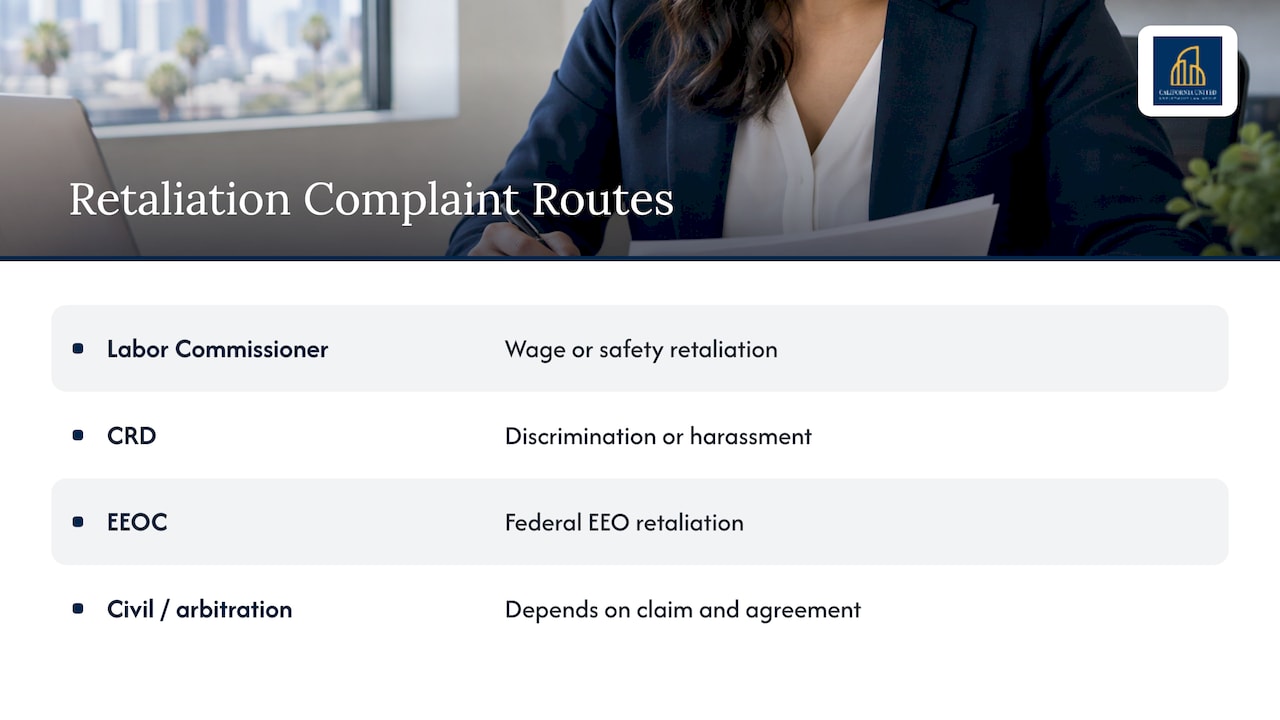
Retaliation complaints can be raised through more than one avenue. The right one depends on what you complained about and what law applies.
The Labor Commissioner’s Office
For retaliation connected to wage, safety, and similar workplace rights, the Labor Commissioner’s Office accepts complaints online or by mail, according to the Department of Industrial Relations. That page also notes that these complaints generally must be filed within one year of the retaliatory act. Some exceptions, such as Equal Pay Act violations, allow two or three years.
The California Civil Rights Department
When the underlying complaint involved discrimination or harassment, FEHA is the main framework. The CRD is the state agency that handles those complaints, and filing or encouraging a CRD complaint is itself protected activity. Deadlines under FEHA are different from the Labor Commissioner’s one-year window. A CRD complaint generally must be filed within three years of the unlawful practice, with limited exceptions, and a civil lawsuit must be filed within one year after the CRD issues a right-to-sue notice. Confirm the timeline that applies to your situation with the agency or an attorney.
The EEOC
Federal law also prohibits retaliation for asserting EEO rights. The EEOC accepts charges alleging retaliation connected to discrimination or harassment.
A civil lawsuit
For FEHA claims, timely filing a CRD complaint and obtaining a right-to-sue notice is generally required before filing suit. Whether a lawsuit or arbitration applies to you depends on your documents and your claim. For a general picture of how that process unfolds, see our overview of the employment lawsuit process in California.
Why deadlines deserve early attention
The one-year window for Labor Commissioner retaliation complaints is a good example of why timing matters. Other claims have their own deadlines, and those can be shorter or longer. Waiting can make evidence harder to gather and memories harder to rely on.
Speaking with an attorney early does not commit you to filing anything. It gives you an informed read on which deadlines may apply to your circumstances.
What may be recoverable in a retaliation case
The value of a case depends on facts such as your pay, how long you were out of work, the harm you experienced, and the law that applies. No one can responsibly predict an amount in advance, and results differ widely.
The EEOC describes the types of relief that may be available in employment discrimination and retaliation matters:
- Placement in a job
- Back pay and benefits
- Steps to prevent future discrimination
- Attorney’s fees, expert witness fees, and court costs
- Compensatory damages, which may cover out-of-pocket expenses and emotional harm
- Punitive damages in cases of especially malicious or reckless conduct, subject to limits based on employer size under federal law
Those federal caps apply to federal claims. Claims under California law, such as FEHA, have their own remedies and standards.
Settlements can also include changes inside the workplace. In one EEOC matter, Tegra Medical agreed to a settlement that included payment to two victims, training, an independent complaint hotline, and revised policies. That case arose in Massachusetts, and it is not a measure of what any other claim may be worth.
If you were fired and want to understand the broader picture, our page on California employee termination rights covers common protections, and our guide to being fired after reporting violations addresses that situation directly.
What retaliation can look like in Long Beach workplaces
Long Beach has a varied economy, including port and logistics operations, healthcare, hospitality, education, retail, and offices. Retaliation can appear in any of them. Common patterns workers describe include:
- Shifts or hours quietly reduced after a worker reports a harassment or safety concern
- A sudden string of negative reviews after years of good ones
- Being excluded from meetings, projects, or promotions after asking for an accommodation
- Threats involving immigration status after a wage complaint
- A termination that follows a protected complaint by days or weeks
None of these automatically amounts to unlawful retaliation. Each depends on the reason behind the action and the evidence. But each is the kind of event worth recording with dates and details, and worth raising with a lawyer.
Our perspective
Retaliation is often the part of a workplace dispute that hurts the most. Many of the workers who come to us were not looking for a fight. They reported a problem, asked for what the law gives them, and then watched their hours, reputation, or job change.
We focus exclusively on employment law for employees in California, including FEHA and Labor Code claims. Several of our attorneys have prior employer-side experience, so we understand how employers and their counsel typically evaluate and respond to these claims. We bring that knowledge to work for employees.
We also know that cost keeps many people from calling a lawyer. We handle retaliation cases on a contingency-fee basis, which means we collect no attorney’s fees unless we obtain a recovery for you through settlement or award. Even then, if a case is lost, a court may order an employee to pay certain costs of the employer, and our fee agreement explains these terms in detail. Consultations and case evaluations are free.
Every situation is different, and we do not promise outcomes. What we can do is listen, review what happened, and explain how California law may apply to you.
California United Law Group
Talk to a California employment attorney
If you work in Long Beach and believe you are being punished for speaking up, we offer a free consultation and case evaluation. We handle retaliation, wrongful termination, discrimination, harassment, whistleblower, and wage claims for employees, and we can also review severance and separation agreements before you sign. Contacting us does not create an attorney-client relationship, and there is no attorney-client relationship until we both sign a written agreement.
👉 Contact California United Law Group to discuss your situation, or read about our employment law services. If your concern involves unpaid overtime or other pay issues, see our wage and hour practice.
FAQ
What is an example of retaliation after a harassment complaint?
A common example is a reduction in hours or a termination soon after a worker reports harassment. In an EEOC lawsuit, the agency alleged an employer cut one clerk’s hours and later fired two clerks after a written complaint. Whether a given event is retaliation depends on its facts.
How long do I have to file a retaliation complaint in California?
Complaints to the Labor Commissioner’s Office generally must be filed within one year of the retaliatory act, with longer periods for some claims such as Equal Pay Act violations, according to the Department of Industrial Relations. FEHA retaliation complaints with the Civil Rights Department generally must be filed within three years of the unlawful practice. Other agencies and claims have their own deadlines. An attorney can tell you which ones may apply to you.
Can I be fired after filing a retaliation complaint?
An employer may still discipline or terminate an employee for legitimate, nonretaliatory reasons, the EEOC explains. It may not do so because you asserted your rights. Timing, consistency, and the stated reason are all part of the analysis.
How much is a retaliation lawsuit worth?
It depends on your circumstances, and no honest answer can be given in advance. Available relief may include back pay, benefits, compensatory damages, attorney’s fees, and in some cases punitive damages, as the EEOC describes. An attorney can discuss what factors may matter in your case.
Sources
- California Civil Rights Department: Workplace retaliation is against the law fact sheet
- EEOC: Enforcement Guidance on Retaliation and Related Issues, Questions and Answers
- EEOC: Retaliation
- EEOC: Preventing Retaliation
- EEOC: Remedies for Employment Discrimination
- EEOC: EEOC Sues Piggly Wiggly for Sexual Harassment and Retaliation
- EEOC: EEOC Sues Market America for Sexual Harassment and Retaliation
- EEOC: Tegra Medical to Pay $240,000 to Settle Sexual Harassment and Retaliation Suit
- California Department of Industrial Relations: What if I am concerned about retaliation from my employer?
- Mathews v. Happy Valley Conference Center, Inc.