
If you work in El Monte and believe your employer treated you unfairly because you are pregnant, you have rights under both California and federal law. You may be able to ask for reasonable accommodations, take pregnancy disability leave, file a complaint with the California Civil Rights Department (CRD), and speak with an employment attorney about your situation. This guide explains those protections in plain language so you can understand where you stand.
This article is for general educational purposes only and is not legal advice. Employment law issues are fact-specific, and outcomes vary from case to case.
TL;DR
- California law prohibits employers with five or more employees from refusing to hire, promote, train, or fire someone because of pregnancy or perceived pregnancy.
- Employees disabled by pregnancy, childbirth, or related conditions may be entitled to up to four months of pregnancy disability leave per pregnancy, with no minimum length-of-service requirement, and may request reasonable accommodations.
- Retaliation for asserting these rights or taking part in a discrimination proceeding is also prohibited.
- Complaints generally go to the California Civil Rights Department, usually within three years of the alleged discriminatory act.
- Remedies can include back pay, reinstatement, emotional distress damages, and attorney’s fees, depending on the facts and the outcome of the case.
Table of Contents
- What pregnancy discrimination means for El Monte workers
- Situations that may raise pregnancy discrimination concerns
- Hiring, promotion, and termination
- Accommodations and pregnancy disability leave
- Retaliation is its own violation
- Keeping records of what happened
- Where an El Monte employee can file a complaint
- What remedies may be available
- How to think about next steps
- Our perspective
- Talking with an El Monte employment attorney
- Frequently asked questions
- Sources
What pregnancy discrimination means for El Monte workers
Pregnancy discrimination happens when an employer treats an applicant or employee worse because of pregnancy, childbirth, or a related medical condition. The U.S. Department of Labor describes it as a form of sex discrimination, which also covers policies that keep women out of jobs because they could become pregnant.
The protection reaches beyond the person who is visibly pregnant. California guidance for employers notes that the laws apply to current pregnancy and to perceived pregnancy. So if a manager assumes you are pregnant and treats you differently for that reason, the law may still apply.
You may also see the term “maternity discrimination.” In practice it describes the same kind of conduct: unfavorable treatment tied to pregnancy, childbirth, or the period around them. In California, the main statute is the Fair Employment and Housing Act (FEHA), and federal law adds another layer. At the federal level, the Pregnancy Discrimination Act treats pregnancy discrimination as sex discrimination under Title VII, and the Pregnant Workers Fairness Act, in effect since June 27, 2023, requires covered employers to provide reasonable accommodations for known limitations related to pregnancy, childbirth, or related medical conditions unless doing so would cause undue hardship.
(PDA and PWFA)
Assumptions and stereotypes count
Discrimination does not always look hostile. The U.S. Equal Employment Opportunity Commission (EEOC) explains that actions based on assumptions about a pregnant worker’s abilities, schedule, or commitment are unlawful, even when the employer believes it is acting in the employee’s best interest.
That matters in El Monte workplaces such as warehouses, logistics operations, retail stores, restaurants, medical offices, and schools, where a supervisor may decide on their own that a pregnant employee “can’t handle” certain work or hours.
California courts have recognized how this can show up in practice. In Kelly v. Stamps.com Inc. (2005) 135 Cal.App.4th 1088, the court treated a decisionmaker’s comment that a pregnant employee had “checked out” as direct evidence of discriminatory motive in her termination. In Abed v. Western Dental Services, Inc. (2018) 23 Cal.App.5th 726, evidence that an employer said hiring a pregnant applicant “would not be convenient for the office,” together with a false claim that no positions were available, was enough to support a FEHA pregnancy discrimination claim. Every case depends on its own facts, and these decisions do not predict the outcome of any other matter.
Situations that may raise pregnancy discrimination concerns
Every case turns on its own facts, so nothing below is a conclusion about any particular workplace. These are examples of situations people commonly ask about:
- Not being hired or promoted after the employer learned of a pregnancy
- Being terminated shortly after announcing a pregnancy or requesting leave
- Having hours, duties, or pay reduced after a pregnancy announcement
- Being denied a reasonable accommodation your health care provider recommended
- Being pressured to take leave you did not ask for, or discouraged from taking leave you are entitled to
- Facing negative comments, harassment, or changed treatment tied to pregnancy
- Receiving a poor performance review that appears after a pregnancy announcement, following a history of good reviews
If one of these sounds familiar, it does not automatically mean the law was violated. It does mean the situation may be worth understanding more closely.
Hiring, promotion, and termination
California’s regulations are direct on this point. Under Cal. Code Regs. tit. 2, § 11039, it is unlawful for an employer to refuse to hire, promote, or select a person for training, or to discharge them, because of pregnancy or perceived pregnancy. These protections generally apply to employers with five or more employees. Even an employer with fewer than five employees may face liability if it fires an employee because she is pregnant. In Badih v. Myers (1995) 36 Cal.App.4th 1289, the court allowed a claim for wrongful discharge in violation of public policy on that basis.
That means the protection applies at every stage of employment: the job interview, the training program, the promotion decision, and the decision to end employment. Under FEHA, an employee generally must show that pregnancy was a substantial motivating factor in the decision, as the California Supreme Court explained in Harris v. City of Santa Monica (2013) 56 Cal.4th 203. If you want a broader view of how California treats job loss, our overview of California employee termination rights covers the legal protections that apply more generally.
Accommodations and pregnancy disability leave
California gives pregnant employees more than protection from firing. The state’s guide to rights and obligations of pregnant employees explains that employees may request:
- Reasonable accommodations related to pregnancy
- Transfer to less strenuous or hazardous work, if available and medically needed
- Up to four months of pregnancy disability leave (PDL) per pregnancy when disabled by pregnancy, childbirth, or a related condition
The amount of PDL an employee needs is determined by a health care provider, not by the employer or by a fixed calendar. Four months is the maximum entitlement for an eligible employee, and some people need less. Four months is not always the end of the story. In Sanchez v. Swissport, Inc. (2013) 213 Cal.App.4th 1331, the court held that an employee disabled by a high-risk pregnancy could state a FEHA disability claim for leave beyond what the Pregnancy Disability Leave Law provides. PDL is also generally unpaid unless the employee uses available paid time off or qualifies for disability benefits, such as State Disability Insurance.
What a reasonable accommodation can look like
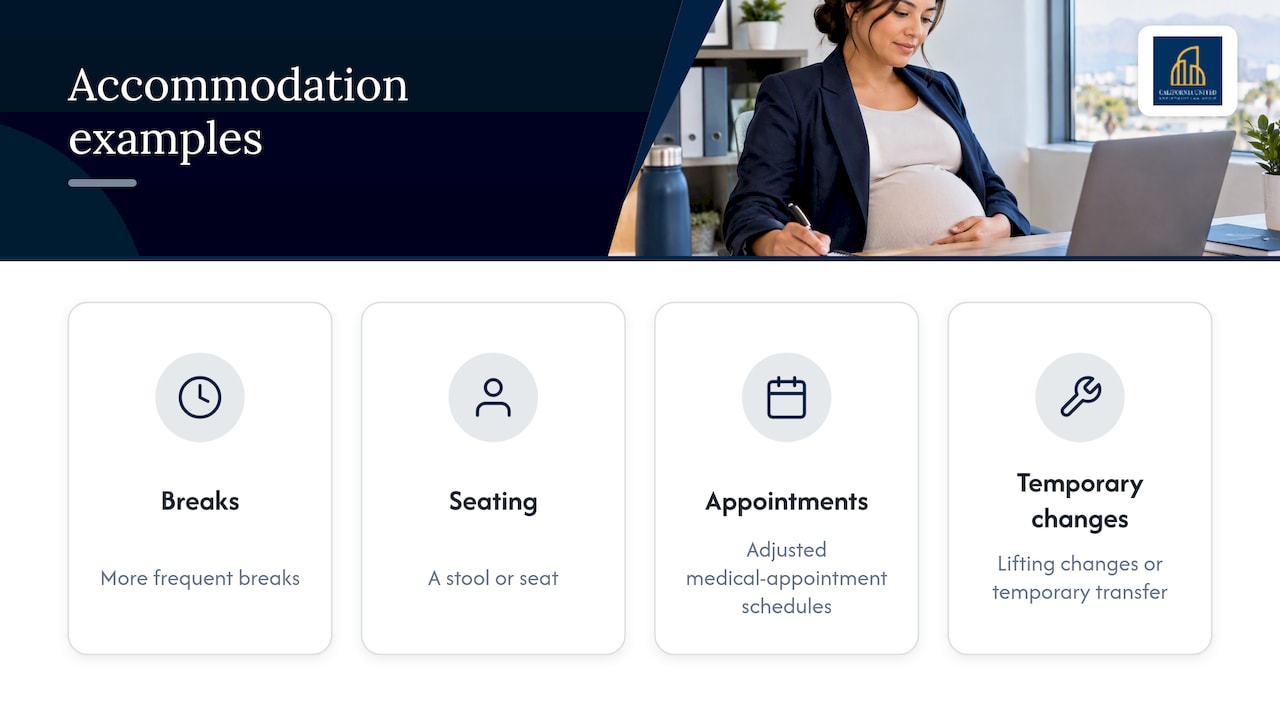
Accommodations depend on your job and what your provider recommends. Common examples people discuss include more frequent breaks, a stool or seat, adjusted schedules for medical appointments, temporary changes to lifting duties, or a temporary transfer. Your health care provider’s guidance usually shapes what is considered medically necessary. To prove a failure-to-accommodate claim under California law, an employee generally must show a pregnancy-related condition, an accommodation request made on the advice of a health care provider, the employer’s refusal, and the ability to perform the job’s essential functions with the accommodation, as the court set out in Lopez v. La Casa De Las Madres (2023) 89 Cal.App.5th 365. Under federal law, the U.S. Supreme Court held in Young v. United Parcel Service, Inc. (2015) 575 U.S. 206 that an employer that accommodates other workers with similar limitations may have to accommodate pregnant workers too.
Why timing matters
The EEOC advises that employers generally do not have to excuse poor job performance caused by a pregnancy-related condition. For that reason, employees may benefit from asking for accommodations before performance problems begin or get worse, rather than afterward.
Pregnancy disability leave compared with other leave
PDL is tied to a period of disability caused by pregnancy, childbirth, or related medical conditions. It is separate from time off to bond with a new child, which falls under different rules. For example, after PDL ends, an eligible employee may have up to 12 workweeks of California Family Rights Act leave available for bonding, subject to that law’s own eligibility rules. Because these programs interact, many employees find it useful to ask for a clear written explanation of how their employer is treating each type of leave, and to ask questions if something is unclear.
Retaliation is its own violation
Some of the most serious pregnancy-related disputes begin after an employee speaks up. California regulations state that retaliation against an employee for opposing forbidden practices or taking part in FEHA proceedings is prohibited.
That can include asking for an accommodation, complaining to HR about unfair treatment, filing a complaint with a government agency, or helping a coworker with theirs. Retaliation may take the form of termination, demotion, schedule cuts, reassignment, or sudden discipline.
If you are trying to understand whether treatment you have experienced could qualify, these pages explain the general legal picture:
- Retaliation in the workplace: your rights and legal options in California
- Signs of employer retaliation California workers should know
Keeping records of what happened
People who later raise a concern often find that organized information helps them describe what happened clearly. Employees commonly keep things like:
- Written messages, emails, and performance reviews that show how they were treated before and after a pregnancy announcement
- Their health care provider’s notes about accommodations or leave
- Any written requests they made and the responses they received
- Notes about conversations, including who said what and roughly when
This is general information about the kinds of records that tend to matter, not a strategy for any particular claim. An attorney can tell you what is relevant to your circumstances.
Where an El Monte employee can file a complaint
There are two main government agencies: the California Civil Rights Department at the state level, and the EEOC at the federal level.
According to the CRD’s employment page, you can file a complaint online, by phone, by mail, or by email. A complaint must generally be filed within three years of the date of the alleged discriminatory act.
The CRD also explains that you must file a complaint with the CRD to pursue state-level discrimination claims, but you may request an immediate right-to-sue notice, which allows you to proceed directly to court rather than waiting for an agency investigation. Once a right-to-sue notice is issued, a separate deadline to file a lawsuit begins, so it is important to act promptly.
Because deadlines can differ between state and federal processes and between types of claims, it is wise to confirm the timeline that applies to you with the agency or with an attorney soon after something happens. For the EEOC’s current filing procedures, check the agency’s own website.

Administrative filing and court
An agency complaint and a lawsuit are connected but not identical. The agency process can include investigation or mediation, while a right-to-sue notice opens the door to a court case. Which route fits depends on the facts, the evidence, and your goals, and it is a decision worth discussing with counsel.
What remedies may be available
When discrimination or retaliation is established, the law provides for several kinds of relief. The CRD lists remedies that may include back pay, front pay, hiring or reinstatement, promotion, and out-of-pocket expenses. Victims may also be awarded damages for emotional distress, punitive damages in cases involving especially serious employer misconduct, and attorney’s fees.
These are categories of relief the law allows, not predictions. What any individual receives depends on the evidence, the employer’s response, and how a settlement, arbitration, or court process unfolds. No lawyer can promise a result.
How to think about next steps
After a pregnancy-related problem at work, people often feel pressure to decide quickly. A calm approach usually serves you better. Questions many El Monte employees find useful to consider:
- Has my employer treated me differently since it learned of my pregnancy?
- Did my health care provider recommend an accommodation or leave, and how did my employer respond?
- Have I experienced any change in pay, hours, duties, or job status?
- Have I raised a concern, and did anything change afterward?
- Have I been asked to sign a document, such as a separation or severance agreement?
That last one deserves attention. Agreements presented during a separation can affect your legal rights, so it is reasonable to have someone who represents employees review it before you sign.
Our perspective
When someone calls us about a pregnancy-related problem at work, the situation is rarely just about a job. It involves income, health insurance, medical appointments, and plans for a family. We take that seriously.
We represent employees only. Our practice is focused on California employment law, including FEHA and Labor Code claims, and our attorneys include lawyers with prior employer-side experience. We believe knowing how employers and their counsel approach these disputes helps us explain the process to you honestly.
We work on a contingency fee basis, which means you pay no attorney’s fees unless we obtain a settlement or award for you. The specific terms are explained in our written fee agreement. Consultations are free, so you can talk through what happened before deciding anything.
We also believe the best time to get answers is early, before a conversation with HR turns into a termination meeting or before you sign something you do not fully understand. Each situation is different, and we will never promise an outcome. What we can do is listen, explain how California law may apply to your facts, and represent you at every stage if you choose to move forward.
California United Law Group
Talking with an El Monte employment attorney
If you believe you were treated unfairly because of pregnancy, a confidential conversation can help you understand your options. We represent California employees in discrimination, retaliation, wrongful termination, and related disputes, from pre-litigation through litigation, including administrative complaint filings.
👉 Learn about our employment law services, read about our El Monte employment lawyers, or contact us to schedule a free consultation.
You can also browse our legal insights for more articles on California workplace rights.
Frequently asked questions
Is it illegal to not hire someone because they are pregnant?
Yes. California regulations make it unlawful for an employer to refuse to hire, promote, or select someone for training because of pregnancy or perceived pregnancy. This applies even if the employer believes it is protecting the applicant or the business. Whether a particular hiring decision was discriminatory depends on the facts.
How much pregnancy leave can I take in California?
Eligible employees who are disabled by pregnancy, childbirth, or related medical conditions may be entitled to up to four months of pregnancy disability leave per pregnancy. Your health care provider determines how much leave you actually need. Eligibility and how leave interacts with other programs can vary, so confirm details with the CRD or an attorney.
Can my employer fire me after I announce I am pregnant?
An employer cannot lawfully terminate you because of pregnancy or perceived pregnancy, and it also cannot retaliate against you for asserting your rights. An employer may still take lawful action for legitimate, unrelated reasons, so the reasons behind the decision and its timing are what matter. Under FEHA, the question is generally whether pregnancy was a substantial motivating factor in the decision. An employment attorney can review your specific circumstances.
Where do I file a pregnancy discrimination complaint if I work in El Monte?
You can file with the California Civil Rights Department online, by phone, by mail, or by email, and the EEOC handles federal complaints. The CRD generally expects complaints within three years of the alleged discriminatory act. You may also request an immediate right-to-sue notice if you want to proceed to court. Federal EEOC deadlines are different and can be shorter, so check them early.
What is the difference between pregnancy discrimination and maternity discrimination?
The terms describe the same general problem: unfavorable treatment connected to pregnancy, childbirth, or related conditions. In legal terms, pregnancy discrimination is treated as a form of sex discrimination, and California law protects against it in hiring, promotion, termination, and other terms of employment.
Sources
- Sex and pregnancy, U.S. Department of Labor
- Pregnancy Discrimination, HRCalifornia
- Questions and Answers about the EEOC’s Enforcement Guidance on Pregnancy Discrimination
- Cal. Code Regs. tit. 2, § 11039
- Your Rights and Obligations as a Pregnant Employee, California Civil Rights Department
- Legal Rights of Pregnant Workers under Federal Law, EEOC
- Employment, California Civil Rights Department