
Yes. If you work in Culver City and your employer did not pay the overtime California law requires, you may be entitled to recover the missing wages and, depending on the facts, additional amounts such as interest and penalties. You can file a wage claim with the state or sue in court, and the deadline for most overtime claims is generally three years, though some claims filed in court can reach back four years. The strongest claims are built on records, and an employment lawyer who handles these cases can use your records to estimate what may be owed and evaluate your options. At California United Law Group, we represent employees in wage and hour disputes, including unpaid overtime, on a contingency basis: attorney fees are paid from a settlement or award only if there is a recovery. How case costs are handled is explained in our written fee agreement.
TL;DR
- California requires 1.5x pay after 8 hours in a day, after 40 in a week, and on the first 8 hours of a seventh consecutive workday, and double time beyond 12 hours in a day and beyond 8 hours on the seventh consecutive workday.
- You can recover unpaid overtime through a Labor Commissioner wage claim or a lawsuit. If you have left the job, waiting-time penalties may also apply if your employer willfully failed to pay all wages owed when your job ended.
- Most overtime claims must be filed within three years (up to four years for certain claims filed in court), so older unpaid hours can expire.
- Daily start and end times, pay stubs and wage statements are the evidence that matters most.
- Your employer cannot lawfully punish you for asking about or claiming overtime.
Table of Contents
- What California overtime law requires of Culver City employers
- Does being salaried mean no overtime?
- What you can recover
- How long you have to act
- Two ways to recover: a wage claim or a lawsuit
- Evidence to keep, starting today
- Protection against retaliation
- What about Culver City public employees?
- How we can help
- Our perspective
- FAQ
- Sources
What California overtime law requires of Culver City employers
Culver City sits inside Los Angeles County, but there is no separate city overtime rule for private employers. California state law sets the standard, and it is more generous than the federal one. Federal law generally requires overtime only after 40 hours in a week, and where both laws apply, the employee gets the higher standard.
Under Labor Code section 510, the rules for covered employees are:
- 1.5 times your regular rate for hours over 8 in a workday, hours over 40 in a workweek, and the first 8 hours on the seventh consecutive day of work in a workweek.
- Double your regular rate for hours over 12 in a workday and hours over 8 on the seventh day.
The statute carves out certain alternative workweek schedules, so a schedule like four 10-hour days may be treated differently if it was adopted properly. Whether yours was properly adopted is something an attorney can evaluate by reviewing your paperwork.
The Division of Labor Standards Enforcement (DLSE), the state agency that enforces wage laws, adds several points that surprise many workers:
- Overtime is due no later than the payday for the next regular payroll period after you earned it.
- Unauthorized overtime still has to be paid at the overtime rate. A supervisor who did not approve your extra hours does not erase the debt if you actually worked them.
- You cannot waive overtime. An agreement to work for a lower wage does not stop you from recovering the difference.
Does being salaried mean no overtime?
No. According to the DLSE, salaried employees receive overtime unless they meet a federal or state exemption test or a specific exemption in the Labor Code or an IWC Wage Order. A job title such as “manager” or a flat weekly salary does not decide the question. What you actually do all day, and what you are paid, does. The California Supreme Court has held that an exemption from overtime is an affirmative defense, so the employer bears the burden of proving the employee is exempt. Ramirez v. Yosemite Water Co. (1999) 20 Cal.4th 785, 794–795.
This is where many Culver City claims begin: studio-adjacent production workers, retail and restaurant staff, office coordinators, healthcare support staff and warehouse employees who may have been told they were “exempt” even though their duties or pay may not meet the legal test. If you want a deeper look at this issue, our article on salaried employees and overtime pay walks through how classification works.
What you can recover
A successful overtime claim can include more than a single back paycheck. Depending on your facts, recoverable amounts may include:
- The unpaid overtime itself, calculated at 1.5x or 2x your regular rate.
- Waiting-time penalties, if you no longer work for the employer and the employer willfully failed to pay all wages due at separation. The DLSE notes that a former employee can claim the Labor Code section 203 waiting-time penalty in addition to the wages. The penalty is up to 30 days of your daily wages, and a good-faith dispute over whether wages are owed can bar it. These penalties are designed to punish and deter late final pay rather than to pay you for your labor, which is why they grow the longer payment is delayed, up to the 30-day cap. The California Supreme Court has described the penalty as a disincentive for employers to pay final wages late. Pineda v. Bank of America, N.A. (2010) 50 Cal.4th 1389, 1400.
- Other wage violations uncovered along the way, such as missed meal or rest break pay or illegal deductions, which carry their own filing deadlines.
- Interest on the unpaid wages and, in a successful court action, reasonable attorney’s fees and costs as allowed by law. Then add after the list: The California Supreme Court has held that missed meal and rest break premium pay is compensation for the employee, not a penalty, and is subject to a three-year limitations period. Murphy v. Kenneth Cole Productions, Inc. (2007) 40 Cal.4th 1094, 1114.
How the regular rate affects your number
Overtime is not calculated on your base hourly wage alone. The DLSE explains that your regular rate of pay includes hourly earnings, salary, piecework earnings and commissions, and it can never be lower than the applicable minimum wage. If you earn a bonus or commission on top of your hourly rate, your overtime premium may be higher than you think. For flat-sum bonuses, the California Supreme Court has held that the overtime rate is calculated using only the nonovertime hours actually worked in the pay period. Alvarado v. Dart Container Corp. of California (2018) 4 Cal.5th 542, 573.
There is also a detail for part-time schedules. If your agreed workweek is shorter than 40 hours, say 35, the premium is not owed until you pass 8 hours in a day or 40 in a week. Hours between 35 and 40 in that case are paid at your regular rate.
A worked example
Suppose a Culver City employee earns $24 an hour, works Monday through Friday, and is regularly kept for 10 hours a day without overtime pay. Each day has 2 hours beyond 8. The overtime rate is 1.5 x $24 = $36 an hour, so total overtime pay owed for those hours is 2 x $36 = $72 a day, or $360 a week on a five-day schedule, less whatever was paid at straight time for those hours. If the straight-time pay was already received, the shortfall is the extra half-time: 2 hours x $12 = $24 a day, or $120 a week. Over 50 weeks, that is $6,000 in one year alone, before penalties and before other years are counted. That is why the time window below matters so much.
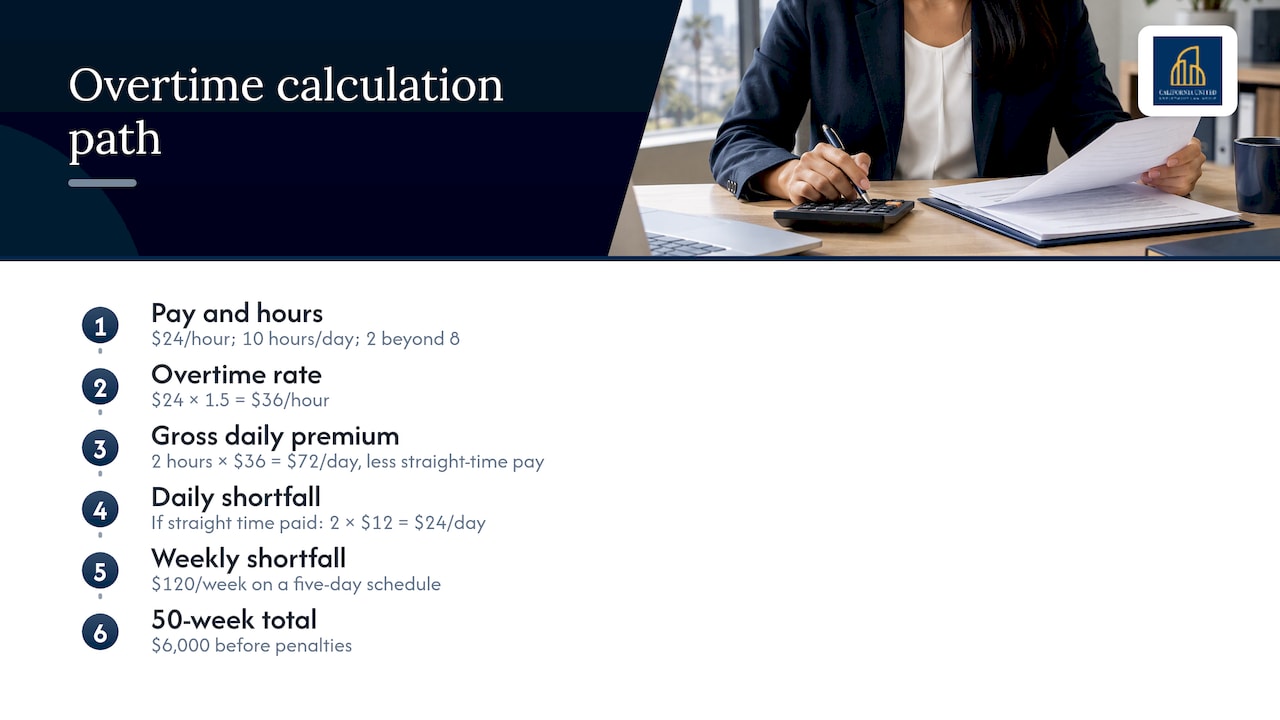
The figures here are an illustration, not a prediction for your case. What your records show about days over 12 hours, seventh-day work and commissions can change the result.
How long you have to act
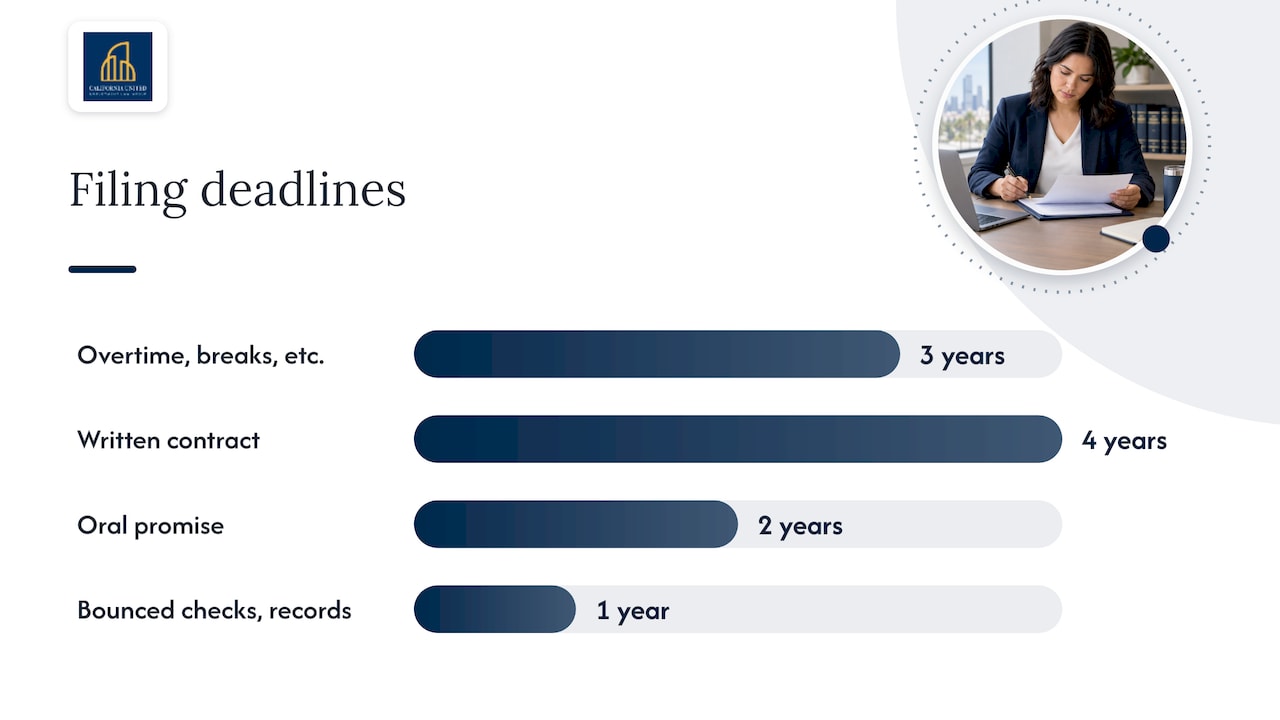
The DLSE lists the filing deadlines for wage claims:
| Type of claim | Deadline |
|---|---|
| Overtime, minimum wage, unpaid meal and rest breaks, sick leave, illegal deductions, unpaid reimbursements | 3 years |
| Wages owed under a written contract | 4 years |
| Oral promise to pay more than minimum wage | 2 years |
| Bounced-check penalties, or failure to give access to payroll or personnel records | 1 year |
The clock runs backward from the day you file. Every week you wait can push the oldest unpaid weeks out of reach. In court, unpaid overtime can sometimes also be pursued under California’s Unfair Competition Law, which has a four-year limitations period that applies even when the underlying statute has a shorter one. Cortez v. Purolator Air Filtration Products Co. (2000) 23 Cal.4th 163, 178–179. The remedies available under that law are limited, so whether it fits your case is a question for an attorney. A federal claim under the Fair Labor Standards Act has a shorter two-year lookback, or three years for willful violations, which is one reason California claims are usually pursued under state law. For more on how the time limits work in this city, see our guide to deadlines to recover unpaid wages in Culver City.
If you also fear retaliation or have been fired after raising the issue, a separate and shorter deadline applies. Complaints to the Labor Commissioner about retaliation generally must be filed within one year of the retaliatory act. Do not assume the three-year overtime period covers it.
Two ways to recover: a wage claim or a lawsuit
The DLSE states that when an employer does not pay overtime, you can file a wage claim with the Labor Commissioner’s Office or file a lawsuit to recover the lost wages. Each route has its own rhythm.
The Labor Commissioner wage claim
Per the DLSE wage-claim page, you can file online, by email, by mail or in person. The Labor Commissioner investigates and usually schedules a settlement conference. If the dispute is not resolved, a hearing officer reviews the evidence and decides the claim.
After the hearing, an Order, Decision or Award is served on both sides. Either party may appeal to a civil court for a new trial, and if the employer appeals, the DLSE may represent an employee who cannot afford counsel. If you win and the employer neither pays nor appeals, the order can be entered as a court judgment that you can collect yourself or have the DLSE collect.
We handle administrative complaint filings for employees, and we can prepare the claim form so your hours, rates and time periods are stated accurately from the start. Claims for meal and rest break premium pay use their own forms, as our article on DLSE Forms 1 and 55 for meal and rest break pay explains.
A civil lawsuit
A lawsuit is the other path. It lets you pursue wages together with related claims, such as waiting-time penalties, and in some situations it can be brought on behalf of many coworkers who were shorted the same way. Where the same practice affected a whole department or site, a class action or representative action may be worth considering. Our article on how Alhambra employees can pursue DLSE claims, lawsuits and waiting-time penalties compares the routes in detail, and the same principles apply to Culver City workers.
Which path fits depends on how much is owed, whether you still work there, whether others are affected and how strong your records are. That is a decision to make with an attorney before you file, because the choice affects what you can recover.
Evidence to keep, starting today
The DLSE advises keeping records of daily start and end times, breaks, pay stubs and itemized wage statements. In practice, build a file like this:
- A daily log. Write down when you clock in, when you take meals, when you clock out and any work you do before or after.
- Pay stubs and wage statements. Keep every one, and save digital copies.
- Schedules and messages. Texts, emails and chat messages that show you were working after hours, or that a supervisor assigned extra hours.
- Your job duties. A written description of what you actually do, which matters for salaried exemption disputes.
- Your offer letter or contract. It shows your agreed rate and schedule.
If you are already collecting records of this kind, our article on documenting hours and DLSE steps for Long Beach overtime claims offers a practical routine you can adopt in Culver City too. If you suspect your time was rounded in your employer’s favor, see our piece on unlawful time rounding.
Keep copies on your own phone or personal email, not only on a work system you may lose access to.
Protection against retaliation
Raising an overtime problem is protected activity. Under Labor Code section 98.6, employees who file bona fide wage complaints or claims are protected. If the employer acts against you within 90 days of the protected activity, the law creates a rebuttable presumption of unlawful retaliation, and the penalty can reach up to $10,000 per employee per violation. Federal law also treats firing or any adverse action that would dissuade a reasonable employee from raising a concern as retaliation, and overtime pay is among the protected topics.
If you have been demoted, had your hours cut, been disciplined or been fired after asking about overtime, tell us right away. Retaliation and whistleblower claims are among the matters we handle. Our article on wage complaint rights and retaliation protection explains what the protections look like in practice.
What about Culver City public employees?
The rules are different for some government workers. The City of Culver City’s agreements with its employee groups set their own overtime terms. For example, the police officers’ memorandum of understanding for 2022 to 2025 (which may have been replaced by a newer agreement) used a 28-day work period with overtime for hours over 171 in the cycle. Federal law also contains exceptions for some public-agency police and fire employees. If you work for a public agency, we can review which rules cover you before you assume anything.
How we can help
We represent California employees only, and our practice is built around employment disputes, including wage and hour claims and unpaid overtime. Our attorneys include lawyers with prior employer-side experience, which we use to anticipate how an employer’s defense will be built. We work on a contingency basis, so you pay no attorney fees unless we obtain a recovery through settlement or judgment. Your written fee agreement explains how case costs are handled, and we offer free consultations and case evaluations.
👉 Talk to our team about your Culver City overtime claim
Our perspective
Many overtime problems start the same way: an employee assumes the paycheck must be right because the payroll system produced it. Then they learn that overtime was never calculated on the full regular rate, that a salary was treated as a reason to skip overtime, or that hours before and after the shift were never counted.
We believe an employee should not have to bear the cost of proving that. Our firm practices only employment law for employees, and our contingency structure means attorney fees come out of a recovery rather than being paid up front. We use attorneys who have worked on the employer side so that we know where an employer’s defense will push.
Our advice is simple: write down your hours today, keep every pay stub, and do not let the three-year window quietly close on the oldest weeks. Then let us look at the numbers with you.
California United Law Group
FAQ
What happens if my boss doesn’t pay me overtime?
You can file a wage claim with the Labor Commissioner or file a lawsuit to recover the wages. If you have left the job, you may also claim waiting-time penalties under Labor Code section 203. Your employer cannot lawfully retaliate against you for making the claim.
Do I get overtime after 8 hours in California?
Yes, if you are a covered non-exempt employee. Work over 8 hours in a day is paid at least 1.5 times your regular rate, and work over 12 hours in a day is paid at least double. Certain properly adopted alternative workweek schedules are treated differently.
Can a salaried employee get overtime in Culver City?
Yes. Salaried employees receive overtime unless they meet an exemption test under federal or state law. A salary or a manager title alone does not make you exempt, so your actual duties and pay need to be reviewed.
Can I recover overtime if my employer never approved it?
Yes. The DLSE states that unauthorized overtime must still be paid at the required overtime rates. Generally, if you worked the hours and your employer knew or should have known you were working them, they are owed. An employer that had no knowledge of the overtime work, because the employee did not notify it or prevented it from finding out, may not be liable. Jong v. Kaiser Foundation Health Plan, Inc. (2014) 226 Cal.App.4th 391, 395.
Do I need a lawyer to recover unpaid overtime?
You can file a wage claim yourself, but an attorney can calculate what you are owed, identify penalties and related violations, and choose between a claim and a lawsuit. With us, there is no attorney fee unless we obtain a recovery, and the first consultation is free. Then add a closing paragraph: This article provides general information, not legal advice, and reading it does not create an attorney-client relationship. Every case depends on its own facts, and past results do not guarantee a similar outcome.
Sources
- California Labor Code section 510
- DLSE overtime FAQ
- DLSE overtime FAQ (rates, regular rate, appeals)
- DLSE: how to file a wage claim and filing deadlines
- DIR: laws that prohibit retaliation and discrimination
- U.S. Department of Labor: FLSA questions and answers
- U.S. Department of Labor: back pay
- U.S. Department of Labor: retaliation
- City of Culver City police officers’ MOU, 2022 to 2025