
Yes. If you work in Los Angeles, two sets of laws protect you from being treated differently because of where you or your family come from: California’s Fair Employment and Housing Act (FEHA) and the federal Title VII of the Civil Rights Act of 1964. That protection reaches hiring, firing, pay, promotions, harassment and more. It also covers your accent, your language, your ancestry and even a national origin an employer only assumes you have. At California United Law Group, we represent California employees in these disputes, and a free consultation is a practical first step toward finding out whether you may have a claim.
TL;DR
- National origin discrimination is unlawful in Los Angeles workplaces under both FEHA and Title VII, including discrimination based on ancestry, accent, language and perceived background.
- FEHA covers employers with 5 or more employees, and its harassment rules apply to every workplace. Title VII covers employers with 15 or more.
- Most FEHA complaints must be filed with the California Civil Rights Department (CRD) within three years of the discriminatory act. Federal Title VII charges must generally be filed with the EEOC within 180 days, but in California that period is generally extended to 300 days.
- English-only rules, accent-based decisions and, since October 2025, some automated hiring tools can be unlawful national origin discrimination. So can a ban on speaking your own language during meal and rest breaks.
- Retaliation for complaining can be a separate violation. Keep records, and speak with an employment attorney early.
Table of Contents
- What national origin discrimination means
- Which laws protect you in Los Angeles
- What counts as national origin discrimination at work
- What changed in 2025
- Deadlines: how long you have to act
- How to build and protect your claim
- Does it matter that you work in Los Angeles?
- Our perspective
- Talk to us about your Los Angeles case
- FAQ
- Sources
What national origin discrimination means
The U.S. Equal Employment Opportunity Commission (EEOC) says national origin discrimination means treating workers unfavorably because they are from a particular country or part of the world, because of ethnicity or accent, or because they appear to be of a certain ethnic background, even if they are not. It also covers treating someone badly because they are married to, or associated with, a person of a certain national origin.
The EEOC’s enforcement guidance adds two points that matter in a city as diverse as Los Angeles:
- The protection extends to your ancestors’ place of origin and to the physical, cultural or linguistic traits of a national origin group.
- A member of one national origin group can discriminate against a member of the same group. A supervisor sharing your heritage does not make the conduct lawful.
The protection is not limited to immigrants. The EEOC states that Title VII protects employees and applicants of every background, Americans included.
Which laws protect you in Los Angeles
FEHA, the California law
The CRD, the state agency that enforces FEHA, explains that FEHA applies to public and private employers, labor organizations and employment agencies. It is illegal for an employer with 5 or more employees to discriminate against applicants and employees because of a protected category, including ancestry and national origin, or to retaliate against them for asserting their rights. Harassment is prohibited in all workplaces, even those with fewer than five employees. add: FEHA also generally protects employees from having to pay an employer’s attorney’s fees unless the court finds the lawsuit unreasonable, frivolous or meritless.
For most Los Angeles workers, FEHA is the stronger tool. It reaches smaller employers than federal law does, and the CRD lists broad remedies for victims, including back pay, front pay, reinstatement, promotion, damages for emotional distress, punitive damages, and attorney’s fees and costs.
Title VII, the federal law
Title VII applies to employers with 15 or more employees, according to the EEOC. It forbids discrimination in any aspect of employment: hiring, firing, pay, job assignments, promotions, layoff, training and fringe benefits.
Some conduct may also violate federal immigration-related laws, the Immigration and Nationality Act and the Immigration Reform and Control Act of 1986. The EEOC notes that workers can report to both the EEOC and the Department of Justice’s Civil Rights Division in those situations.
What counts as national origin discrimination at work
A claim does not need a slur or a written policy. These are the patterns we see described most often in the guidance from the agencies themselves.
Harassment
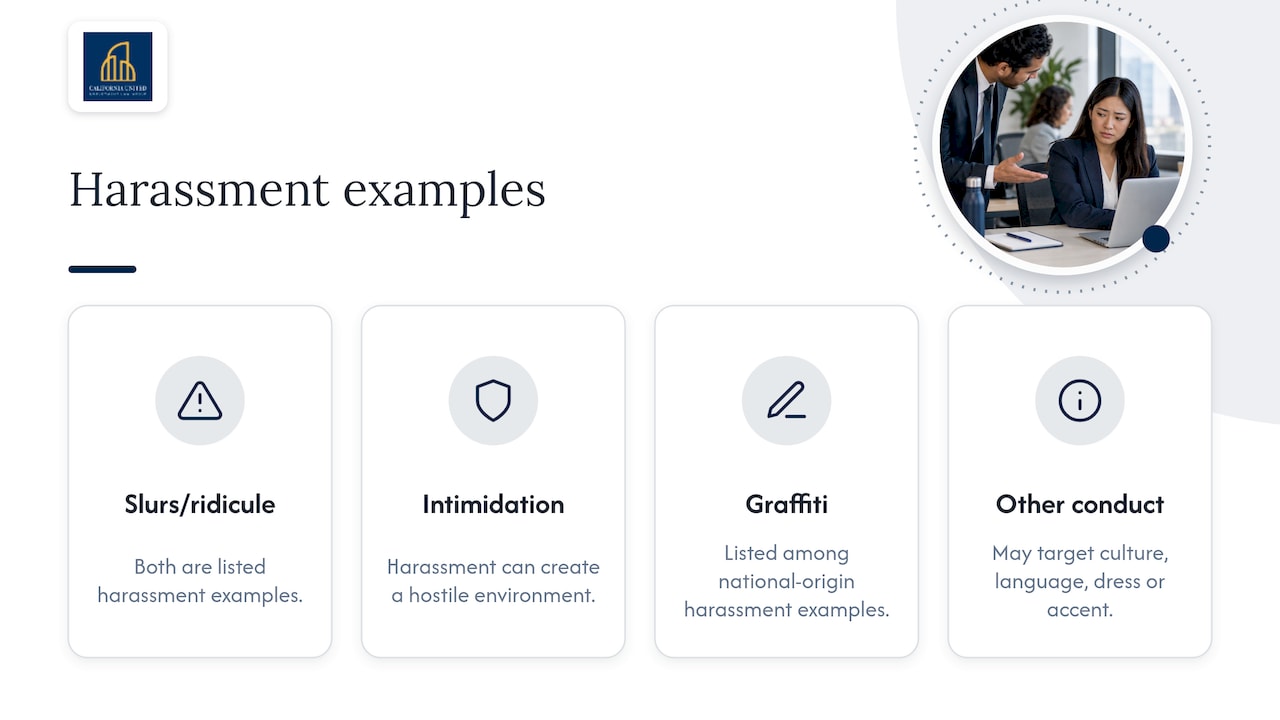
The EEOC states that national origin harassment is unlawful when it is so frequent or severe that it creates a hostile or offensive work environment, or when it leads to an adverse decision such as firing or demotion. Its guidance lists ethnic slurs, ridicule, intimidation, graffiti and other offensive conduct aimed at someone because of birthplace, ethnicity, culture, language, dress or foreign accent. The harasser can be a supervisor, a co-worker or a non-employee such as a client or customer. California law can be more protective than the federal standard. Under FEHA, the question is whether the conduct was severe or pervasive. A single incident can be enough to support a harassment claim under Government Code section 12923(b).
Unequal treatment in pay, assignments and promotions
The EEOC gives examples such as paying visa guest workers less than similarly situated American workers, or preferring foreign or visa-status workers over American workers. Both directions can be unlawful.
Under FEHA, HRCalifornia explains that employers may not assign positions, facilities or geographic areas by national origin without a permissible defense. It also notes that customer preference is not a valid justification. A “corporate look” or an “All-American look” policy can simply reflect discriminatory customer preferences, and it would not justify disparate treatment in hiring, assignment or promotion.
Accent and language rules
This is where many Los Angeles employees recognize their own situation. According to HRCalifornia:
- Employment decisions based on your accent are unlawful unless the employer proves the accent materially interferes with your ability to do the job.
- English-only policies are unlawful unless the employer proves business necessity, narrow tailoring, and effective notice to employees of when the rule applies and what happens if it is broken.
- English-only rules are never lawful under FEHA during an employee’s non-work time, such as meal and rest breaks.
The EEOC and the Department of Justice’s Office of Special Counsel give a plain example in their joint publication: hiring only native English speakers regardless of whether an accent would affect job performance.
Courts have recognized these protections. A California Court of Appeal has held that “Discrimination on the basis of an employee’s foreign accent is a sufficient basis for finding national origin discrimination.” (Galvan v. Dameron Hospital Assn. (2019) 37 Cal.App.5th 549, 562.) The Ninth Circuit, whose rulings bind federal courts in California, observed in Raad v. Fairbanks North Star Borough School Dist. (9th Cir. 2003) 323 F.3d 1185 that accent and national origin are often inextricably intertwined, in a case where a school district allegedly used a substitute teacher’s accent as a pretext to deny her a full-time position.
So being told to stop speaking Spanish, Armenian, Korean, Tagalog or any other language on your meal or rest break, which California regulations do not allow, or being passed over because of how you sound, is worth having reviewed.
Citizenship, immigration and driver’s license practices
The CRD’s regulations treat citizenship requirements as unlawful when they are a pretext for discrimination or have the purpose or effect of discriminating on the basis of national origin or ancestry, unless a permissible defense applies. HRCalifornia also notes that using force, fraud or coercion to compel work, or to subject someone to adverse treatment because of national origin, is a FEHA violation.
What changed in 2025
Two recent changes matter for Los Angeles workers.
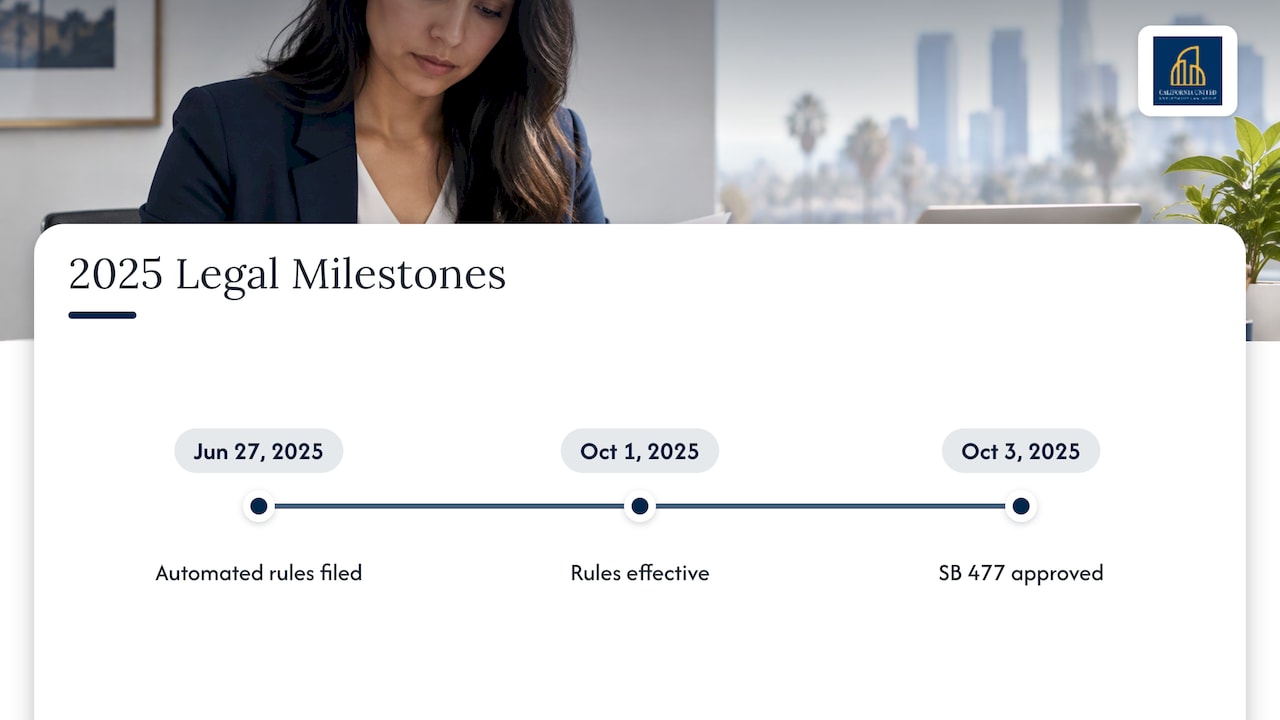
Driver’s license status. California’s SB 477, approved by the Governor on October 3, 2025, amends FEHA so that national origin discrimination includes discrimination based on holding a driver’s license or ID card issued under Vehicle Code section 12801.9, the license available to California residents regardless of immigration status.
Automated hiring tools. The Civil Rights Council’s regulations on automated decision systems were approved and filed with the Secretary of State on June 27, 2025, with an effective date of October 1, 2025. The final text makes it unlawful to use an automated decision system or selection criteria, such as a qualification standard, employment test or proxy, that discriminates based on national origin or a proxy for it. Evidence of anti-bias testing is relevant to any defense. If an applicant screening tool or online test filtered you out, that process can be part of a claim.
Deadlines: how long you have to act
Deadlines are where good claims get lost, so treat them seriously.
| Path | Who handles it | General deadline |
|---|---|---|
| FEHA complaint | California Civil Rights Department | Three years from the discriminatory act, with limited extensions |
| Title VII charge | EEOC | 180 days, generally extended to 300 days in California |
| Immigration-related charge, employers with 4 to 14 employees | DOJ Civil Rights Division, Immigrant and Employee Rights Section (formerly the Office of Special Counsel) | Some laws require filing within 180 days |
The sources behind the table:
- The CRD states that a complaint must generally be filed within three years of the alleged act. SB 477 restates that three-year limit in Government Code section 12960 and adds limited extensions, for example up to 90 days for late-discovered facts.
- The EEOC gives 180 days as the standard charge-filing deadline for Title VII. That deadline extends to 300 days where a state agency enforces a similar law, and a timely CRD complaint is generally treated as filed with the EEOC under the two agencies’ worksharing agreement.
- The EEOC and DOJ joint publication says charges go to the EEOC for employers with 15 or more employees and to the Department of Justice’s Immigrant and Employee Rights Section (formerly the Office of Special Counsel) for employers with 4 to 14 employees
Two FEHA details are worth knowing. First, the CRD states that you must file a CRD complaint even if you want to sue in court, and you can request an immediate right-to-sue notice when you file. Second, if the CRD does not bring its own civil action within 150 days, it must notify you that a right-to-sue notice will be issued on request, and that notice allows you one year to bring a civil action. Group and class complaints follow a different timetable.
Because the deadline that applies depends on the law, the employer’s size and the date of each incident, confirm yours with an attorney as soon as you suspect a claim.
How to build and protect your claim
You do not need a complete case before you call a lawyer. You do need to preserve what you have.
- Write a timeline. Record dates, places, who said or did what, and who saw it. Do it while memories are fresh.
- Save documents. Keep emails, texts, schedules, performance reviews, pay stubs, job postings and any written language or dress policy. Store copies somewhere that does not depend on your work account. Do not take confidential company records, trade secrets or other people’s private information. Ask an attorney before you copy anything beyond your own records and communications.
- Note comparisons. If co-workers from other backgrounds received better pay, schedules or promotions, write down who and how.
- Report internally in writing. A written complaint to HR or a manager creates a record, and it is also protected activity. FEHA prohibits retaliation against employees who assert their rights, according to the CRD.
- Watch for retaliation. Schedule cuts, demotions, sudden discipline or termination after you complain can support a separate retaliation claim.
- Decide where to file. The CRD takes complaints through its online California Civil Rights System or at its Contact Center, 800-884-1684. The EEOC can be reached at 1-800-669-4000. Filing with an agency is a step the law builds into the process, and your attorney can handle it for you.
- Talk to an employment attorney before you sign anything. A severance or separation agreement can include a release of claims.
We handle each of these stages for employees, from pre-litigation work through litigation, including administrative complaint filings. That means you do not have to choose the agency, meet the filing rules and answer the employer alone while you are still dealing with the job itself.
Does it matter that you work in Los Angeles?
Yes, in practical ways. FEHA protects people who work in California, and the CRD’s rules apply across the whole state, so the law is the same whether you work in downtown Los Angeles, the Westside, the Valley or the harbor area. What changes from one city to another is the mix of workplaces: hotels, restaurants, warehouses, studios, hospitals, logistics operations and offices, with workforces drawn from many countries. In a multilingual workforce, language rules and accent comments become common flashpoints. Those are exactly the issues California’s regulations address. Our firm also publishes related guides for neighboring communities, such as Glendale employees facing national origin claims and Monterey Park workers, and more on our legal insights page.
Our perspective
Many employees who contact us wait longer than they should, often not because they doubted themselves, but because the conduct came in small pieces: a comment about an accent, a language rule that only applied to some people, a promotion that went to someone else. Each piece looks minor alone. Together they can form a pattern under FEHA.
We practice employment law for employees across California, and our attorneys include lawyers with prior employer-side experience. We use that experience to anticipate how an employer will defend a national origin claim, for example by pointing to “business necessity” for a language rule or by calling an accent a communication problem, and to prepare your case for those arguments from the start.
We handle these cases on a contingency fee basis, so you pay no attorney’s fees unless we recover money for you through a settlement or award. Our written fee agreement explains how case costs are handled, including whether you may be responsible for any costs. Your first consultation is free, so the question of whether you have a claim does not depend on what you can afford to pay.
We want you to feel informed and supported. You have rights, and you do not have to take on your employer by yourself.
California United Law Group
Talk to us about your Los Angeles case
National origin cases are one part of our employment law practice, which also covers harassment, retaliation, wrongful termination, whistleblower claims and severance agreements. If you work in Los Angeles and believe your background, accent or language played a role in how you were treated, 👉 contact us for a free consultation. If we take your case, our attorney’s fees come only from a settlement or award, and your written fee agreement explains how costs are handled.
FAQ
Can I claim national origin discrimination if my employer is small?
Often yes. FEHA applies to employers with 5 or more employees, while Title VII applies to those with 15 or more. Harassment is prohibited under FEHA in every workplace, even one with fewer than five employees, according to the CRD.
Can I be discriminated against for my accent?
Yes, in many situations. In California, employment decisions based on an accent are unlawful unless the employer proves the accent materially interferes with your ability to perform the job. Comments about your accent can also support a harassment claim if they are severe or pervasive, and under California law a single incident can be enough.
Is an English-only rule at work legal in California?
Not automatically. An employer must prove business necessity, narrow tailoring and effective notice of when the rule applies and what the consequences are, according to HRCalifornia. An English-only rule is never lawful during meal and rest breaks. If you were disciplined under a blanket English-only rule, have an attorney review it.
Do I have to file with the CRD before I can sue?
For FEHA claims, yes. The CRD states that a complaint must be filed even if you plan to sue in court, and you can request an immediate right-to-sue notice when you file. Once you have the notice, you generally have one year to bring a civil action. An attorney can file for you and track each deadline.
This article is for general information only. It is not legal advice, and reading it does not create an attorney-client relationship. Every case depends on its own facts, and past results do not guarantee a similar outcome.
Sources
- National Origin Discrimination, U.S. Equal Employment Opportunity Commission
- EEOC Enforcement Guidance on National Origin Discrimination
- EEOC and Civil Rights Division, Department of Justice joint publication
- Employment, California Civil Rights Department
- SB 477, California Fair Employment and Housing Act bill text
- Civil Rights Council Rulemaking Actions, CRD
- Automated Decision System Regulations, Final Unmodified Text, CRD
- National Origin Discrimination, HRCalifornia