
Age discrimination in the workplace is defined as unfavorable treatment of employees aged 40 and older based on their age rather than their job performance. In Alhambra, this conduct is prohibited under California’s Fair Employment and Housing Act (FEHA) and the federal Age Discrimination in Employment Act (ADEA). Both laws protect workers from discriminatory hiring, firing, demotion, and harassment. FEHA also prohibits retaliation against employees who report age bias or participate in investigations. If you work in Alhambra and believe your age is affecting your employment, understanding your rights is the first step toward protecting them.
What are common signs of age discrimination in Alhambra workplaces?
Age bias in the workplace takes many forms, and not all of them are obvious. 64% of workers 50 and older report witnessing or experiencing age discrimination. That figure reflects how widespread the problem is across California industries, including those concentrated in Alhambra such as healthcare, retail, and local government services.

Workplace ageism examples range from subtle to overt. Subtle bias often goes unaddressed because it is harder to name and prove.
Subtle signs of age bias include:
- Being passed over for training programs or new technology rollouts
- Receiving comments about being “set in your ways” or resistant to change
- Assumptions that you lack digital skills or cannot adapt to new software
- Exclusion from meetings, team projects, or social events
- Younger colleagues receiving mentorship or advancement opportunities you are not offered
Age bias can begin as early as a worker’s late 30s or early 40s, often through stereotypes about tech ability or adaptability. This matters because many Alhambra employees may not realize they are protected until they understand that FEHA coverage starts at age 40, not 50 or 60.
Overt signs of age discrimination include:
- Termination or layoff targeting older workers disproportionately
- Demotion or reduction in responsibilities without a performance-based reason
- Negative performance reviews that appear after you raise age-related concerns
- Direct comments about your age, retirement plans, or “making room for new blood”
- Harassment from supervisors or coworkers based on age-related stereotypes
A newer form of workplace ageism involves technology. AI hiring software has been alleged in lawsuits to favor younger workers, with claims that automated systems screen out older applicants during hiring. Age bias in hiring through algorithmic tools is an emerging issue that affects Alhambra workers applying to companies using automated recruitment platforms.
Pro Tip: Keep a written log of incidents as they happen. Note the date, who was present, what was said or done, and how it affected your work. This contemporaneous record is far more credible than memory alone.
What legal protections do Alhambra employees have against age discrimination?
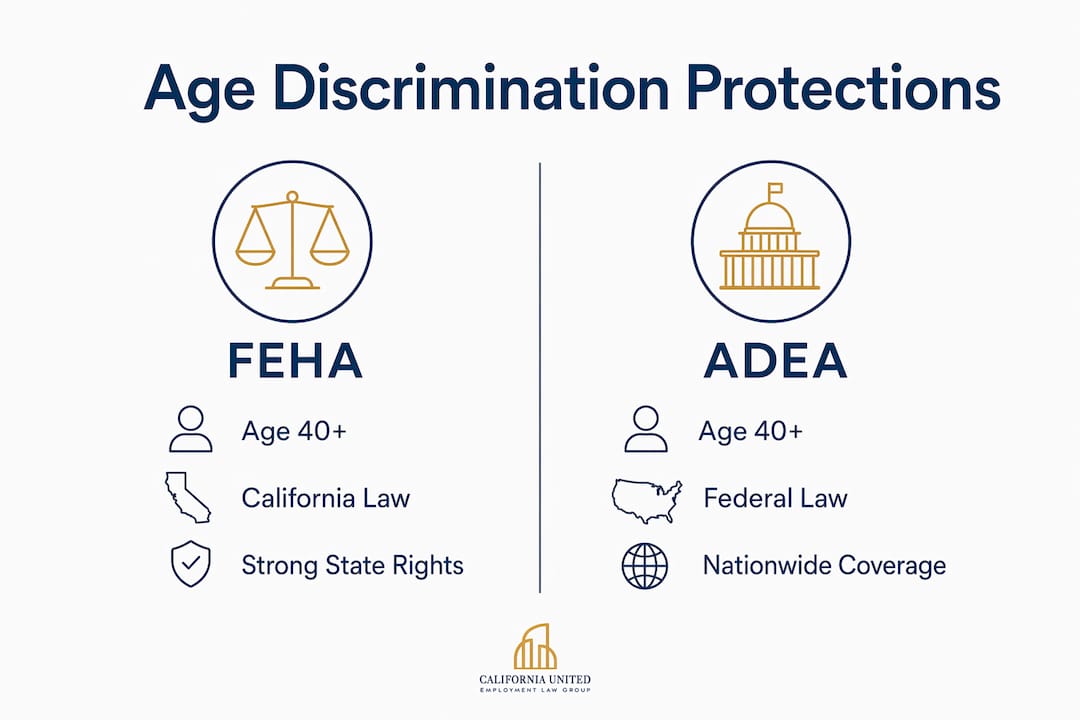
California law gives Alhambra employees some of the strongest age-related workplace rights in the country. FEHA, administered by the California Civil Rights Department (CRD), prohibits employers with five or more employees from discriminating against workers aged 40 and older. The federal ADEA covers employers with 20 or more employees. Because FEHA has a lower threshold, more Alhambra employers fall under state law protection.
Here is how the key protections compare:
| Protection | FEHA (California) | ADEA (Federal) |
|---|---|---|
| Age covered | 40 and older | 40 and older |
| Employer size | 5+ employees | 20+ employees |
| Retaliation prohibited | Yes | Yes |
| Filing agency | California CRD | EEOC |
| Statute of limitations | 3 years (with CRD filing) | 300 days (with EEOC filing) |
FEHA’s broader employer coverage means most small businesses in Alhambra are subject to state law, even if they fall below the federal threshold. That is a meaningful distinction for workers in smaller local companies.
California courts have confirmed these protections in practice. In Sandell v. Taylor-Listug, Inc. (2010) 188 Cal.App.4th 297, the Court of Appeal held that an employee’s prima facie case of FEHA age discrimination requires showing: (1) the employee is over 40; (2) suffered an adverse employment action; (3) was performing satisfactorily; and (4) was replaced by or treated less favorably than a significantly younger employee. Separately, in Mahler v. Judicial Council of Calif. (2021) 67 Cal.App.5th 82, the court affirmed that FEHA’s age discrimination protections extend to disparate impact claims, meaning an employer policy that disproportionately harms workers 40 and older can be challenged even without proof of intentional bias — a particularly relevant principle for Alhambra employees facing systemic practices in hiring or layoffs.
The CRD complaint process works as follows:
- File a complaint with the CRD. You submit a complaint describing the discriminatory conduct. The CRD reviews it for completeness and jurisdiction.
- CRD investigates or issues a right-to-sue notice. The agency may investigate or, upon request, issue a right-to-sue letter allowing you to file in court.
- File a civil lawsuit within one year. Once you receive the right-to-sue notice, you have one year to file in California Superior Court.
- Pursue your claim through litigation or settlement. Your attorney will gather evidence, conduct discovery, and represent you through trial or resolution.
California courts also recognize the continuing violation doctrine, which allows claims to extend beyond a single incident. If you experienced a pattern of age-based mistreatment, the clock may start from the most recent act in that pattern rather than the first.
Pro Tip: Do not wait to consult an attorney. Many workers delay because they are unsure whether what happened “counts” as discrimination. An employment lawyer can assess your situation quickly and help you avoid missing critical deadlines.
How can Alhambra employees document and report age discrimination?
Strong documentation is your most reliable tool when reporting age discrimination. Early documentation and legal consultation significantly improve case outcomes. The goal is to build a clear, factual record before memories fade and evidence disappears.
What to document and preserve:
- Emails, text messages, or written communications referencing your age, retirement, or “fit” with the company
- Performance reviews, especially any that changed after you raised concerns or reached a milestone age
- Records of job postings, promotions, or training opportunities you were denied
- Notes from meetings where age-related comments were made
- Witness names and contact information for anyone who observed the conduct
After gathering your records, follow your employer’s internal grievance procedure. Report the conduct to HR or a supervisor in writing. This step matters for two reasons. First, it creates a formal record. Second, California law may limit your remedies if you did not give your employer a reasonable chance to address the problem.
Filing a complaint with the CRD is the next step if internal reporting does not resolve the issue. The CRD accepts complaints online, by mail, or in person. You do not need an attorney to file, but having one helps you present your complaint clearly and completely.
Proving age discrimination often relies on indirect evidence because employers rarely state age as a reason for adverse actions. Patterns matter here. If your employer terminated five workers over 50 in the same quarter while retaining younger employees with similar performance records, that pattern is evidence. An experienced employment attorney can help you identify and present these patterns effectively.
Pro Tip: Save copies of all work-related documents to a personal, secure location outside your work devices. If your employment ends, you may lose access to company email and internal systems immediately.
What are the legal deadlines for age discrimination claims in Alhambra?
Missing a filing deadline forfeits your right to pursue a claim, regardless of how strong the evidence is. California workers must understand two separate timelines under FEHA.
| Deadline | Requirement |
|---|---|
| 3 years from discriminatory act | File complaint with the CRD |
| 1 year from right-to-sue notice | File civil lawsuit in Superior Court |
| 300 days from discriminatory act | File with EEOC for federal ADEA claims |
| Varies | Public entity claims may have shorter notice requirements |
FEHA provides a three-year window for filing discrimination complaints with the CRD. Many workers mistakenly believe they have three years to file a lawsuit directly. They do not. The three-year period applies to the CRD complaint, and the one-year court filing window begins only after the right-to-sue notice is issued.
The continuing violation doctrine can extend these deadlines when discrimination is ongoing. If your employer engaged in a series of related discriminatory acts, the filing period may run from the most recent act rather than the first. This doctrine does not apply to isolated incidents, so the pattern of conduct must be connected.
The California Supreme Court addressed the continuing violation doctrine’s requirements in Richards v. CH2M Hill, Inc. (2001) 26 Cal.4th 798, holding that the doctrine applies where the employer’s discriminatory acts predating the statutory period are sufficiently similar in kind to those within the period and reflect the same discriminatory animus — such as a pattern of lack of promotions, undesirable assignments, and hostility over a period of years. Courts have also held that the doctrine does not apply where the employee knew that further efforts to resolve the mistreatment internally would be futile. See Jumaane v. City of Los Angeles (2015) 241 Cal.App.4th 1390. Documenting the pattern as it unfolds — rather than viewing each incident in isolation — is therefore critical to preserving this theory.
If your employer is a public entity such as a city department or school district, it is important to know that FEHA age discrimination claims are generally exempt from the Government Claims Act’s pre-lawsuit claim filing requirement. You still must exhaust your administrative remedies by filing with the CRD within the three-year window, and the one-year lawsuit filing period after your right-to-sue notice remains applicable. However, if you also intend to pursue non-FEHA claims against a public employer — such as certain state tort claims — those separate claims may be subject to a government claim presentation deadline as short as six months. Consult an employment attorney promptly to identify which deadlines apply to your specific situation.
The practical takeaway is straightforward. Do not wait to see if things improve. Consulting an Alhambra employment attorney early preserves your options and prevents accidental forfeiture of valid claims.
Key Takeaways
Alhambra employees aged 40 and older are protected from age discrimination under both California FEHA and the federal ADEA, and acting quickly on documentation and deadlines is the most effective way to preserve a valid claim.
| Point | Details |
|---|---|
| FEHA covers workers at 40 | California law protects employees at age 40, covering employers with 5 or more workers. |
| Document early and thoroughly | Preserve emails, performance reviews, and incident notes as soon as bias occurs. |
| CRD complaint comes first | You must file with the CRD before filing a lawsuit; the three-year window applies to this step. |
| Continuing violations extend deadlines | Ongoing patterns of discrimination may reset the filing clock to the most recent act. |
| AI bias is a real and growing risk | Algorithmic hiring tools have been alleged to screen out older workers, affecting Alhambra applicants. |
What I’ve Learned Handling Age Discrimination Cases in Alhambra
The most common mistake I see is waiting. Workers spend months hoping the situation will change, and by the time they consult an attorney, critical deadlines are close or already missed. The three-year CRD filing window sounds generous, but it disappears faster than people expect when they factor in the time needed to gather evidence, consult counsel, and prepare a complaint.
The second misconception I encounter regularly is about proof. Many workers believe they need a supervisor on record saying “we fired you because of your age.” That almost never happens. Age discrimination cases are built on patterns, comparisons, and circumstantial evidence. A 55-year-old employee replaced by a 29-year-old, after a series of suddenly negative reviews, tells a story that courts and agencies understand.
Local context matters too. Alhambra’s workforce spans healthcare, education, retail, and small business. Each of those environments carries its own version of age bias. In healthcare, it might be assumptions about a nurse’s ability to learn new electronic records systems. In retail, it might be scheduling practices that push older workers out of full-time hours. Recognizing the pattern in your specific workplace is the first step toward addressing it.
California’s FEHA is genuinely one of the strongest age discrimination statutes in the country. Workers here have real protections. The goal is not to create fear or conflict at work. It is to make sure you understand what the law provides so you can make informed decisions about your situation.
How California United Law Group Supports Alhambra Employees Facing Age Discrimination
If you believe you are experiencing age discrimination at your Alhambra workplace, California United Law Group is here to help.
California United Law Group, P.C. represents employees in FEHA and ADEA claims throughout the Alhambra area. The firm handles wrongful termination, discriminatory demotion, retaliation, and related employment disputes. Attorney Jennifer A. Clingo and the team offer confidential consultations to review your situation and explain your options clearly. There is no obligation, and your conversation is private. Whether you are at the documentation stage or ready to file, California United Law Group provides professional, compassionate guidance through every step of the process.
Contact California United Law Group today to schedule your confidential consultation.
FAQ
What age does california law protect against workplace discrimination?
California’s FEHA protects employees aged 40 and older from age discrimination. This protection applies to employers with five or more employees, which covers most Alhambra businesses.
How long do I have to file an age discrimination complaint in California?
You have three years from the discriminatory act to file a complaint with the California Civil Rights Department. After receiving a right-to-sue notice, you have one year to file a civil lawsuit.
Can I be discriminated against based on age during the hiring process?
Yes. Age bias in hiring is prohibited under both FEHA and the ADEA. This includes discriminatory job postings, interview questions about retirement plans, and AI hiring tools that screen out older applicants.
What if my employer retaliates after I report age discrimination?
Retaliation is independently prohibited under FEHA. If your employer demotes, terminates, or harasses you after you report age discrimination, that retaliation is a separate legal violation you can pursue alongside your original claim.
Do I need an attorney to file an age discrimination complaint?
You do not need an attorney to file with the CRD, but legal counsel can help you present your complaint accurately, avoid procedural errors, and understand your rights throughout the process.
Recommended
- Rounding Time Entries: What Alhambra Employees Need To Know – California United Law Group
- Are Alhambra employers violating California paystub laws? – California United Law Group
- Are Alhambra employers breaking California paystub laws? – California United Law Group
- When Are Alhambra Employers Required to Correct Workplace Safety Hazards? – California United Law Group