
Yes. If you work in Santa Monica and are paid less than a coworker of a different sex, race, or ethnicity for substantially similar work, California law may give you the right to bring a claim, unless your employer can prove the gap rests on a lawful reason. The claim rests on the California Equal Pay Act, and in some situations on federal law and the Fair Employment and Housing Act (FEHA). This article explains how those laws work, what an employer may and may not cite to explain a pay gap, and where a claim can be brought.
This article is general education, not legal advice. Pay disputes are fact-specific, and outcomes vary from case to case.
TL;DR
- California’s equal pay law covers pay differences based on sex, race, or ethnicity for “substantially similar” work, not only identical jobs.
- It applies to public and private employers of any size, so a Santa Monica workplace is covered whether it is a small studio or a large company.
- Employers can point to seniority, merit, production, or a job-related bona fide factor, but prior salary cannot justify a gap.
- Complaints can go to the Labor Commissioner’s Office or to court. A FEHA pay claim generally requires a complaint with the Civil Rights Department (CRD) before you can sue. Deadlines vary by law and forum. They can be as short as one year for some retaliation complaints, and a California Equal Pay Act lawsuit generally must be filed within two years (three years for a willful violation).
- Talking about your pay is protected, and retaliation for asserting equal pay rights is prohibited. If an employer takes adverse action within 90 days after you exercise these rights, the law presumes the action was retaliation, though the employer can rebut that presumption.
Table of Contents
- What the law says about equal pay in California
- What “substantially similar work” means
- What reasons an employer may give for a pay difference
- Who is protected, and how
- Records and evidence that matter in pay disputes
- You are allowed to talk about pay
- Where an equal pay complaint can be brought
- What remedies may be available
- Our perspective
- When to talk with an employment attorney
- FAQ
- Sources
What the law says about equal pay in California
California’s equal pay rule sits in Labor Code section 1197.5. It prohibits an employer from paying employees less than employees of another sex, race, or ethnicity for substantially similar work. Many people think the law only covers pay between men and women. It goes further: race and ethnicity are included. California courts have long read the statute as a guarantee of equal pay for equal work. The California Supreme Court described its purpose as codifying the principle that an employee is entitled to equal pay for equal work without regard to gender (Jones v. Tracy School Dist. (1980) 27 Cal.3d 99, 104). The law has been amended several times since then to broaden that protection.
The law applies to all public and private employers regardless of size, and it is not limited by establishment or physical place of business. In practical terms, that means your claim does not depend on being at the same address as the higher-paid coworker. A Santa Monica employee may compare pay with someone doing similar work for the same employer elsewhere.
How California differs from the federal rule
The federal Equal Pay Act is narrower. According to the EEOC, it prohibits sex-based pay discrimination between employees performing equal work in the same establishment. The EEOC also explains that jobs need not be identical, but a significant portion of the tasks must be the same.
| California Equal Pay Act | Federal Equal Pay Act | |
|---|---|---|
| Protected categories | Sex, race, ethnicity | Sex |
| Work compared | Substantially similar work | Equal work, same establishment |
| Employer size | All public and private employers | Covered employers under federal law |
| Filing window | Generally three years from the last violation | Generally two years |
Because California’s standard is broader on categories and on the work compared, California employees often look to state law first.
FEHA as a separate path
California’s Fair Employment and Housing Act also prohibits pay discrimination. FEHA prohibits intentional pay discrimination based on protected characteristics such as sex, gender, race, and national origin. A FEHA claim can seek compensatory damages, including emotional distress, in addition to lost wages and interest. FEHA may also allow punitive damages and attorney’s fees in appropriate cases. Before suing under FEHA, an employee generally must file a complaint with the CRD and get a right-to-sue notice.
What “substantially similar work” means
The phrase is the heart of most equal pay disputes. Under the statute, work is substantially similar when, viewed as a composite of skill, effort, and responsibility, it is performed under similar working conditions. California’s civil jury instructions (CACI No. 2740) follow the same structure. An employee must show lower pay than a person of the opposite sex or another race or ethnicity, substantially similar work considering the overall combination of skill, effort, and responsibility, and similar working conditions.
That test looks at the job itself, not the title on a business card. Consider what a comparison usually weighs:
- Skill: the training, experience, and abilities the work actually requires.
- Effort: the physical or mental exertion the work involves.
- Responsibility: the decisions you make, the people or budgets you oversee, and the accountability you carry.
- Working conditions: the environment, schedule, and hazards that come with the role.
The California Commission on the Status of Women and Girls has said that roles should be grouped by actual job content, function, and level, rather than by job title alone. Two people with different titles can still do substantially similar work, and two people with the same title can do very different work. Choosing the right comparator matters. A California Court of Appeal held that an employee must show lower pay than a comparator for equal work and also that she picked the proper comparator, and that a comparison to a specifically chosen employee is scrutinized closely (Allen v. Staples, Inc. (2022) 84 Cal.App.5th 188, 194).
An illustration
Imagine two marketing coordinators at a Santa Monica company. One is a woman, the other a man. Both manage campaigns, report to the same director, and work similar hours. If the man’s pay is meaningfully higher, the question becomes whether their work is substantially similar and whether the employer has a lawful explanation for the difference. This is a hypothetical to show how the analysis works, not a prediction about any real situation.
What reasons an employer may give for a pay difference
A pay gap between people doing substantially similar work is not automatically unlawful. Once an employee shows a pay gap for substantially similar work, the burden shifts to the employer to prove the gap is based on one or more of the following:
- A seniority system.
- A merit system.
- A system that measures earnings by quantity or quality of production.
- A bona fide factor other than sex, race, or ethnicity, such as education, training, or experience.
The statute sets conditions on that last category: business necessity with the factor must not be based on or derived from a sex-, race-, or ethnicity-based pay differential, must be job-related, and must be consistent with business necessity, and each factor must be applied reasonably. Together, the factors the employer relies on must account for the entire difference in pay.
One point matters in almost every hiring conversation: under California law, prior salary cannot, by itself, justify a disparity in compensation. An employer that says a coworker earns more because he was paid more at his last job is relying on a reason the statute does not accept.
Who is protected, and how
Employees of any sex, race, or ethnicity may be protected. The law is not limited to women. A man paid less than a woman for substantially similar work, or an employee of one ethnicity paid less than a colleague of another, falls within the same statute.
An Equal Pay Act claim does not require proof of discriminatory intent. A California Court of Appeal confirmed this in Green v. Par Pools, Inc. (2003) 111 Cal.App.4th 620. Equal pay claims under the statute differ from many discrimination claims in that the question is the pay difference and the employer’s lawful explanation, which is a different focus than proving what a manager was thinking. A FEHA pay claim, by contrast, concerns intentional discrimination.
Records and evidence that matter in pay disputes
Pay disputes are built on documents. California requires employers to keep records of wages, wage rates, job classifications, and other terms of employment for each employee for at least three years. Those records are often where a comparison is confirmed or answered.
Employees often already hold useful information of their own. Common examples include:
- Offer letters and any written pay changes.
- Pay stubs and year-end tax statements.
- Job descriptions and postings for your role and similar roles.
- Performance reviews that show your duties and results.
- Emails or messages that mention pay, titles, or responsibilities.
Keeping documents you are lawfully entitled to access can make a later conversation with an attorney more productive. Do not take confidential material you are not authorized to have, and do not make decisions about your job based on this list alone. Whether any document is relevant depends on the facts of your situation.
You are allowed to talk about pay
California’s statute prohibits retaliation against an employee who invokes or assists in enforcing equal pay rights, and that protection extends to discussing wages. An employer cannot lawfully discharge or discriminate against you for disclosing your own wages, discussing the wages of others, asking about another employee’s wages, or encouraging coworkers to exercise their equal pay rights. California courts take workplace motive seriously. In a case arising from Santa Monica, Harris v. City of Santa Monica (2013) 56 Cal.4th 203, the California Supreme Court set the substantial motivating reason standard for FEHA discrimination claims.
If you want to understand what retaliation can look like in a California workplace, our overview of signs of employer retaliation walks through common patterns.
Where an equal pay complaint can be brought
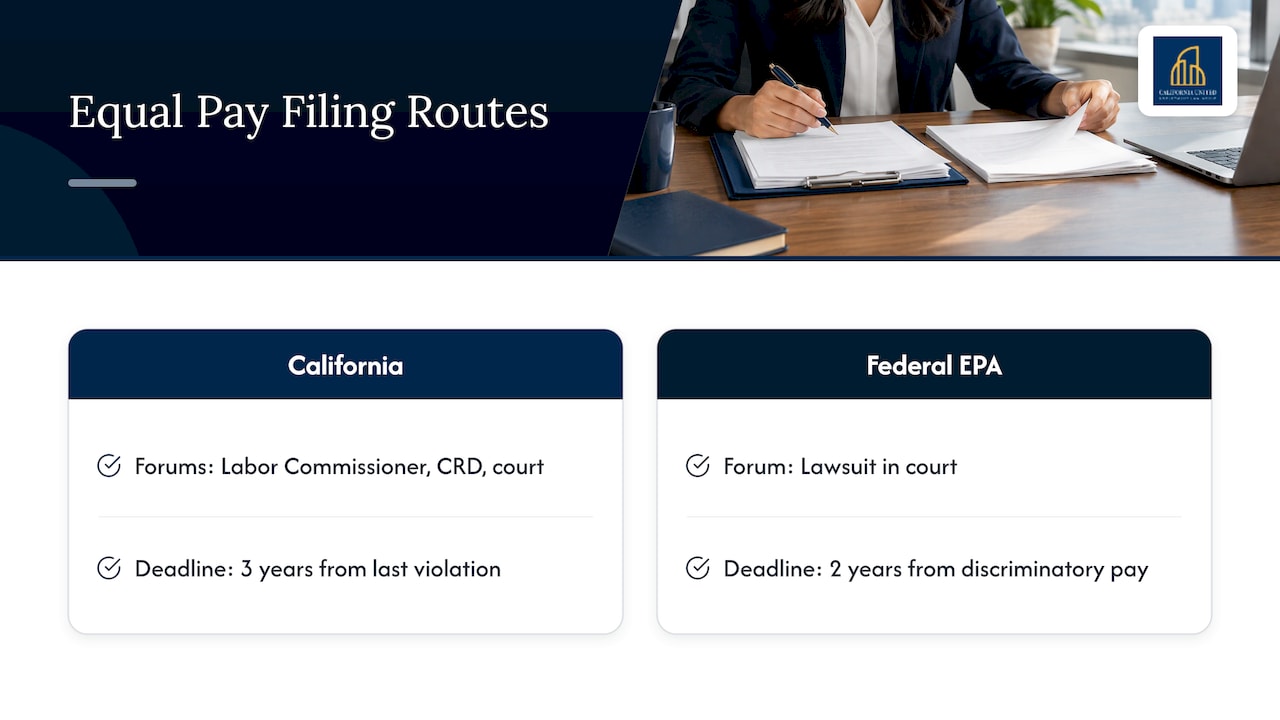
A Santa Monica employee has several forums. California Equal Pay Act claims can be brought with the Labor Commissioner’s Office or directly in court, with no requirement to file with an agency first. A lawsuit generally must be filed within two years of the violation, or three years if the violation was willful. A retaliation complaint with the Labor Commissioner generally must be filed within one year. A FEHA pay claim generally starts with a complaint to the Civil Rights Department. Federal Equal Pay Act claims do not require an EEOC charge and are generally subject to a two-year deadline (three years for willful violations). For Santa Monica employees, a California lawsuit would typically be filed in the Los Angeles County Superior Court.
The forum matters because each has its own procedures and consequences. For some claims, such as FEHA claims, an administrative filing with the CRD is a required step rather than an optional extra, and our attorneys handle administrative complaint filings for employees. For a broader view of how a case moves once it is filed, see our employment lawsuit process overview.
Because deadlines can differ by law and by claim, and because they can run from different events, an employee who suspects a pay gap should not wait to get individualized advice.
What remedies may be available
Under section 1197.5, an employee may recover the unpaid balance of wages, interest, an equal amount as liquidated damages, and costs and reasonable attorney’s fees. A retaliation claim may also seek reinstatement, lost wages and benefits, interest, and equitable relief. A FEHA claim can add compensatory damages, including emotional distress, along with lost wages, interest, and in appropriate cases punitive damages.
What any one employee can recover depends on the facts: the size of the pay gap, how long it lasted, which law applies, and the employer’s explanation. No lawyer can promise a result, and this article does not.
Our perspective
Pay questions usually start quietly. An employee learns what a colleague earns, or notices a pattern in raises, and wonders whether the difference is fair. Our firm practices employment law for employees across California, and we want people to know that the question is a legitimate one to raise.
Our attorneys include lawyers with prior employer-side experience. We believe that background helps us understand how an employer is likely to explain a pay gap, and what documents it may rely on. We focus on California Labor Code and FEHA claims, which govern most equal pay disputes in California.
Every pay case turns on its facts. We evaluate the work you do, the comparison you have in mind, and the reasons the employer gives. We represent employees at every stage, from pre-litigation through litigation, and we also file administrative complaints when that is the right forum.
We handle employment cases on a contingency fee basis, meaning attorney’s fees are paid only if there is a recovery. Whether you are responsible for case costs is explained in our written fee agreement, and we review it with you before you sign.
California United Law Group
When to talk with an employment attorney
Some situations are worth a conversation sooner rather than later. They include a pay gap you cannot explain, a manager who gave a reason that sounds like prior salary, or a negative change at work after you asked about pay. If you believe the issue extends to many employees, it may raise class-wide or representative claims.
👉 If you work in Santa Monica and suspect you are paid less for substantially similar work, you can request a free consultation with California United Law Group. We handle employment law matters for employees, including discrimination, retaliation, and wage disputes. You can contact us to discuss your situation. Contacting us does not create an attorney-client relationship.
FAQ
Does the California Equal Pay Act cover only women?
No. The statute covers pay differences based on sex, race, or ethnicity for substantially similar work. That means men and employees of any race or ethnicity can be protected. Whether a specific pay gap violates the law depends on the facts.
Does my coworker have to have the same job title as mine?
No. The test is whether the work is substantially similar when viewed as a composite of skill, effort, and responsibility under similar working conditions. Titles can be misleading, and the actual duties are what matter.
Can my employer justify lower pay because I earned less at my last job?
No. California law says prior salary cannot, by itself, justify. After those factors must account for the entire difference., add: The employer bears the burden of proving them a disparity in compensation. An employer may still cite seniority, merit, production, or a job-related bona fide factor, and those factors must account for the entire difference.
How long do I have to bring an equal pay claim?
A California Equal Pay Act lawsuit generally must be filed within two years of the violation, or three years if it was willful, and federal Equal Pay Act lawsuits follow the same two- and three-year rule. Retaliation complaints with the Labor Commissioner and FEHA complaints with the CRD have their own deadlines. Because deadlines depend on which law and forum apply, speak with an attorney about your specific dates.
Can I be fired for asking about pay?
California law prohibits retaliation against employees who assert equal pay rights, including by discussing wages. Adverse action within 90 days of exercising those rights creates a rebuttable presumption of retaliation. If you believe you were treated differently after raising pay, an employment attorney can review what happened.
Sources
- California Equal Pay Act (Department of Industrial Relations)
- California Labor Code section 1197.5
- EEOC: Questions and Answers About the Equal Pay Act
- Equal Pay Cases Handout (Department of Industrial Relations)
- Labor Code 1197.5 text (California Commission on the Status of Women and Girls)
- Step by step job evaluation template (CCSWG)