
Yes. If you work in Burbank and your employer took money from your paycheck in a way California law does not allow, you can challenge it. The state’s Division of Labor Standards Enforcement (DLSE) accepts claims for illegal deductions from pay, and you may also sue in court. Which route fits depends on the facts of your situation.
This article is general education, not legal advice. Employment law is fact-specific, and outcomes vary from case to case.
TL;DR
- California limits an employer to a short list of lawful deductions: those required by law, those you authorize in writing within legal limits, and those set by a wage or collective bargaining agreement.
- Charges for things like uniforms, business expenses, bonds and required medical exams are, as a general matter, not lawful deductions.
- You can file a wage claim with the Labor Commissioner’s Office or file a lawsuit to recover wages taken by an illegal deduction.
- The filing window for illegal deductions is generally three years, though related claims can carry different deadlines.
- Burbank employees can talk with an employment attorney about their facts in a free consultation with us.
Table of Contents
- What California law lets an employer deduct
- Deductions California treats as unlawful
- Cash shortages, breakage and damaged equipment
- Business expenses and uniforms
- Why a deduction can matter more than it looks
- Your options if a Burbank employer took an unlawful deduction
- What you may be able to recover
- The deadline for challenging a deduction
- Records that help show what happened
- Burbank workplaces and where deductions tend to appear
- Our perspective
- How we can help Burbank employees
- FAQ
- Sources
What California law lets an employer deduct
California starts from a simple principle: wages belong to the employee. An employer does not get to subtract from them just because it is convenient or because a policy says so.
According to the DLSE’s Deductions From Wages FAQ, citing Labor Code sections 221 and 224, an employer may withhold amounts from your wages only in three situations:
- When the law requires or empowers it. Income tax withholding, Social Security and Medicare contributions, and court-ordered wage garnishments are common examples.
- When you expressly authorize it in writing. This covers things like insurance premiums and benefit plan contributions, or other deductions that do not amount to a rebate of your wages back to the employer.
- When a wage or collective bargaining agreement expressly authorizes it. This applies to health, welfare or pension contributions.
The key word in the second category is expressly. A vague line in a handbook, or an assumption that you went along with it, is a different thing from a clear written authorization for a specific purpose.
Even a lawful garnishment has a protection attached. The same DLSE page notes that an employer may not discharge an employee because a wage garnishment was threatened, or because wages were garnished to pay one judgment.
Deductions California treats as unlawful
The DLSE FAQ lists categories that employers generally cannot take out of your pay, along with the Labor Code sections behind each:
| Type of deduction | Labor Code reference |
|---|---|
| Gratuities (tips) | Section 351 |
| Photographs | Section 401 |
| Bonds | Section 401 |
| Uniforms | Section 2802 and IWC Orders, Section 9 |
| Business expenses | Section 2802 |
| Medical or physical examinations | Section 222.5 |
In practice, here is how that can show up on a Burbank paystub:
- A restaurant or hospitality employer withholding part of tips.
- A required uniform or branded apparel charged back to you.
- A fee for an ID photo, a background check or a required medical exam.
- A “deposit” or bond collected to cover possible losses.
- A line item that reduces pay to cover work supplies, tools or equipment you needed to do the job.
The fact that a deduction appears on your paystub does not make it lawful. A line item is simply a record of what was taken.
Cash shortages, breakage and damaged equipment
These are some of the most common disputes, and they are more nuanced. The DLSE FAQ explains that an employer’s ability to deduct for a cash shortage, breakage or loss of equipment is specifically regulated by the Industrial Welfare Commission Orders and limited by court decisions. It names Kerr’s Catering Service v. Department of Industrial Relations (1962), Barnhill v. Robert Saunders & Co. (1981), CSEA v. State of California (1988) and Hudgins v. Neiman Marcus Group, Inc. (1995).
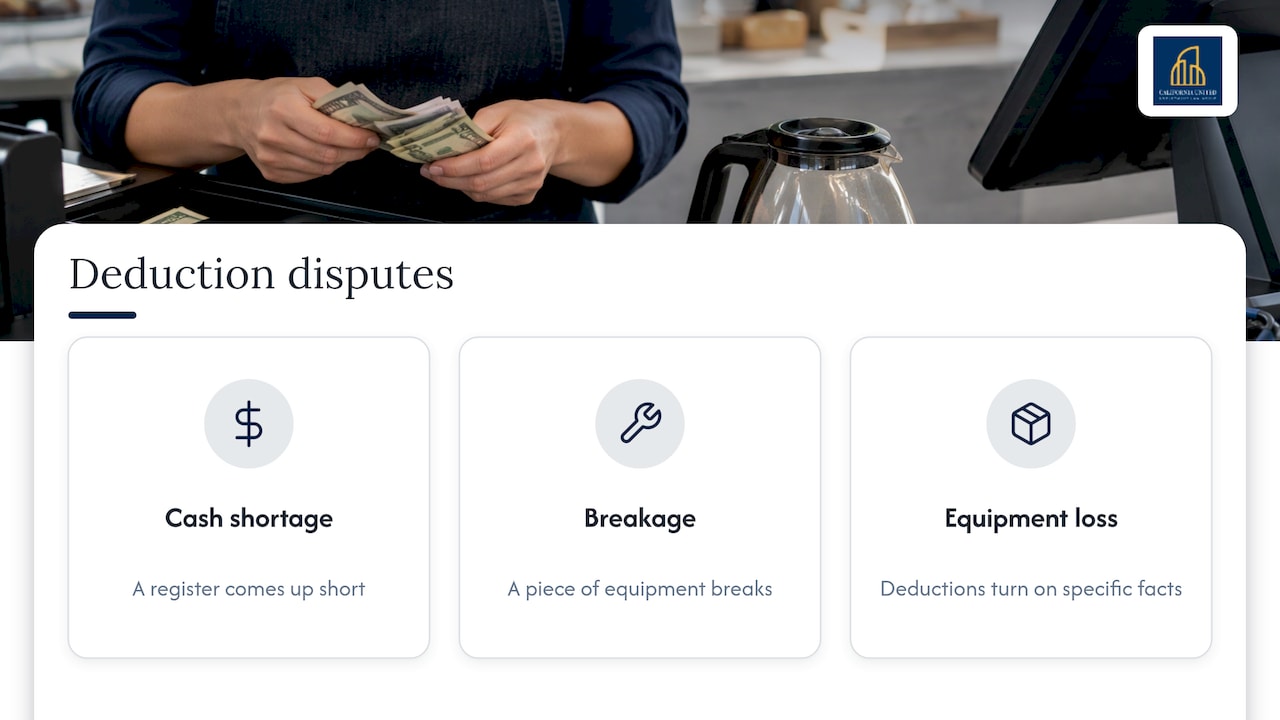
The practical takeaway for a reader is that an employer cannot simply decide you owe for a register that came up short or a piece of equipment that broke and then reduce your check. Whether any such deduction is allowed turns on the specific facts, and those cases set real limits. If this happened to you, a lawyer who handles wage matters can review the details. California courts have taken these limits seriously. In Kerr’s Catering Service v. Department of Industrial Relations (1962) 57 Cal.2d 319, the California Supreme Court held that a lunch truck driver’s commissions could not be reduced to cover cash shortages. The court reasoned that losses from ordinary negligence are inevitable in almost any business and must be borne as expenses of management. The IWC Wage Orders follow the same rule. An employer may not deduct for a cash shortage, breakage or loss of equipment unless it can show the loss was caused by a dishonest or willful act or by the employee’s gross negligence. In Hudgins v. Neiman Marcus Group, Inc. (1995) 34 Cal.App.4th 1109, the Court of Appeal confirmed that Labor Code section 221 has long been held to prohibit deductions for these kinds of losses when they result from simple negligence. In Barnhill v. Robert Saunders & Co. (1981) 125 Cal.App.3d 1, the court held that an employer is not entitled to set off debts an employee owes it against wages due.
Business expenses and uniforms
California is among the stronger states on expense reimbursement. The DLSE states that if an employer requires you to wear a uniform, the employer must pay for it under Labor Code section 2802 and IWC Orders section 9. The same section means you are entitled to be reimbursed for expenses or losses you incur as a direct consequence of doing your job.
The text of Labor Code section 2802 says an employer must indemnify an employee for all necessary expenditures or losses incurred in direct consequence of the discharge of their duties. Several features matter if you have a claim:
- Reimbursement awards carry interest at the same rate as civil judgments, running from the date you incurred the expense.
- “Necessary expenditures or losses” includes reasonable costs, among them attorney’s fees you incur enforcing your rights under that section.
That last point is notable. In an expense reimbursement claim, the law itself contemplates recovery of attorney’s fees. The California Supreme Court has described the purpose of section 2802 as preventing employers from passing their operating expenses on to their employees, in Gattuso v. Harte-Hanks Shoppers, Inc. (2007) 42 Cal.4th 554. Building on that principle, the Court of Appeal held in Cochran v. Schwan’s Home Service, Inc. (2014) 228 Cal.App.4th 1137 that an employer who requires employees to use personal cell phones for work must reimburse a reasonable percentage of the phone bill.
Why a deduction can matter more than it looks
A $15 or $40 deduction may not feel like much on one paycheck. Repeated every pay period, across months or years, it adds up. It can also be applied to many employees at once, which is why unlawful deduction practices sometimes become the basis of group claims.
Some workers also hesitate because they fear retaliation or because they believe they “agreed” to the deduction when they signed paperwork on their first day. Neither concern is a reason to assume you have no options. Whether a signed form is valid authorization depends on what it says and what California law permits. An employee cannot simply waive protections the Labor Code gives them.
If you are worried about speaking up, you may want to read our overview of common Labor Code rights every California employee should know, including the protections against retaliation.
Your options if a Burbank employer took an unlawful deduction
The DLSE states that if an employer makes an illegal deduction, you can either file a wage claim with the Labor Commissioner’s Office or file a lawsuit in court against the employer to recover the lost wages. If you no longer work for the employer and it willfully failed to pay all wages due when your employment ended, you may also be able to claim waiting-time penalties under Labor Code section 203.
These are the two main paths, described in general terms.
The Labor Commissioner (DLSE) wage claim
The DLSE’s How to File a Wage Claim page says California workers have the right to file when employers do not pay wages or benefits owed. Claims can be filed online, by email, by mail or in person. It also states that California’s labor laws protect all workers regardless of immigration status. The Legal Aid at Work guide likewise says undocumented workers have the same right to file for wages.
The DLSE’s published instructions for filing a wage claim describe the paperwork in general terms. It includes Form 1, additional forms when they apply, and one copy of supporting documents if you have them, such as:
- Time records
- Paychecks and pay stubs
- Dishonored checks
- A Notice of Employment Information, if you received one after January 1, 2012
The DLSE’s claim processing policies ask for as much detail as possible about the employer, including its legal name, location and business status, such as sole proprietorship, partnership or corporation. They also say that once a claim is assigned to a deputy, the parties are notified within thirty days of what will happen first: a conference, a hearing or dismissal.
The DLSE’s Recover Your Unpaid Wages brochure outlines what typically follows:
- You and your employer are notified by mail about next steps.
- A settlement conference is scheduled for most claims.
- If the claim does not settle, a hearing is set, where both sides testify under oath.
- After the hearing, an Order, Decision or Award is issued.
- An appeal must be filed within 10 days after service of the decision. If no one appeals, the decision becomes final and enforceable as a court judgment.
The brochure also makes an important point about evidence. You are responsible for proving the employer owes you wages, and the hearing officer will not have the supporting documents you previously gave the Labor Commissioner. You bring all of your evidence to the hearing.
A civil lawsuit
You can also pursue the deduction in court. A lawsuit can involve different procedures, different potential remedies and, in some situations, a broader group of affected employees. Improper wage deductions can also support a claim under California’s Unfair Competition Law, Business and Professions Code section 17200, as recognized in Hudgins v. Neiman Marcus Group, Inc. (1995) 34 Cal.App.4th 1109. Which route is better depends on the amount at stake, the type of violation, whether others were affected and how your employer responded. An attorney can talk through these considerations with you based on your facts.
What you may be able to recover
Remedies depend on the claim, but California law provides several categories that can apply to unlawful deductions:
- The wages that were taken. The core remedy is getting back the money that was deducted.
- Civil penalties. Under Labor Code section 225.5, an employer that unlawfully withholds wages can be subject to civil penalties of $100 per employee for an initial violation and $200 per employee for a subsequent or willful violation, plus 25 percent of the amount unlawfully withheld. The Labor Commissioner enforces these penalties. An affected employee may pursue them only through a Private Attorneys General Act (PAGA) action, after first giving notice to the employer and the Labor and Workforce Development Agency. Most of any PAGA penalty recovered goes to the state.
- Waiting-time penalties. If you have left the job, section 203 may apply, as the DLSE notes.
- Expense reimbursement with interest and fees. As described above, section 2802 provides for reimbursement, interest and reasonable attorney’s fees incurred in enforcing that section.
The Labor Commissioner’s process is not limited to pure deduction claims. According to the Legal Aid at Work guide, the office accepts claims for minimum wage, overtime, commissions, deductions from pay, reimbursement of expenses, bonuses, vacation pay, waiting-time penalties and missed meal or rest period pay, among others. If your deduction is one of several problems on your paycheck, it may be worth reviewing all of them together.
No outcome is guaranteed. What you can actually recover depends on the evidence, the legal theory and how the employer responds.
The deadline for challenging a deduction
Time limits matter. The DLSE says the filing deadline for illegal deductions from pay is within three years. Its brochure repeats that claims for minimum wage, overtime, illegal deductions or unpaid reimbursements must be filed within three years. The Legal Aid at Work guide adds that for illegal deductions the claim can reach back up to three years from the date you file with the Labor Commissioner or court.
In simple terms, each unlawful deduction starts its own clock, and older deductions can age out while newer ones remain recoverable. If your employer has been taking money for a long time, waiting can mean losing part of what could otherwise be claimed. Other types of claims have different deadlines, so it is worth getting a read on all of them early. Our article on deadlines to recover unpaid wages in California covers the timing questions in more detail.
Records that help show what happened
Whatever route you take, documents usually carry a lot of weight. Many Burbank employees find it useful to keep:
- Every paystub and wage statement, in paper or digital form
- Offer letters, handbooks and anything you signed about deductions or pay
- Texts and emails about charges, shortages or equipment
- Your own notes on dates, amounts and who said what
- Bank records showing what was actually deposited
Paystubs are especially useful because California requires them to be itemized. If yours is missing information or never arrives, that can be its own issue. See our pieces on challenging paystub violations under Labor Code section 226 and the two key tests for a section 226 claim.
Burbank workplaces and where deductions tend to appear
Burbank is home to a wide mix of employers, from studios and media production support to healthcare, hospitality, retail, logistics and small businesses. Deduction problems are not tied to one industry, but some patterns come up often:
- Hospitality and food service: tip handling, till shortages, breakage charges and uniform costs.
- Retail and warehouse work: shortage or loss charges, required gear and equipment fees.
- Healthcare and caregiving: required exams, scrubs or supplies charged back to staff.
- Production and creative support: work-related costs, equipment and mileage that are used on the job but not reimbursed.
- Delivery and driving roles: vehicle, fuel and phone expenses that may fall under reimbursement rules.
A Burbank employee in any of these settings is covered by California’s Labor Code in the same way, and the state-level rules above apply no matter how big or small the employer is. Some rules apply differently to public employers, such as the City of Burbank or a local school district, and to workers covered by a collective bargaining agreement.
Our perspective
We handle employment matters for California employees, including wage and hour violations, and we focus on the California Labor Code and FEHA. Unlawful deductions are one of the most overlooked wage problems because they often look routine on a paystub.
Several of our attorneys have prior experience on the employer side. We think that helps us read how a payroll practice was built, and how an employer is likely to defend it.
We work on a contingency fee basis. Under our written fee agreement, clients do not pay attorney’s fees or case costs unless we obtain a recovery through a settlement or judgment. Your first conversation with us is a free consultation, and it is a chance to ask questions about your own facts.
We do not promise outcomes. Every case depends on its documents and circumstances. What we can do is explain which of your options fit your situation, at whatever stage you are in.
California United Law Group
How we can help Burbank employees
If you think money was unlawfully taken from your pay, we can review your situation. Our wage and hour practice represents employees in claims involving unpaid overtime, deductions and other wage violations, from pre-litigation through litigation. Where the problem affects many coworkers, we also handle class and representative actions.
👉 Contact us for a free consultation to talk through your paystubs and your options.
We also represent employees in related matters, such as retaliation after raising a pay concern, through our employment law practice. If you have already left the job, our guide to California employee termination rights may also be relevant.
FAQ
Can my employer deduct money from my paycheck if I signed a form?
Sometimes, but only within limits. California allows deductions you expressly authorize in writing for things like insurance premiums and benefit contributions, but not deductions that amount to a rebate of your wages, that shift ordinary business losses or expenses onto you, or that fall into prohibited categories. A signature does not automatically make a deduction lawful, and the details of the form matter.
Can my employer make me pay for my uniform or work expenses?
Generally, no. The DLSE states that an employer who requires a uniform must pay for it, and Labor Code section 2802 requires reimbursement of necessary expenses you incur doing your job. If you were charged or never reimbursed, you may have a claim.
How long do I have to challenge an unlawful deduction?
The DLSE gives a filing deadline of three years for illegal deductions from pay. Because each deduction has its own timeline, older ones can fall outside the window. Other claims you may have can carry different deadlines, so it helps to review your situation soon.
Do I have to be a current employee to file a claim?
No. The DLSE notes that if you no longer work for the employer, you can still make a claim, 1. including for waiting-time penalties under section 203 when final wages were willfully not paid on time. Workers are also entitled to file regardless of immigration status.
Should I file with the Labor Commissioner or go to court?
Both are options the DLSE identifies. The right path depends on the amount, the type of violation, whether coworkers were affected and other facts. A consultation with an employment attorney can help you understand how each option may apply to you.
Sources
- California DIR DLSE: Deductions From Wages FAQ
- California DIR DLSE: How to File a Wage Claim
- California DIR DLSE: Instructions for Filing a Wage Claim
- California DIR DLSE: Recover Your Unpaid Wages brochure
- California DIR DLSE: Policies and Procedures for Wage Claim Processing
- Legal Aid at Work: How to Represent Yourself Before the California Labor Commissioner
- California Labor Code section 225.5
- California Labor Code section 2802 (SB 1305)