
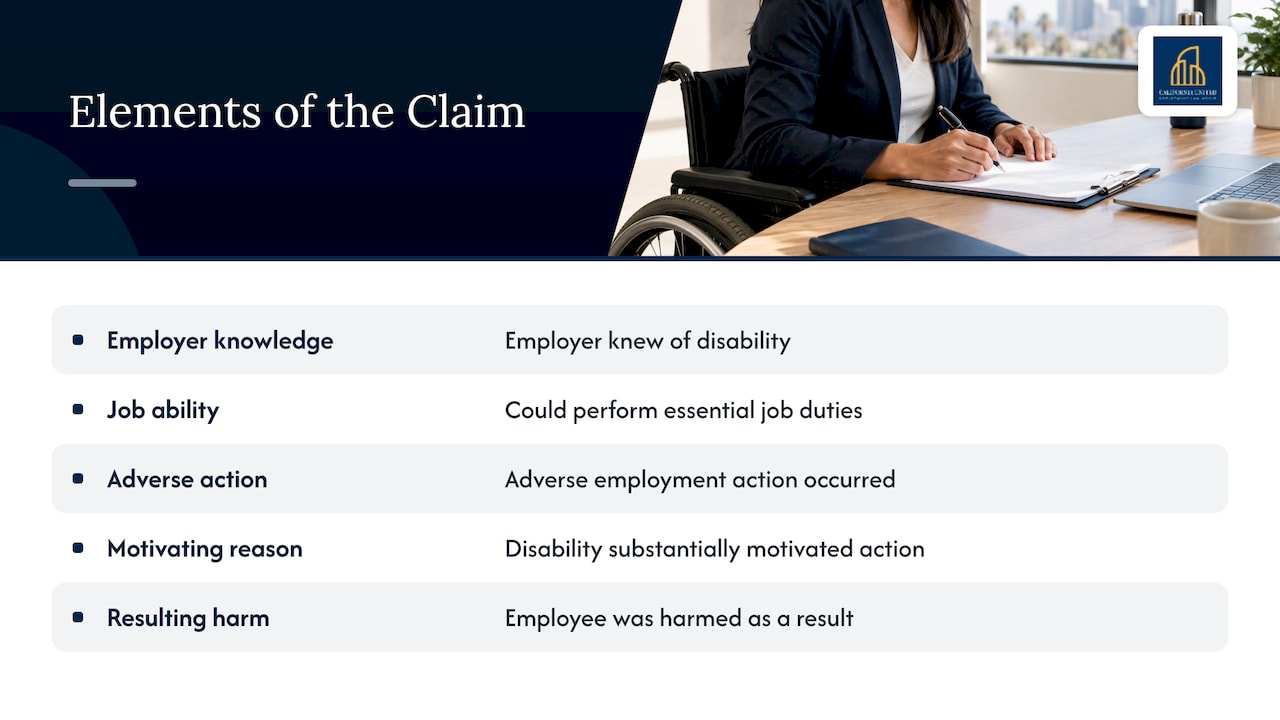
If you work in Torrance and believe your employer treated you badly because of a disability, the claim usually rests on several elements: your employer was covered by FEHA, you had a disability the employer knew about, you could do the essential parts of the job (with or without accommodation), you suffered an adverse action, the disability was a substantial motivating reason for it, and you were harmed as a result.
This article is for general educational purposes only and is not legal advice. Employment law issues are fact-specific, and outcomes vary.
TL;DR
- California’s Fair Employment and Housing Act (FEHA) puts the burden on the employee to show they could do the job, with or without reasonable accommodation, and that the adverse action happened because of the disability.
- Useful evidence tends to fall into groups: proof of the disability and employer knowledge, accommodation requests and replies, the adverse action itself, timing, and how coworkers were treated.
- An employer’s stated reason can be challenged with evidence that it is inconsistent, has no factual basis, or is contradicted by the employer’s own documents.
- In California employment cases, a complaint generally must be filed with the Civil Rights Department (CRD) within three years of the last harm, with limited exceptions. A lawsuit generally must then be filed within one year after CRD issues a Right-to-Sue notice.
- Torrance employees can talk with an employment attorney about how these principles apply to their specific facts.
Table of Contents
- What the law asks you to show
- Types of evidence that may be relevant
- Timing, comparisons and witnesses
- Keeping a record as events unfold
- When the employer gives a different reason
- Where to file and how long you have
- Our perspective
- Talk with an employment attorney
- FAQ
- Sources
What the law asks you to show
FEHA is the main California statute covering disability discrimination at work. Proof is built around a set of elements rather than a single “smoking gun.”
In Green v. State of California (2007), the California Supreme Court held that the employee bears the burden of proving he or she was able to do the job, with or without reasonable accommodation, and that the adverse employment action occurred because of the disability. An earlier Court of Appeal decision in the same case describes the basic framework: the employee shows a disability or medical condition and an adverse decision made because of it, and the burden then shifts to the employer to offer a legitimate, nondiscriminatory reason. If the employer makes that showing, the burden shifts back to the employee to produce substantial evidence that the employer’s reason was untrue or pretextual, or that the employer acted with discriminatory animus (Furtado v. State Personnel Bd. (2013) 212 Cal.App.4th 729).
California’s jury instructions follow the same logic. CACI No. 2540 lists the factual elements: the defendant was an employer (or other covered entity), the plaintiff was its employee or applicant, the employer knew of the disability, the employee could perform the essential job duties with or without reasonable accommodation, an adverse employment action occurred, the disability was a substantial motivating reason for the decision, the employee was harmed, and the employer’s conduct was a substantial factor in causing that harm.
The California Supreme Court in Harris v. City of Santa Monica (2013) 56 Cal.4th 203 held that “substantial motivating reason” is the right standard under FEHA, because an employer’s decision can have both discriminatory and nondiscriminatory motives. Under CACI No. 2507, a substantial motivating reason is one that actually contributed to the decision. It must be more than remote or trivial, but it does not have to be the only reason.
Why “essential functions” matter
The ability to perform essential job functions is a threshold issue. In Miller v. Department of Corrections and Rehabilitation (2024), the court stated that an employee must produce evidence addressing that ability.
The California Department of Justice explains in its Disability Rights in Employment guide that an employer may decline to employ someone who cannot perform the essential functions even with reasonable accommodation, and that removing an essential function is not a reasonable accommodation. So evidence of what the job really requires, and how you did it, is central.
Discrimination and failure to accommodate are separate claims
A disparate-treatment claim asks whether you were treated worse because of a disability. A failure-to-accommodate claim asks whether the employer failed to provide reasonable accommodation once it knew of your needs. CACI No. 2541 sets out separate elements for the second type: a covered employer, an employment or applicant relationship, a disability (or being treated as having one), employer knowledge, ability to perform the essential duties of the current position or a vacant alternative position with reasonable accommodation, failure to provide reasonable accommodation, harm, and that the failure was a substantial factor in causing the harm.
The DOJ guide notes that FEHA imposes an affirmative duty on employers who know of a disability to make reasonable accommodation, and that this duty is broader than under the federal ADA. California courts have said the same, including in Bagatti v. Department of Rehabilitation (2002) 97 Cal.App.4th 344. FEHA also generally applies to employers with five or more employees, while the ADA applies only to employers with 15 or more. If you want to understand which employers are covered, our page on Torrance employer accommodation duties under FEHA explains the coverage question in more detail.
Types of evidence that may be relevant
No single document is required. Courts and agencies look at the whole picture. The categories below are the ones most often discussed by California agencies and disability rights organizations.
Proof of the disability and your employer’s knowledge
Your employer generally must know about the condition, or about the limitations that come with it, before it can be said to have acted because of it. California courts treat a disability as “known” when it is obvious, when the employee told the employer about it, or when the employer perceives (correctly or not) that the employee has a disabling condition (Gelfo v. Lockheed Martin Corp. (2006) 140 Cal.App.4th 34). Evidence may include:
- Emails, texts or messages where you told a supervisor or HR about your condition
- Medical notes or work-status forms you gave the employer
- Leave requests that mention a medical reason
- Notes of verbal conversations, written down soon afterward
The California Civil Rights Department’s Disability Accommodations at Work guide (July 2026) states that employers cannot require a request to be in writing or to use specific words. That means a casual spoken request can still count, but a written trail is much easier to show later.
Evidence about your ability to do the job
Because you carry the burden on this point, evidence of how well you performed matters:
- Job descriptions and postings
- Performance reviews, praise, awards or raises
- Records of the tasks you handled before and after the condition arose
- Statements from coworkers or supervisors about your work
The DOJ guide explains that the accommodation process involves an individualized look at the job and the person’s disability-related limitations, and that reasonable medical documentation may be requested when the need is not obvious. Records of that exchange can show what the employer understood about your abilities.
Accommodation requests and the employer’s responses
For accommodation claims, the paper trail often is the case. Helpful items include:
- Each request, with its date and the person you made it to
- Any reply, delay, denial or silence
- Meeting invitations, notes and emails about the interactive process
- Medical documentation you submitted and any follow-up requests
The CRD guide says there is no limit on when a person may request an accommodation or on how many they may request, and that everyone involved must take part in the interactive process in good faith without delaying it. California courts have held that once the interactive process starts, the employer has a continuing obligation to take part in good faith, and responsibility for a breakdown falls on the party who failed to participate in good faith (Swanson v. Morongo Unified School Dist. (2014) 232 Cal.App.4th 954). Failure to engage in the interactive process is also a separate FEHA violation, apart from failure to provide a reasonable accommodation (Wysinger v. Automobile Club of Southern California (2007) 157 Cal.App.4th 413). In Nigro v. Sears, Roebuck & Co. (9th Cir. 2015), a federal case applying California law, the Ninth Circuit held that requests and a phone call put the employer on notice, so a reasonable jury could find the employer had a duty to engage in the interactive process under FEHA and failed to do so.
The adverse action itself
An adverse action can include a termination, demotion, discipline, reduced hours, a lost promotion, a forced transfer, or a pattern of conduct that, taken as a whole, materially and adversely affects the terms or conditions of employment. Minor or trivial actions that only anger or upset an employee generally do not qualify. A constructive discharge, where intolerable conditions force an employee to resign, can also count. Disability Rights Ohio’s guide to evidence in employment complaints suggests keeping termination letters, write-ups, discipline notices, relevant policies and your own notes of what happened, when, and who was involved. Although that organization is based in another state, the types of records it describes are the same documents that matter in a California workplace.
Timing, comparisons and witnesses
Three kinds of evidence often help connect the adverse action to the disability.
Timing
In Anderson v. KAR Global (8th Cir. 2023), a federal appeals court found that a ten-day gap between a decisionmaker learning of an employee’s disability and accommodation request and the decision to identify that employee for termination supported causation at the initial stage. The court also looked at a changed attitude and at performance criticism that appeared only after the disclosure. That is an out-of-state federal case, but it illustrates a general point: timing is usually one piece of a larger pattern, not the whole claim.
Comparisons with coworkers
Disability Rights Ohio notes that information about other employees in the same type of job who were treated differently may help. If coworkers without disabilities had similar attendance or performance issues and were not disciplined, that contrast can matter.
Witnesses
People who saw or heard what happened can provide statements. Keep their names and contact information. Coworkers who heard a supervisor’s comments about your condition, or who watched how your accommodation request was handled, are often the most useful.
Keeping a record as events unfold
A contemporaneous chronology is widely recommended. Disability Rights Arizona describes recording dates, times, locations, participants, exact words where remembered, witnesses, documents, complaints, accommodation requests and later discipline. It also suggests keeping copies of emails, notes, policies, evaluations and reports, and putting important verbal conversations into writing.
A short table shows how different kinds of records tend to map to the elements of a claim:
| Element | Examples of records that may relate to it |
|---|---|
| Disability and employer knowledge | Medical notes, messages to HR, leave paperwork |
| Ability to do the job | Job description, reviews, praise, work samples |
| Accommodation request | Emails, meeting notes, replies or lack of replies |
| Adverse action | Termination letter, write-ups, schedule changes |
| Causation | Timing, comments, inconsistent explanations |
| Comparison | How coworkers in similar roles were treated |
Be careful about how you gather records. Keep personal copies of documents that belong to you or that you were lawfully given, and avoid taking confidential company materials without first asking an attorney what is appropriate.
When the employer gives a different reason
Most employers say the decision was about performance, attendance, restructuring or policy. The question then becomes whether that reason is believable. California courts have also recognized that disability cases sometimes involve direct evidence that the employee’s condition played a role in the decision. In those cases, the dispute often centers on whether the employee could perform essential functions with reasonable accommodation, not on the employer’s stated reason (Wallace v. County of Stanislaus (2016) 245 Cal.App.4th 109).
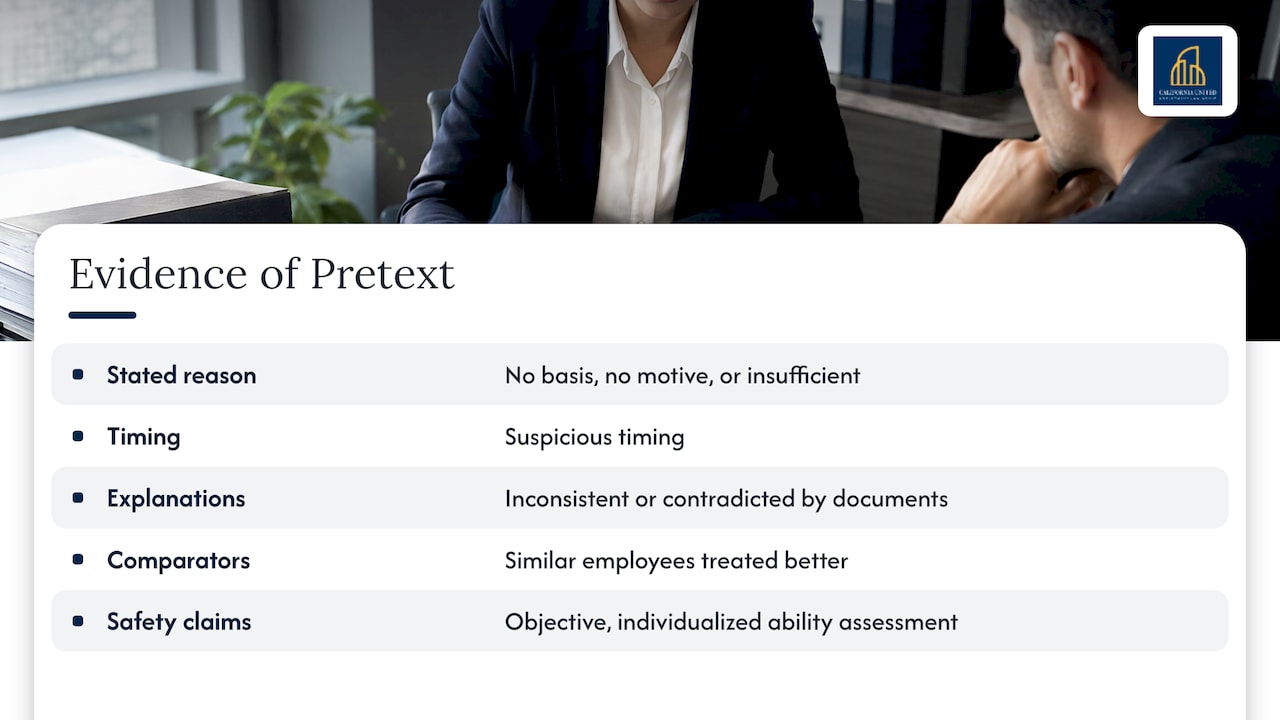
An EEOC litigation brief in the Verizon case describes several ways an employee can show that a stated reason is a pretext. These include showing that the reason has no basis in fact, did not actually motivate the decision, or was not enough to justify it. Other evidence it discusses includes suspicious timing, inconsistent explanations, better treatment of similar employees without disabilities, and internal documents that contradict the stated reason, such as a termination form citing a different reason. The brief also explains that a factfinder may treat dishonesty about a material fact as evidence against the party who was dishonest.
Safety is another common explanation. According to an EEOC informal discussion letter, a decision based on a claimed safety risk must rest on objective evidence and an individualized assessment of the employee’s present ability to perform essential functions, not on stereotypes or irrational fears. Under California law, a health or safety defense is an affirmative defense that the employer must prove.
In federal court, the Ninth Circuit noted in Nigro that it should not take much for a discrimination plaintiff to overcome a motion for summary judgment, because the ultimate question is best resolved by a factfinder on a full record. Every case turns on its own facts, however, and this observation is not a prediction about any particular outcome.
Where to file and how long you have
In California employment cases, the process generally runs through the Civil Rights Department. According to the CRD’s Complaint Process page, you must submit an intake form within three years of the date you were last harmed, and in employment cases you must obtain a Right-to-Sue notice from CRD before filing your own lawsuit in court. Some exceptions to the three-year deadline apply, and a complainant can also ask CRD for an immediate Right-to-Sue notice. After the notice issues, a FEHA lawsuit generally must be filed within one year of the date of the notice. That date is when CRD issues the notice, not when you receive it.
CRD’s Employment Discrimination Based on Disability guide adds that if CRD finds enough evidence and settlement efforts fail, it may file a lawsuit on the complainant’s behalf after mandatory dispute resolution. It lists possible remedies including damages for emotional distress, reinstatement or hiring, back pay or promotion, changes in employer policies, punitive damages, and reasonable attorney’s fees and costs. Whether any remedy is available depends on the facts, the claims proven, and the outcome of the case. Some remedies, such as punitive damages, require additional proof.
To see how a case moves after the administrative stage, read our overview of the employment lawsuit process in California.
Our perspective
Employees in Torrance often come to us believing they have “no proof” because nobody said anything openly discriminatory. In our experience, many disability claims do not depend on openly discriminatory statements. Disability cases are usually built from ordinary workplace records: an accommodation email that went unanswered, a review that was glowing until a medical leave, a termination notice that gives one reason while an internal form gives another.
We practice employment law for employees across California, with a focus on FEHA and the Labor Code. Our attorneys include lawyers with prior employer-side experience, which helps us understand how an employer is likely to explain its decisions and what records it keeps. We believe a careful, early look at your documents and timeline gives you the clearest picture of where you stand.
We also believe you should not have to carry the cost of that evaluation up front. We offer free consultations and case evaluations. Our representation is on a contingency basis, which means our attorney’s fees are paid only from a settlement or award. If there is no recovery, you will not owe us attorney’s fees or case costs. The terms are set out in a written fee agreement. Every matter is different, and we cannot guarantee or predict any result, but we can tell you honestly how the law applies to what happened to you.
California United Law Group
Talk with an employment attorney
We represent California employees in disability discrimination, failure-to-accommodate, retaliation and wrongful termination matters, from pre-litigation through litigation. If you work in Torrance and want to understand whether your records and timeline fit the elements described above, we are glad to review them with you. Reviewing your situation does not by itself create an attorney-client relationship.
👉 Learn about our employment law services
👉 Contact us for a free consultation
FAQ
Do I need a written accommodation request to prove my claim?
No. The California Civil Rights Department states that employers cannot require requests to be in writing or to use specific words. Even so, a written record such as an email or a follow-up note makes it easier to show later what was asked and when.
Is timing alone enough to prove disability discrimination?
Timing can support a link between your disability or accommodation request and an adverse action, but it is usually treated as one part of a larger pattern. Other evidence, such as inconsistent explanations, sudden criticism after years of good reviews, or different treatment of coworkers, is often considered alongside it.
What if my employer says I could not do the essential functions of the job?
Under FEHA, you carry the burden of showing you could perform the essential functions with or without reasonable accommodation. Job descriptions, performance reviews and records of the work you actually did can address this point. An attorney can help you assess how those records fit your situation.
How long do I have to file a disability discrimination complaint in California?
For employment cases, the CRD says you generally must submit an intake form within three years of the date you were last harmed, with limited exceptions. You must also obtain a Right-to-Sue notice from CRD before filing your own lawsuit, and the lawsuit generally must be filed within one year of the date of that notice. Because deadlines depend on the facts, consider speaking with an attorney promptly.
Does it cost anything to talk to a lawyer about my situation?
We offer free consultations and case evaluations. Our representation is on a contingency basis, which means our attorney’s fees are paid only from a settlement or award. If there is no recovery, you will not owe us attorney’s fees or case costs. The terms are set out in a written fee agreement.
Sources
- Green v. State of California (2007), California Supreme Court
- Green v. State (2005), California Court of Appeal
- CACI No. 2540, Disability Discrimination: Disparate Treatment
- CACI No. 2541, Disability Discrimination: Reasonable Accommodation
- Miller v. Department of Corrections and Rehabilitation (2024)
- California DOJ, Disability Rights in Employment
- California Civil Rights Department, Disability Accommodations at Work
- Nigro v. Sears, Ninth Circuit (2015)
- Anderson v. KAR Global, Eighth Circuit (2023)
- Disability Rights Ohio, evidence in an employment complaint
- Disability Rights Arizona, Documenting Discrimination in Employment
- EEOC litigation brief, Verizon
- EEOC informal discussion letter on safety risk
- California Civil Rights Department, Complaint Process
- California Civil Rights Department, Employment Discrimination Based on Disability