
If you work in Glendale and you are dealing with sexual harassment, California law gives you several options. You can report the conduct to your employer, file a complaint with the California Civil Rights Department (CRD) or the federal EEOC, and, after a right-to-sue notice, bring a lawsuit in court. You do not need a lawyer to file with either agency, but many employees want one to explain the choices. This article is general education, not legal advice, and every situation depends on its own facts.
We wrote it for Glendale employees who want to understand where they stand before they decide anything. It covers what the law counts as sexual harassment, what your employer must do when you speak up, what records can matter, how agency complaints work and what the deadlines look like.
TL;DR
- California treats sexual harassment as a form of sex discrimination under the Fair Employment and Housing Act (FEHA). It covers unwelcome sexual conduct and sex-based conduct that creates a hostile or offensive workplace.
- Employers must have a complaint process and must investigate reports that, if true, would violate policy or the law. Retaliation for complaining is also unlawful. After the CRD issues a right-to-sue notice, you generally have one year from the date of that notice to file a lawsuit.
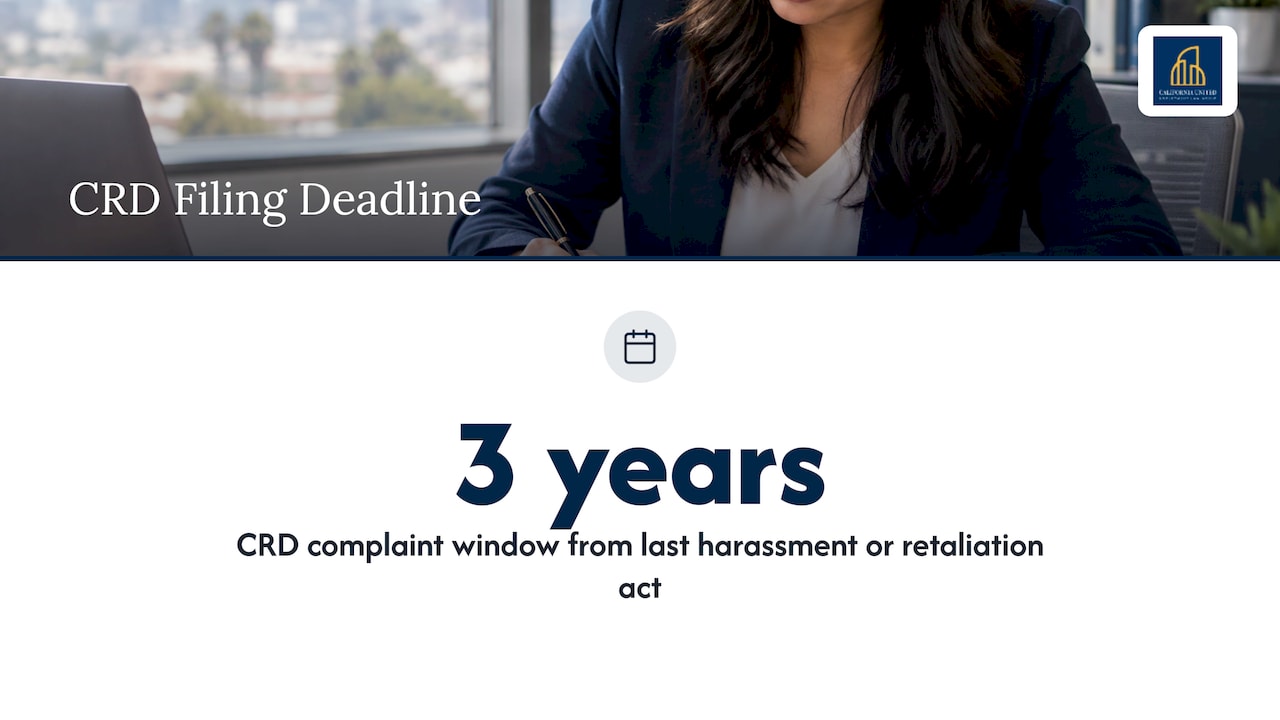
- You may file with the CRD within three years of the last act of harassment or retaliation. A complaint filed with the CRD or EEOC is cross-filed with the other agency.
- Keeping dated records of what happened is the approach the California Attorney General recommends.
- Outcomes depend on the facts. A free consultation with an employment attorney can help you understand your situation.
Table of Contents
- What counts as sexual harassment under California law
- What your employer is required to do
- Your reporting options in Glendale
- Which option fits which situation
- Deadlines that matter
- Records that can support a complaint
- Retaliation and wrongful termination after you speak up
- What remedies may be available
- Our perspective
- Talking with an employment attorney
- FAQ
- Sources
What counts as sexual harassment under California law
The California Attorney General explains that workplace sexual harassment is a form of sex discrimination. It violates both Title VII and FEHA. The conduct can be unwelcome sexual advances, or visual, verbal or physical conduct of a sexual nature. It can also be conduct that creates an intimidating, hostile or offensive work environment because of sex.
Two points often surprise people:
- The conduct does not have to be motivated by sexual desire. California courts have held that a plaintiff must show the conduct happened because of sex, but need not show sexual desire (Pantoja v. Anton (2011) 198 Cal.App.4th 87, 114).
- It can be based on actual or perceived sex or gender identity, sexual orientation, pregnancy, childbirth or related medical conditions.
Two recognized types
The CRD’s sexual harassment fact sheet describes two types:
- Quid pro quo harassment. A job, promotion or other work benefit is conditioned on submitting to sexual advances.
- Hostile work environment harassment. Unwelcome sex-based conduct unreasonably interferes with work performance or creates an intimidating, hostile or offensive environment.
For a hostile work environment, the conduct must generally be severe or pervasive. The CRD notes that a single act can be severe enough to be unlawful. California courts look at all the circumstances, including how often the conduct happened, how severe it was, whether it was physically threatening or humiliating, and whether it unreasonably interfered with work (Miller v. Dept. of Corrections (2005) 36 Cal.4th 446, 462). California law also provides that a single incident of harassing conduct can be enough to create a triable issue about whether a hostile work environment existed (Gov. Code, § 12923). Whether a particular situation meets that standard is a fact-specific question. Our guide on what counts as workplace harassment in California goes deeper into examples.
Who is covered
The protections reach beyond full-time staff. The CRD fact sheet states that all employers, regardless of how many employees they have, are covered by California’s harassment provisions. Employers are generally strictly liable for harassment by a supervisor acting in a supervisory capacity (State Dept. of Health Services v. Superior Court (2003) 31 Cal.4th 1026, 1040-1041). For harassment by a coworker, the employer is liable if it knew or should have known of the conduct and failed to take immediate and appropriate corrective action. Harassers, whether supervisors or coworkers, may also be held personally liable for harassment or for aiding and abetting it. Harassment and discrimination are separate claims under FEHA, and the California Supreme Court has recognized that an employee can have both claims in the same case (Roby v. McKesson Corp. (2009) 47 Cal.4th 686, 707).
Harassment by a non-employee, such as a client or customer, can also create employer liability. In that situation the employer is liable only if it knew or should have known of the conduct and failed to take immediate and appropriate corrective action.
What your employer is required to do
California does not leave the process entirely up to your employer’s discretion. Under California Code of Regulations, Title 2, Section 11023, employers must develop and distribute a harassment, discrimination and retaliation prevention policy. That policy must set up a complaint process that provides:
- confidentiality to the extent possible
- a timely response
- impartial and timely investigations by qualified personnel
- documentation and tracking for reasonable progress
- appropriate options for remedial action and resolution
- timely closure
The CRD’s Harassment Prevention Guide adds detail. If a report alleges conduct that, if true, would violate company policy or the law, the employer must investigate to determine what happened and should act on the investigator’s findings. Employers should take reasonable steps to prevent and correct unlawful behavior, and any remedial action should be proportionate to the misconduct.
The same guide describes what a fair investigation looks like in practice. The employer should conduct a thorough interview with the person who complained, give the accused person a chance to respond, interview relevant witnesses and review relevant documents. It may also need to look at emails, chats and text messages.
That gives you a useful reference point. If you report harassment in Glendale and nothing seems to happen, or the process looks very different from what the regulation describes, that is information worth discussing with an employment attorney.
Your reporting options in Glendale
There is no single required path. Employees commonly use one or more of these routes.
Reporting within the company
The Attorney General advises employees to read and follow any company sexual harassment policy, put complaints in writing and inform the employer under that policy. A written report creates a clear record that the employer was on notice. This matters because employer responsibility often turns on what the employer knew and what it did next.
The policy itself is worth reading closely. It should identify who receives complaints, and it is the document your employer is expected to follow.
Filing with the Civil Rights Department
The CRD is the state agency charged with protecting Californians from unlawful employment discrimination. According to the Attorney General, you can file a complaint with the CRD online, by mail or over the phone, and the CRD can pursue damages on your behalf if a violation occurred.
The CRD describes itself as a neutral fact-finder that attempts to help the parties resolve disputes voluntarily. When it decides to sue, it files a civil lawsuit in its own name against the employer. According to its FAQ, the complainant receives 100% of any remedies recovered except attorney fees and costs, and the CRD does not charge complainants attorney fees or take a percentage of an award or settlement.
Filing with the EEOC
Complaints filed with the CRD or the EEOC are generally cross-filed with the other agency, so in many cases you only need to submit one. Federal EEOC charges usually have a shorter filing deadline than the CRD’s three-year window, and an EEOC right-to-sue notice does not by itself allow a lawsuit under California’s FEHA. The Attorney General also confirms that you do not need a lawyer to file with either agency.
Going to court
The CRD’s employment page explains that you must file a complaint with the CRD even if you want to bring your case directly in court. If you want to go to court, you can request an immediate right-to-sue notice. Once a complaint is filed and the notice is issued, you can pursue a private lawsuit in civil court. For an overview of how those cases generally move, see our employment lawsuit process overview.

Which option fits which situation
The table below summarizes how the routes differ in general terms. It is a map of the options, not a recommendation for any individual.
| Route | Who handles it | Lawyer required? | What it can lead to |
|---|---|---|---|
| Internal report | Your employer, under its written policy | No | An investigation and corrective action by the employer |
| CRD complaint | California Civil Rights Department | No | Investigation, voluntary resolution, a CRD lawsuit or a right-to-sue notice |
| EEOC charge | Federal agency, cross-filed with the CRD | No | Agency review and resolution efforts |
| Civil lawsuit | A court | Not required, but commonly used | Remedies decided by settlement, verdict or award |
These routes are not mutually exclusive. An employee may report internally and also file with an agency. An attorney can explain how the timing of each step may affect the others in your particular case.
Deadlines that matter
The CRD states that a complaint must be filed within three years from the date the alleged discriminatory act occurred. For sexual harassment and related retaliation, the sexual harassment fact sheet says employees or applicants may file within three years of the last act of harassment or retaliation.
The CRD’s retaliation fact sheet adds that you cannot file an employment discrimination lawsuit in court without first receiving a right-to-sue from the CRD. Once the CRD issues a right-to-sue notice, a FEHA lawsuit generally must be filed within one year from the date of that notice. If you request an immediate right-to-sue notice, that one-year clock starts right away.
Three years is a long window, but memories fade, coworkers move on and messages get deleted. Many employees find it easier to talk through their situation early. If your case involves retaliation, our page on Glendale retaliation rights and the three-year CRD deadline explains more.
Records that can support a complaint
The Attorney General’s guidance is to keep records of each incident, noting the date, time and people involved. That simple habit is the foundation of most harassment documentation.
Types of information employees often keep include:
- a dated personal log of incidents, written close to when they happened
- the names of coworkers or others who saw or heard what occurred
- messages, emails or other communications you received
- a copy of your employer’s harassment policy and any written complaint you submitted
- any responses from HR or management
- performance reviews, schedule changes or pay records, if your treatment shifted after you rejected advances or complained
Two cautions apply. First, be careful about what you take from your employer’s systems. Confidential company documents can raise separate issues, so ask an attorney before copying anything beyond your own messages and records. Second, keep your records somewhere private, not on a work computer or work account.
For a deeper look at how harassment is established, read our legal guide on how to prove workplace harassment in California.
Retaliation and wrongful termination after you speak up
Many employees worry that reporting will cost them their job or their hours. California law addresses that fear directly. The CRD fact sheet states that actual or threatened retaliation for rejecting advances or for complaining about harassment is unlawful.
The retaliation fact sheet explains that protected activity includes speaking out against harassment, discrimination or another practice you reasonably believe is illegal. The CRD may investigate a complaint or issue a right-to-sue notice so you can pursue the case in civil court.
Retaliation can look like:
- termination or a forced resignation
- demotion or a loss of hours
- an undeserved negative review
- being moved to a less favorable schedule or location
- threats connected to your complaint
When harassment, retaliation and a job loss are linked, the situation may involve several claims at once, including gender discrimination and wrongful termination. Employees who report other misconduct at work may also have additional protections. Our pages on whistleblower claims for Glendale employees explain how those claims work.
What remedies may be available
The CRD’s employment page lists remedies that can be available in employment discrimination matters. They include:
- back pay (past lost earnings)
- front pay (future lost earnings)
- hiring, reinstatement or promotion
- out-of-pocket expenses
- damages for emotional distress
- punitive damages
- changes to employer policies and training
- attorney’s fees and costs
Not every remedy applies in every case, and no outcome can be promised. For example, punitive damages are generally not available against public employers, which matters for employees of the City of Glendale or other public agencies. What an employee can recover depends on the facts, the evidence and the forum.
Our perspective
Employees in Glendale often come to us after weeks or months of trying to handle harassment on their own. They are usually unsure whether what happened “counts,” worried about their job and unsure who to trust.
We practice employment law for employees across California, and our attorneys include lawyers with prior employer-side experience. We understand how employers evaluate complaints, and we use that understanding to advocate for the people we represent. Our work centers on California Labor Code and FEHA claims, from pre-litigation through litigation.
We believe an informed employee makes better decisions. Knowing the reporting channels, the CRD process and the deadlines lets you decide what to do on your own timeline, rather than reacting under pressure. A consultation with us is free, and our fee structure is contingency-based: attorney fees are paid only from a settlement or award, and you owe no attorney fees unless we recover for you. [State your actual cost policy here, for example: Case costs are advanced by our firm and reimbursed from any recovery; if there is no recovery, you do not owe those costs.] In some cases, a court may also order a party to pay the other side’s costs.
Every case is different, and we do not guarantee results. What we offer is a clear explanation of your options and committed representation if you choose to move forward.
California United Law Group
Talking with an employment attorney
You are not required to hire a lawyer to file with the CRD or EEOC. Some employees still want one to review the facts, explain how the internal, agency and court routes fit together and handle communication with the employer.
California United Law Group represents employees in sexual harassment, retaliation, wrongful termination and discrimination matters. Our sexual harassment lawyer page describes how we approach these cases, and you can see the full range of workplace matters we handle on our employment law page.
👉 Ready to talk through your situation? Contact us for a free consultation.
FAQ
Do I need a lawyer to file a sexual harassment complaint in California?
No. The California Attorney General states that you do not need a lawyer to file a complaint with the CRD or the EEOC. Many employees consult an attorney to understand their options and to help with the process, but it is your choice.
Can I be fired for reporting sexual harassment?
California law prohibits actual or threatened retaliation for complaining about harassment or rejecting advances. If you believe you were retaliated against, you may file a complaint with the CRD. Whether a particular action legally qualifies as retaliation depends on the facts.
How long do I have to file a complaint?
The CRD states that a complaint must be filed within three years of the date of the alleged discriminatory act. For sexual harassment and retaliation, that period runs from the last act of harassment or retaliation. After the CRD issues a right-to-sue notice, a lawsuit generally must be filed within one year of that notice. An attorney can help you confirm how this applies to your situation.
Does my employer have to investigate my complaint?
According to the CRD’s Harassment Prevention Guide, when a report alleges conduct that would violate company policy or the law if true, the employer must investigate. State regulations also call for impartial and timely investigations by qualified personnel.
Does harassment by a customer or client count?
It can. The CRD explains that an employer may be liable for harassment by a non-employee if it knew or should have known about it and failed to take immediate and appropriate corrective action.
Sources
- Workplace Sexual Harassment, California Attorney General
- Sexual Harassment Fact Sheet, California Civil Rights Department
- Employment, California Civil Rights Department
- Employment FAQ, California Civil Rights Department
- Workplace Retaliation Fact Sheet, California Civil Rights Department
- Harassment Prevention Guide, California Civil Rights Department
- Cal. Code Regs. Tit. 2, Section 11023