
Yes. If you work in Pasadena and paid out of pocket for something your job required, California law generally says your employer must pay you back. The rule is Labor Code section 2802, and it covers necessary expenditures or losses you incur in direct consequence of doing your duties or following your employer’s directions. When an employer does not reimburse, you may have a claim for the money, interest and, in some cases, attorney’s fees.
This article is for general educational purposes only and is not legal advice. Employment law is fact-specific, and outcomes vary from case to case.
TL;DR
- California Labor Code section 2802 requires employers to indemnify employees for necessary work expenses, and that applies to Pasadena workplaces like any other in the state.
- Commonly cited examples include mileage for using a personal car for work, tools and supplies, and a reasonable share of a personal cell phone bill used for work.
- Remote workers may be able to recover reasonable costs that result from doing their jobs at home.
- Recoverable amounts can include interest and attorney’s fees incurred to enforce the right.
- Agreements that try to waive your right to reimbursement are void under California law.
- Time limits apply, so it helps to understand them early and to speak with an employment attorney about your facts.
Table of Contents
- What California law says about work expense reimbursement
- Which expenses are commonly reimbursable
- Phone, internet and remote work costs
- What you may be able to recover
- Time limits and where claims are filed
- Records that often matter
- Can an employer say you waived the right?
- Related wage issues for Pasadena employees
- Our perspective
- Talk with a Pasadena employment lawyer
- FAQ
- Sources
What California law says about work expense reimbursement
Section 2802 is short, but it carries a lot of weight. It says an employer must indemnify an employee for all necessary expenditures or losses the employee incurs in direct consequence of discharging their duties, or of obeying the employer’s directions. The statute is part of the California Labor Code, which means it protects employees working in California regardless of where the company is headquartered. As the California Supreme Court explained in Gattuso v. Harte-Hanks Shoppers, Inc. (2007) 42 Cal.4th 554, the purpose of section 2802 is to prevent employers from passing their operating expenses on to their employees. Different rules may apply to some public-sector employers, so government employees in Pasadena should have their situation reviewed separately.
Two features matter most for Pasadena employees:
- The cost must be necessary. The statute covers reasonable costs. A personal preference or a luxury upgrade is a different matter from something the job actually needed.
- The cost must flow from your work. It has to be incurred because you were doing your duties or following instructions.
The statute also states that necessary expenditures or losses include all reasonable costs, and that includes attorney’s fees incurred to enforce the rights granted by section 2802. That detail is important because it shapes how these claims can be pursued.
The three elements courts look at
In Thai v. International Business Machines Corp. (2023) 93 Cal.App.5th 364, a published California Court of Appeal decision, the court described a section 2802 claim as requiring expenditures or losses, a direct consequence of job duties or obedience to employer directions, and necessity. Those three questions are a helpful way to think about whether an expense might qualify:
- Did you actually spend money or suffer a loss?
- Did it result directly from your duties or your employer’s directions?
- Was it necessary?
Whether a particular expense meets those elements depends on the facts, which is why two employees in the same city can have very different situations.
Which expenses are commonly reimbursable
The California Labor Commissioner’s brochure lists tools, supplies, and mileage for use of a personal car as examples of reasonably necessary expenses that must be reimbursed. The same brochure notes a hand-tool exception: it applies to employees earning at least twice the minimum wage, where the tools are customarily used in the occupation.
Here are everyday examples that Pasadena employees often ask about:
| Type of expense | Common question | What to consider |
|---|---|---|
| Mileage | You drive your own car between job sites, client visits or errands for your employer | Business travel is treated differently from ordinary commuting |
| Vehicle costs | Fuel, repairs, insurance, registration, depreciation | Guidance from a professional HR source says covered vehicle costs can include these items for business use |
| Tools and supplies | You buy materials your employer expects you to have | The hand-tool exception may apply in some higher-paid roles |
| Cell phone | You must take work calls or use apps on a personal phone | Courts have addressed a reasonable share of the bill |
| Home office | You work remotely and pay for internet, supplies or equipment | Reasonable costs resulting from your duties may qualify |
| Uniforms and required gear | Your employer requires specific items | Depends on what was required and who paid |
Mileage and vehicle use
If your job has you driving your own car for the employer’s benefit, those costs may fall under section 2802. SHRM’s California compliance guidance reports that covered vehicle expenses can include business-use maintenance, repairs, fuel, insurance, registration and depreciation, while ordinary commuting is distinct from business travel. For a Pasadena employee, the practical difference is often between the drive from home to a regular worksite and the drive from the worksite to a client’s location in the San Gabriel Valley or beyond.
Pre-approval policies
Some employers tell staff that anything not approved in advance will not be paid. The same SHRM guidance says an employer may use a reasonable preapproval policy, but that refusing reimbursement solely because the employee did not get preapproval carries legal risk. Necessity and the reasonableness of the employee’s choices remain relevant either way. If you were told to “just buy it and submit a receipt,” or your supervisor knew about the cost, those facts may matter. Labor Code section 2804 also makes void any agreement in which an employee waives the benefits of section 2802. A company policy therefore cannot simply cancel the reimbursement right.
Phone, internet and remote work costs
Many Pasadena employees now work part or all of the week from home, or rely on a personal phone for work. Questions about those costs come up often.
Personal cell phones
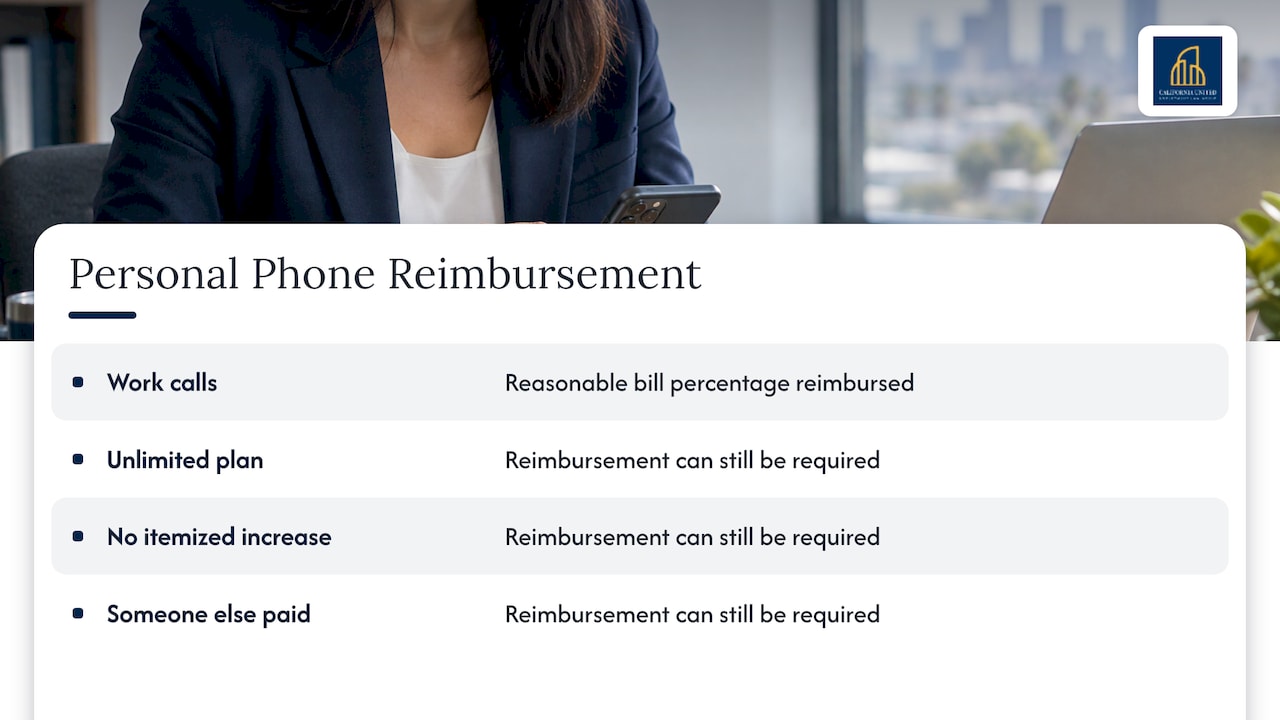
In Cochran v. Schwan’s Home Service, Inc. (2014) 228 Cal.App.4th 1137, a published California Court of Appeal decision, the court held that an employer must reimburse a reasonable percentage of a personal cell phone bill when employees must use their phones for work calls. The same decision held that reimbursement can be required even if the employee has an unlimited plan, incurs no separately itemized increase, or has the bill paid by someone else. The court put it directly: reimbursement is always required, because otherwise the employer would receive a windfall by passing its operating expenses on to the employee.
In plain terms, the question is not whether your phone bill went up. It is whether you had to use your phone for work.
Working from home
According to Legal Aid at Work, employees working from home may be reimbursed for reasonable expenses resulting from performing their work duties, including cellphone use and office supplies.
The Thai decision addressed remote work directly. The court held that section 2802’s direct-consequence test is not a tort-like proximate-cause test, so expenses incurred while employees were required to work from home under a pandemic stay-at-home order could still be reimbursable if they actually resulted from performing job duties. The decision supports looking at whether you actually incurred the cost because of your work duties, rather than whether your employer was the only reason you worked from home.
What that means for you depends on your arrangement. Some questions an attorney may ask include:
- Did your employer require or expect you to work from home?
- Which costs (internet, phone, equipment, supplies) did you actually pay for?
- Did your employer provide any stipend or equipment, and did it cover the full reasonable cost?
- Were these costs necessary for your duties?
Under Gattuso, an employer may meet its obligation through a stipend, a lump-sum payment or higher pay. To do so, it needs a way to separate the reimbursement from wages, and the amount must actually cover the necessary expenses. If the payment falls short, the employee may still challenge it.
What you may be able to recover
The statute and Labor Commissioner guidance describe several categories of recovery.
- The expense itself. A court or the Labor Commissioner may award reimbursement of what you paid.
- Interest. Under section 2802, reimbursement carries interest at the civil-judgment rate from the date you incurred the expense or loss.
- Attorney’s fees. The statute includes attorney’s fees incurred to enforce section 2802 rights among the covered costs.
- Labor Commissioner citations. The Labor Commissioner may issue a citation for amounts due, which are paid to the affected employee.
The amount in any individual matter depends on documentation, the facts and the forum. Nothing here is a prediction of what a particular claim may be worth.
Time limits and where claims are filed
The Labor Commissioner’s brochure states that employees must file claims for unpaid reimbursements within three years, while claims based on a written contract may generally be brought within four years. Different claims can carry different deadlines, and they can depend on how and when the facts developed. Because of that, it makes sense to talk with an employment attorney sooner rather than later if you think you are owed money.
Labor Commissioner process in brief
The Labor Commissioner’s brochure explains that a claimant completes an Initial Report or Claim with the district office that handles wage claims for the city where they worked, and submits copies rather than originals of supporting documents. It adds that most claims proceed to a settlement conference, followed by a hearing if settlement fails, and that the claimant must attend or the claim may be dismissed.
That is an administrative path. Some employees pursue claims in court or through other forums instead, and which route fits depends on the facts, including whether other wage violations are involved. An attorney can explain the options for your situation.
Records that often matter
Employees who paid out of pocket often wonder what paperwork is relevant. Without turning this into a how-to, these are the kinds of records that are commonly useful in expense disputes:
- Receipts, credit card statements and invoices
- Mileage logs or calendar entries showing business trips
- Emails or messages in which a supervisor requested or approved the purchase
- Your employer’s written expense or reimbursement policy
- Phone or internet bills, along with a description of how you used the service for work
- Pay stubs showing whether any stipend was paid
If you are unsure what you have, an attorney can review it with you during a consultation.
Can an employer say you waived the right?
Employees sometimes sign handbooks or agreements stating that they are responsible for their own work costs. Under Labor Code section 2804, any agreement in which an employee waives the benefits of section 2802 is null and void. The California Supreme Court relied on that rule in Edwards v. Arthur Andersen LLP (2008) 44 Cal.4th 937, where it read a general release of claims as not covering the employee’s nonwaivable indemnity rights. Whether a specific expense was necessary and incurred because of your work still depends on the facts. If you have signed something and are unsure how it applies, an attorney can read it with you.
Related wage issues for Pasadena employees
Unreimbursed expenses sometimes appear alongside other pay problems. For example, if a required expense pulled your effective pay down, you may also want to understand unpaid minimum wage rights in Pasadena. You can also read our overview of failure to reimburse employee expenses in Pasadena for more local context.
Our perspective
We represent employees only, and our practice focuses on California Labor Code and FEHA matters. Our attorneys include lawyers with prior employer-side experience, so we understand how employers approach expense policies and how they respond when a claim is raised.
Expense reimbursement problems are easy to overlook. A few hundred dollars here and there can seem too small to raise, and employees often worry about how a supervisor will react. But these costs can add up across months or years, and they are often connected to other wage and hour issues that deserve a careful look.
We believe employees should understand that California law treats this as a right, not a favor. Our approach is to listen to the facts, review the documents and explain the options in plain language. We generally work on a contingency fee basis, which means attorney’s fees are paid from a settlement or award. The terms of every engagement are set out in a written fee agreement.
Every situation is different, and we make no promises about results. What we can offer is a clear conversation about where you stand.
California United Law Group
Talk with an employment lawyer serving Pasadena
If your employer has not reimbursed mileage, phone costs, supplies or home-office expenses, we can look at the facts with you. Our firm handles wage and hour matters, including claims that involve unpaid overtime and related violations, and the first consultation is free.
👉 Learn about our wage and hour practice or contact our team to discuss your situation. You can also read about our employment lawyer in Pasadena page.
FAQ
Do Pasadena employers have to reimburse work expenses?
Generally, yes. Labor Code section 2802 requires California employers to indemnify employees for necessary expenditures or losses incurred in direct consequence of their duties or of following the employer’s directions. Whether a specific expense qualifies depends on the facts.
Can I be reimbursed for using my personal phone for work?
Potentially. A California Court of Appeal held in Cochran that an employer must reimburse a reasonable percentage of a personal cell phone bill when the employee must use the phone for work calls. That can apply even with an unlimited plan.
Is there a deadline to bring an expense reimbursement claim?
Yes. The Labor Commissioner’s guidance says claims for unpaid reimbursements must be filed within three years, and claims based on a written contract may generally be brought within four years. Because deadlines can vary with the facts, speak with an employment attorney promptly.
Can I recover attorney’s fees if my employer refuses to reimburse me?
Section 2802 states that necessary expenditures or losses include all reasonable costs, including attorney’s fees incurred to enforce rights under the section. Whether and how much may be recovered depends on the case.
Does the employer have to approve the expense first?
Not always. An employer may have a reasonable preapproval policy, but professional compliance guidance notes that refusing payment solely for lack of preapproval carries legal risk. Necessity and reasonableness remain relevant.
Can my employer make me sign away my right to reimbursement?
No. Labor Code section 2804 makes any agreement that waives the benefits of section 2802 null and void. Whether a particular expense qualifies still depends on the facts.
Sources
- California Labor Code section 2802
- California Labor Commissioner brochure on recovering unpaid wages
- Thai v. International Business Machines Corp. (2023)
- Cochran v. Schwan’s Home Service, Inc. (2014)
- SHRM: Tips for Reimbursing California Employees’ Business Expenses
- Legal Aid at Work: Costs on the Job