
A hostile work environment in Los Angeles is defined as a workplace where harassment or discriminatory conduct is severe or pervasive enough to alter the conditions of the employee’s employment and create a hostile or abusive work environment. California’s Fair Employment and Housing Act, known as FEHA, provides some of the strongest workplace protections in the country. Under FEHA, employers with five or more employees must prevent and address harassment based on protected characteristics. Starting in 2026, the Workplace Know Your Rights Act adds a new layer of protection by requiring employers to provide annual written notice of employee rights. If you work in Los Angeles and believe your workplace crosses the legal line, understanding these protections is your first step.
What counts as Los Angeles harassment and a hostile work environment?
A hostile work environment is not simply a stressful or unpleasant job. Under California law, the conduct must be based on a protected characteristic and must be severe or pervasive enough to alter the conditions of employment. A single offensive comment rarely meets that threshold, but a pattern of behavior often does. However, California law under Government Code section 12923 expressly provides that a single incident of harassment can be sufficient to create a triable issue if it unreasonably interfered with the employee’s work performance or created an intimidating, hostile, or offensive environment. California courts have applied this standard broadly, and harassment cases are rarely appropriate for resolution on summary judgment.
Harassment under California law includes a wide range of conduct. Common examples include:
- Verbal abuse such as derogatory slurs, offensive jokes, or demeaning comments about race, gender, religion, national origin, disability, or sexual orientation
- Sexual harassment, including unwanted touching, explicit comments, or quid pro quo demands where job benefits are tied to sexual favors
- Discriminatory remarks targeting an employee’s protected class, repeated over time
- Workplace bullying that targets employees based on a protected characteristic such as race, gender, age, disability, or sexual orientation — not merely based on job performance
- Physical intimidation or threats that make an employee fear for their safety at work
Los Angeles workplaces across many industries see these issues regularly. The entertainment, hospitality, healthcare, and retail sectors are among the most commonly affected, given their high-volume, hierarchical, and often informal work cultures.
Pro Tip: Document every incident as it happens. Write down the date, time, location, what was said or done, and who witnessed it. This record becomes your strongest defense if you pursue a formal complaint.

The legal distinction between an isolated incident and pervasive conduct matters significantly. One offensive joke does not automatically create a hostile work environment. A supervisor who makes repeated derogatory comments about an employee’s ethnicity over several months likely does. Courts and agencies look at the totality of the circumstances, including frequency, severity, and whether the conduct was physically threatening.
California courts have addressed these standards in significant decisions. In Aguilar v. Avis Rent A Car System, Inc., the California Supreme Court confirmed that to prevail on a harassment claim, a plaintiff must show conduct “sufficiently ‘severe’ or ‘pervasive’ to alter the conditions of their employment.” In Beltran v. Hard Rock Hotel Licensing, Inc. (2023), the Court of Appeal reversed summary judgment for an employer, holding that trial courts must consider Government Code section 12923’s provision that a single incident of harassment can be sufficient — and that harassment cases are rarely appropriate for early dismissal. And in Hughes v. Pair (2009), the California Supreme Court reaffirmed the standard for hostile work environment claims under FEHA, emphasizing that harassing conduct must be severe enough or sufficiently pervasive to alter the working conditions themselves.
How does California law protect employees from workplace harassment?
California law offers layered protections that go beyond federal standards. FEHA applies to employers with 5+ employees and prohibits harassment based on race, sex, gender identity, gender expression, sexual orientation, religion, national origin, ancestry, color, physical or mental disability, medical condition, genetic information, marital status, age, military and veteran status, and other protected characteristics. That coverage is broader than Title VII of the federal Civil Rights Act, which applies only to employers with 15 or more employees.
The protections employees have under California law include:
- The right to a workplace free from harassment and discrimination, enforced through FEHA and the California Civil Rights Department.
- The right to report harassment without retaliation. California law prohibits retaliation such as firing, demotion, or negative assignments for employees who report misconduct or participate in investigations.
- The right to an annual written notice of workplace rights, required by the Workplace Know Your Rights Act starting February 1, 2026. Employers must provide this notice to all employees each year.
- The right to designate an emergency contact to be notified if you are detained or arrested at work, a protection employers must honor by March 30, 2026.
- The right to file a complaint with the California Labor Commissioner’s Office or the Civil Rights Department if your employer fails to act.
The California Labor Commissioner’s Office enforces labor laws statewide, including protections against retaliation and harassment. The office investigates complaints, educates workers on their rights, and can pursue enforcement actions against employers who violate the law. This is a meaningful resource for Los Angeles employees who face retaliation after reporting a hostile work environment.
Retaliation protections extend to all workers, including immigrants and unauthorized workers. Employers cannot fire, demote, or punish any employee for reporting harassment or exercising their legal rights. This protection applies regardless of immigration status.
What steps can you take if you face harassment at work in Los Angeles?
Recognizing that your situation may qualify as a hostile work environment is the first step. Many employees in Los Angeles tolerate conditions they do not realize are illegal, often because they fear losing their job or do not know where to turn. Understanding your rights changes that.
Here are practical steps to consider:
- Document everything. Keep a written log of each incident, including dates, times, what happened, who was involved, and any witnesses. Save emails, texts, or other communications that support your account.
- Report internally. Most employers have an HR department or a formal complaint process. Reporting to your employer creates a record and gives the company an opportunity to address the issue. Keep a copy of any written complaint you submit.
- Use state and local resources. The California Labor Commissioner’s Office and the Los Angeles County Office of Labor Equity both provide information and support for workers facing harassment or retaliation. Dedicated hotlines and advocacy coalitions are also available.
- Protect your confidentiality. Be thoughtful about who you discuss your complaint with at work. Sharing details widely before a formal process begins can complicate your situation.
- Consult a qualified employment attorney. Harassment claims are fact-specific. An attorney can evaluate your situation and explain your options without you having to commit to any course of action.
Pro Tip: If you report harassment and your employer retaliates, document that too. Retaliation itself is a separate legal violation under California law and can significantly strengthen your position.
You can also learn how to prove workplace harassment under California law, which helps you understand what evidence matters most before you take any formal steps. Knowing what agencies look for gives you a clearer picture of where your situation stands.
What must Los Angeles employers do to comply with harassment laws?
Employers in Los Angeles carry significant legal responsibilities when it comes to preventing and addressing harassment. Compliance is not optional, and failure to meet these obligations exposes employers to liability.
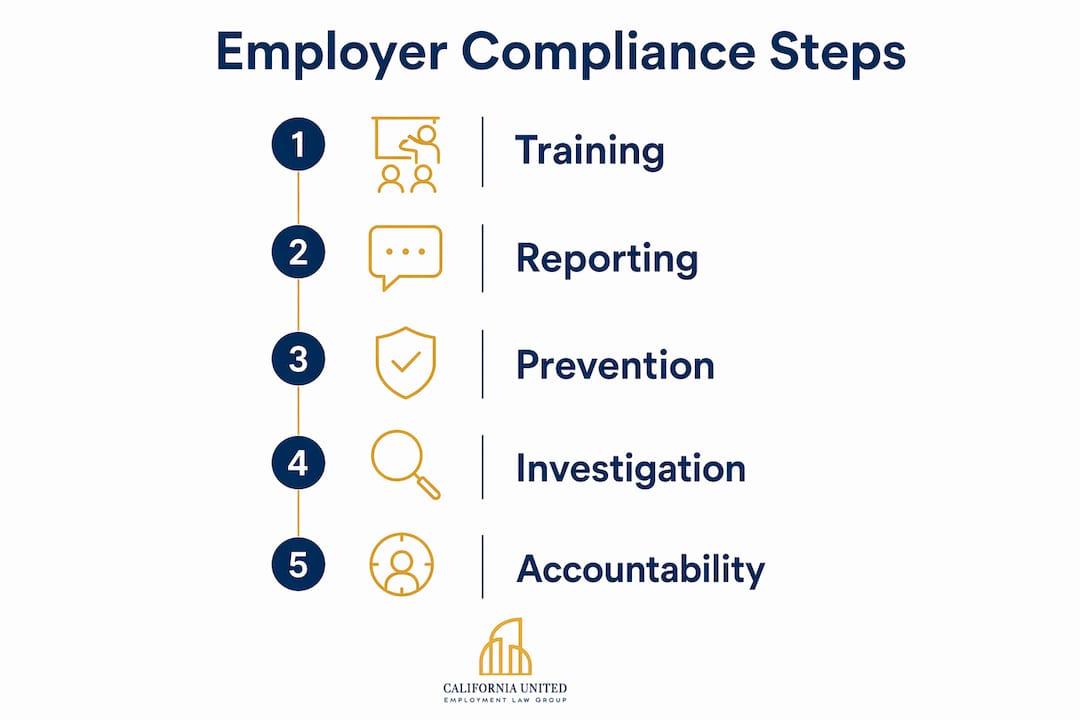
| Employer Obligation | Requirement |
|---|---|
| Sexual harassment prevention training | Supervisors must complete two hours of training every two years; non-supervisory employees must complete at least one hour of training every two years. |
| Annual workplace rights notice | Required under the Workplace Know Your Rights Act starting February 1, 2026 |
| Workplace postings | Anti-harassment and employee rights posters must be displayed in visible locations |
| Anti-retaliation policy | Employers must have a written policy prohibiting retaliation and communicate it to all employees |
| Complaint investigation | Employers must investigate harassment complaints promptly and take corrective action |
Mandatory sexual harassment prevention training extends to specific industries in California. Janitorial workers must complete biennial in-person sexual violence and harassment prevention training under the Janitor Survivor Empowerment Act and the Property Service Workers Protection Act. Employers should confirm current implementation status with the California Department of Labor Standards Enforcement, as rollout has been subject to administrative delays. The entertainment industry has specific additional training requirements, including obligations for talent agencies and employers of minor performers, reflecting the heightened risk of harassment in that sector.
Los Angeles County enforces additional local protections through the Office of Labor Equity, including the Fair Chance Ordinance and requirements for workplace notices related to human trafficking prevention. Employers operating in Los Angeles County must account for both state and local compliance requirements.
Proactive employers go beyond minimum compliance. They train managers to recognize and address harassment early, create clear reporting channels, and build workplace cultures where employees feel safe speaking up. That approach reduces legal risk and produces better outcomes for everyone.
Key Takeaways
California’s FEHA and the 2026 Workplace Know Your Rights Act give Los Angeles employees some of the strongest legal protections against workplace harassment in the country.
| Point | Details |
|---|---|
| Hostile work environment defined | Conduct must be severe or pervasive enough to interfere with job performance, not just unpleasant. |
| FEHA coverage | Applies to employers with 5 or more employees, covering a broad range of protected characteristics. |
| 2026 annual notice requirement | Employers must provide written workplace rights notices to all employees starting February 1, 2026. |
| Retaliation is illegal | California law prohibits firing, demotion, or punishment for reporting harassment or exercising rights. |
| Document and report | Keeping a written record and reporting internally are the two most important early steps for employees. |
What I’ve seen working with Los Angeles employees on harassment cases
The most common misconception I encounter is that a hostile work environment requires physical contact or an obvious, dramatic incident. That is rarely how it works in practice. The cases that hold up legally are often built on a pattern of comments, exclusions, and small acts of hostility that accumulate over months. Employees frequently minimize what they are experiencing because each individual incident seems minor. Taken together, those incidents can meet the legal standard.
Another pattern I see often in Los Angeles is employees waiting too long to document or report. By the time they seek help, key details have faded and witnesses have moved on. California law has deadlines for filing complaints, and those deadlines are firm. Acting early, even if you are not sure whether your situation rises to the level of a legal claim, protects your options.
Los Angeles is a large, diverse city with workplaces ranging from major studios to small family businesses. The law applies across all of them. Knowing your rights is not about being confrontational. It is about understanding what you are entitled to and making informed decisions from a position of knowledge.
How California United Law Group supports Los Angeles employees facing workplace harassment
California United Law Group represents employees across Los Angeles in harassment and hostile work environment cases under California law. The firm handles FEHA claims, retaliation disputes, and related employment matters from the earliest stages through litigation. If you are unsure whether your situation qualifies as a hostile work environment, a case evaluation can help you understand your rights without any obligation. California United Law Group also covers workers in nearby areas including Santa Monica, West Hollywood, and Culver City. Contact California United Law Group to speak with an employment attorney about your situation.
FAQ
What is a hostile work environment under California law?
A hostile work environment exists when harassment based on a protected characteristic is severe or pervasive enough to interfere with an employee’s job performance. California’s FEHA sets this standard and applies to employers with five or more employees.
Does FEHA cover small businesses in Los Angeles?
Yes. FEHA applies to any employer with five or more employees, which covers the vast majority of Los Angeles businesses. Federal law sets a higher threshold of 15 employees, making California’s protections significantly broader.
Can my employer fire me for reporting harassment?
No. California law prohibits retaliation against employees who report harassment or participate in workplace investigations. Retaliation is itself a separate legal violation that can be reported to the California Labor Commissioner’s Office.
What is the Workplace Know Your Rights Act?
The Workplace Know Your Rights Act, enacted as SB 294, requires California employers to provide an annual written notice of employee rights starting February 1, 2026. The notice covers workplace protections, reporting rights, and anti-retaliation rules.
Where can Los Angeles employees file a harassment complaint?
Employees can file complaints with the California Civil Rights Department, the California Labor Commissioner’s Office, or access local support through the Los Angeles County Office of Labor Equity. An employment attorney can also help you identify the right agency and process for your specific situation. Note that California law imposes strict deadlines for filing harassment and discrimination complaints. An employment attorney can advise you on the applicable timeframes for your specific situation.
Recommended
- How to Prove Workplace Harassment in California: A Legal Guide for Employees – California United Law Group
- Understanding Hostile Work Environment Rights in West Hollywood – California United Law Group
- What Creates a Hostile Work Environment in West Hollywood? – California United Law Group
- Hostile Work Environment Claims Under California Law: A Guide for Culver City Workers – California United Law Group