
If you work in West Hollywood and your final paycheck is late, short or never arrived, California law is on your side, and strict deadlines apply to your employer. Your employer owes you every dollar earned, on a fixed deadline, and if the delay is willful, each day it misses that deadline can add a penalty of one full day of your pay, up to 30 days. You can pursue it with a written demand, a wage claim with the state Labor Commissioner, or a lawsuit, and you do not need to wait for your employer’s permission to start.
This guide walks you through the deadlines, what a final paycheck must include, how the penalty is calculated, and the steps to take now. It is written for employees who work in West Hollywood, whether you were fired, laid off or quit.
TL;DR
- Fired or laid off: in most jobs, all wages are due immediately at termination. Quit: due at your last day if you gave 72 hours’ notice, otherwise within 72 hours.
- Your final pay must include earned, unused vacation or PTO. An employer cannot hold your check over unreturned equipment or unsigned paperwork.
- A willful delay can trigger a waiting-time penalty: your daily rate for each day unpaid, up to 30 calendar days.
- You can file a wage claim with the Labor Commissioner or go to court. Paying you or filing a lawsuit stops the penalty clock. Filing a wage claim does not.
- 👉 If your employer ignores a demand, talk to an employment lawyer early. We handle these cases on a contingency basis, so you pay no attorney fees unless we recover money for you. You will not be responsible for case costs if there is no recovery.
Table of Contents
- When your final paycheck is due in California
- What your final paycheck must include
- The waiting-time penalty: how a late check grows
- Step by step: what to do when your check is missing
- Filing a wage claim with the Labor Commissioner
- Going to court over a missing final paycheck
- West Hollywood’s local rules
- Perspective
- How we can help
- FAQ
- Sources
When your final paycheck is due in California
California sets the deadline by how your job ended. The rules below cover most cases, though some industries have special timing rules, and both come from the state’s Division of Labor Standards Enforcement (DLSE), the agency inside the Department of Industrial Relations that enforces wage laws.
According to the DLSE final pay guidance:
| Situation | When all wages are due | Labor Code |
|---|---|---|
| You were fired or laid off | Immediately, at the time of termination, at the place of discharge | §§ 201, 208 |
| You quit with at least 72 hours’ notice | At the time you quit | § 202 |
| You quit without 72 hours’ notice | Within 72 hours of quitting | § 202 |
Two details matter in practice.
First, “immediately” means on your last day, not on the next regular payday. A manager who tells you the check will arrive with the next payroll run is already outside the law for a discharged employee.
Second, if you quit without notice, you can ask to be paid by mail and name the address. Under Labor Code section 202, the mailing date counts as the payment date. So a check postmarked within 72 hours can be on time even if it reaches you later.
California courts enforce these deadlines strictly. In Smith v. Superior Court (L’Oreal) (2006) 39 Cal.4th 77, the California Supreme Court held that a fashion model hired for a one-day assignment was entitled to her pay at the end of that day. In Zaremba v. Miller (1980) 113 Cal.App.3d Supp. 1, the court rejected a claimed industry practice of waiting until the employer was paid by its own client.
These rules apply to work performed in West Hollywood the same way they apply anywhere in California. The city adds its own layer on top for wage rates and retaliation, which we cover below.
What your final paycheck must include
A “final paycheck” is more than your last hourly or salary period. It must cover all wages you earned through your last day.
- Regular and overtime pay for every hour worked.
- Earned, unused vacation or PTO. The DLSE explains that “all wages” include accrued vacation under Labor Code section 227.3, so if your employer provides paid vacation, the vested, unused amount must be paid out at your final rate. The same DLSE guidance notes California does not require payout of accrued sick leave at termination.
- Earned commissions and bonuses that were already due.
What an employer cannot do is hold your pay hostage. The California Chamber of Commerce’s HR guidance states that employers may not withhold a final paycheck because you have not returned company property or turned in expense paperwork. It also says the cost of lost equipment or of reissuing a check is a cost of doing business that cannot be deducted from your wages.
Even when your employer claims a real dispute, such as a disagreement over a commission, it must still pay the amount that is not in dispute. The DLSE paydays FAQ says the employer cannot require you to sign a release in exchange for that undisputed pay, and Labor Code section 206.5 makes any release required in exchange for wages already due null and void.
If you are being asked to sign something before you get your money, pause. Our page on severance and separation agreements explains what we review for employees in that situation.
The waiting-time penalty: how a late check grows
This is the part most employees do not know about, and it is often the reason a missing paycheck is worth pursuing.
Under Labor Code section 203, an employer that willfully fails to pay final wages on time owes a penalty. The DLSE waiting-time penalty FAQ explains how it works:
- The penalty applies only if the employer’s failure to pay is willful.
- The penalty equals your daily rate of pay for each day the wages stay unpaid.
- It runs for up to 30 calendar days, counting weekends and holidays.
- Overtime counts toward your daily rate only if it was regularly scheduled each week.
- It stops when the employer pays or when a court action is commenced. Filing a DLSE claim does not stop it.
A worked example
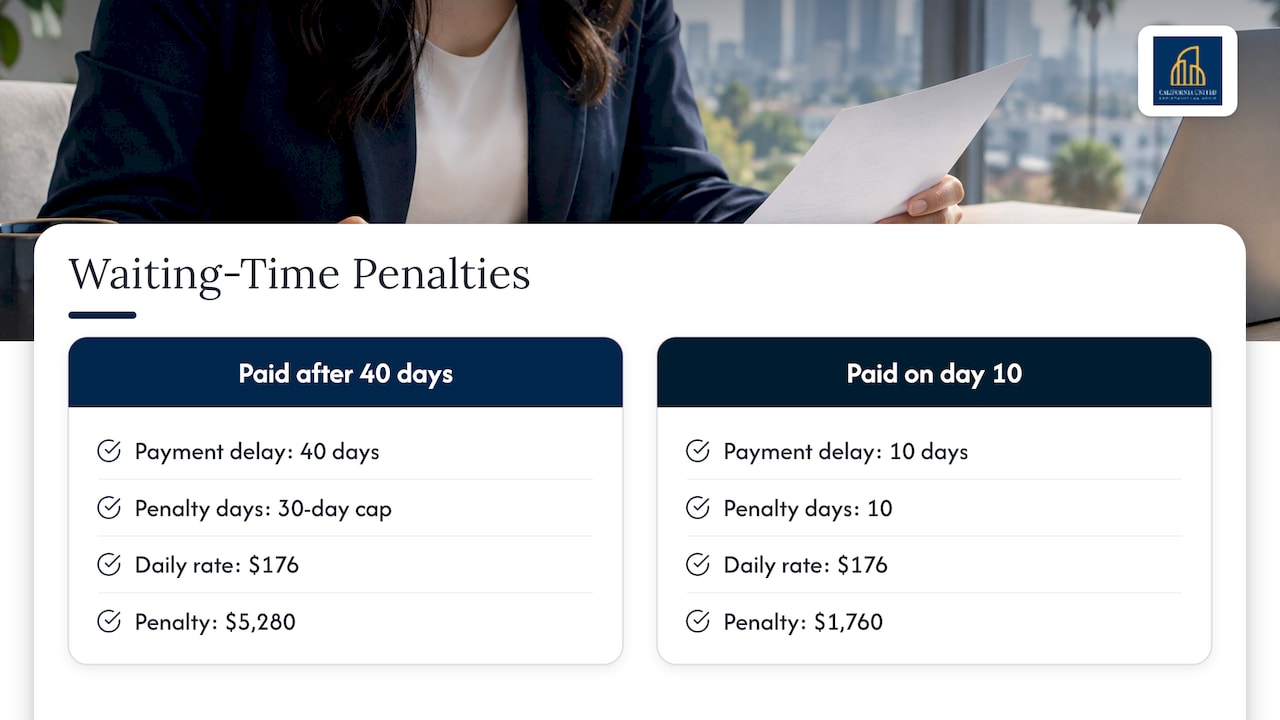
Say you work at a West Hollywood restaurant and earn $22 an hour on an eight-hour shift. Your daily rate is $176. You are fired on a Friday, and your employer, with no good-faith dispute, pays nothing until 40 days later.
The penalty is capped at 30 days, so the waiting-time penalty would be 30 × $176 = $5,280, on top of the wages themselves. If the employer pays on day 10 instead, the penalty is 10 × $176 = $1,760. The numbers are illustrative; your own rate and schedule decide the real figure.
“Willful” is easier to meet than you think
Many employees assume they must prove the employer meant to cheat them. California courts agree. In Barnhill v. Robert Saunders & Co. (1981) 125 Cal.App.3d 1, the court explained that “willful” merely means the employer intentionally failed or refused to do what the law required. The employer does not need an evil purpose to cheat you. In Nishiki v. Danko Meredith, APC (2018) 25 Cal.App.5th 883, a former employee was entitled to waiting-time penalties because the employer was slow to issue a corrected final check for unused vacation, even though the error in the original check was inadvertent. The penalty is separate from your wages.
Two things can reduce or eliminate the penalty. One is a genuine good-faith dispute: the DLSE says the employer must present a defense, based in law or fact, that would defeat any recovery if it succeeded. In Diaz v. Grill Concepts Services, Inc. (2018) 23 Cal.App.5th 859, the court held that a defense that is unsupported by evidence, unreasonable, or presented in bad faith does not qualify as a good-faith dispute. The other is avoidance: if you dodge or refuse a proper tender of payment, the penalty does not accrue for that period. Accepting a proper payment does not waive penalties that have already accrued, so accept it and ask for a written breakdown if the amount looks wrong.
Step by step: what to do when your check is missing
Here is the sequence we walk employees through. Each step builds a record that matters later.
Step 1: Confirm the deadline has passed
Count from your termination or resignation date using the table above. If you quit and asked for mailed payment, check the postmark rule before assuming your employer is late.
Step 2: Gather your records
Pull together anything that shows what you were owed:
- Pay stubs and the itemized wage statements your employer must give you with each paycheck. The DLSE’s wage claim page lists what they must show, including pay period dates, deductions and accrued sick hours.
- Your offer letter or any written pay agreement, including the Labor Code section 2810.5 notice you got at hire.
- Texts, emails or schedules showing your hours, your last day and any promise to pay.
- Bank records showing direct deposits, or a bounced or dishonored check.
If your pay stubs were missing or incomplete, that is a separate violation. Our Long Beach paystub rights guide explains how incomplete wage statements are treated.
Step 3: Ask for your pay in writing
Send a short, dated email or letter to HR or your manager. State your last day, say your final wages and accrued vacation are past due, and ask for payment by a specific date. Keep it factual and calm. This does not stop the penalty from accruing, but it documents the delay and often prompts payment.
Step 4: Do not sign away your claim
If payment arrives with a release, a severance agreement or a request to waive claims, do not sign it before you understand what you are giving up. As noted above, the undisputed wages are yours without a release.
Step 5: Choose your route
You have three routes: a wage claim with the Labor Commissioner, a civil lawsuit, or representation by an employment attorney who can use either. We compare them next.
Filing a wage claim with the Labor Commissioner
The Labor Commissioner’s Office, also known as the DLSE, is the state authority that hears wage claims. The DLSE’s late payment FAQ says a worker whose wages are not paid on time can file a wage claim for statutory penalties that go to the employee. When a group of workers is affected, a Report of Labor Law Violation can seek civil penalties payable to the State.
Here is how the process works, according to the DLSE’s instructions for filing a wage claim:
- File the Initial Report or Claim (DLSE Form 1). Add Form 55 if you worked irregular hours, Form 155 for commissions, or the Vacation Pay Schedule for vacation wages.
- Attach copies, never originals, of time records, pay stubs, dishonored checks and your section 2810.5 notice if you have one.
- Attend the settlement conference. If the case does not settle, it may be set for a hearing. Bring your original documents plus two sets of copies.
The DLSE says claims can be filed by email, mail or in person. Its brochure on recovering unpaid wages says to file with the district office that handles the city where the work was done, that claims may be filed regardless of immigration status, and that you must attend the conference and hearing or risk dismissal.
For West Hollywood work, the DLSE’s office contact list shows the Los Angeles office at 320 W. Fourth Street, Suite 450, Los Angeles, CA 90013, (213) 620-6330, open weekdays from 8:00 AM to 5:00 PM. Confirm the office and address handling your claim before you file, since the DLSE updates its listings.
The catch most people miss
Filing a DLSE claim does not stop the 30-day penalty from accruing. Only payment or commencing a court action does. Because filing a lawsuit stops the penalty, timing matters. The penalty caps at 30 days either way, so the reason to choose court is usually the size and scope of your claim, not stopping the clock. In Pineda v. Bank of America, N.A. (2010) 50 Cal.4th 1389, the California Supreme Court held that a three-year statute of limitations applies to a claim for waiting-time penalties. Claims also have filing deadlines; our guide to deadlines to recover unpaid wages in California explains them.
We handle administrative complaint filings for employees, so you do not have to manage the forms and hearing preparation alone.
Going to court over a missing final paycheck
The DLSE confirms you may bring an action in court to recover unpaid wages and waiting-time penalties instead of, or in addition to, using the claim process. Court makes sense when:
- The employer has ignored your demand or claims a dispute you believe is not genuine.
- Your pay problems go beyond the final check, such as unpaid overtime, missed meal and rest break premiums or incomplete wage statements. In Naranjo v. Spectrum Security Services, Inc. (2022) 13 Cal.5th 93, the California Supreme Court held that unpaid meal and rest break premiums are wages that can support waiting-time penalties.
- You were fired right after complaining about pay, safety or discrimination.
- Other employees were shorted in the same way.
For the steps of a lawsuit from start to finish, see our employment lawsuit process overview. For a close comparison, our guides on how Burbank workers pursue late final paycheck penalties and Torrance rights when a final paycheck is late cover the same state law, and our page on Alhambra wage claims and waiting-time penalties lays out how DLSE claims and civil suits compare.
West Hollywood’s local rules
West Hollywood has its own minimum wage ordinance, and it matters if your missing pay includes underpaid hours. The city’s ordinance set a $17.64 hourly rate as of January 1, 2022, with annual CPI-W increases, so the rate has risen since. Check the City of West Hollywood’s current schedule before you calculate what you were owed, because it adjusts on a set schedule.
The same ordinance has two protections that help in a pay dispute:
- Anti-retaliation. Section 5.130.120 makes it unlawful to retaliate against someone for exercising rights under the chapter, and an adverse action within 90 days of exercising those rights raises a rebuttable presumption of retaliation.
- No waivers. Section 5.130.100 voids an employee’s waiver of the chapter’s provisions, except in a bona fide collective bargaining agreement.
If you were fired or cut back right after you asked about pay, tell your attorney the dates. Timing can be evidence.
Perspective
We see a missing final paycheck as the most visible sign of a larger problem. When an employer ignores a deadline that clear, it is worth asking what else went wrong: overtime, break premiums, vacation payout, pay stubs.
We practice employment law only, and only for employees across California. Our attorneys include lawyers with prior employer-side experience, which means we understand how the other side builds its good-faith-dispute defense and how to answer it.
You pay no attorney fees unless we recover money for you through a settlement or award. You will not be responsible for case costs if there is no recovery. That lets you pursue a claim without paying up front while your income is already interrupted.
Because we work on both administrative filings and litigation, we can recommend the route that fits your facts, and you make the final decision.
California United Law Group
How we can help
If your West Hollywood employer has not paid your final wages, our wage and hour practice represents employees in unpaid wage and overtime claims, and our employment law practice covers wrongful termination, retaliation and severance agreements. We offer free consultations and case evaluations, and you pay no attorney fees unless we recover money for you. You will not be responsible for case costs if there is no recovery.
👉 Contact us to talk through your final paycheck
Bring your last pay stub, your termination or resignation date, and any messages about your pay.
FAQ
How long should I wait for my final pay before taking action?
You should not wait. If you were fired, the money was due the moment you were discharged, and if you quit, it was due on your last day or within 72 hours. If the delay is willful, each day past the deadline can add to the waiting-time penalty, up to 30 days.
Can my employer keep my last paycheck until I return my laptop or badge?
No. California guidance says an employer may not withhold final pay for unreturned property or unsubmitted paperwork. Return the item, keep proof that you did, and put your request for pay in writing.
Do I get paid for unused vacation after I quit or am fired?
Yes, if your employer provides paid vacation or PTO. Earned, unused vacation or PTO counts as wages under Labor Code section 227.3 and must be included in your final paycheck. California does not require payout of accrued sick leave at termination.
Does filing a wage claim stop the 30-day penalty?
No. Per the DLSE, only payment or the start of a court action stops the penalty from accruing. A pending wage claim leaves the clock running until the 30-day cap. Filing a lawsuit stops it.
Do I need a lawyer to get my final paycheck?
Not for every case, but an employment lawyer can help when the employer is stalling, claims a dispute, asks you to sign a release, or when other wage violations are involved. A free consultation lets you learn where you stand before you decide.
This article provides general information, not legal advice. Reading it does not create an attorney-client relationship. Every case depends on its own facts, and past results do not guarantee a similar outcome.
Sources
- DLSE final pay guidance
- California Labor Code section 202
- DLSE paydays, pay periods and final wages FAQ
- California Chamber of Commerce HRCalifornia: final paycheck and company property
- DLSE waiting-time penalty FAQ
- CalHR Human Resources Manual on waiting-time penalties
- DLSE FAQs on late payment of wages
- DLSE: How to file a wage claim
- DLSE instructions for filing a wage claim
- Labor Commissioner brochure: recover your unpaid wages
- DLSE office contact list
- City of West Hollywood minimum wage ordinance