
Yes. If you work in Torrance and your employer will not reimburse necessary and reasonable expenses you incurred because of your job duties or your employer’s directions, California law may give you a claim. Labor Code §2802 requires employers to reimburse necessary work-related expenditures and losses, and a successful claim may allow recovery of unreimbursed expenses, interest, and reasonable attorney’s fees incurred to enforce those rights. You can enforce this through the Labor Commissioner’s office or a civil lawsuit.
Before you do anything else:
- Keep every receipt, bill, and screenshot tied to the expense.
- Save texts, emails, or Slack messages showing your employer knew about the cost.
- Send a written demand that specifically cites Labor Code §2802 and gives a deadline to respond.
Key Takeaways
California Labor Code §2802 entitles Torrance employees to full reimbursement for necessary work expenses, plus interest and attorney fees when employers refuse to pay.
| Point | Details |
|---|---|
| Broad statutory standard | Mileage, phone, internet, supplies, and uniforms may qualify if they were necessary, reasonable, and incurred because of job duties or employer directions. |
| No waiver allowed | Section 2804 voids any policy or agreement that tries to sign away reimbursement rights. |
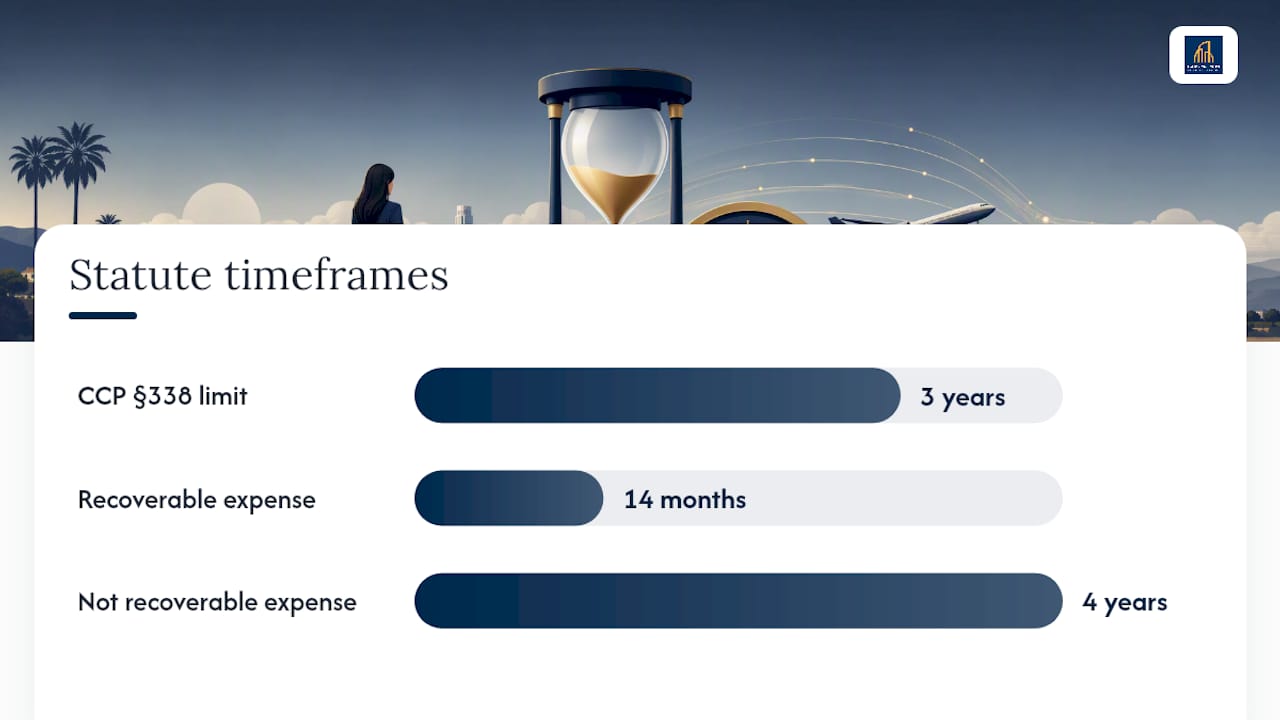
| Three-year window | Many reimbursement claims are analyzed under a three-year limitations period, and timing may be measured separately for each expense. Because deadlines can be fact-specific, employees should get advice promptly. |
| Multiple enforcement paths | DLSE claims, small claims, superior court, and PAGA actions each fit different claim sizes. |
| Contingency representation available | California United Law Group may handle qualifying §2802 claims for Torrance employees on a contingency basis. Clients may still be responsible for costs depending on the fee agreement. |
Table of Contents
- Torrance Failure to Reimburse Employee Expenses: What Counts
- What You Can Recover Under California Employee Expense Laws
- How Do You Document and File a Torrance Expense Claim?
- Why Employer Excuses for Not Reimbursing Often Don’t Hold Up
- DLSE, Small Claims, or Superior Court: Which Path Fits Your Claim?
- How California United Law Group Handles Torrance §2802 Claims
- What Torrance Workers Get Wrong About Reimbursement Claims
- Get Help Recovering Unreimbursed Expenses in Torrance
- Sources
Torrance Failure to Reimburse Employee Expenses: What Counts
Not every out-of-pocket cost qualifies, but the standard is broader than most Torrance employers admit. Under §2802, an expense is reimbursable when it is a necessary and reasonable cost incurred as a direct consequence of discharging job duties or obeying the employer’s directions. Courts read that phrase generously, and administrative guidance from HRCalifornia confirms employers routinely underestimate how much this covers. California courts have applied §2802 broadly in several contexts, including personal cell phone use and remote-work expenses. Employer-side guidance also recognizes that reimbursement duties can be broader than many workplace policies assume.
Depending on the job duties, employer directions, and reasonableness of the expense, common reimbursable categories may include:
- Mileage and auto costs for driving between job sites, client visits, or errands run for the employer (commuting to a fixed office doesn’t count).
- Cell phone use when you’re expected to call, text, or check email for work, even on a personal plan. For example, in Cochran v. Schwan’s Home Service, Inc., the Court of Appeal held that when employees must use personal cell phones for work, the employer must pay some reasonable percentage of the phone bill so the employer does not pass operating expenses to employees.
- Home internet for remote employees, apportioned to the business-use share.
- Office supplies, software subscriptions, or professional licensing dues required to do your job.
- Uniforms and PPE the employer mandates but doesn’t supply.
Mixed-use expenses, like a phone or home internet connection used for both personal and work purposes, often require a reasonable allocation. Employers should have a method to determine what portion is reimbursement, and a flat stipend may be inadequate if it does not reasonably cover necessary business expenses. This exact issue reached the California Court of Appeal in Thai v. International Business Machines Corporation, where the court confirmed that remote employees are entitled to reimbursement for internet and phone costs, and that the employer’s obligation turns on whether the expense was necessary for the job, not on who decided you’d work from home. The better way to state the rule is that the expense must be tied to the employee’s work duties, and an employer cannot avoid reimbursement merely because a third-party event, such as a stay-at-home order, contributed to the remote-work arrangement.
California courts have applied §2802 in several employee-expense contexts. In Gattuso v. Harte-Hanks Shoppers, Inc., the California Supreme Court recognized that an employer may reimburse expenses through enhanced compensation only if there is a way to identify what portion is reimbursement. In Cochran v. Schwan’s Home Service, Inc., the Court of Appeal held that employees required to use personal cell phones for work must receive reimbursement for some reasonable percentage of the bill. In Thai v. International Business Machines Corp., the Court of Appeal held that required remote-work expenses during a stay-at-home order could still be reimbursable when tied to the performance of job duties.
What You Can Recover Under California Employee Expense Laws
Labor Code §2802 does more than require reimbursement. It builds in financial consequences for employers who drag their feet, and it closes the door on contract tricks that try to sign the right away.
Here’s what a valid claim can recover:
- The full amount of the unreimbursed expense.
- Interest, which accrues from the date you incurred the expense, not from when you filed a claim.
- Reasonable attorney’s fees and costs incurred to enforce reimbursement rights under Labor Code §2802.
- Potential statutory penalties or representative remedies may be available in some cases, especially where the employer’s policy affected multiple employees.
Labor Code §2804 supports these rights by limiting an employer’s ability to contract around them. A policy or agreement that requires an employee to waive reimbursement rights under §2802 may be unenforceable.
A §2802 claim isn’t just about getting one expense paid back. The interest clock starts the day you spent the money, and if the case goes to litigation, the employer can end up paying your legal fees on top of everything else.
Timing matters too. Many reimbursement claims are analyzed under a three-year limitations period, and each expense may have its own timing issue. A mileage expense from 14 months ago may still be timely, while an expense from four years ago may face a limitations defense.
How Do You Document and File a Torrance Expense Claim?
A strong §2802 claim usually depends on clear documentation. Torrance employees who build a clean record before they ever contact a lawyer or file with the state put themselves in a far stronger position.
- Gather every record tied to the expense. Receipts, phone bills, mileage logs, internet statements, and your employer’s written reimbursement policy (or the absence of one) all matter.
- Save the paper trail proving necessity. Emails or texts asking you to use your personal phone or drive your own car for work can be important evidence in a §2802 case.
- Calculate a reasonable amount. For mileage, the IRS standard mileage rate is a common, defensible benchmark. For phone and internet, estimate the percentage of use that’s actually work related.
- Send a written demand. State the amount owed, cite §2802 directly, attach your documentation, and give the employer a reasonable deadline, typically 10 to 14 days, to respond.
- Escalate if there’s no response. File a wage claim with the DLSE or move toward a civil suit, depending on the size and complexity of your claim.
Pro Tip: Before your first conversation with an attorney, organize your documents by month and expense type. A claim that is easy to follow can make evaluation more efficient because the employer and its counsel can see what expenses are being claimed and why.
If your unreimbursed expenses run into the thousands, or your employer applied the same bad policy to your coworkers, that’s the point to bring in counsel rather than handle the claim solo.
Why Employer Excuses for Not Reimbursing Often Don’t Hold Up
Torrance employers may raise several common defenses to reimbursement claims, but those defenses depend on the facts and do not automatically defeat a valid §2802 claim.
- “We didn’t ask you to work from home; the government did.” Thai v. International Business Machines Corp. rejected that defense where the claimed expenses were tied to required remote work and the performance of job duties.
- “Our policy says we don’t reimburse for that.” A policy can’t override a statute. Section 2804 voids any waiver of §2802 rights, no matter how the policy is worded.
- “We already pay a stipend.” A stipend may help satisfy the employer’s obligation only if it reasonably covers reimbursable expenses and the employer can identify what portion is reimbursement rather than wages.
- “You didn’t follow our expense procedure.” Failure to follow an internal procedure may affect proof or timing, but it does not necessarily eliminate reimbursement rights if the expense was necessary, reasonable, and known to the employer.
Inconsistent enforcement, no accountable reimbursement process, and proof the cost was unavoidable for the job all strengthen your position.
DLSE, Small Claims, or Superior Court: Which Path Fits Your Claim?
Torrance employees have four realistic paths to recover unreimbursed expenses, and the right one depends on the dollar amount, whether other employees were affected, and how much evidence the dispute requires.
- DLSE wage claim. Filed with the Division of Labor Standards Enforcement, this route has no filing fee and moves toward a settlement conference or hearing. It works well for individual claims with clear documentation.
- Small claims court. Practical for modest amounts, generally under the small claims dollar limit, when you’re comfortable representing yourself and the facts are straightforward.
- Superior court. Better suited to larger claims, complex discovery, or cases where you need formal subpoenas for employer records. Because Labor Code §2802 allows recovery of reasonable attorney’s fees incurred to enforce reimbursement rights, hiring counsel may be realistic even when the unreimbursed expense amount is modest.
- PAGA or class action. When a no-reimbursement policy affects many employees in a similar way, a representative or class action may address broader workplace practices rather than only one employee’s reimbursement request.
| Enforcement Path | Best For |
|---|---|
| DLSE claim | Individual claims, no filing fee, faster informal resolution |
| Small claims | Modest amounts, simple facts, no attorney needed |
| Superior court | Larger claims, complex evidence, attorney-fee recovery available |
| PAGA/class action | Company-wide policies affecting multiple employees |
How California United Law Group Handles Torrance §2802 Claims
Reimbursement disputes usually turn on documents an employer controls: expense policies, stipend calculations, and internal emails asking you to use personal resources for work. California United Law Group pursues that evidence early, often through formal discovery when litigation is filed, and may represent qualifying Torrance employees on a contingency basis. Clients may still be responsible for case costs depending on the written fee agreement. Because Labor Code §2802 allows fee-shifting, the potential cost of litigation can affect how employers evaluate disputed reimbursement claims.

What Torrance Workers Get Wrong About Reimbursement Claims
Most guidance on this topic treats §2802 like a minor HR footnote, something you mention once and move past. That undersells it. The statute exists specifically to stop employers from quietly shifting their operating costs onto employees, and Torrance workers in retail, logistics, and remote-capable office jobs absorb this cost more than most realize, one unreimbursed phone bill and mileage log at a time.
The conventional advice, “ask HR nicely and hope for the best,” fails because it treats reimbursement as a favor rather than a legal obligation. It isn’t. To prove a §2802 claim, the employee generally must show that the expense was necessary and reasonable, was incurred because of job duties or employer directions, and was not fully reimbursed.
What actually matters is sequencing. Document first, demand second, escalate third. Employees who skip straight to a DLSE claim without a clean paper trail lose leverage they didn’t need to give up. Employees who build the record early usually give their lawyer, the DLSE, or the employer a clearer basis to evaluate the claim.
— California United Law Group
Get Help Recovering Unreimbursed Expenses in Torrance
California United Law Group may represent qualifying Torrance employees on a contingency basis. That means no attorney’s fee is charged unless there is a recovery, but clients may still be responsible for case costs depending on the written fee agreement. If Labor Code §2802 applies, reasonable attorney’s fees incurred to enforce reimbursement rights may be recoverable from the employer. A free consultation takes stock of what you’ve already gathered: receipts, mileage logs, texts asking you to use your personal phone, and any written reimbursement policy your employer has (or doesn’t). From there, the firm calculates what’s owed, drafts a demand that cites the statute directly, and moves toward a DLSE claim or lawsuit if your employer won’t pay. If you’re carrying unreimbursed work costs, visit the firm’s employment law page to schedule a consultation and discuss whether you may have a reimbursement claim.
Sources
Labor Code §2802, DLSE, Thai v. IBM analysis, CACI No. 2750.
This article is general information, not a substitute for advice from a qualified lawyer. Consult a qualified legal professional about your own circumstances before acting on anything here.
- Court of Appeal Clarifies Employers’ Expense Reimbursement Obligations for Pandemic-Related Remote Work | California Employment Law Update
- California Legislative Information (Labor Code §2802)
- Expense Reimbursement – HRCalifornia
Recommended
- Do Torrance employers have to reimburse work expenses? – California United Law Group
- Pasadena Failure to Reimburse Employee Expenses – California United Law Group –
- Torrance Unpaid Wages: Recovering Missing Compensation – California United Law Group –
- Do Los Angeles Employers Have To Reimburse Work Expenses? – California United Law Group