
California law generally requires employers to provide nonexempt employees with paid, duty-free 10-minute rest breaks for every four hours worked or major fraction of four hours, unless the total workday is less than three and one-half hours. Rest break violations can create significant wage liability for employers, including premium pay owed to affected employees. Under the California Labor Code and Industrial Welfare Commission Wage Orders, every nonexempt employee in Long Beach has the right to these breaks. Understanding what the law requires is the first step toward knowing whether your rights have been denied.
What are the specific rest break requirements in Long Beach workplaces?
California’s rest break schedule is generally based on one paid 10-minute rest break for every four hours worked or major fraction of four hours. In practice, this usually means:
- A shift of more than 3.5 hours and up to 6 hours generally requires one 10-minute rest break.
- A shift of more than 6 hours and up to 10 hours generally requires two 10-minute rest breaks.
- A shift of more than 10 hours and up to 14 hours generally requires three 10-minute rest breaks.
Each break must fall near the middle of the work period, as far as practicable. That means your employer cannot stack all your breaks at the start or end of a shift.
Rest breaks must be completely duty-free. In Augustus v. ABM Security Services, Inc., the California Supreme Court held that during required rest periods, employers must relieve employees of all duties and relinquish control over how employees spend their break time. Your employer must relieve you of all work and all employer control during that time. You cannot be required to monitor equipment, answer calls, remain on call, or stay under employer control in a way that prevents you from using the break as your own time. Any break that includes a work obligation does not count as a compliant rest break under California law.

Rest breaks also differ from meal breaks in a critical way. Rest breaks are paid and last 10 minutes, while meal breaks are unpaid and must last at least 30 minutes. Both carry distinct legal rules and separate penalty structures. Most nonexempt Long Beach workers, including employees in retail, logistics, healthcare, and other industries, are covered by California’s rest break rules, although some narrow industry-specific exceptions and special rules may apply.
Pro Tip: If your employer tells you to “take a quick break” but expects you to stay at your station or keep your radio on, that break does not meet California’s duty-free standard. Document it.
How do rest break violations happen and what penalties apply?
Common violation patterns
Employers in Long Beach violate rest break laws in three recurring ways.
- Skipping breaks entirely. Some employers simply do not schedule rest breaks, particularly during busy periods or short-staffed shifts.
- On-call breaks. Requiring employees to remain reachable or on-site during a break is a violation. On-call rest breaks are not compliant under California law, even if the employee never receives a call. This principle comes from Augustus, where the California Supreme Court rejected rest breaks that left employees subject to employer control.
- Interrupted breaks. A break cut short by a supervisor or a work demand does not satisfy the legal requirement, regardless of how much time the employee did receive.
Penalty structure for missed breaks
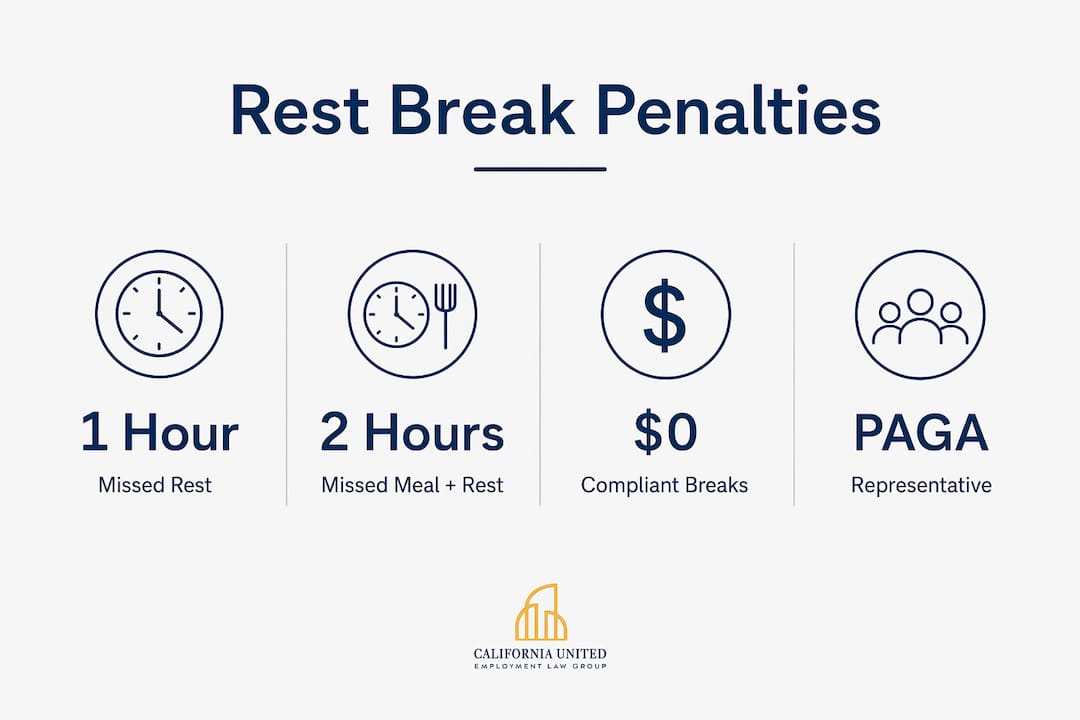
The financial consequences for employers are real and specific. When an employer fails to provide a compliant rest break, they owe one hour of premium pay at the employee’s regular rate of pay for each missed break per workday. That premium pay is not calculated on base wage alone. It includes nondiscretionary bonuses and commissions, which means many employees are owed more than they initially expect.
If both a meal break and a rest break are missed on the same day, the employer owes two hours of premium pay for that workday. For rest break violations, premium pay is generally capped at one additional hour of pay per workday, even if more than one rest break was missed that day. If both a compliant meal period and a compliant rest period were not provided on the same workday, the employee may be owed up to two additional hours of premium pay for that day.
| Violation | Premium Pay Owed |
|---|---|
| One or more missed rest breaks in a workday | 1 hour at the regular rate |
| One missed meal break | 1 hour at regular rate |
| Both missed in one day | 2 hours at regular rate |
| Improper wage statement | Up to $4,000 per employee |
The Naranjo ruling and wage statement penalties
The legal stakes increased significantly after the Naranjo ruling. In Naranjo v. Spectrum Security Services, Inc., the California Supreme Court held that premium pay for noncompliant meal or rest breaks is treated as wages, which can support wage statement and waiting time penalties when the employer fails to pay or report those wages correctly. That classification means employers who fail to list missed break premiums correctly on wage statements face additional penalties. Wage statement violations under Labor Code § 226 can reach $4,000 per employee. This secondary layer of liability catches many employers off guard.
Systematic violations across a workforce can escalate into PAGA representative actions, where one employee’s claim covers all similarly situated coworkers. These cases have produced seven-figure outcomes for employers and significantly higher recoveries for affected workers.
Pro Tip: Check your pay stubs. If you missed rest breaks and no premium pay appears on your wage statement, that absence may itself be a separate violation under the Naranjo ruling.
What steps can Long Beach employees take after a rest break violation?
If you believe your employer has denied you compliant rest breaks, gathering evidence is your most important first action. Strong documentation makes a material difference in how a claim proceeds.
- Timecards and punch records. These show when your shifts started and ended, and whether break periods appear in the records.
- Pay stubs. Review each statement for premium pay entries. Missing entries for known missed breaks are significant.
- Written communications. Texts, emails, or scheduling notices that show you were required to work through breaks or remain on call are useful records.
- Personal notes. Write down dates, times, and descriptions of missed or interrupted breaks as soon as possible after they occur. Date-stamped notes carry weight.
Once you have gathered records, you can file a wage claim with the California Labor Commissioner’s Office, also known as the Division of Labor Standards Enforcement (DLSE). The DLSE claim process is designed to be accessible without an attorney, though complete documentation can make a claim easier to evaluate and present. The DLSE will schedule a settlement conference and, if unresolved, a hearing.
One common pitfall is misclassification. Some employers label workers as independent contractors or exempt employees to avoid break obligations. If you are classified as exempt or as an independent contractor but your actual job duties and working relationship resemble those of a nonexempt employee, the classification may need legal review. Long Beach workers in port and logistics roles, for example, should review their classification carefully. More detail on those specific rights is available for Long Beach port workers.
This information is educational and does not constitute legal advice. Every situation is fact-specific, and outcomes vary.
How do California rest break laws connect to other worker protections?
California’s rest break rules do not exist in isolation. They sit within a broader framework of worker protections that Long Beach employees benefit from.
| Feature | Rest Break | Meal Break |
|---|---|---|
| Duration | 10 minutes | 30 minutes minimum |
| Paid or unpaid | Paid | Unpaid |
| Duty-free required | Yes | Yes |
| Penalty for violation | 1 hour premium pay | 1 hour premium pay |
| Waivable by employee | Generally not waivable by agreement | Waivable only under specific legal conditions |
California enforces these rules more strictly than most other states. Industrial Welfare Commission Wage Orders set specific requirements by industry, and most nonexempt employees statewide are covered, subject to narrow exceptions and special rules. Long Beach workers in retail, manufacturing, food service, and healthcare all fall under this framework.
A common misconception is that rest break rules only matter for hourly workers. Salaried nonexempt employees are also entitled to rest breaks. Another misconception is that a short break of any length satisfies the law. California requires a full 10 minutes of duty-free time. A five-minute pause at a workstation does not qualify.
Rest break violations can also affect overtime calculations. Because break premium pay is treated as wages, missed break issues can overlap with wage statement, final pay, and other wage-and-hour claims. Workers who believe they have both rest break and overtime issues should review both areas together. California United Law Group handles wage and hour claims that involve multiple overlapping violations, including cases where unpaid wages compound the impact of missed breaks.
Key Takeaways
California rest break law gives Long Beach workers a clear, enforceable right to paid, duty-free breaks, and one or more missed rest breaks in a workday can trigger premium pay.
| Point | Details |
|---|---|
| Break thresholds are specific | One break per 4 hours worked; a 3.5-hour shift requires one, a 10-hour shift requires three. |
| Duty-free means fully off duty | On-call breaks and interrupted breaks do not satisfy California law. |
| Premium pay is generally calculated by workday | One or more missed rest breaks in a workday can trigger one hour of pay at the regular rate, which may include nondiscretionary bonuses and commissions. |
| Naranjo ruling adds liability | Failure to list premium pay on wage statements can add up to $4,000 per employee in penalties. |
| Documentation is your foundation | Timecards, pay stubs, and dated notes are the core evidence for any DLSE claim. |
What I’ve Seen Working These Cases in Long Beach
The pattern I see most often is not the employer who openly refuses to give breaks. It is the employer whose policies look fine on paper but whose floor operations make breaks practically impossible. A retail manager who schedules a two-person shift during peak hours is not writing “no breaks allowed” in any policy document. But the result is the same.
The Naranjo ruling changed the stakes in a way that many employers have not fully absorbed. Before that decision, a missed break was a missed break. Now, the failure to reflect premium pay on a wage statement is its own separate violation. I have seen cases where the underlying break violations were modest in dollar terms, but the wage statement penalties multiplied the employer’s exposure significantly.
Workers in Long Beach often underestimate the value of their own records. A simple note in your phone, dated and timestamped, describing a missed break is more useful than most people expect. The DLSE process rewards workers who show up prepared. Clear documentation can also make it easier for both sides to evaluate the claim early.
The broader lesson is that California’s break laws are not aspirational. They are enforceable, specific, and backed by real financial consequences. Retail workers in Long Beach and workers across every other sector have the same core rights. Knowing those rights is not the same as acting on them, but it is where every successful claim begins.
— California United Law Group
California United Law Group is here for Long Beach workers
If you work in Long Beach and believe your employer has denied you compliant rest breaks, California United Law Group can help you understand your options. The firm represents employees in wage and hour claims, including missed rest break violations, premium pay disputes, and related wage statement issues. Consultations are confidential and carry no obligation. Contacting the firm does not guarantee any particular result, and each case depends on its own facts, records, and applicable law. California United Law Group handles cases at all stages, from initial review through litigation, and serves Long Beach workers remotely and in person. Contact the firm today for a confidential case evaluation and get clear answers about your rights.
FAQ
What counts as a rest break violation in California?
A rest break violation can occur when an employer fails to provide a required paid, duty-free 10-minute rest break. California generally requires one rest break for every four hours worked or major fraction of four hours, unless the total workday is less than three and one-half hours. On-call breaks, interrupted breaks, and skipped breaks all qualify as violations under California law.
How much can I recover for missed rest breaks in Long Beach?
If your employer fails to provide one or more required rest breaks in a workday, you may be entitled to one hour of premium pay at your regular rate, which can include nondiscretionary bonuses and commissions. If both a meal break and a rest break were not provided on the same workday, additional premium pay may be available. If both a meal break and a rest break are missed on the same day, you are owed two hours of premium pay.
How do I report a rest break violation in California?
You can file a wage claim with the California Labor Commissioner’s Office (DLSE). Gather timecards, pay stubs, and written records of missed breaks before filing to support your claim.
Are salaried employees entitled to rest breaks in Long Beach?
Yes. Salaried nonexempt employees are entitled to the same rest break protections as hourly workers under California law. Exempt status depends on job duties and salary level, not just job title.
What is the Naranjo ruling and why does it matter?
Naranjo v. Spectrum Security Services, Inc. held that meal and rest break premium pay is treated as wages. That matters because unpaid premiums may also create wage statement or waiting time penalty issues when they are not properly paid or reported. Employers who fail to list missed break premiums on wage statements now face additional penalties of up to $4,000 per employee, separate from the underlying break violation.