
Failure to provide reasonable accommodation generally occurs when an employer fails to reasonably accommodate an employee’s or applicant’s known disability, even though the person can perform the essential functions of the position with or without accommodation, unless the accommodation would create an undue hardship. In West Hollywood, this obligation exists under both the Americans with Disabilities Act (ADA) and California’s Fair Employment and Housing Act (FEHA). FEHA goes further than federal law by imposing an affirmative duty on employers to engage in a timely, good faith interactive process. If your employer has ignored, delayed, or denied your accommodation request, you may have legal rights worth understanding. California United Law Group represents employees in West Hollywood in disability accommodation matters.
What is West Hollywood failure to provide reasonable accommodations?
Failure to provide reasonable accommodation occurs when an employer does not fulfill its legal duty to provide reasonable workplace adjustments for an employee or applicant with a qualifying known disability, unless doing so would create an undue hardship. Reasonable accommodations can include job or workplace modifications that enable a qualified individual with a disability to perform essential job functions or access equal employment opportunities, unless the accommodation would create an undue hardship.
The legal standard is not perfection. Employers are not required to provide the exact accommodation an employee requests. They are required to engage seriously, promptly, and in good faith to find a workable solution. When they fail to do that, a failure to accommodate claim can arise.

California law treats this obligation seriously. FEHA also imposes a timely, good faith interactive process duty, so an employer’s silence or unexplained delay may be relevant evidence in evaluating whether it complied with the law. It may support a failure-to-engage claim and, depending on the facts, may also be relevant to other FEHA claims.
What is the interactive process and why does it matter?
The interactive process is the back-and-forth communication between employer and employee used to identify effective accommodations; it is typically triggered by an accommodation request, and may also be triggered when the employer otherwise becomes aware of the need for accommodation. Courts assign fault for process breakdowns to whichever party refuses to cooperate. That means both sides must participate in good faith, and responsibility for a breakdown can depend on which party failed to cooperate.
Employer responsibilities in the interactive process include:
- Responding promptly to accommodation requests, while requesting reasonable supporting documentation when permitted and needed
- Initiating informal dialogue after receiving a request, rather than waiting for paperwork
- Exploring multiple accommodation options in good faith
- Protecting the confidentiality of any disability-related medical information obtained during the process
Employee responsibilities include:
- Cooperating with the employer’s reasonable requests for documentation
- Participating in discussions about potential accommodations
- Following the company’s internal accommodation procedures when they exist
Some public agencies use internal response benchmarks for accommodation requests, but California law does not impose a universal 20-business-day rule for every employer. The legal question is whether the employer engaged in a timely, good faith interactive process under the circumstances. Long, unexplained delays may support a failure-to-accommodate or failure-to-engage claim.
Pro Tip: Document every communication related to your accommodation request. Write down dates, names, and what was said. “Written records can be important evidence if the process breaks down.
A common employer mistake is ignoring an initial request because formal documentation has not yet arrived. Employers generally should not ignore or indefinitely delay the interactive process simply because paperwork is pending, although reasonable documentation may be appropriate when the disability or need for accommodation is not obvious. The duty to communicate begins when the employer first learns of the need.
Common Reasonable Accommodation Examples For West Hollywood Employees
Reasonable accommodations include job or workplace modifications that enable qualified individuals to perform essential functions without causing undue hardship to the employer. Covered West Hollywood employers across industries, from entertainment to retail to healthcare, may be subject to these requirements depending on employer size and the law at issue.
Common accommodation categories include:
- Schedule modifications: Adjusted start and end times, part-time schedules, or additional break time for medical needs
- Physical workspace adjustments: Ergonomic equipment, accessible workstations, or reassignment to a ground-floor office
- Telework options: Remote work arrangements when the essential functions of the job can be performed off-site. Courts and regulators have increasingly recognized remote work as a disability accommodation in appropriate circumstances.
- Policy modifications: Exceptions to attendance policies for medical appointments or treatment schedules
- Assistive technology: Screen readers, voice recognition software, or amplified telephone equipment
- Reassignment: Transfer to a vacant position the employee is qualified for when no accommodation in the current role is feasible
The table below illustrates how accommodation types are evaluated against the undue hardship standard.
| Accommodation Type | Generally Required | May Qualify As Undue Hardship |
|---|---|---|
| Schedule adjustment | Often considered, depending on the job | May be undue hardship if fixed scheduling is essential or operations would be significantly disrupted |
| Ergonomic equipment | Often reasonable, particularly when low cost | May be undue hardship if cost or implementation burden is disproportionate to employer size and resources |
| Remote work | May be reasonable when essential functions can be performed remotely | If in-person presence is essential or remote work creates undue hardship |
| Reassignment to vacant role | Yes, if position exists | If no suitable vacancy is available |
| Creating a new position | No | Not required under ADA or FEHA |
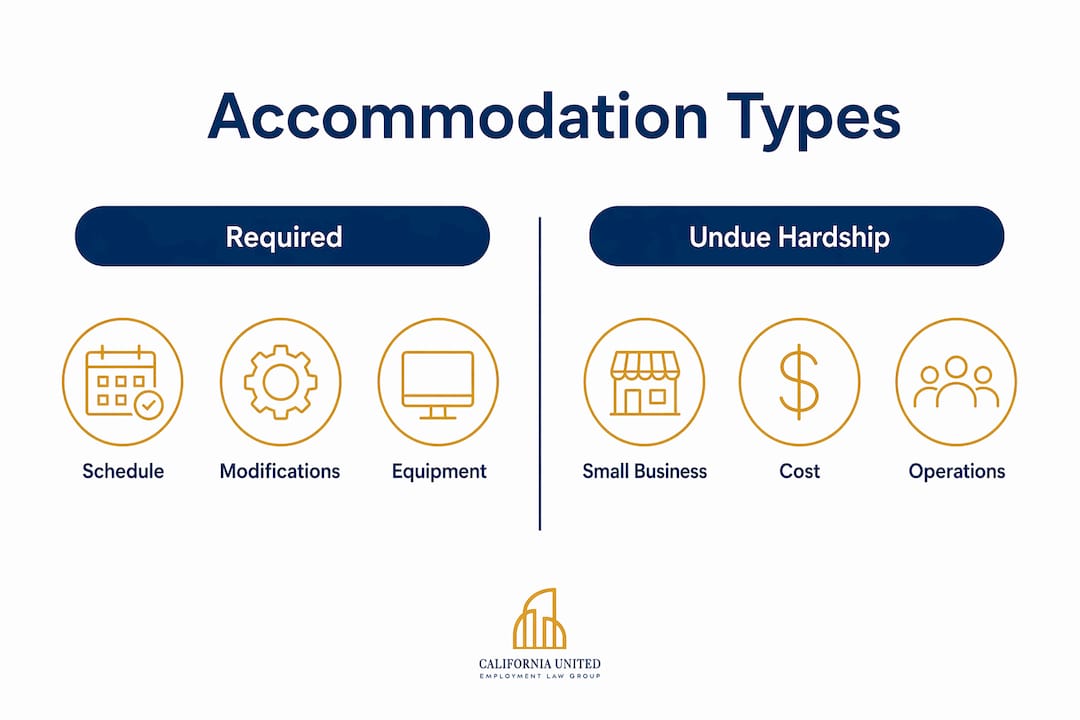
Undue hardship is a fact-specific defense that requires more than a bare assertion of inconvenience, cost, or operational preference. Small businesses may have more latitude than large corporations, but the analysis is always fact-specific. An employer cannot simply claim hardship without evidence.
What can employees do if their accommodation request is ignored or denied?
When an employer fails to engage or denies a request without justification, employees have options. The steps below are not legal advice. They reflect general information about how accommodation disputes typically proceed.
Document everything. Keep copies of all written requests, emails, and notes from verbal conversations. Record dates and the names of anyone you spoke with. Employees who maintain detailed written records improve their ability to assert accommodation rights.
Follow your employer’s internal procedures. Even if no formal form is required, engaging with your company’s accommodation policy protects your rights. Using internal procedures when available can help create a clear record, but the legal analysis still depends on whether both sides participated in good faith and whether the employer met its obligations.
Understand what constitutes a violation. Unlawful conduct includes outright denial without exploring alternatives, unreasonable delay, and bad faith engagement. Unreasonable, unexplained delay may support a violation, even if an accommodation is later granted.
Know your legal options. Employees in West Hollywood may file claims under FEHA with the California Civil Rights Department (formerly DFEH) or under the ADA with the Equal Employment Opportunity Commission (EEOC). These filings are typically required before a lawsuit can proceed.
Consult an employment attorney. Accommodation claims are fact-specific. An attorney can assess whether your employer’s conduct meets the legal threshold for a violation and what remedies may be available.
Pro Tip: If possible, speak with an employment attorney before resigning, because resignation can affect potential claims and remedies.
The employment lawsuit process in California involves specific deadlines and procedural requirements. Missing a filing deadline can bar your claim entirely, regardless of how strong the underlying facts are.
How California and West Hollywood laws enhance employee protections
California’s FEHA provides broader protections than the ADA in several important ways. The table below summarizes key differences.
| Legal Standard | ADA (Federal) | FEHA (California) |
|---|---|---|
| Employer size threshold | 15 or more employees | 5 or more employees |
| Interactive process duty | Required | Affirmative duty, more strictly enforced |
| Definition of disability | Substantially limits a major life activity | Limits a major life activity (lower threshold) |
| Remedies available | Federal damages caps may apply to compensatory and punitive damages | FEHA may allow broader remedies, and certain damages may not be subject to the same federal caps |
| Confidentiality of medical info | Required | Required, with additional state privacy protections |
FEHA’s lower employer size threshold matters significantly in West Hollywood, where many businesses are small or mid-sized. An employer with as few as five employees must comply with FEHA’s accommodation requirements. That coverage gap between federal and state law protects a large share of the West Hollywood workforce that the ADA would not reach.
West Hollywood also has local worker protection ordinances that address scheduling, wage standards, and anti-discrimination policies. While these ordinances do not replace FEHA or the ADA, they may be relevant background for West Hollywood employees evaluating workplace rights.
California law recognizes failure to engage in the interactive process as a separate FEHA violation from failure to provide reasonable accommodation. Depending on the facts, the same conduct may also relate to other disability discrimination claims.
Key Takeaways
Covered West Hollywood employers may violate FEHA, the ADA, or both if they fail to provide required reasonable accommodations or fail to engage in a timely, good faith interactive process. FEHA applies to smaller employers than the ADA, which can give California workers broader protection.
| Point | Details |
|---|---|
| Interactive process is mandatory | Employers must engage promptly and in good faith once an accommodation request is made. |
| Delays can be violations | Courts recognize that unreasonable delays constitute failure to accommodate, even if accommodation is later granted. |
| FEHA covers more employers | California’s FEHA applies to employers with 5 or more employees, compared to 15 under the ADA. |
| Documentation protects employees | Written records of requests and communications are important to preserving accommodation claims. |
| Both parties share responsibility | Employees must also cooperate with the process; failure to do so can weaken a valid claim. |
What I’ve Learned About Accommodation Claims In West Hollywood
The interactive process is often central to accommodation disputes. In my experience reviewing these disputes, the legal question is rarely whether an accommodation was technically possible. The real question is whether the employer treated the employee’s request with genuine seriousness.
Employers in West Hollywood sometimes make the mistake of treating accommodation requests as administrative burdens rather than legal obligations. They delay responses, route requests through HR without any real follow-up, or offer a single alternative and call it good faith. Those facts can become important evidence in evaluating whether the employer acted in good faith.
Employees, on the other hand, sometimes underestimate how much their own participation matters. Skipping the company’s internal process, refusing to provide supporting documentation, or failing to respond to employer outreach can all damage an otherwise strong claim. The law expects both sides to show up.
What I find most important to communicate is this: accommodation claims are fact-specific, and a case does not have to be perfect to deserve careful legal review. If your employer ignored your request, delayed without explanation, or denied it without exploring alternatives, that conduct may be actionable depending on the facts. The first step is understanding what actually happened and whether it crosses the legal line.
— California United Law Group
California United Law Group and West Hollywood Accommodation Claims
California United Law Group represents employees in West Hollywood who believe their employer failed to meet its accommodation obligations under FEHA or the ADA. The firm handles claims at every stage, from pre-litigation through trial, and focuses exclusively on California employment law. If your accommodation request was ignored, delayed, or denied without a good faith process, understanding your rights is the right place to start. Contact California United Law Group to discuss your situation with an attorney who handles these claims regularly. There are no generic answers in accommodation law. Every case turns on its specific facts, and a direct conversation is the most reliable way to understand where you stand.
FAQ
What qualifies as a reasonable accommodation under California law?
A reasonable accommodation is any modification to a job, work environment, or work schedule that allows a qualified employee with a disability to perform essential job functions. Under FEHA, the definition of disability is broader than under the ADA, covering any condition that limits a major life activity.
How long does an employer have to respond to an accommodation request?
California law does not set one universal response deadline for every accommodation request. Employers must engage in a timely, good faith interactive process under the circumstances. Long, unexplained delays can support a failure-to-engage or failure-to-accommodate claim, even if an accommodation is later granted.
Can an employer deny an accommodation request?
Yes. An employer does not always have to provide the exact accommodation requested if another effective reasonable accommodation is available. An employer may also deny an accommodation if it would create an undue hardship, meaning significant difficulty or expense based on factors such as the employer’s size, resources, and operations. An employer cannot deny a request without first engaging in a good faith interactive process to explore all available options.
What should I do if my employer ignores my accommodation request in West Hollywood?
Document all requests and communications in writing, follow your employer’s internal accommodation procedures, and consult an employment attorney. Missing procedural steps or filing deadlines can affect your ability to bring a claim under FEHA or the ADA.
Does FEHA apply to small businesses in West Hollywood?
Yes. FEHA applies to employers with five or more employees, which can include many small and mid-sized West Hollywood businesses. This is a significantly lower threshold than the ADA’s 15-employee minimum, giving California workers broader legal protection.