
This article is for general informational purposes only and does not constitute legal advice. Reading this article does not create an attorney-client relationship. For advice about your specific situation, consult a licensed California employment attorney.
Employee misclassification in Long Beach occurs when a worker who legally qualifies as an employee is labeled an independent contractor, stripping them of key labor protections under California law. This distinction is not a technicality. It determines whether you receive minimum wage, paid sick leave, overtime pay, and workers’ compensation. California uses the ABC test, one of the strictest worker classification standards in the country, to decide your status. If your employer cannot satisfy all three prongs of that test, you are likely an employee under California law, regardless of what your contract says.
What is Long Beach employee misclassification: employee or independent contractor?
Worker misclassification is the formal term for what happens when an employer treats someone as an independent contractor when the law says they should be an employee. In Long Beach, this issue arises across industries including logistics, healthcare, food delivery, construction, and retail. The California Labor Commissioner and the U.S. Department of Labor both have authority to investigate misclassification, but California’s state standard is the one that governs most Long Beach workers day to day.

California law does not defer to what a contract calls you. The law looks at the actual working relationship. A written agreement that says “independent contractor” carries no legal weight if the facts of your work situation say otherwise. That gap between label and reality is where misclassification harms workers.
How does California’s ABC test determine your employee status?
California’s ABC test requires an employer to prove all three of the following conditions to lawfully classify a worker as an independent contractor:
- A. Free from control. The hiring company does not control or direct how you perform your work, either in fact or under the terms of a contract.
- B. Outside the usual course of business. Your work falls outside the company’s core business activities. A delivery driver working for a delivery company fails this prong automatically.
- C. Customarily engaged in an independent trade. You are independently established in the same type of work you perform for this company, with your own clients or business presence.
Failing even one prong means the employer cannot legally classify you as an independent contractor under California law.
California’s ABC test was established by the state Supreme Court in Dynamex Operations West, Inc. v. Superior Court (2018) 4 Cal.5th 903. In Dynamex, the Court ruled that drivers working for a package delivery company were employees because the company failed to satisfy Prongs B and C. The Court placed the burden on the hiring entity — not the worker — to prove each prong. The Legislature then codified the Dynamex ruling in Labor Code section 2775, extending its reach beyond wage orders to the full Labor Code. The California Supreme Court later confirmed in Vazquez v. Jan-Pro Franchising International, Inc. (2021) 10 Cal.5th 944 that Dynamex applies retroactively, meaning workers can use the ABC test even for periods before the 2018 decision.
Prong B is the one most employers struggle with. A traditional transportation company whose core business is moving goods or people cannot classify its drivers as independent contractors under this standard. Note, however, that app-based ride-share and delivery platforms such as Uber and Lyft operate under a distinct framework. California voters passed Proposition 22 in 2020, which classified app-based transportation and delivery drivers as independent contractors with separate (and more limited) protections. The constitutionality of Proposition 22 has been subject to ongoing litigation. Long Beach workers in the gig economy should consult an employment attorney to understand which rules apply to their specific platform and arrangement.
Pro Tip: Keep records of how your work is actually performed, including who sets your schedule, who provides your tools, and whether you work exclusively for one company. These details are what matter most in a classification dispute.
California’s ABC test is stricter than many federal standards. That strictness is intentional. The California Legislature designed it to close loopholes that allowed employers to avoid payroll taxes and deny workers basic protections.
How do federal classification rules compare to California’s ABC test?
The federal standard and California’s ABC test measure the same question but reach different answers in many cases. That gap creates real confusion for Long Beach workers.
| Factor | California ABC Test | Federal Standard (2026 Proposal) |
|---|---|---|
| Legal basis | California Labor Code (AB 5) | Fair Labor Standards Act (FLSA) |
| Number of factors | 3 (all must be met) | 2 core factors (control, profit/loss) |
| Strictness | Very strict | More flexible |
| Who bears the burden | Employer must prove contractor status | Totality of circumstances |
| Relevance to Long Beach workers | Governs state wage and hour claims | Governs federal wage claims |
The U.S. Department of Labor’s 2026 proposed rule plans to rescind the 2024 six-factor test and replace it with a streamlined “core factor” framework focused on control and opportunity for profit or loss. That federal shift does not affect California workers in any meaningful way for state law purposes.
California employees must satisfy the ABC test regardless of how the federal government classifies them. A Long Beach worker could be considered an independent contractor under federal law and still be a legal employee under California law. When that happens, California’s protections apply. The state standard is the one that governs your right to minimum wage, sick leave, and overtime in Long Beach.
What rights do Long Beach employees have that contractors lack?
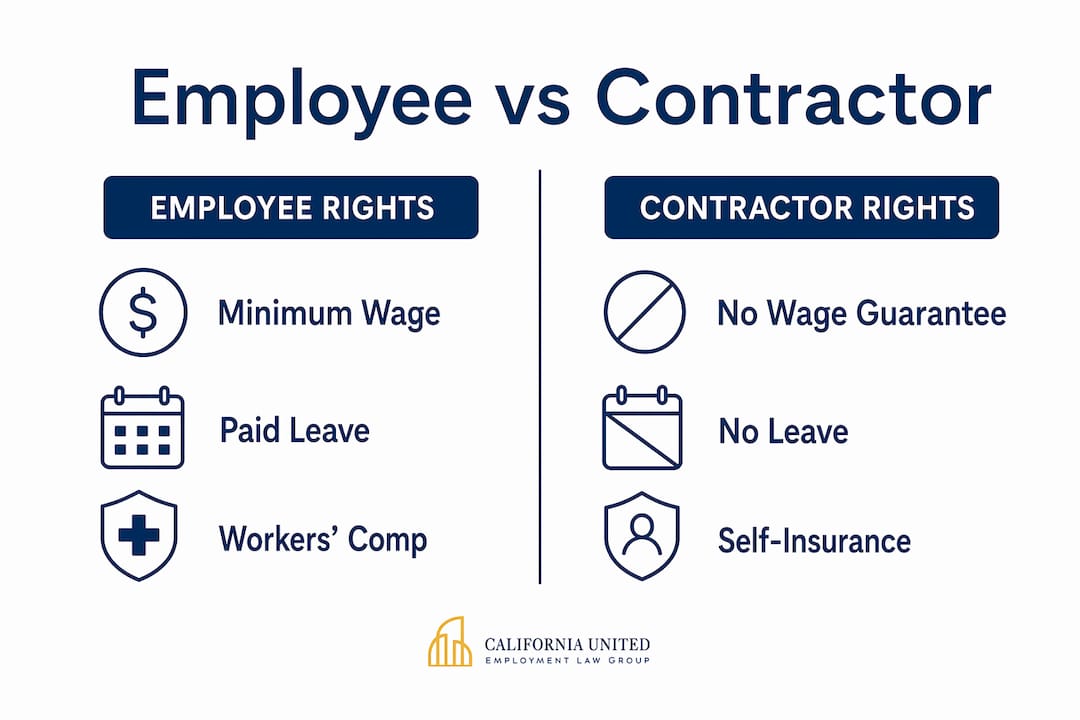
Correct employee classification in Long Beach unlocks a specific set of legal protections. Independent contractors are excluded from all of the following under California law.
Minimum Wage
California Labor Code section 1182.12 sets the statewide minimum wage at $16.50 per hour as of 2025, with annual cost-of-living adjustments. Long Beach has no higher general wage ordinance for 2026, so the state rate applies. Independent contractors have no guaranteed floor on their pay.
Paid Sick Leave
The California Healthy Workplaces Healthy Families Act requires employers to provide at least 40 hours or 5 days of paid sick leave annually to most employees. Sick leave accrues at one hour for every 30 hours worked, or it may be front-loaded at the start of the year. Long Beach does not have a higher citywide sick leave requirement beyond the state standard. Contractors receive none of this by law.
Additional Protections Employees Receive
- Overtime pay. Employees earn 1.5 times their regular rate for hours worked beyond 8 in a day or 40 in a week, and double their regular rate for hours worked beyond 12 in a single day or beyond 8 hours on a seventh consecutive workday in a workweek, under California law.
- Meal and rest breaks. California requires a 30-minute unpaid meal break for shifts over 5 hours and a paid 10-minute rest break for every 4 hours worked.
- Workers’ compensation. Employees injured on the job are covered. Contractors bear the full cost of workplace injuries themselves.
- Unemployment insurance. Employees who lose their jobs may qualify for state unemployment benefits. Contractors do not.
Pro Tip: If you are currently labeled a contractor but your employer controls your schedule, provides your equipment, and your work is central to their business, you may already qualify as an employee under California law. That means you may have claims for unpaid wages and benefits going back several years.
Misclassification leads to significant losses in wages and job protections for workers in cities like Long Beach, where local ordinances do not fully supplement state protections.
What are common signs of misclassification for Long Beach workers?
Recognizing the signs of misclassification is the first step toward understanding your rights. These are the most common red flags:
- Your employer sets your schedule. If you cannot choose your own hours or must be available during specific times the company dictates, that points toward employee status.
- The company provides your tools and equipment. True independent contractors typically supply their own tools, vehicles, or technology. If your employer provides these, that is a sign of control.
- Your work is the company’s core service. A warehouse worker at a logistics company is performing the company’s primary function. That worker almost certainly fails Prong B of the ABC test.
- You work exclusively for one company. Independent contractors typically serve multiple clients. If you work only for one employer and cannot take outside work, that exclusivity signals an employment relationship.
- You have no real opportunity for profit or loss. Contractors run their own businesses and bear financial risk. If your income is simply a set rate per hour or task with no business risk, that points toward employee status.
- The relationship is permanent or indefinite. Long-term, ongoing work arrangements with no defined project end date resemble employment, not contracting.
Signs of misclassification often appear in combination. One factor alone may not be conclusive, but several together build a strong picture of an employment relationship.
What can Long Beach workers do if they suspect misclassification?
Understanding your options is not the same as taking legal action. The steps below are general educational information, not legal advice.
- Review your actual working conditions against the ABC test. Compare how your work is really performed, not just what your contract says, against each of the three prongs.
- File a complaint with the California Labor Commissioner. The Labor Commissioner’s Office investigates wage and hour violations, including those arising from misclassification. You can file a claim online or at a local office.
- Report uncollected taxes using IRS Form 8919. If you believe you were misclassified and your employer did not withhold Social Security and Medicare taxes, IRS Form 8919 allows you to report and pay your share of those taxes.
- Consult an employment attorney. Classification questions are fact-specific. An attorney who focuses on California labor law can assess your specific situation and explain your options.
Worker misclassification cases often involve active class action lawsuits or representative actions under California’s Private Attorneys General Act (PAGA), which allows aggrieved employees to pursue civil penalties for Labor Code violations on behalf of themselves and other workers without meeting the formal requirements of a class action. If you work alongside others in the same role, their experiences may be relevant to your situation.
Key Takeaways
California’s ABC test is the controlling standard for worker classification in Long Beach, and failing even one prong means the employer must treat the worker as an employee with full labor protections.
| Point | Details |
|---|---|
| ABC test governs Long Beach workers | All three prongs must be met for contractor status; one failure means employee status. |
| California standard is stricter than federal | The 2026 federal proposal does not override California’s ABC test for state wage claims. |
| Minimum wage applies to employees only | Long Beach follows California’s $16.50/hour rate; contractors have no guaranteed minimum. |
| Paid sick leave is an employee right | California law provides at least 40 hours annually; independent contractors are excluded. |
| Misclassification has real financial costs | Workers may lose overtime, sick leave, workers’ compensation, and unemployment benefits. |
Why Classification Clarity Matters More Than Most Workers Realize
Worker classification is one of those legal issues that feels abstract until it directly affects your paycheck or your ability to pay a medical bill after a workplace injury. I have seen Long Beach workers spend years believing they were running their own businesses, only to realize they had none of the independence that status is supposed to reflect. They had one client, one schedule, and one set of tools, none of which belonged to them.
California’s ABC test exists precisely because the legislature recognized that the label on a contract does not reflect reality for millions of workers. The state’s approach is not anti-business. It is a recognition that economic dependence on a single employer looks a lot like employment, regardless of what the paperwork says.
The federal standard is shifting again in 2026, and that creates understandable confusion. But for Long Beach workers, the practical answer is straightforward. California law applies to your wage and hour rights, and California’s standard is the stricter one. Federal changes matter for federal claims, but your right to $16.50 per hour, paid sick leave, and overtime is governed by Sacramento, not Washington.
Classification questions are genuinely fact-specific. Two workers at the same company can have different outcomes depending on the details of their arrangements. That complexity is not a reason to do nothing. It is a reason to get clear information about your specific situation before drawing conclusions.
California United Law Group Is Here For Long Beach Workers With Classification Concerns
If you work in Long Beach and believe you may be misclassified as an independent contractor, California United Law Group, P.C. can help you understand your rights under California law. The firm represents employees in wage and hour disputes, including misclassification claims under the California Labor Code. California United Law Group focuses exclusively on employee-side representation, which means the firm’s interests are aligned with yours from the first conversation. To discuss your situation with an employment attorney, contact our team for a consultation. You deserve to know where you stand.
FAQ
What is employee misclassification under California law?
Employee misclassification occurs when a worker who qualifies as an employee under California’s ABC test is labeled an independent contractor. This denies the worker legal protections including minimum wage, overtime, and paid sick leave.
Does Long Beach have its own worker classification rules?
Long Beach follows California state law for worker classification. The city has no separate ordinance overriding the ABC test or the state minimum wage of $16.50 per hour for 2026.
Can I be an employee under California law but a contractor under federal law?
Yes. California’s ABC test is stricter than the federal standard. A worker can fail the ABC test and be classified as an employee under California law while still being considered a contractor under federal rules.
How far back can I claim unpaid wages if I was misclassified?
California courts have confirmed the four-year UCL period “admits of no exceptions” and applies even where the underlying statute has a shorter limitations period. (Cortez v. Purolator Air Filtration Products Co. (2000) 23 Cal.4th 163, 178–179.) An employment attorney can assess the specific timeframe for your situation.
What is the first step if I think I am misclassified?
Compare your actual working conditions against each prong of California’s ABC test. If your employer controls your schedule, provides your tools, and your work is central to their business, consult a California employment attorney to understand your options.
The information in this article is provided for general educational purposes only. It does not constitute legal advice and does not create an attorney-client relationship between the reader and California United Law Group, P.C. Laws change frequently, and the information above may not reflect the most current legal developments. Do not rely on this article as a substitute for advice from a licensed California employment attorney familiar with your specific facts.
Recommended
- Long Beach Port Workers’ Meal & Rest Break Rights Explained – California United Law Group
- Employment Lawyer Long Beach – California United Law Group
- Long Beach Sexual Harassment in the Workplace: Know Your Rights – California United Law Group –
- Can Long Beach Workers Claim Unpaid Wages? Your Rights Explained – California United Law Group