
A Burbank paystub violation is defined as any instance where an employer fails to include required wage details on an employee’s pay statement, making that omission illegal under California Labor Code §226. These are not minor administrative oversights. Under California law, formally called wage statement violations, missing or inaccurate paystub details give employees the right to seek statutory penalties. To recover monetary penalties under §226(e), the violation must be knowing and intentional, but employees do not need to prove they actually lost wages — the law deems an injury to exist when required information is missing and the employee cannot verify their pay from the stub alone. If your paystub in Burbank is incomplete, California law may deem you to have suffered a legal injury — even without proof of lost wages. Whether you are entitled to monetary penalties depends on additional factors, including whether the employer’s violation was knowing and intentional.
Burbank paystub violations: what does California law actually require?
California Labor Code §226 requires every employer to provide a written wage statement with nine specific items at each pay period. Each item serves a distinct verification purpose. Together, they allow you to confirm that your pay is accurate, your hours are counted, and your employer is properly identified.
The nine required items are:
- Gross wages earned during the pay period
- Total hours worked (required for non-exempt employees)
- Piece-rate units and rates, if applicable
- All deductions made from gross wages
- Net wages earned after deductions
- Inclusive pay period dates (a start date and an end date, not just a month name)
- Employee name and last four digits of Social Security number or an employee ID
- Employer’s legal name and address (not a P.O. Box or out-of-state location)
- All applicable hourly rates in effect during the pay period
Burbank employers commonly omit the inclusive pay period dates, listing only something like “October 2025” instead of a specific date range. Others use inaccurate employer addresses such as a P.O. Box or a corporate headquarters located outside California. Both errors are violations under §226.
| Required item | Common violation example |
|---|---|
| Inclusive pay period dates | Only month and year listed, no start or end date |
| Employer legal name and address | P.O. Box used instead of physical address |
| All applicable hourly rates | Only one rate shown when multiple rates apply |
| Total hours worked | Hours omitted for salaried non-exempt employees |
| All deductions | Deductions listed without description or itemization |

Pro Tip: Compare your paystub against this nine-item checklist every pay period. A single missing field is enough to constitute a violation under California law.
How do statutory penalties work for missing wage details?
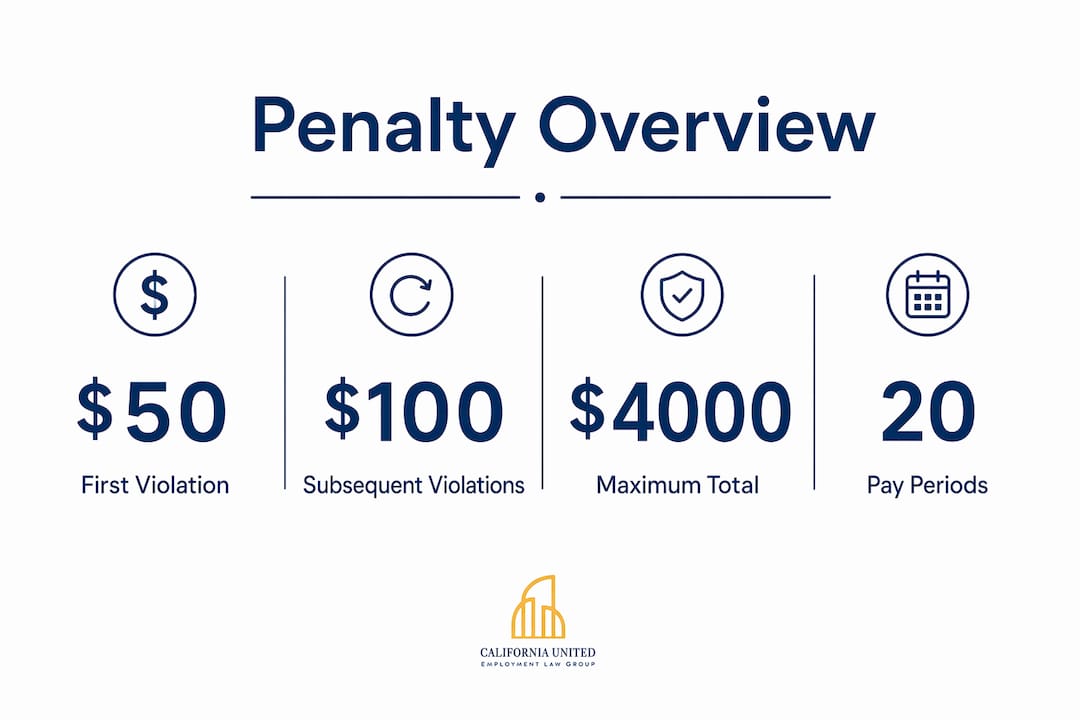
California law sets specific penalty amounts for violations that accumulate quickly. To recover monetary penalties under §226(e), the employer’s violation must be knowing and intentional. When that standard is met, the employee may recover the greater of all actual damages or $50 for the initial pay period in which a violation occurs, and $100 per employee for each subsequent violation. The total statutory penalty is capped at $4,000 per employee. In cases where the actual wage loss caused by the inaccurate paystubs exceeds those flat amounts, the actual damages figure may control.
Here is how those numbers add up in practice:
| Violation number | Penalty per pay period | Running total (biweekly) |
|---|---|---|
| 1st pay period | $50 | $50 |
| 2nd pay period | $100 | $150 |
| 3rd pay period | $100 | $250 |
| 10th pay period | $100 | $950 |
| 40th pay period | $100 | $4,000 (cap reached) |
It is important to understand that the flat statutory penalty amounts described above are available under §226(e) only when the employer’s violation is ‘knowing and intentional.’ California courts have applied a ‘predicate facts’ test, asking whether the employer knew the facts existed that triggered its obligation to comply with §226(a). (Gola v. University of San Francisco (2023) 90 Cal.App.5th 548, 566.) An employer that held a good faith belief that its practices were lawful may raise that belief as a defense. (Naranjo v. Spectrum Security Services, Inc. (2023) 88 Cal.App.5th 937, 951, review granted.) Separately, employees may also pursue civil penalties under California’s Private Attorneys General Act (PAGA, Lab. Code §2698 et seq.), which does not require proof of a ‘knowing and intentional’ violation and provides an additional recovery avenue.
A Burbank employee paid biweekly who has had missing paystub information for 20 pay periods could be owed close to $2,000 in statutory penalties alone. That figure does not include any unpaid wages that the incomplete paystub may have concealed.
One of the most important features of California’s wage statement law is that you do not need to prove you actually lost money in order to establish a legal injury. Under §226(e)(2), the law deems injury to exist when key details are missing and you cannot promptly and easily determine — without reference to other documents — information such as your gross wages, applicable hourly rates, employer identity, or deductions. Missing hourly rates, absent employer information, or vague pay period descriptions all qualify as deemed injury. However, for the court to award monetary penalties rather than just injunctive relief, the employer’s violation must also have been knowing and intentional.
California paystub violations can also signal deeper wage theft issues hidden behind incomplete records. Missing hourly rates or inaccurate time entries may mask unpaid overtime or improper deductions. The paystub is often the first place those problems become visible.
What rules apply to electronic paystubs in Burbank?
Many Burbank employers now deliver pay statements through online portals rather than paper. California law permits electronic delivery, but it comes with firm requirements. Electronic paystub delivery must include free access for employees, the ability to print at no cost, and the right to request paper copies instead.
Employers must also maintain wage statement records for at least three years and make them accessible to employees on request. These obligations apply whether the paystub is paper or digital.
Common electronic paystub compliance failures include:
- Portals that require employees to pay for printing
- Systems that lock employees out after termination or a payroll provider change
- Paystubs stored in formats that cannot be easily downloaded or saved
- No paper opt-out option offered to employees who request one
Changing payroll providers is a particularly common trigger for access problems. When a company switches systems, employee accounts from the old platform are often deactivated. If you cannot retrieve past pay statements, that access failure can itself constitute a violation.
Pro Tip: Download and save every electronic paystub as a PDF immediately after each pay period. If your employer changes payroll systems or your account is deactivated, you will still have your own records.
How can Burbank employees identify and respond to paystub violations?
Recognizing a violation is the first step. Responding to it correctly protects your rights and preserves your ability to recover penalties.
Review each paystub against the nine required items. Check for missing dates, absent hourly rates, and incomplete employer information. Do this for every pay period, not just the most recent one.
Keep a written log. Record which pay periods have missing or inaccurate details. Note the specific items that are absent. This log becomes evidence if you file a complaint.
Submit a written request to your employer. Request corrected paystubs in writing before escalating to a state agency. A written request creates a paper trail and gives your employer a chance to correct the error. Send it by email so you have a timestamped record.
File a complaint with the California Labor Commissioner. If your employer does not respond or refuses to correct the paystubs, you can file a wage claim with the California Division of Labor Standards Enforcement (DLSE). The DLSE handles wage statement violations and can order penalties and back pay.
Consult an employment attorney promptly. California has statutes of limitations on wage claims. Waiting too long can eliminate your right to recover penalties, even if the violations are clear.
Burbank employees should also be aware that California Labor Code rights extend well beyond paystubs. Wage statement violations often accompany other issues such as unpaid overtime or missed meal breaks. Reviewing your full pay history when you find one violation is a sound practice.
Pro Tip: If you are unsure whether your paystub is compliant, compare it to a paystub from a prior employer or ask a labor attorney for a free review. Many employment firms offer no-cost initial consultations.
Key Takeaways
California Labor Code §226 makes missing wage details on paystubs a legal violation in Burbank, and employees can recover statutory penalties without proving they lost wages.
| Point | Details |
|---|---|
| Nine items are required | Every California paystub must include gross wages, hours, deductions, net wages, pay period dates, employee ID, employer address, and hourly rates. |
| Penalties accumulate fast | Violations cost $50 for the first pay period and $100 for each subsequent one, up to $4,000 per employee. |
| Injury is presumed by law | The law deems legal injury to exist when missing details prevent you from verifying your wages from the stub alone — no proof of actual wage loss is required for the injury element. However, to recover monetary penalties under §226(e)(1), the employer’s violation must also be knowing and intentional. Injunctive relief may be available regardless. |
| Electronic paystubs carry obligations | Employers must provide free access, printing capability, and a paper opt-out option for digital wage statements. |
| Act before deadlines | California statutes of limitations apply to wage claims. Delayed action can forfeit your right to penalties. |
What I Have Seen Working These Cases
Paystubs are legal compliance documents. They are not just receipts for your paycheck. That distinction matters more than most employees realize.
In my experience, the violations that cause the most damage are not the dramatic ones. They are the quiet, repetitive omissions. An employer who lists only “November 2025” instead of specific pay period dates, or who uses a P.O. Box as the company address, may not intend to deceive anyone. But California law does presume legal injury when key details are missing and an employee cannot promptly verify wages from the stub alone — proof of intent is not required to establish that injury. But the law is not so simple when it comes to collecting monetary penalties. Penalties under §226(e) require that the employer’s violation be knowing and intentional, and courts look to whether the employer knew the facts that triggered its compliance obligation. Employers have attempted to defeat penalty claims by arguing a good faith belief in their practices. That defense is currently being addressed by the California Supreme Court, and the law continues to develop in this area. Employees with clear, repeated omissions on their paystubs — especially where those omissions benefit the employer — will generally present stronger penalty claims than those involving isolated or ambiguous errors.
What concerns me most is how often these small errors mask larger problems. A paystub that omits applicable hourly rates is frequently hiding a wage calculation that would not survive scrutiny. Missing overtime rates, blended rate errors, and improper deductions all become harder to detect when the paystub does not show the full picture. The incomplete paystub is not just a technical violation. It is often a symptom.
California law does presume legal injury when key details are missing and an employee cannot promptly verify wages from the stub alone — proof of intent is not required to establish that injury. But the law is not so simple when it comes to collecting monetary penalties. Penalties under §226(e) require that the employer’s violation be knowing and intentional, and courts look to whether the employer knew the facts that triggered its compliance obligation. Employers have attempted to defeat penalty claims by arguing a good faith belief in their practices. That defense is currently being addressed by the California Supreme Court, and the law continues to develop in this area. Employees with clear, repeated omissions on their paystubs — especially where those omissions benefit the employer — will generally present stronger penalty claims than those involving isolated or ambiguous errors.
California courts have been enforcing §226 penalties with increasing consistency, and employers in Burbank are not exempt from that trend. If your paystub has been missing required details for multiple pay periods, the penalties owed to you may already be substantial. The time to act is before the statute of limitations closes, not after.
California United Law Group Helps Burbank Employees With Paystub Violations
If your paystub is missing required wage details, you may already have a valid claim under California Labor Code §226.
California United Law Group, California United Law Group, P.C., represents employees in Burbank and across California in wage and hour disputes, including wage statement violations. The firm handles claims at every stage, from initial review through litigation. If you have noticed missing pay period dates, absent hourly rates, or incomplete employer information on your pay statements, a case evaluation can clarify what you are owed.
Contact Gerardo J. Sosa at California United Law Group to schedule a consultation about your wage statement rights. Employees in Burbank dealing with similar paystub compliance issues in neighboring cities have found that early legal review makes a significant difference.
FAQ
What is a paystub violation under California law?
A paystub violation occurs when an employer fails to include any of the nine items required by California Labor Code §226 on a wage statement. Employees can recover statutory penalties without proving they lost wages.
How much can I recover for paystub violations in Burbank?
Under §226(e), when an employer’s violation is knowing and intentional, employees may recover the greater of all actual damages or $50 for the first pay period in which a violation occurs and $100 for each subsequent pay period, up to a maximum of $4,000 per employee. Employees may also pursue civil penalties through PAGA, which provides a separate recovery avenue.
Does my employer have to give me a paper paystub?
California law allows electronic delivery, but employees have the right to request paper copies at no cost. Employers must also provide free access and printing capability for digital wage statements.
What should I do if my paystub is missing required information?
Document the missing details, submit a written correction request to your employer, and consult an employment attorney if the issue is not resolved. Acting promptly protects your right to recover penalties before claim deadlines pass.
Can a missing paystub detail reveal unpaid wages?
Yes. Incomplete paystubs, particularly those missing hourly rates or accurate time records, can conceal unpaid overtime or improper deductions that would otherwise be visible on a compliant wage statement.
Recommended
- Are Alhambra employers breaking California paystub laws? – California United Law Group
- Are Alhambra employers violating California paystub laws? – California United Law Group
- Inglewood Paystub Rights: What You’re Owed And How To Act – California United Law Group –
- Broken Employment Contracts in Burbank: Employee Rights – California United Law Group