
If you work at Amazon or Apple near Culver City, you’ve likely felt the anxiety that comes with constant headlines about tech layoffs. The fear is understandable. But the reality on the ground may surprise you. While Amazon made executive cuts at its MGM Studios location in late 2025, Apple is actually expanding its Culver City footprint, not shrinking it. Before you assume the worst about your job, it’s worth separating fact from fear. This article breaks down what actually happened, what wrongful termination means under California law, and what you should do if you believe your rights were violated.
Disclaimer: This article is for informational purposes only and does not constitute legal advice. The outcome of any legal matter depends on the specific facts and circumstances of each case. Reading this article does not create an attorney-client relationship with California United Law Group, P.C.
Table of Contents
- Understanding recent layoffs at Amazon and Apple near Culver City
- What counts as wrongful termination in California?
- Apple versus Amazon: Comparison of job security and layoff concerns in Culver City
- What to do if you suspect wrongful termination at Amazon or Apple
- Most workers fear layoffs, but evidence matters most
- Get help if you suspect wrongful termination
- Frequently asked questions
Key Takeaways
| Point | Details |
|---|---|
| Apple expanding locally | Apple is building new offices in Culver City and has not announced layoffs there. |
| Amazon layoffs limited | Amazon MGM Studios had layoffs affecting executives, but there are no reports of wrongful termination lawsuits in Culver City. |
| Legal rights remain strong | California employees have protections against wrongful termination, especially for discrimination or retaliation. |
| Specific evidence is key | No credible evidence has linked recent Culver City layoffs at these companies to wrongful termination as of 2026. |
Understanding recent layoffs at Amazon and Apple near Culver City
The tech industry has been through significant turbulence. Thousands of workers across the country have been affected by cost-cutting, restructuring, and shifts toward AI-driven operations. It’s natural to wonder whether your employer in Culver City is next.
But the local picture is more nuanced than the national headlines suggest.
Apple near Culver City is not laying off workers. In fact, Apple is building expansive offices in the area, signaling long-term investment and growth. Construction is ongoing, and the company appears committed to increasing its local presence rather than pulling back.
Amazon MGM Studios in Culver City tells a different story. Amazon MGM Studios saw executive layoffs in October 2025, part of a broader round of Amazon cuts affecting multiple divisions. These were real job losses, primarily at the executive level, tied to Amazon’s company-wide restructuring.
Here’s a quick summary of what the evidence shows:
| Company | Culver City activity | Layoffs reported? |
|---|---|---|
| Apple | Expanding, new offices under construction | No |
| Amazon MGM Studios | Executive restructuring | Yes, October 2025 |
“No specific layoffs have been reported at Apple offices near Culver City. Apple is expanding its local presence with new office construction underway as of early 2025.”
As of early 2026, public records do not show confirmed wrongful termination lawsuits tied to either company’s Culver City location. However, this does not mean individual employees may not have valid claims, as many employment matters are resolved privately or may not yet be filed. That doesn’t mean individual employees haven’t been affected, but it does mean the situation is far less alarming than social media might suggest.
If you work in the area, understanding your specific Culver City worker protections is the smartest first step you can take right now.
Now that we’ve set the context for recent company actions, let’s define wrongful termination and its legal framework in California.
What counts as wrongful termination in California?
California follows the at-will employment doctrine. Subject to important exceptions discussed below, this generally means an employer can terminate an employee at any time, for any lawful reason, or for no reason at all. But that rule has important exceptions, and those exceptions are where your legal rights live.
Wrongful termination occurs when an employer fires you for an illegal reason. Under California law, a termination becomes unlawful when it violates:
- Anti-discrimination laws: You cannot be fired because of your race, gender, age, disability, religion, national origin, or other protected characteristics under the Fair Employment and Housing Act (FEHA).
- Retaliation protections: California law (including Labor Code § 1102.5 and Government Code § 12940(h)) prohibits employers from retaliating against employees who report illegal activity, file complaints about working conditions, or engage in other protected activities.
- Public policy violations: Terminating someone for serving on jury duty, whistleblowing, or refusing to do something illegal crosses a clear legal line.
- Contract violations: If you have an employment contract, written or implied, your employer must follow its terms before letting you go.
Not every layoff is a wrongful termination. Broader tech layoffs driven by cost-cutting and AI restructuring are generally lawful, even if they feel unfair. The key question is why you were fired and how the decision was made.
Pro Tip: If your termination happened shortly after you filed a complaint, requested medical leave, or raised a concern about workplace conduct, that timing can be significant evidence of retaliation.
California also provides stronger worker protections than most states. Courts here look carefully at the circumstances surrounding a termination, not just the employer’s stated reason. Understanding wrongful termination in California means knowing that the burden often shifts once you show a suspicious pattern.
California courts have recognized that employment terminations violating fundamental public policy are actionable even in at-will employment relationships. In Tameny v. Atlantic Richfield Co. (1980) 27 C3d 167, 164 CR 839, the California Supreme Court established that tort remedies are available for discharge contrary to fundamental public policy. This landmark decision paved the way for wrongful termination claims based on various public policy violations, including discrimination, retaliation, and refusing to engage in illegal conduct.
When pursuing wrongful termination claims, California courts apply a burden-shifting framework derived from McDonnell Douglas Corp. v. Green (1973) 411 US 792, 802, 93 S.Ct. 1817, 1824. Under this framework, you must first establish a prima facie case by showing: (1) you belong to a protected class or engaged in protected activity, (2) you suffered an adverse employment action, and (3) a causal connection exists between the two. Once you establish this initial showing, the burden shifts to your employer to articulate a legitimate, non-discriminatory reason for the termination. You then have the opportunity to prove that the employer’s stated reason is pretextual—merely a cover for the real discriminatory or retaliatory motive.
For retaliation claims specifically, Yanowitz v. L’Oreal USA, Inc. (2005) 36 Cal.4th 1028, 1042 established that a plaintiff must show: (1) engagement in a protected activity, (2) an adverse employment action by the employer, and (3) a causal link between the protected activity and the adverse action. The timing of your termination relative to your protected activity can be powerful circumstantial evidence of this causal link.
Even if you weren’t formally fired, the doctrine of constructive discharge may apply. As the California Supreme Court explained in Turner v. Anheuser-Busch, Inc. (1994) 7 Cal.4th 1238, constructive discharge occurs when an employer’s conduct effectively forces an employee to resign, creating conditions so intolerable that a reasonable person would feel compelled to quit. The court emphasized that ‘a constructive discharge is legally regarded as a firing rather than a resignation.’ This doctrine prevents employers from attempting ‘end runs’ around wrongful discharge liability by creating unbearable working conditions instead of formally terminating employment.
A useful starting point is reviewing the illegal termination criteria that California courts apply. Even if your employer calls it a layoff, the facts may tell a different story.
Statistic to know: California’s Fair Employment and Housing Act (Gov. Code § 12900 et seq.) covers employers with five or more employees, meaning most tech workers at large companies like Amazon and Apple are fully protected under state anti-discrimination law.
Apple versus Amazon: Comparison of job security and layoff concerns in Culver City
Let’s put both companies side by side so you can see where the real risks lie for employees in the Culver City area.
| Factor | Apple (Culver City) | Amazon MGM Studios (Culver City) |
|---|---|---|
| Recent layoffs | None reported | Executive cuts, October 2025 |
| Expansion activity | Active construction | Restructuring ongoing |
| Wrongful termination cases | None confirmed | None confirmed locally |
| Employee risk level | Low based on current data | Moderate for affected roles |
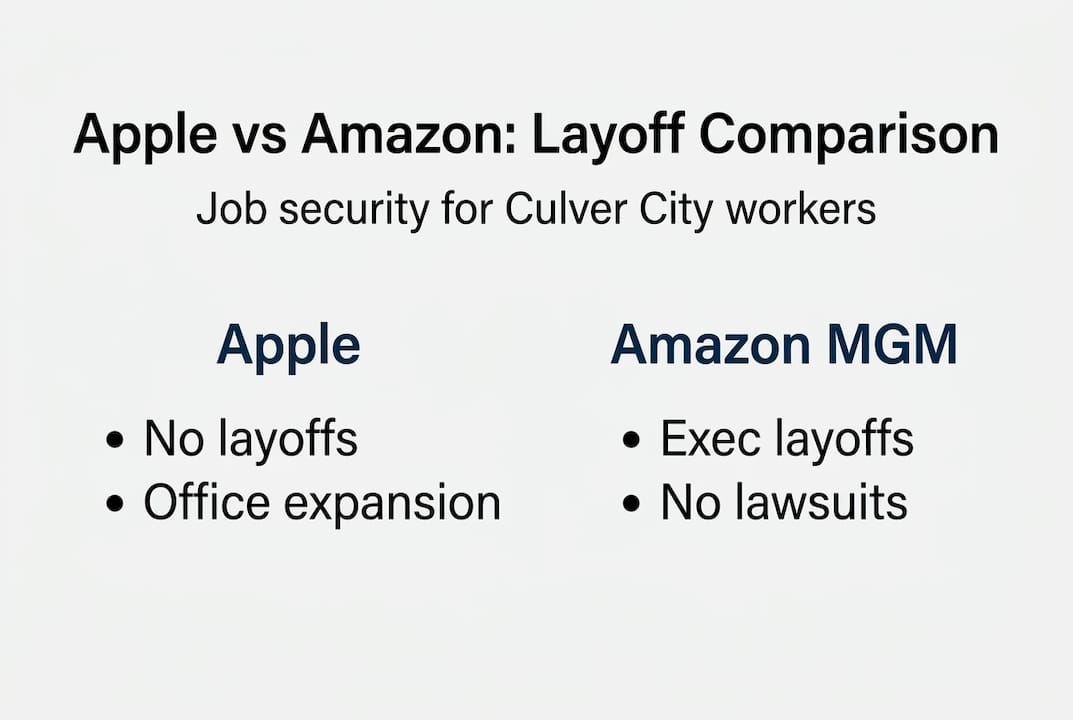
Apple shows no signs of layoffs near Culver City. The construction of new offices is a strong indicator that the company is investing in the region for the long term. If you work at Apple in this area, your job security appears solid based on the available evidence.
Amazon’s situation is more complicated. The October 2025 executive cuts at MGM Studios were real, and they reflect Amazon’s broader push to streamline operations across its entertainment and streaming divisions. However, these cuts were concentrated at the leadership level.
“Amazon’s MGM Studios layoffs in Culver City were part of a wider restructuring effort across Amazon’s divisions, not a targeted action against any specific protected group.”
For rank-and-file employees at Amazon, the risk is lower than headlines might suggest. Still, if you were among those affected, you deserve to know whether your termination followed proper legal procedures.
For broader context on how California employment law applies to situations like these, reviewing legal insights for tech layoffs can help you understand what questions to ask and what patterns to watch for.
What to do if you suspect wrongful termination at Amazon or Apple
If you’ve been let go and something feels off, here are the concrete steps you should take.
Write everything down immediately. Document the circumstances of your termination: the date, who told you, what reason was given, and any conversations that led up to it. Memory fades fast, and written notes carry weight.
Gather your employment records. Collect performance reviews, emails, offer letters, and any written policies your employer provided. These documents can show whether the stated reason for your firing holds up.
Review the California WARN Act. If your employer conducts a mass layoff affecting 50 or more employees at a single location, California law requires 60 days of advance written notice. A violation of this rule can entitle you to back pay and benefits.
Understand the employment lawsuit process. California has specific deadlines for filing claims. Missing them can cost you your right to pursue legal action entirely.
Know your retaliation rights. If you reported misconduct before being fired, California’s workplace retaliation protections may apply directly to your situation.
Consult an employment attorney. An initial consultation can help you determine whether what happened to you crosses the legal line from a painful layoff into an unlawful termination.
Pro Tip: Don’t sign any severance agreement before speaking with a lawyer. Once you sign, you may waive your right to sue, even if the termination was illegal.
Most workers fear layoffs, but evidence matters most
Here’s something we see often: employees come to us convinced their situation is hopeless because of what they read online. National tech layoff headlines create real fear, and that fear can cloud your ability to assess your actual situation clearly.
The Culver City data is a good example of why local facts matter. Apple is actively expanding in the area, not retreating. Amazon’s cuts were reportedly concentrated at the executive level and, as of early 2026, public records do not show confirmed wrongful termination cases filed locally. However, individual circumstances vary, and employees should evaluate their specific situations.

We believe the smartest thing you can do is separate national noise from local reality. Read the actual reports. Look at what your specific employer is doing in your specific location. Then assess your risk based on evidence, not anxiety.
If something still feels wrong after you’ve looked at the facts, that instinct deserves attention. Understanding your tech worker legal protections in California gives you the foundation to make an informed decision rather than a reactive one.
Get help if you suspect wrongful termination
If you’re an Amazon or Apple employee near Culver City and you’re worried about your job or believe your termination was unlawful, you don’t have to figure this out alone.
👉 California United Law Group, P.C. represents employees in employment law matters throughout California. We offer consultations to help individuals understand their rights under California employment law. Our firm has experience assisting workers with evaluating potential claims and navigating the legal process. If you believe your rights may have been violated, we are available to discuss your situation. Past results do not guarantee future outcomes, and each case is evaluated on its individual merits.
While this article discusses employment law as it relates to the Culver City area, California United Law Group, P.C. represents clients throughout California in employment law matters.
Frequently asked questions
Were there any layoffs at the Apple offices near Culver City?
No. Recent reports confirm that Apple is expanding its Culver City offices, and no layoffs have been announced at this location.
Did Amazon’s layoffs in Culver City lead to wrongful termination lawsuits?
As of late 2025, no wrongful termination lawsuits have been reported in connection with Amazon MGM Studios layoffs in Culver City, though individual employees may still have valid claims worth reviewing.
What should I do if I think my termination was wrongful?
Document everything right away, review your rights under California law, and speak with an employment attorney as soon as possible before signing any severance agreement.
Does the California WARN Act apply to tech layoffs at Amazon and Apple?
The California WARN Act (Labor Code § 1400 et seq.) generally requires employers to provide 60 days’ advance written notice before a mass layoff, relocation, or termination affecting 50 or more employees at a single site of employment within a 30-day period. Specific requirements and exceptions apply, and affected employees should consult with an attorney to understand their rights.