
Many Long Beach port workers stay silent about dangerous conditions because they fear losing their jobs. That fear is understandable, but it is also based on a misconception. Both California state law and federal regulations specifically protect you from punishment when you report a workplace safety issue. Knowing where those protections come from, what retaliation actually looks like, and what steps to take if your employer crosses the line can make the difference between staying safe and staying silent. This article walks you through all of it.
Table of Contents
- Understanding your rights: Reporting safety issues at the port
- What counts as retaliation—and what doesn’t?
- How to report safety issues: Step-by-step for Long Beach port workers
- If you experience retaliation: What comes next?
- The Port of Long Beach: Local enforcement and special programs
- The real challenge: Bridging the gap between rights and reality
- Get help if your rights are threatened
- Frequently asked questions
Key Takeaways
| Point | Details |
|---|---|
| Reporting is legally protected | Long Beach port workers cannot be punished for reporting safety concerns to regulators. |
| Know what counts as retaliation | Illegal retaliation includes firing, demotion, or negative treatment because of safety reporting. |
| Act quickly on retaliation | Retaliation complaints must be filed with OSHA within 30 days to protect your rights. |
| Local programs support your rights | The Port’s Labor Compliance Program reinforces protections, giving workers multiple ways to report and seek help. |
Understanding your rights: Reporting safety issues at the port
If you work at the Port of Long Beach, you are covered by a layered set of legal protections whenever you report a safety hazard or file a complaint. These protections come from both state and federal sources, and they apply whether you are a longshoreman, a truck driver, a crane operator, or any other port employee.
On the state level, California Labor Code §6310 prohibits retaliation against employees for reporting hazards or filing complaints. California courts have interpreted this protection broadly. In Lujan v. Minagar (2004) 124 Cal.App.4th 1040, 1045-1046, the court held that employers cannot engage in ‘preemptive retaliation’—firing an employee whom the employer fears will file a safety complaint—even before any complaint is actually filed.
On the federal level, Section 11(c) of the Occupational Safety and Health Act (29 U.S.C. § 660(c)) prohibits retaliation against employees who exercise their rights under OSHA. Port workers may also have protections under the Longshore and Harbor Workers’ Compensation Act (LHWCA), which provides coverage for maritime workers who are not classified as seamen.
Here is a quick look at the actions these laws protect:
- Reporting a safety hazard to a supervisor, manager, or government agency
- Filing a formal complaint with Cal/OSHA or federal OSHA
- Participating in workplace safety inspections or investigations
- Refusing to perform work you reasonably believe poses an imminent danger
- Testifying in a safety-related proceeding
Courts have consistently held that these protections are broad. In Cabesuela v. Browning-Ferris Industries of California, Inc. (1998) 68 Cal.App.4th 101, 109, the court found that an employee stated a claim under Labor Code §6310 even where the employee complained to the employer’s management rather than to a government agency, because the statute protects complaints made ‘to the employer.’
Retaliation, in legal terms, means any adverse action your employer takes because you engaged in one of these protected activities. It is not limited to firing. Demotion, schedule changes, pay cuts, and hostile treatment can all qualify.
Your right to report a safety issue is not a favor your employer grants you. It is a legal protection you already have.
Understanding your Long Beach safety rights is the first step toward exercising them confidently. If you have ever hesitated to speak up because you worried about the consequences, knowing these protections exist should change how you approach that decision. You also have broader workplace retaliation rights under California law that go beyond just safety reporting.
What counts as retaliation—and what doesn’t?
Not every negative experience at work after you file a complaint is retaliation. Employers are still allowed to discipline employees for legitimate, unrelated reasons. The key question is whether the employer’s action was motivated by your protected activity.
Here is a comparison to illustrate potential differences. Whether conduct constitutes illegal retaliation depends on the specific facts and circumstances of each case:
| Situation | Legal or illegal? |
|---|---|
| Fired the day after filing a Cal/OSHA complaint | May constitute illegal retaliation |
| Written up for being late, unrelated to any complaint | Likely legal discipline |
| Demoted after reporting a crane malfunction | May constitute illegal retaliation |
| Passed over for promotion due to documented performance issues | May be legal |
| Assigned worse shifts after testifying in a safety investigation | May constitute illegal retaliation |
Illegal retaliation often shows up in these specific ways:
- Sudden termination shortly after a complaint is filed
- Unexplained demotion or reduction in hours
- Hostile treatment or isolation from coworkers
- Threats about job security tied to your complaint
- Negative performance reviews that appear out of nowhere
Port-specific labor compliance programs enforce wage and safety laws with no exception for safety reporting. This means the Port’s own compliance structure reinforces your right to speak up without fear.
Pro Tip: Keep a written log of every interaction with your employer after you file a complaint. Note dates, times, what was said, and who was present. This record can be critical evidence if you later need to prove retaliation.
If you are unsure whether what happened to you crosses the line, reviewing your reporting misconduct rights can give you a clearer picture. You can also find broader context in our legal insights section.
How to report safety issues: Step-by-step for Long Beach port workers
Knowing your rights is one thing. Taking action is another. Here is exactly how to report a safety issue at the Port of Long Beach.
- Document the hazard first. Write down what you observed, when you saw it, where it was located, and who else witnessed it. Take photos if it is safe to do so.
- Report internally. Notify your supervisor or safety officer in writing. Keep a copy of everything you submit.
- Contact Cal/OSHA. You can file a complaint online at www.dir.ca.gov/dosh/complaint.htm, by phone, or by mail. Your complaint can be anonymous. Cal/OSHA covers most California workplaces and has authority to inspect and cite employers.
- Contact federal OSHA if maritime operations are involved. Federal OSHA covers longshore and maritime work under the Longshore and Harbor Workers’ Compensation Act framework.
- Reach out to the Port’s compliance office. The Port of Long Beach has its own labor compliance structure that handles safety and wage concerns.
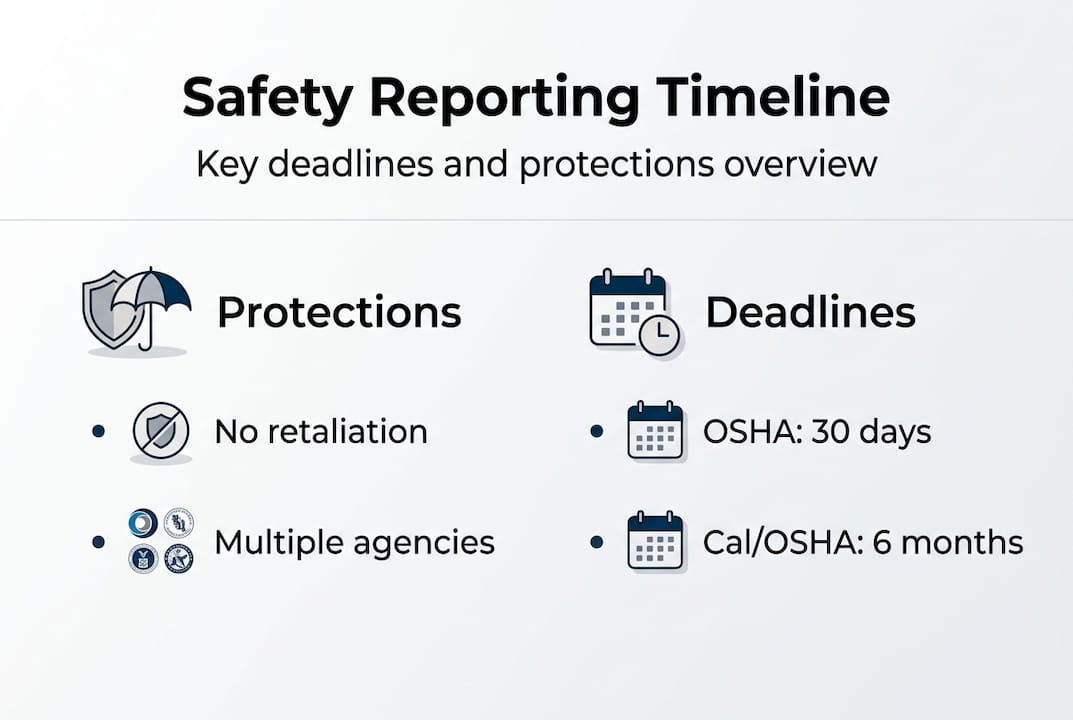
Here are key deadlines you need to know:
| Type of claim | Filing deadline |
|---|---|
| Federal OSHA retaliation complaint | 30 days from adverse action |
| Cal/OSHA retaliation complaint | 6 months from adverse action |
| California Labor Code §6310 claim | 1 year from adverse action |
The federal deadline is the tightest. If you believe your employer retaliated against you after a federal OSHA complaint, you have only 30 days to file. Do not wait.
Pro Tip: Always file your complaint in writing, even if you also call. Written records create a paper trail that protects you if your employer later denies knowing about your complaint.
For a full walkthrough of the process, see our guide on how to report safety issues as a Long Beach port worker.
If you experience retaliation: What comes next?
If your employer punishes you after you report a safety issue, you have options. Acting quickly and strategically matters.
Here is what to do right away:
- Write everything down. Document every retaliatory act, including dates, what happened, and who was involved.
- Save all communications. Keep emails, texts, and written notices from your employer.
- Tell a trusted coworker. A witness who observed the retaliation can support your case.
- Do not resign. Quitting can complicate your legal claims. Stay on the job if you can do so safely.
- File a complaint promptly. Contact Cal/OSHA, federal OSHA, or both, depending on your situation.
If your complaint is validated, the law may provide remedies depending on the circumstances of your case. Available remedies can include reinstatement, back pay, and compensatory damages. The specific remedies available depend on the strength of your evidence, which statute your claim is brought under, and the particular facts of your case.
Retaliation for reporting safety violations is prohibited by both state and federal law, and legal remedies may be available to protect your rights.
Knowing your legal rights after retaliation helps you move forward with confidence rather than confusion. An employment attorney can help you evaluate your situation, meet your deadlines, and build the strongest possible case.
The Port of Long Beach: Local enforcement and special programs
Beyond state and federal law, the Port of Long Beach operates its own compliance infrastructure that adds another layer of accountability for employers.
The Port’s Labor Compliance Program enforces prevailing wage and safety laws, with no exception carved out for workers who report safety violations. This is important because it means local enforcement reinforces, rather than undermines, your right to speak up.
Here is how the Port’s program interacts with broader protections:
- The Port’s compliance office can investigate wage and safety violations independently
- Port contractors are required to comply with both state and federal labor laws
- Workers can report concerns directly to the Port’s compliance office in addition to state and federal agencies
- The Port’s program does not limit or replace your rights under California Labor Code or federal OSHA
This layered system means you have multiple avenues for reporting and multiple agencies that can respond. You are not limited to one path.
If you work for a Port contractor, your employer is still bound by the same rules. The Port’s compliance requirements flow down to contractors, which means subcontractors and their employees are also covered.
If you are unsure which agency to contact or how local enforcement applies to your specific situation, speaking with a Long Beach employment lawyer can help you map out the right approach.
The real challenge: Bridging the gap between rights and reality
Here is something we see consistently in our work with port workers: the law is clear, but the experience of using it is not always straightforward.
Fear of retaliation does not disappear just because a statute prohibits it. Employers sometimes use subtle tactics, like shifting schedules, assigning undesirable tasks, or creating a chilly atmosphere, that are hard to prove but very real to experience. Workers often second-guess themselves and wonder whether what happened was really retaliation or just bad luck.
What actually separates successful safety reporting from failed attempts is documentation and speed. Workers who keep detailed records from day one, who report in writing, and who contact an attorney early have significantly better outcomes. Those who wait, hoping things will improve, often find that deadlines have passed and evidence has faded.
Another underappreciated factor is community. Port workers who connect with coworkers who have faced similar situations, or who work with unions that understand these rights, are far less isolated when trouble arises.
Our practical safety reporting tips reflect what we have learned from real cases. The law gives you the right. Preparation gives you the power to use it.
Get help if your rights are threatened
At California United Law Group, P.C., we represent Long Beach port workers and other California employees who face retaliation for doing the right thing. If you reported a safety issue and your employer responded with punishment, we want to hear from you.
👉 Our Long Beach employment lawyer team understands the specific laws that protect port workers and can help you evaluate your options quickly.
Each case is unique, and outcomes depend on the specific facts and circumstances. Prior results do not guarantee or predict future outcomes.
If you were fired after reporting a hazard, you may also have a claim for wrongful termination in California. We handle these cases at every stage, from the first complaint through litigation. Reach out today for a confidential consultation. You do not have to navigate this alone.
Frequently asked questions
Can my employer fire me for reporting unsafe conditions at the Port of Long Beach?
No. Both California Labor Code §6310 and federal OSHA Section 11(c) prohibit employers from retaliating against employees for reporting safety hazards. If you were fired or faced other negative consequences after reporting a safety concern, you may have the right to file a complaint and seek remedies, subject to strict filing deadlines.
What should I do if I experience retaliation after filing a Cal/OSHA complaint?
Document the retaliation immediately, save all related communications, and contact Cal/OSHA or a qualified attorney. Available remedies for proven retaliation can include reinstatement and back pay, depending on the specific circumstances of your case. Acting fast protects your ability to file within required deadlines.
Are there deadlines to file a retaliation complaint under OSHA rules?
Yes, and they are strictly enforced. Federal OSHA Section 11(c) retaliation complaints must be filed within 30 days of the retaliatory action. Cal/OSHA retaliation complaints generally have a 6-month deadline. California Labor Code §6310 civil claims have a 1-year statute of limitations. Missing these deadlines can permanently bar your claims, so immediate action is critical.
Does the Port of Long Beach have its own rules beyond state and federal law?
The Port administers a Labor Compliance Program that enforces safety and wage laws, but it does not override your legal right to report safety issues. The Port of Long Beach Labor Compliance Program adds accountability without limiting your existing protections.