
ATTORNEY ADVERTISEMENT. This article provides general information only and does not constitute legal advice. Reading this article does not create an attorney-client relationship. Every case is different and outcomes depend on specific facts and circumstances. Past results do not guarantee or predict future outcomes.
Many employees in California assume they have no legal options unless they work directly for large employers. California law protects qualifying employees from hostile work environments regardless of their employment arrangement. California law protects all qualifying employees from hostile work environments, regardless of who signs their paycheck. Whether you work for a vendor, a production company, or a business adjacent to the studio, you may have a valid claim under the Fair Employment and Housing Act (FEHA). This guide walks you through your rights, what qualifies legally, and exactly how to take action.
Table of Contents
- Who is covered under California hostile work environment laws?
- What legally qualifies as a hostile work environment?
- The lawsuit process for hostile work environment claims
- Sony Pictures: Relevant cases and what they mean for you
- Employer liability: Supervisors, coworkers, and third parties
- Get expert help: Legal support for Culver City hostile work environment cases
- Frequently asked questions
Key Takeaways
| Point | Details |
|---|---|
| Legal coverage is broad | You are likely protected even if you are not a direct Sony Pictures employee. |
| Must be based on protected class | Only harassment linked to race, sex, age, or other protected status legally qualifies. |
| Strict steps are required | Employees must exhaust administrative remedies and meet deadlines before suing. |
| Employer liability varies | Employers are strictly or negligently liable depending on who the harasser is. |
| Legal consultation available | Consulting with an employment attorney can help you understand whether your situation may give rise to a claim. |
Who is covered under California hostile work environment laws?
One of the biggest misconceptions is that only full-time, direct employees of a company like Sony Pictures can file a hostile work environment claim. California law is broader than that.
FEHA covers a wide range of workers, including:
- Full-time and part-time employees at any qualifying employer
- Contractors and freelancers who work in covered workplaces
- Temporary staffing agency workers placed at a studio or adjacent business
- Third-party vendors and on-site service workers who regularly work at a location
The key question is whether you were subjected to harassment in a covered workplace by a covered employer, not your employment classification or who issues your paycheck.
Important: To pursue a lawsuit, you must file a complaint with the CRD within 3 years of the last incident. Missing this deadline can end your case before it begins.
What legally qualifies as a hostile work environment?
Not every uncomfortable or unpleasant workplace rises to the legal standard. California law requires that the conduct be severe or pervasive and tied to a protected characteristic.
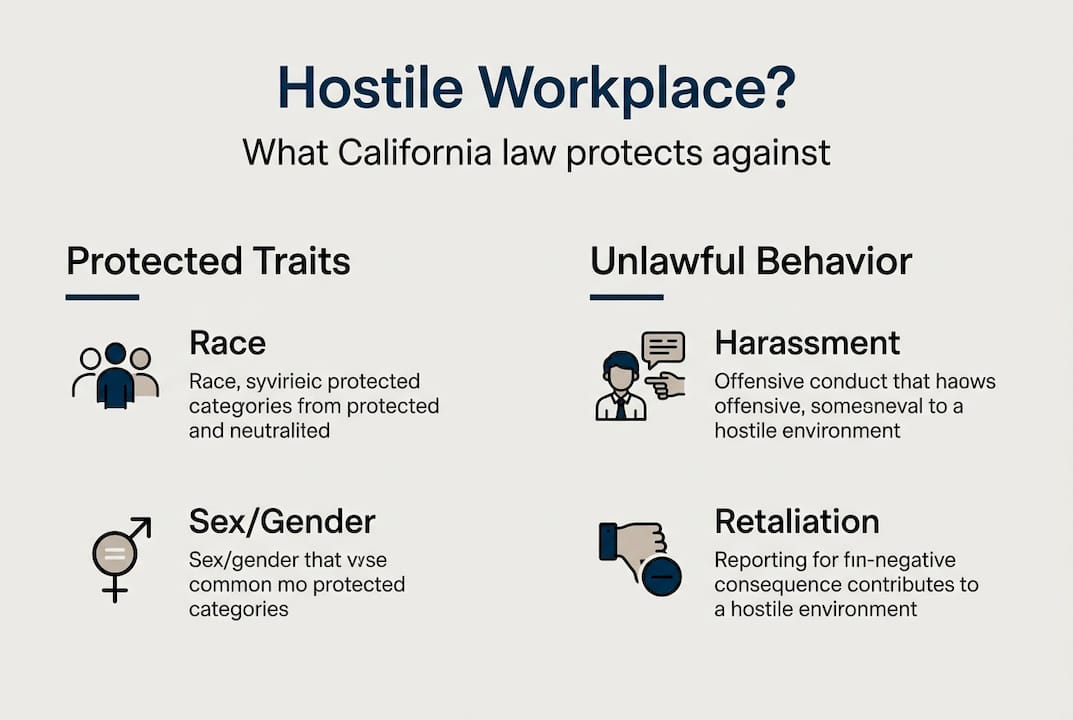
Protected characteristics under FEHA include race, sex, gender identity, sexual orientation, national origin, religion, age, disability, and more.
Examples of conduct that may qualify:
- Repeated racial slurs or ethnically offensive jokes
- Unwanted touching or sexual comments
- Persistent mockery based on someone’s religion or national origin
- Threats or intimidation tied to a protected class
Under California law, harassment must be ‘severe or pervasive’ enough to alter the conditions of employment and create an abusive working environment. Courts assess this from the perspective of a reasonable person in the plaintiff’s position. A ‘concerted pattern of harassment of a repeated, routine or generalized nature’ is typically required, though a single incident can qualify if it is sufficiently severe.
What does not qualify:
- A rude or demanding manager with no discriminatory motive
- General workplace stress or a difficult team dynamic
- A single isolated comment or incident, unless it is sufficiently severe to alter working conditions
- Personality conflicts unrelated to a protected characteristic
Not all toxic workplaces qualify under FEHA. The harassment must connect directly to a protected class, not just reflect a generally unpleasant environment.
| Behavior | Qualifies as hostile work environment? |
|---|---|
| Repeated racial slurs from a supervisor | Yes |
| Manager yelling at everyone equally | No |
| Unwanted sexual touching | Yes |
| Stressful deadlines and high pressure | No |
| Ongoing religious mockery | Yes |
| Personality clash with a coworker | No |
For more on building your case, see our guide on proving workplace harassment in California.
Pro Tip: Document every incident, even if you are not sure it legally qualifies. Write down dates, times, locations, what was said or done, and who witnessed it. This record can be important evidence if you pursue a claim.
The lawsuit process for hostile work environment claims
If your experience meets the legal definition, here is exactly how to move forward in California.
Step-by-step process:
- Document the harassment thoroughly, including dates, witnesses, and any written evidence like emails or texts.
- Report internally to HR or a supervisor (if safe to do so). This creates a record and may be required to show the employer had notice.
- File a complaint with the California Civil Rights Department (CRD) within 3 years of the last incident.
- Complete the administrative process. The CRD will investigate or issue a right-to-sue notice.
- Obtain your right-to-sue notice. You cannot file in civil court without it.
- File your civil lawsuit within the timeframe specified in your notice.
The CRD may investigate, attempt mediation, issue a right-to-sue notice immediately, or issue a right-to-sue notice after investigation. You have one year from the date the CRD issues a right-to-sue notice to file a civil lawsuit.
The full process from CRD filing to court requires you to exhaust administrative remedies before a judge can hear your case.
| Stage | CRD process | Civil court |
|---|---|---|
| Where you file | California Civil Rights Department | Superior Court |
| Deadline to file | 3 years from last incident | Per right-to-sue notice |
| Investigation | CRD investigates claim | Discovery and trial process |
| Outcome | Settlement, dismissal, or right-to-sue | Damages, injunctions |
Important: California employees generally must file with the CRD within 3 years of the last incident of harassment. Missing this deadline typically bars a subsequent lawsuit. Limited exceptions may apply in certain circumstances.
California law prohibits employers from retaliating against employees who file FEHA complaints or participate in FEHA proceedings.
Common pitfalls to avoid:
- Waiting too long to file with the CRD
- Failing to keep written records of incidents
- Not reporting internally before filing externally
- Assuming a single incident is not worth documenting
Entertainment Industry Cases: Lessons from California FEHA Litigation
California courts take FEHA hostile work environment claims seriously regardless of industry. In Steib v. Sony Pictures Television Inc., Case No. 2:22-cv-07491-ODW (ASx) (C.D. Cal. May 5, 2023), a Director of Photography alleged racial discrimination and harassment while working on a television production. The plaintiff, Vincent Steib, reported that he was subjected to “inappropriate comments and threats of physical violence because of his race,” but supervisors failed to meaningfully respond to his complaints. When Steib’s harassers made allegations against him, the employer investigated and terminated Steib, while failing to investigate Steib’s own complaints of harassment.
The federal court recognized that FEHA claims are independent of employment contracts and that California’s anti-discrimination protections “are ‘nonnegotiable’ and ‘cannot be removed by private contract.'” The court remanded most of Steib’s claims to state court for adjudication, finding that discrimination claims turn on whether the employee experienced harassment based on protected characteristics and whether the employer responded appropriately.
Cases like Steib illustrate how California law protects workers across industries and employment arrangements when they face workplace harassment tied to protected characteristics.
Employer liability: Supervisors, coworkers, and third parties
Knowing who is legally responsible matters when you are deciding whether to pursue a claim. California law draws a clear line between different types of harassers.

Supervisor harassment: Employers are strictly liable for supervisor harassment. This means if your direct supervisor or a manager with authority over you is the harasser, the employer is automatically responsible, even if they claim they did not know.
This strict liability standard applies when the supervisor is acting in the capacity of a supervisor when the harassment occurs. Employers are not strictly liable for a supervisor’s acts of harassment that result from a completely private relationship unconnected with employment and not occurring at the workplace or during working hours.
In Steib v. Sony Pictures Television Inc., the plaintiff alleged that when he complained of racial harassment to supervisors, they ‘failed to meaningfully respond,’ but when his harassers made allegations against him, the employer immediately opened an investigation. This type of differential treatment—investigating complaints against the employee while ignoring the employee’s own harassment complaints—can support employer liability under FEHA’s failure to prevent harassment provisions.
Coworker harassment: The employer is liable if they knew or should have known about the harassment and failed to take corrective action. This is a negligence standard, meaning you need to show the employer dropped the ball.
Third-party harassment: Vendors, clients, film crews, or on-site contractors can also create a hostile work environment. If you reported the conduct and the employer did nothing, they can be held liable.
If you reported the conduct to your employer and the employer knew or should have known about it but failed to take prompt and effective corrective action, the employer may be liable under a negligence standard.
In a dynamic workplace like a film studio or production lot, you may interact with dozens of people who are not your direct employer. That does not reduce your protections.
Common scenarios in entertainment and production environments:
- A vendor representative makes repeated offensive comments to on-site staff
- A visiting production crew member harasses a facilities worker
- A contractor supervisor targets a temp worker with discriminatory remarks
Pro Tip: Always report harassment in writing, even if you also report it verbally. An email to HR creates a timestamp and a paper trail that is much harder to dispute later.
For a deeper look at how liability works in complex workplace settings, see our breakdown of employer liability explained.
Consult with an Employment Attorney
If you believe you are experiencing workplace harassment based on a protected characteristic, consulting with a California employment attorney can help you understand your rights and options. An attorney can review the specific facts of your situation, advise you on applicable deadlines, and help you navigate the administrative and potential litigation process.
Every case is different, and outcomes depend on specific facts, applicable law, and other factors. An initial consultation can help you understand whether your circumstances may support a FEHA claim.
Frequently asked questions
What is the deadline for filing a hostile work environment claim in California?
You must file with the CRD within 3 years of the last incident of harassment. Missing this deadline generally bars a subsequent lawsuit, though limited exceptions may apply in certain circumstances.
Does general bullying or workplace stress count as a hostile work environment?
No. The harassment must be tied to a protected characteristic like race or sex. General bullying or a stressful environment alone does not meet the legal standard.
Can contractors or freelance workers near Sony studios qualify for protection?
Contractors and certain other workers may be protected under FEHA depending on the specific nature of the working relationship and whether they qualify as ’employees’ under FEHA’s broad definition. California law extends FEHA protections beyond traditional W-2 employees to persons providing services pursuant to a contract. Whether protection applies depends on the specific facts of the working relationship.
Are employers liable for harassment by third parties, like vendors or guests?
Yes, if the employer knew or should have known about the harassment and failed to take corrective action, they can be held liable under California law.
Recommended
- What Creates a Hostile Work Environment in West Hollywood? – California United Law Group
- Pay gaps at Disney and Warner Bros. in Burbank: What California employees need to know in 2026 – California United Law Group
Disclaimer: This article provides general information about California employment law and is not a substitute for legal advice. Laws change, and every situation is unique. If you are experiencing workplace harassment, consult with a qualified California employment attorney to discuss your specific circumstances. Nothing in this article should be construed as legal advice, and reading this article does not create an attorney-client relationship with California United Law Group, P.C. or any attorney.