
Note: This article reflects California wage and hour laws as of March 2026. Laws may change, and you should consult with an attorney about current requirements.
Working event shifts at SoFi Stadium should mean getting paid for every hour you work. Yet many stadium event workers near Inglewood face confusion about whether they receive full pay for all their time on duty, including setup, breakdown, and mandatory tasks before or after official shift times. California wage and hour laws require employers to pay you for all hours worked, including overtime when applicable. This guide explains your legal wage rights as a stadium worker in 2026, identifies common violations that lead to unpaid hours, and shows you how to recognize and address wage theft near SoFi Stadium. This article provides general legal information and should not be construed as legal advice for your specific situation.
Table of Contents
- Understanding Payment Rights For Stadium Event Workers Under California Law
- Common Wage And Hour Violations Faced By Sofi Stadium Event Workers
- How To Identify If You Are Not Being Paid For All Hours Worked
- What To Do If Your Employer Is Not Paying For All Hours Worked
- Get Expert Legal Help To Protect Your Wage Rights Near Sofi Stadium
- Are Stadium Event Workers Near Sofi Stadium Being Paid For All Hours Worked? Frequently Asked Questions
Key takeaways
| Point | Details |
|---|---|
| All hours worked must be paid | California law requires payment for every hour you are on duty, including pre-shift and post-shift tasks. |
| Overtime protections apply | Stadium workers earn 1.5x pay for hours over 8 per day or 40 per week under state law. |
| Off-the-clock work is illegal | Employers cannot require unpaid work before, during, or after your scheduled shift. |
| Document your hours carefully | Keep personal records of all work time to identify pay discrepancies and protect your rights. |
| Legal remedies are available | You can file wage claims or pursue lawsuits to recover unpaid wages with professional legal help. |
Understanding payment rights for stadium event workers under California law
California’s wage and hour laws establish strict rules about when and how employers must pay you. Hours worked means all time your employer requires you to be on duty or at a workplace, whether you are actively performing tasks or waiting for assignments. This definition covers setup time before events start, breakdown after crowds leave, mandatory safety briefings, uniform changes, and any other employer-controlled activities. California wage and hour laws protect stadium workers just like employees in any other industry.
The California Supreme Court has held that ‘hours worked’ includes time during which an employee is subject to the employer’s control, as well as all time the employee is suffered or permitted to work. (Morillion v. Royal Packing Co. (2000) 22 Cal.4th 575, 585.) This means employers must compensate employees for off-the-clock work if the employer knows or should have known the employees were working those hours.
The state’s Industrial Welfare Commission issues wage orders that apply specifically to different industries and job types. Stadium event workers typically fall under orders covering mercantile, amusement and recreation, or transportation industries depending on your exact role. These orders spell out minimum wage rates, overtime requirements, meal and rest break rules, and record keeping obligations your employer must follow. Wage orders carry the force of law, meaning violations can result in penalties and liability for unpaid wages.
NOTE: While the Industrial Welfare Commission no longer actively issues new wage orders, existing IWC wage orders remain in effect and carry the force of law.
Overtime pay is a critical protection for stadium workers who often work long event days. California requires employers to pay 1.5 times your regular rate for hours over 8 in a single workday or over 40 in a workweek. If you work more than 12 hours in one day, you earn double time (2x your regular rate) for those excess hours. You also earn double time for all hours worked in excess of 8 hours on the seventh consecutive day of work in a workweek. These overtime rules apply regardless of whether you work full time or part time. Your employer cannot avoid overtime by calling you an independent contractor or asking you to work off the clock.
Pro Tip: Always verify your pay stub shows the correct number of regular and overtime hours. California law requires detailed wage statements listing your hourly rates, hours worked in each pay period, and gross and net wages.
Off-the-clock work represents one of the most common violations affecting stadium employees. This occurs when your employer requires or permits you to perform work duties without recording or paying for that time. Examples include arriving early to set up your station, staying late to clean or secure equipment, attending mandatory meetings before your shift starts, or performing tasks during unpaid meal breaks. Wage & Hour laws require payment for all hours worked, including pre-shift or post-shift tasks, no matter how brief.
Under California law, an employer must compensate employees for off-the-clock work if the employer knew or should have known the employees were working those hours. However, simply arriving early or staying late is not sufficient by itself to establish the employer’s knowledge.
Under California Labor Code section 1194, an employee has a statutory right to recover unpaid minimum wages and overtime compensation from an employer, along with reasonable attorney’s fees and costs. (See Lab. Code § 1194(a).)
Employers must maintain accurate time records showing when you start work, when you take breaks, and when you finish each day. These records protect both you and your employer by documenting actual hours worked. When employers fail to keep proper records or falsify time entries, they create conditions where wage theft can occur. You have the right to review your time records and request corrections if they are inaccurate.
Common wage and hour violations faced by SoFi Stadium event workers
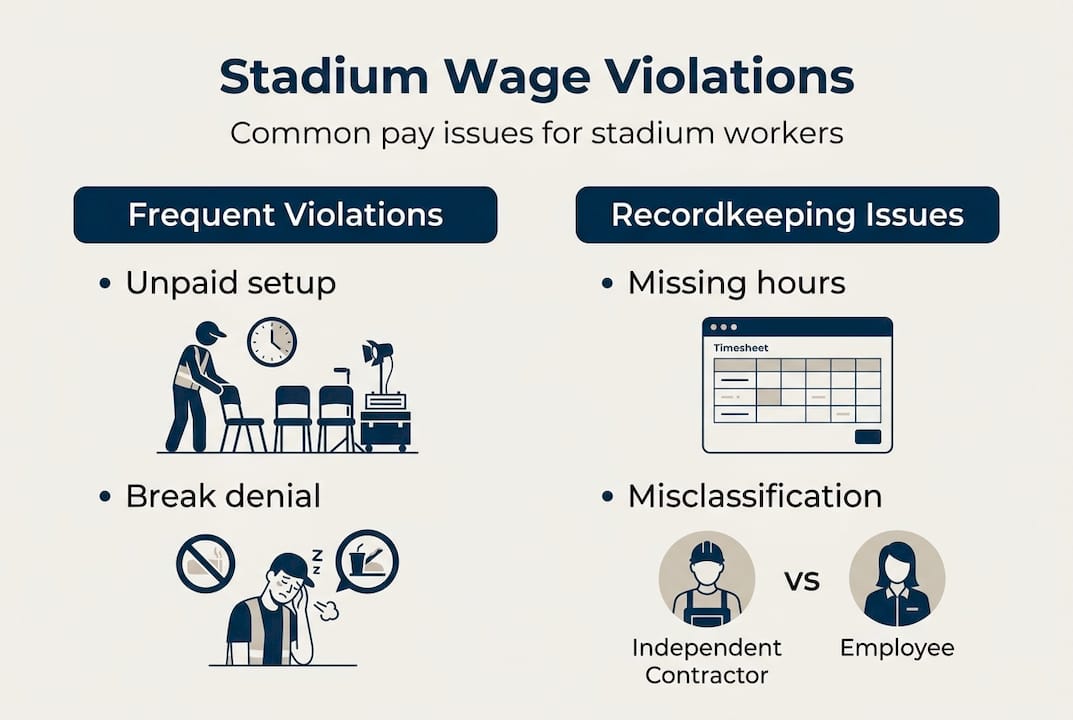
Stadium event work creates unique opportunities for wage violations due to irregular schedules, high turnover, and the chaotic nature of large events. Unpaid pre-shift and post-shift work tops the list of common violations. Employers may require you to arrive 30 minutes early for security screening, uniform distribution, or team briefings but only pay you from the official event start time. Similarly, you might spend 20 minutes after an event ends breaking down equipment, cleaning your area, or returning supplies without compensation. These unpaid minutes add up to significant wage theft over multiple shifts.

Employee misclassification represents another widespread problem in the stadium and event industry. Some employers label workers as independent contractors to avoid paying overtime, providing benefits, or covering payroll taxes. Off-the-clock work and misclassification are frequent issues causing unpaid wages in California hospitality and event sectors. True independent contractors control how, when, and where they work. If your employer sets your schedule, provides training, supplies equipment, and supervises your work, you are likely an employee entitled to full wage protections.
California applies the ‘ABC test’ to determine whether a worker is properly classified as an independent contractor. (Dynamex Operations West, Inc. v. Superior Court (2018) 4 Cal.5th 903, 916-917.) Under this test, a hiring entity must prove all three conditions: (A) the worker is free from control and direction; (B) the worker performs work outside the usual course of the hiring entity’s business; and (C) the worker is customarily engaged in an independently established trade or business of the same nature. Failure to satisfy any one element means the worker is an employee entitled to full wage protections.
Missing or incomplete time records hide hours worked and make it difficult to prove wage violations. Some stadium employers use informal timekeeping methods, rely on supervisor estimates, or fail to record short periods of work. Without accurate records, you may find hours missing from your paycheck with no documentation to support your claim. Employers sometimes pressure workers to clock out during slow periods while remaining on site and available, creating unpaid gaps in your workday.
| Violation Type | How It Appears | Legal Requirement |
| — | — |
| Unpaid setup time | Required to arrive early but paid from event start | Must pay from actual start of work duties |
| Missed overtime | Straight pay for hours over 8 per day | 1.5x rate for overtime hours |
| Skipped breaks | No meal period or interrupted rest breaks | 30-minute meal break and 10-minute rest breaks |
| Contractor misclassification | Paid as 1099 contractor despite employee control | Proper classification with full wage protections |
Break violations reduce your paid time and violate California’s strict meal and rest period rules. You must receive a 30-minute unpaid meal break before working more than 5 hours and a second meal break before exceeding 10 hours. You also earn paid 10-minute rest breaks for every 4 hours worked or major fraction thereof. Stadium employers sometimes deny breaks during busy event periods, interrupt breaks to handle tasks, or require you to remain on call during meal periods. Each missed or interrupted break entitles you to one hour of pay at your regular rate as a penalty.
California courts have strictly enforced meal and rest break requirements. (Brinker Restaurant Corp. v. Superior Court (2012) 53 Cal.4th 1004, 1034-1041.) Employers must provide work-free meal periods but are not required to ensure no work is performed, though at least one appellate court has held employers have an affirmative duty to ensure workers are actually relieved of duty during rest periods.
Pro Tip: If your employer denies required breaks, document each occurrence with dates and details. These violations create additional compensation you can recover through wage claims or lawsuits.
Incorrect overtime calculations or outright denial of overtime pay cheats workers out of premium wages they earned. Some employers average hours across two weeks to avoid daily overtime, pay overtime only after 40 hours per week while ignoring daily limits, or claim certain tasks do not qualify for overtime. California’s daily overtime rule means you can earn overtime pay even in a week with fewer than 40 total hours if any single day exceeds 8 hours.
How to identify if you are not being paid for all hours worked
Detecting wage violations requires vigilance and careful record keeping on your part. Start by maintaining a personal written log of all your work time for every shift. Record the exact time you begin work duties, not just when your official shift starts. Note when you take meal and rest breaks, when breaks are interrupted or denied, and when you finish all work tasks and leave the premises. Include any time spent in mandatory meetings, training sessions, or waiting for assignments. Your personal log becomes crucial evidence if you later discover pay discrepancies.
Compare your personal time records to your pay stubs or the time records your employer maintains. Look for differences in start times, end times, break periods, and total hours. Even small discrepancies of 10 or 15 minutes per shift compound into substantial unpaid wages over weeks and months.
Calculate whether you received proper overtime pay for hours over 8 in any workday or over 40 in any workweek. Verify the overtime rate equals 1.5 times your regular hourly rate. Check that all overtime hours appear on your pay stub with the correct premium rate.
Review whether you were paid for all pre-shift activities like security screening, uniform changes, equipment pickup, or mandatory briefings. Confirm you received pay for post-shift tasks including cleanup, equipment return, debriefing, or required paperwork.
Examine your pay stubs for meal and rest break premiums. If your employer denied breaks or interrupted them, you should see additional pay equal to one hour at your regular rate for each violation.
Request detailed pay statements showing the breakdown of regular hours, overtime hours, rates of pay, and any deductions. California law entitles you to receive accurate itemized wage statements with every paycheck.
Watch for patterns suggesting systematic wage violations rather than occasional errors. Consistent missing time from your pay, regular denial of overtime despite long workdays, or frequent break violations indicate your employer may have policies or practices that violate wage laws. Workers should document all hours worked to detect off-the-clock violations and build evidence for potential claims.
Pro Tip: Take photos of time clocks, sign-in sheets, or scheduling boards showing your actual work times. These images corroborate your personal records and make it harder for employers to dispute your hours.
Be alert if your employer discourages you from recording overtime, asks you to work through breaks, or tells you to clock out while remaining available. These requests signal potential wage violations. Similarly, if you are classified as an independent contractor but your employer controls your schedule and work methods, you may be misclassified and denied wage protections. Pay attention to how your employer treats timekeeping records. Employers who refuse to provide copies of your time records, alter entries without explanation, or maintain incomplete records may be hiding wage violations.
What to do if your employer is not paying for all hours worked
Once you identify unpaid wages or other violations, take action to protect your rights and recover what you are owed. Start by talking to your employer or human resources department about the pay discrepancies. Present your personal time records and explain the specific hours or wages missing from your paychecks. Some employers will correct honest mistakes or misunderstandings when you bring them to their attention. Document this conversation in writing, either through email or a follow-up letter summarizing what you discussed and what resolution you seek.
If your employer refuses to correct the problem or retaliates against you for raising wage concerns, file a formal Wage Claim with the California Labor Commissioner’s Office. The Labor Commissioner investigates wage claims, holds hearings, and can order employers to pay unpaid wages plus penalties and interest. Filing a wage claim is free and does not require a lawyer, though legal representation can strengthen your case. The Labor Commissioner handles claims for unpaid minimum wage, overtime, meal and rest break premiums, and other wage violations going back up to three years.
Consider consulting with an employment lawyer experienced in California wage and hour law. An attorney can evaluate whether you have additional claims beyond unpaid wages, such as wrongful termination if your employer fired you for complaining about pay, or penalties for wage statement violations. California workers can file wage claims with labor agencies or pursue lawsuits to recover unpaid wages, and lawyers often work on contingency, meaning you pay no fees unless you win.
- Document all communication with your employer about wage issues, including emails, text messages, and written notices. Save copies of all pay stubs, time records, and work schedules.
- Retain your personal time logs and any photos or other evidence showing your actual hours worked. These records become critical if your case proceeds to a hearing or lawsuit.
- Know the statute of limitations for wage claims in California is generally three years from the date wages were due, though some claims may have shorter deadlines. Acting promptly protects your right to recover all unpaid wages.
- Understand that California law prohibits retaliation against employees who complain about wage violations, file claims, or cooperate with labor investigations. If your employer fires, demotes, or otherwise punishes you for asserting your wage rights, you may have additional legal claims.
You can also contact other workers at your workplace to see if they face similar wage problems. Wage violations often affect multiple employees, and group or class action claims can be more effective at holding employers accountable and recovering unpaid wages for everyone. California’s Private Attorneys General Act (PAGA) allows employees to sue on behalf of the state and other employees for Labor Code violations and share in penalties recovered. PAGA claims require notice to the Labor and Workforce Development Agency before filing suit and are subject to specific procedural requirements.
Get expert legal help to protect your wage rights near SoFi Stadium
Navigating California’s complex wage and hour laws while working demanding stadium event shifts can feel overwhelming. California United Law Group provides experienced legal support to confirm whether you have been fully paid for all hours worked and help you recover any wages your employer owes. Our employment attorneys understand the unique challenges facing stadium and event workers near SoFi Stadium and have experience representing employees in wage and hour cases throughout Southern California. Past results do not guarantee future outcomes, and each case depends on its specific facts and circumstances. We handle everything from filing Labor Commissioner claims to pursuing lawsuits for unpaid wages, overtime, and break violations. As California employment lawyers serving the Inglewood area and surrounding communities,, we offer free initial consultations to discuss your case confidentially and explain your options. Let us help you understand the employment lawsuit process and evaluate your potential claims.
Are stadium event workers near SoFi Stadium being paid for all hours worked? Frequently asked questions
What hours must my employer pay me for as a stadium event worker?
Your employer must pay you for all time you are required to be on duty or at the workplace, including pre-shift setup, post-shift cleanup, mandatory meetings, training, uniform changes, and waiting time. Any work your employer requires or permits counts as compensable hours, even if it occurs before or after your scheduled shift.
Can my employer classify me as an independent contractor to avoid paying overtime?
No, your employer cannot avoid wage laws through misclassification. If your employer controls when, where, and how you work, provides equipment and training, and supervises your tasks, you are likely an employee entitled to minimum wage, overtime, and other protections under California wage and hour laws regardless of what label your employer uses.
What should I do if my employer denies me meal or rest breaks during events?
Document each denied or interrupted break with the date and circumstances. Your employer owes you one hour of pay at your regular rate for each day they fail to provide required meal or rest periods. You can recover these penalties through a wage claim or lawsuit even if you continue working for the employer.
How long do I have to file a claim for unpaid wages in California?
The statute of limitations for wage claims varies depending on the type of claim. Overtime and unpaid wage claims based on statutory liability are subject to a three-year limitations period under California Code of Civil Procedure section 338(a). However, some wage-related claims may have different deadlines, such as one-year limitations for certain penalties. Because limitation periods can be complex, you should consult with an employment attorney promptly to protect your rights.
Will my employer retaliate against me for complaining about unpaid wages?
California law prohibits retaliation against employees who complain about wage violations, file claims, or participate in investigations. If your employer fires, demotes, reduces your hours, or otherwise punishes you for asserting your SoFi Stadium worker wage rights, you may have additional legal claims for retaliation and wrongful termination.
Can I recover unpaid wages if I no longer work for the employer?
Yes, you can file wage claims or lawsuits to recover unpaid wages even after you stop working for an employer. The statute of limitations continues to run from when wages were due, so you have time to pursue your claims after leaving the job. Former employees have the same rights to unpaid wages as current workers.