
Facing sudden job loss or workplace mistreatment can leave you feeling uncertain about your future in California. Understanding whether your experience qualifies as wrongful termination or discrimination under the Fair Employment and Housing Act add: “(FEHA), which protects employees from discrimination based on characteristics including race, sex, age, disability, religion, national origin, sexual orientation, gender identity, and other protected classes, or the Labor Code is more than just a legal technicality. This guide breaks down each step to help you determine if your rights were violated, collecting critical documentation and making informed decisions about your next move.
Table of Contents
- Step 1: Assess Workplace Dispute Facts
- Step 2: Gather Essential Evidence and Documentation
- Step 3: Consult Experienced Employment Attorneys
- Step 4: File Your Labor Code or FEHA Claim
- Step 5: Navigate Litigation and Settlement Strategies
- Step 6: Verify Resolution and Enforce Judgments
Quick Summary
| Essential Insight | Detailed Explanation |
|---|---|
| 1. Document Every Workplace Incident | Gather dates, individuals involved, and specifics of incidents to have a solid foundation for your case. |
| 2. Compile Relevant Evidence Meticulously | Assemble all supporting documents, like pay stubs and emails, to craft a convincing narrative of your claim. |
| 3. Consult Specialized Employment Attorneys | Experienced attorneys can guide you through complex legal processes and enhance your claim’s strength. |
| 4. Meet All Legal Filing Deadlines | Ensure complete and accurate filing of claims within statutory time limits to avoid case dismissal. |
| 5. Actively Monitor Compliance After Judgment | Follow up to ensure that settlements or court judgments are fulfilled to secure your rights effectively. |
Step 1: Assess Workplace Dispute Facts
Assessing workplace dispute facts is your critical first step in understanding whether you have a legitimate legal claim against your employer. This process involves carefully examining the details of your workplace experience, collecting evidence, and determining if your situation meets the legal standards for an employment lawsuit.
To effectively assess your workplace dispute, you’ll want to focus on gathering and documenting specific information. Labor law enforcement details indicate that documenting the exact nature of the workplace violation is crucial. Start by collecting these key pieces of evidence:
- Date and time of specific incidents
- Names and job titles of individuals involved
- Detailed description of what occurred
- Any written communications (emails, texts, memos)
- Witness contact information
- Records of workplace policies potentially violated
Specifically, look for clear patterns of behavior that demonstrate a systemic issue. This might include repeated discriminatory actions, consistent wage violations, or a pattern of retaliation. Legal guidance for workers suggests that isolated incidents might not constitute a strong legal case, but documented patterns can be powerful evidence.
California courts have repeatedly emphasized the importance of thorough documentation in employment cases. In Guz v. Bechtel National, Inc. (2000) 24 Cal.4th 317, the California Supreme Court examined wrongful termination claims and noted that concrete evidence of an employer’s true motives is crucial when challenging stated reasons for termination. Similarly, in Yanowitz v. L’Oreal USA, Inc. (2005) 36 Cal.4th 1028, the court recognized that patterns of conduct and circumstantial evidence can establish discrimination claims even without direct admissions from the employer.
Not every workplace disagreement qualifies as a legal dispute. Focus on concrete, documentable violations of labor laws or employment contracts.
Document everything meticulously. Take detailed notes, save copies of all relevant communications, and create a chronological timeline of events. The more organized and precise your documentation, the stronger your potential case.
Pro tip: Maintain a confidential, secure digital and physical backup of all workplace dispute documentation to ensure you have comprehensive evidence if legal action becomes necessary.
Step 2: Gather Essential Evidence and Documentation
Gathering essential evidence and documentation is a critical step in building a strong employment lawsuit case. Your ability to systematically collect and organize workplace-related documents can significantly impact the strength and credibility of your legal claim.
Comprehensive wage claim documentation requires careful and strategic collection of specific types of evidence. Start by compiling these crucial documents:
- Pay stubs and wage statements
- Employment contract or offer letter
- Work schedules and timesheets
- Performance reviews
- Email communications related to disputes
- Incident reports or written complaints
- Employment policy handbooks
When collecting evidence, focus on creating a clear and chronological narrative. The California Workers’ Rights manual emphasizes the importance of documenting precise details, including dates, times, specific interactions, and any potential witnesses who can corroborate your account.
Preserving original documents is crucial. Always keep both digital and physical copies of your evidence in a secure, organized manner.
Pay special attention to creating a comprehensive timeline that demonstrates patterns of behavior or systematic violations. This means not just collecting documents, but organizing them in a way that tells a cohesive story about your workplace experience.
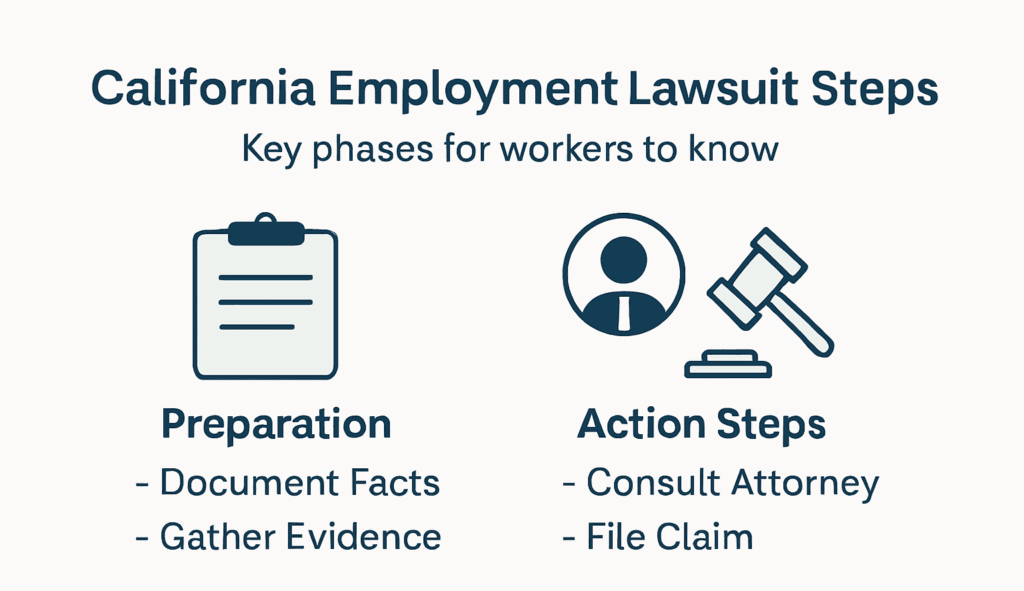
Pro tip: Create a dedicated digital folder with subfolders for different document types and maintain a master spreadsheet tracking each piece of evidence, including its date, source, and relevance to your case.
Step 3: Consult Experienced Employment Attorneys
Consulting experienced employment attorneys is a crucial step in navigating the complex landscape of workplace legal disputes. A skilled attorney can provide invaluable guidance, helping you understand the nuanced legal options available and strategize the most effective approach to your specific case.
Employment law specialists play a critical role in evaluating the strength of your workplace claim. When selecting an attorney, consider these key factors:
- Specialized experience in employment law
- Track record of successful employee-side cases
- Familiarity with California labor regulations
- Clear communication and responsiveness
- Transparent fee structure
- Proven negotiation and litigation skills
The California Supreme Court has recognized that effective legal representation is fundamental to vindicating employment rights. In Armendariz v. Foundation Health Psychcare Services, Inc. (2000) 24 Cal.4th 83, the court held that employees pursuing statutory employment claims must have access to adequate legal representation and remedies to make their rights meaningful.
The California Lawyers Association emphasizes the importance of finding an attorney who can provide comprehensive representation, from initial case assessment through potential settlement or trial proceedings.
A seasoned employment attorney does more than just file paperwork. They become your strategic partner in understanding and asserting your workplace rights.
During your initial consultation, be prepared to provide a detailed account of your workplace situation. Bring all documented evidence you’ve collected, and be ready to answer specific questions about the timeline and nature of your workplace dispute. As the California Supreme Court stated in Armendariz v. Foundation Health Psychcare Services, Inc. (2000) 24 Cal.4th 83, employees pursuing statutory employment claims must have access to adequate remedies and fair procedures to vindicate their workplace rights.

Pro tip: Schedule consultations with multiple attorneys to compare their expertise, communication style, and proposed strategy, ensuring you find the best possible representation for your unique case.
Step 4: File Your Labor Code or FEHA Claim
Filing your Labor Code or Fair Employment and Housing Act (FEHA) claim is a critical step in pursuing justice for workplace violations. This process requires careful preparation and strategic documentation to ensure your legal rights are protected and your case is presented effectively.
California employment law outlines specific requirements for documenting workplace disputes. When preparing to file your claim, focus on these key steps:
- Identify the specific legal violation
- Gather all supporting documentation
- Choose the appropriate filing mechanism
- Complete all required forms accurately
- Meet all statutory filing deadlines
- Prepare for potential settlement conferences
It is important to file your claim with the correct agency. Discrimination, harassment, and retaliation claims based on protected characteristics (such as race, sex, age, disability, religion, national origin, sexual orientation, gender identity, or other protected classes) must be filed with the California Civil Rights Department under FEHA. Wage and hour violations—including unpaid wages, overtime, meal and rest break violations, and misclassification—are filed with the Labor Commissioner. Wrongful termination claims may involve both agencies depending on the underlying basis for termination.
The California Supreme Court has held that exhausting administrative remedies with the CRD is a prerequisite to filing a civil FEHA action in court. In Rojo v. Kliger (1990) 52 Cal.3d 65, the court explained that this requirement serves important public policy goals by giving the agency an opportunity to investigate, conciliate, and potentially resolve disputes before costly litigation begins.
For discrimination or harassment claims, you must file a complaint with the California Civil Rights Department (CRD) before proceeding with a lawsuit. The CRD (formerly known as the Department of Fair Employment and Housing) handles all FEHA discrimination and harassment claims.
Critical deadlines apply to employment claims. For FEHA claims, you must file your complaint with the CRD within three years from the date of the unlawful conduct. After the CRD completes its investigation or mediation process, you will receive a right-to-sue notice. You then have one year from the date of that notice to file a civil lawsuit in court. For wage and hour claims filed with the Labor Commissioner, the deadline is generally three years from the wage violation. Missing these deadlines can permanently bar your claim, so prompt action is essential.
The requirement to exhaust administrative remedies with the CRD serves important policy objectives. In Rojo v. Kliger (1990) 52 Cal.3d 65, the California Supreme Court explained that this administrative process allows the agency to investigate complaints, attempt conciliation, and potentially resolve disputes before parties incur the expense of litigation. The court emphasized that this procedure benefits both employees and employers by providing an expert agency review of workplace discrimination claims.
Your claim is more than paperwork – it’s a formal declaration of your workplace rights and a critical step toward seeking justice.
Each type of claim requires different documentation and follows unique procedural guidelines. Wage claims typically involve different processes compared to discrimination claims, so understanding the specific requirements for your situation is essential.
Here’s a comparison of common workplace dispute pathways and what each entails:
| Dispute Pathway | Typical Purpose | Key Advantage | Main Limitation |
|---|---|---|---|
| Filing a Claim | Seek legal remedy and employer compliance | Formal acknowledgment and possible compensation | Can be time-consuming |
| Arbitration | Settle outside court through neutral arbitrator | Faster resolution than trial | Limited appeal options; may be required by employment agreement |
| Mediation | Facilitate mutually agreed settlement | Collaborative, less adversarial | Outcome not guaranteed |
| Litigation | Pursue dispute in court setting | Enforceable, public record | Potentially costly |
Pro tip: Make digital and physical copies of every document you submit, and maintain a detailed log of all communications and filing dates to create a comprehensive record of your claim process.
Step 5: Navigate Litigation and Settlement Strategies
Navigating litigation and settlement strategies is a complex process that requires careful planning, strategic decision-making, and a clear understanding of your legal options. Your goal is to maximize potential compensation while minimizing emotional and financial stress throughout the legal proceedings.
Employment dispute resolution methods involve multiple potential pathways, each with unique advantages and challenges. Consider these critical strategic approaches:
- Evaluate settlement potential early
- Understand arbitration versus court proceedings
- Assess the strength of your documented evidence
- Calculate potential financial outcomes
- Consider long-term career implications
- Prepare for potential negotiation scenarios
The American Arbitration Association recommends exploring alternative dispute resolution techniques that can provide faster, less expensive routes to resolving workplace conflicts. These may include mediation, which allows for more flexible and collaborative solutions compared to traditional litigation.
Settlement isn’t about winning or losing – it’s about finding a resolution that addresses your professional interests and workplace concerns.
During negotiations, remain objective and focus on documented facts. Your attorney will help you understand the potential risks and benefits of accepting a settlement versus pursuing a full trial.
Pro tip: Maintain emotional distance from the negotiation process and view settlement discussions as a strategic business decision, not a personal confrontation.
Step 6: Verify Resolution and Enforce Judgments
Verifying resolution and enforcing judgments is your final crucial step in ensuring that your workplace dispute receives meaningful closure. This stage transforms legal paperwork into tangible results, holding employers accountable for their legal obligations.
Labor Commissioner’s enforcement procedures provide multiple mechanisms for workers to confirm and implement their legal victories. Key strategies for effective enforcement include:
- Track judgment payment deadlines
- Document all communication with employer
- Request written confirmation of compliance
- Monitor compliance through official channels
- Prepare secondary legal actions if needed
- Keep detailed records of settlement terms
California provides robust enforcement mechanisms for workers who prevail in employment disputes. In Cuadra v. Millan (1998) 17 Cal.4th 855, the California Supreme Court described Labor Commissioner hearings as designed to provide ‘a speedy, informal, and affordable method of resolving wage claims.’ The court recognized that enforcement tools such as wage garnishment ensure that judgments translate into actual recovery for employees.
California employment law emphasizes that enforcement isn’t automatic. You must proactively follow up and be prepared to take additional steps if your employer fails to meet their court-ordered or settlement obligations.
A judgment is only valuable when it translates into actual compensation or required workplace changes.
Consider consulting your attorney about potential additional enforcement mechanisms, such as wage garnishment or liens, if your initial settlement terms are not met. These legal tools can provide additional leverage in securing your rightful remedies.
This summary outlines steps to ensure successful judgment enforcement:
| Step | Purpose | Example Action |
|---|---|---|
| Verify Deadline | Ensure timely employer response | Check payment due date |
| Document Communication | Maintain compliance proof | Save all emails |
| Monitor Compliance | Track fulfillment of agreements | Use court resources |
| Initiate Enforcement | Compel payment if needed | Request wage garnishment |
Pro tip: Maintain a comprehensive digital and physical file of all settlement documents, communications, and proof of compliance to create an unassailable record of your legal proceedings.
Take Control of Your Workplace Rights with Trusted Legal Support
Facing a workplace dispute can feel overwhelming, especially when navigating complex processes like Labor Code and FEHA claims. This article highlights common challenges such as gathering evidence, understanding legal deadlines, and deciding on the best dispute resolution strategies. If you are dealing with wrongful termination, retaliation, or harassment, you do not have to face these challenges alone. Our experienced team at California United Law Group, P.C. specializes in representing employees and guiding them through every stage of their employment lawsuit.
Act now to protect your rights and pursue the legal remedies available under California law. “Learn how our firm may be able to assist with Wrongful Termination & Retaliation and Discrimination & Harassment cases. Visit California United Law Group, P.C. today to schedule a confidential consultation and start building your strongest case with trusted legal advocates by your side.
Frequently Asked Questions
What are the steps to assess my workplace dispute for a legal claim?
Assess your workplace dispute by gathering detailed information, such as dates, individuals involved, and a thorough description of incidents. Document everything meticulously to create a strong foundation for your potential case.
How can I gather the necessary evidence for my employment lawsuit?
Gather essential documentation, including pay stubs, employment contracts, and written communications related to the dispute. Organize these documents chronologically to create a comprehensive narrative of your workplace experience.
How do I find an employment attorney to help with my lawsuit?
To find an employment attorney, look for someone with specialized experience in employment law who has a track record of successful employee-side cases. Schedule consultations with multiple attorneys to compare their expertise and communication styles.
What should I include when filing a Labor Code or FEHA claim?
When filing a Labor Code or Fair Employment and Housing Act (FEHA) claim, identify the specific legal violation and gather all supporting documentation. Complete the required forms accurately and meet all statutory filing deadlines to ensure your claim is processed effectively.
How can I effectively navigate the litigation and settlement process?
Evaluate the potential for settlement early and understand your options between arbitration and court litigation. Work with your attorney to assess the strength of your evidence and prepare for negotiations to maximize your compensation.
What steps should I take to verify resolution and enforce judgments?
To verify resolution, track payment deadlines and document all communications with your employer. Request written confirmation of compliance and keep comprehensive records of settlement terms to ensure effective enforcement of your judgment.
Recommended
- Employment Law – Los Angeles Employment Lawyers | California United Law Group, P.C.
- Employment Lawyer Los Angeles County – Los Angeles Employment Lawyers | California United Law Group, P.C.
- Retaliation in the Workplace: Your Rights and Legal Options in California – Los Angeles Employment Lawyers | California United Law Group, P.C.
- Los Angeles Employment Lawyers | California United Law Group, P.C. – The Best Employment Law Firm Los Angeles California
DISCLAIMER
No attorney-client relationship is created by reading this article or contacting California United Law Group, P.C. for information. An attorney-client relationship is established only through a written agreement signed by both the client and the firm.
The information provided in this article is for general informational purposes only and does not constitute legal advice. Every employment case is unique, and outcomes depend on specific facts, evidence, and applicable law. Past results do not guarantee or predict future outcomes.
California United Law Group, P.C. makes no representations or warranties regarding the outcome of any particular case. While the firm is committed to providing diligent representation, no attorney can guarantee a specific result. You should consult with a qualified employment attorney to discuss your specific situation before taking legal action.
This article may constitute attorney advertising under applicable rules. Prior results referenced do not guarantee a similar outcome.
© 2026 California United Law Group, P.C. All rights reserved.