
Many El Monte manufacturing workers believe short unpaid tasks before or after shifts are acceptable. Under California law, this is incorrect. California law mandates 100% compensation for all hours worked by non-exempt employees, including every minute of off-the-clock labor. This guide explains your rights, the legal protections in place, and how to recover unpaid wages if your employer violates the law.
Table of Contents
- Introduction To Off-the-Clock Work In California Manufacturing
- California Labor Laws Governing Off-the-Clock Work
- Legal Precedents Impacting Off-the-Clock Work Rights
- Common Off-the-Clock Violations In Manufacturing Jobs
- Employer Obligations And Liability For Off-the-Clock Work
- What Employees Should Do: Identifying Violations And Taking Action
- Common Misconceptions About Off-the-Clock Work
- Summary And Next Steps For El Monte Manufacturing Employees
- How California United Law Group Can Help You Enforce Your Rights
- Is Off-the-Clock Work Illegal In El Monte Manufacturing Jobs? Frequently Asked Questions
Key Takeaways
| Point | Details |
|---|---|
| California mandates pay for all off-the-clock work | Non-exempt manufacturing employees must receive compensation for every task performed before clocking in, after clocking out, or during breaks. |
| Pre-shift and post-shift tasks are compensable | Equipment setup, cleaning, donning protective gear, and similar activities require payment at regular or overtime rates. |
| Courts reject unpaid short tasks | The Troester v. Starbucks ruling eliminated the de minimis defense, requiring pay even for brief unpaid periods. |
| Employees have legal remedies and retaliation protections | Workers can file wage claims and lawsuits without fear of employer retaliation under California law. |
| Documentation strengthens wage claims | Personal time logs, photos, and witness statements help prove unpaid work and recover lost wages. |
Introduction to Off-the-Clock Work in California Manufacturing
Off-the-clock work refers to any labor performed before clocking in, after clocking out, or during unpaid break periods. Manufacturing employees in El Monte frequently encounter this problem when supervisors ask them to complete tasks outside recorded hours. In California, it is illegal for employers to require or permit non-exempt employees to perform any work off the clock, including before clock-in and after clock-out times, and during unpaid breaks.
California wage protections require employers to compensate all hours worked by non-exempt employees without exception. This protection applies regardless of whether the employer explicitly authorized the work or whether you volunteered.
Typical manufacturing off-the-clock scenarios include:
- Pre-shift equipment setup, machine warm-ups, or material preparation
- Post-shift cleaning, equipment shutdown, or workspace organization
- Mandatory training sessions, safety meetings, or team briefings outside regular hours
- Donning and doffing protective gear, uniforms, or safety equipment
- Machine checks, quality inspections, or inventory counts performed off the clock
When employers fail to pay for these tasks, they commit wage theft. You deserve full compensation for every minute you spend performing work-related duties, no matter how brief.
Pro Tip: Keep your own daily log of all work performed outside clocked hours, including start times, end times, and task descriptions to protect your rights.
California Labor Laws Governing Off-the-Clock Work
California Labor Code and Industrial Welfare Commission wage orders require employers to compensate employees for all hours worked, including pre-shift, post-shift, and break time work, with overtime rates applying beyond 8 hours per day or 40 hours per week. These protections are foundational to California wage and hour laws that govern manufacturing employment.
California Labor Code §510 mandates overtime compensation at 1.5 times the regular rate for hours beyond 8 in a single day or 40 in a week. Double-time pay applies when you work over 12 hours in a day or on the seventh consecutive day of work. These overtime requirements apply to off-the-clock work just as they do to clocked hours.
Industrial Welfare Commission (IWC) wage orders specific to manufacturing establish that all worked hours must be compensated. This includes time spent on activities integral to your job duties, even if performed outside your scheduled shift. Employers cannot escape payment obligations by claiming they didn’t authorize the work or that you volunteered.
Key compensation requirements include:
- Payment for all pre-shift preparation activities necessary to begin production work
- Compensation for post-shift tasks required to properly conclude your duties
- Overtime rates when off-the-clock work pushes total daily or weekly hours beyond legal thresholds
- Accurate time records maintained by employers documenting all hours worked
- Protection against employer retaliation for asserting your right to full compensation
Employers must maintain detailed records of your work hours and compensate you accordingly. Failure to do so violates California labor law on off-the-clock work and exposes employers to significant liability.
Legal Precedents Impacting Off-the-Clock Work Rights
Court decisions have strengthened protections for California manufacturing workers performing off-the-clock tasks. The California Supreme Court rejected the federal de minimis doctrine, mandating pay for even short unpaid off-the-clock work periods. This landmark ruling in Troester v. Starbucks Corp. (2018) 5 Cal.5th 829, 847 eliminated the defense that very brief unpaid tasks are too minor to require compensation. The California Supreme Court held that ‘an employer that requires its employees to work minutes off the clock on a regular basis or as a regular feature of the job may not evade the obligation to compensate the employee for that time by invoking the de minimis doctrine.’
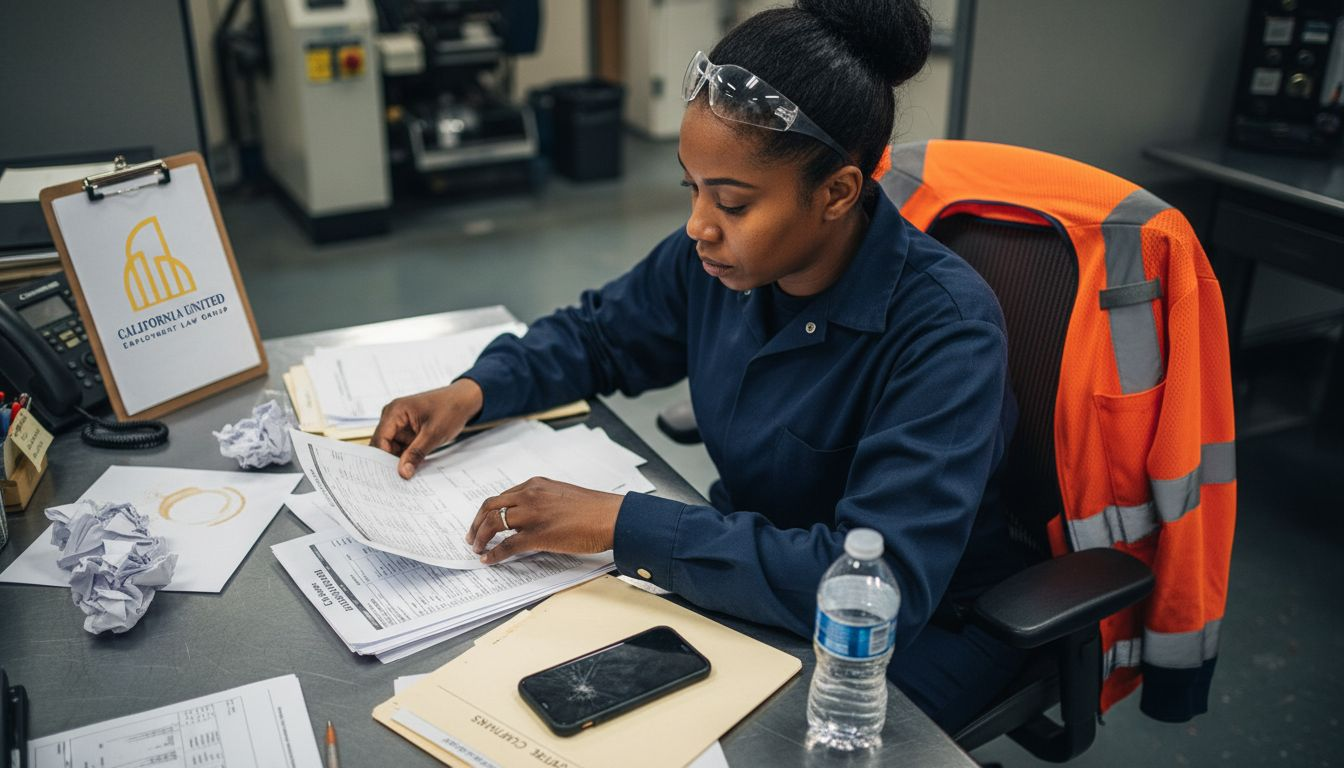
Under federal law, employers could previously avoid paying for small amounts of time that were difficult to record. California rejected this approach entirely. Now, even a few minutes of unpaid work before your shift or after clocking out must be compensated if your employer knew or should have known about it.
This ruling profoundly impacts manufacturing facilities in El Monte where short tasks accumulate throughout shifts. Equipment checks taking three minutes, brief post-shift cleaning periods, or quick pre-shift meetings all require payment. Employers can no longer dismiss these periods as insignificant.
The California Supreme Court’s rejection of the de minimis doctrine means every minute of work counts. Employers who knowingly permit even brief off-the-clock tasks must compensate employees fully, closing a loophole that previously enabled widespread wage theft in manufacturing and other industries.
For California Supreme Court rulings on off-the-clock work and their implications, these precedents shift the burden heavily toward employers. Manufacturing facilities must now implement systems ensuring all work time is captured and paid, or face liability for accumulated unpaid periods that add up to substantial wage theft over time.
California courts have consistently held that employers must compensate employees for all time worked. In Morillion v. Royal Packing Co. (2000) 22 Cal.4th 575, the California Supreme Court emphasized that employers bear the burden of maintaining accurate time records, and when records are inadequate, courts will presume the employee’s account of hours worked is correct. Additionally, Labor Code section 510 has been interpreted strictly in favor of employees, requiring overtime compensation at 1.5 times the regular rate for work exceeding 8 hours per day or 40 hours per week, and double-time for work exceeding 12 hours in a workday.”
Note: This adds authority but should only be included if you can verify the Morillion case is accurately cited from your legal resources.
Common Off-the-Clock Violations in Manufacturing Jobs
Recognizing illegal off-the-clock work helps you identify wage theft in your workplace. Manufacturing environments present numerous opportunities for employers to improperly withhold compensation for tasks performed outside recorded hours.
Common off-the-clock violations include:
- Pre-shift equipment warm-ups, calibration checks, or production line preparation
- Post-shift cleaning, machine shutdown procedures, or workspace restoration
- Unauthorized or pressured clock-ins and clock-outs that don’t reflect actual work time
- Mandatory pre-shift meetings, safety briefings, or training sessions
- Donning and doffing protective equipment, safety gear, or specialized uniforms
These practices violate labor laws by failing to compensate all worked time, including overtime when applicable. Employers sometimes overlook these tasks intentionally to reduce labor costs, or unintentionally through poor time-tracking systems. Either way, you’re entitled to full payment.
| Off-the-Clock Task | Typical Time Lost | Required Compensation |
|---|---|---|
| Pre-shift equipment setup | 10-15 minutes daily | Regular or overtime rate for actual time |
| Post-shift cleaning | 10-20 minutes daily | Regular or overtime rate for actual time |
| Donning/doffing gear | 5-10 minutes per shift | Regular or overtime rate for actual time |
| Mandatory meetings | 15-30 minutes weekly | Regular or overtime rate for actual time |
| Machine checks off-clock | 5-15 minutes daily | Regular or overtime rate for actual time |
Understanding how employment contract implications for off-the-clock work affect your rights helps you spot violations. Your awareness is the first step toward recovering unpaid wages and holding employers accountable for systematic wage theft.
Employer Obligations and Liability for Off-the-Clock Work
Employers must pay for all hours you work, regardless of whether they explicitly authorized the work or you performed it voluntarily. This obligation extends to any task your employer knew about or should have known about through reasonable supervision. If you perform work that benefits your employer, compensation is required.
Employers must maintain accurate records of all hours worked, and failure shifts burden of proof to the employer in wage disputes. When an employer’s records are incomplete or inaccurate, courts presume the employee’s account of hours worked is correct. This powerful protection helps you recover wages even when your employer failed to track your time properly.
Employer responsibilities under California law include:
- Maintaining precise time records for all employees showing actual hours worked
- Compensating all worked hours at regular or overtime rates as applicable
- Preventing wage theft by implementing systems to capture all work time
- Complying with overtime laws when off-the-clock work increases total daily or weekly hours
- Avoiding retaliation against employees who assert their wage rights
Employer liability attaches when off-the-clock work is required, permitted, or even indirectly encouraged. If supervisors regularly see you performing tasks before or after your shift and don’t stop you, your employer must pay for that time. These legal obligations apply regardless of what your employment contract states, as California law prohibits waiver of wage and hour protections.
Pro Tip: Keep personal logs documenting off-the-clock tasks, including dates, times, and descriptions, because recordkeeping failures by your employer strengthen your wage claim and shift the burden of proof in your favor.
California law also addresses employer liability for off-the-clock work in California manufacturing settings where systematic violations often occur. When you have strong documentation, you maximize your chances of full recovery for unpaid wages.
What Employees Should Do: Identifying Violations and Taking Action
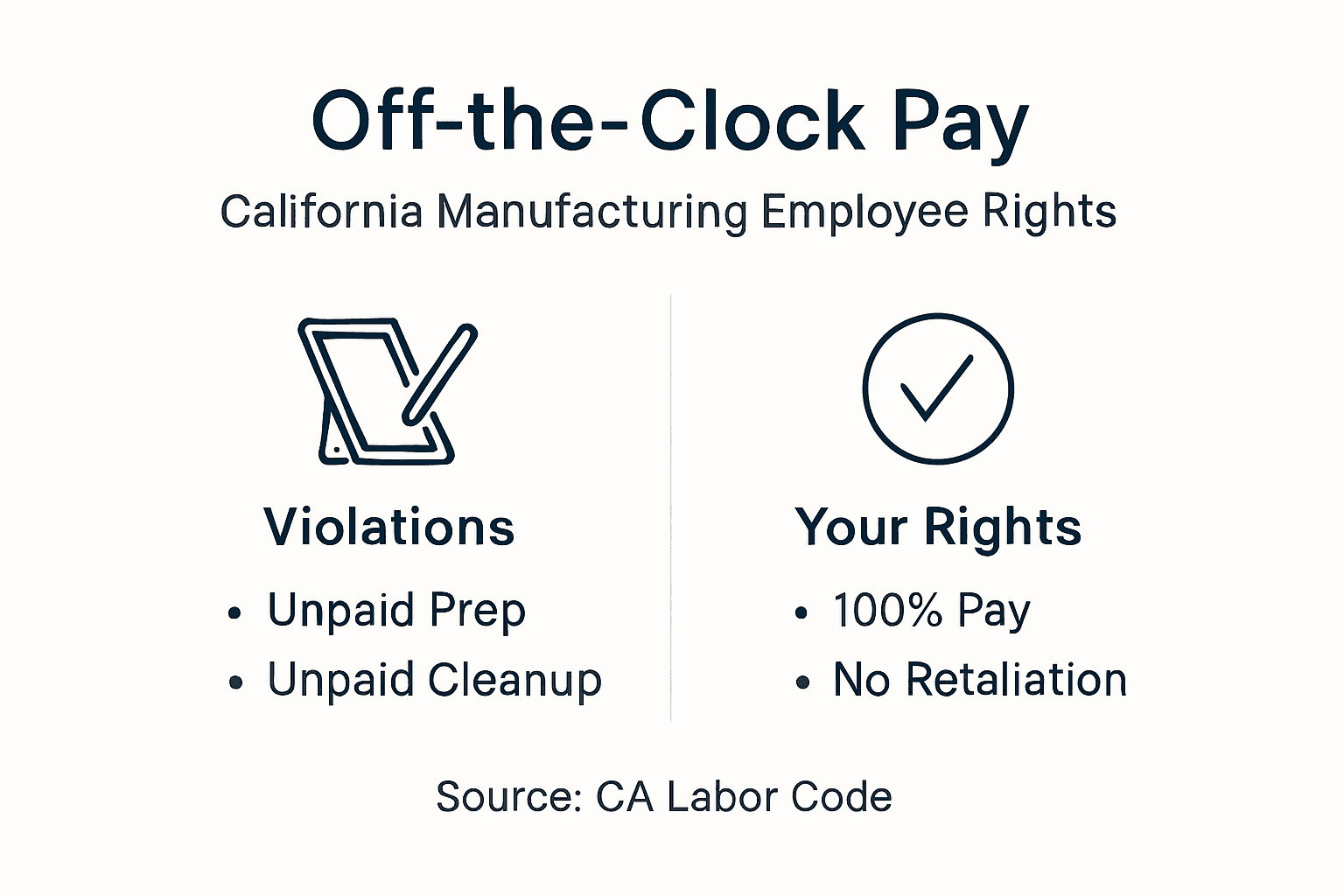
You have the power to protect your wage rights through documentation and timely action. Manufacturing workers who recognize off-the-clock violations and gather evidence position themselves to recover unpaid wages and prevent future wage theft.
Keep accurate personal records including:
- Daily time logs showing actual start and end times for all work, including off-the-clock tasks
- Photos or videos of you performing work before clocking in or after clocking out
- Witness statements from coworkers who observe the same off-the-clock work patterns
- Written communications, emails, or texts from supervisors requesting or acknowledging off-the-clock work
When you suspect wage theft, follow these steps:
- Recognize off-the-clock work by identifying any tasks performed outside your recorded hours
- Document everything with detailed notes, dates, times, and descriptions of unpaid work
- Report violations to your employer through proper channels, keeping copies of all communications
- Consult an experienced employment attorney to understand your legal options and case strength
- File a wage claim with the California Labor Commissioner or pursue a lawsuit to recover unpaid wages
- Protect yourself from retaliation by knowing your rights under California whistleblower protections
California law prohibits employers from retaliating against you for asserting wage rights. This means you cannot be fired, demoted, or otherwise punished for complaining about unpaid off-the-clock work or filing a wage claim. If retaliation occurs, you have additional legal remedies beyond wage recovery.
Pro Tip: Consult an employment attorney early, even before filing a formal claim, to preserve your rights and navigate complexities in California wage law that maximize your recovery and protect you from retaliation.
Multiple legal remedies are available to recover unpaid wages and hold your employer accountable.
Common Misconceptions About Off-the-Clock Work
Many manufacturing employees believe myths that prevent them from asserting their wage rights. Correcting these misunderstandings empowers you to recognize violations and seek full compensation.
Frequent misconceptions include:
- Voluntary off-the-clock work doesn’t require payment: False. If your employer benefits from your work and knew or should have known about it, you must be paid regardless of whether you volunteered.
- Short unpaid periods are legal under a small-task exception: False. California rejected the federal de minimis doctrine, requiring compensation for all off-the-clock work no matter how brief.
- Independent contractor classification eliminates off-the-clock pay rights: False. If you’re truly an employee under California law, misclassification as an independent contractor doesn’t waive your right to compensation for all hours worked.
- Employers can require unpaid work as a condition of employment: False. California law forbids employers from requiring or permitting any unpaid work by non-exempt employees.
These misconceptions allow employers to unlawfully withhold wages through pressure, misrepresentation, or incomplete information. You may hear supervisors claim that a few minutes here or there don’t matter, or that helping out voluntarily means you’re not entitled to pay. These statements are incorrect under California law.
Critically assess any employer statement suggesting certain off-the-clock work is permissible or too minor to compensate. Understanding common misconceptions in manufacturing employment law protects you from being misled and ensures you receive every dollar you’ve earned.
Summary and Next Steps for El Monte Manufacturing Employees
You now understand that California law requires 100% compensation for all off-the-clock work, with no exceptions for brief periods or voluntary tasks. Manufacturing employees in El Monte and throughout California have strong legal protections ensuring payment for every minute worked.
Key points to remember:
- All off-the-clock work must be compensated at regular or overtime rates depending on total hours
- Employers have legal obligations to track time accurately and face liability when they fail
- Court rulings like Troester v. Starbucks eliminated defenses that previously allowed unpaid short tasks
- Troester v. Starbucks Corp. (2018) 5 Cal.5th 829 rejected the federal de minimis doctrine, requiring California employers to compensate employees for all off-the-clock work regardless of duration.
- You have the right to document off-the-clock work, file wage claims, and seek legal counsel without retaliation
- Strong documentation and early legal consultation maximize your chances of full wage recovery
Take immediate action if you’ve performed unpaid off-the-clock work. Start documenting your hours, gather evidence, and consult with an experienced employment attorney who understands California wage and hour law. Delays can affect your ability to recover all unpaid wages, so protecting your rights now is essential.
You deserve full compensation for every hour you work. Don’t let employer pressure, misconceptions, or fear of retaliation prevent you from asserting your legal rights and recovering wages you’ve rightfully earned.
How California United Law Group Can Help You Enforce Your Rights
California United Law Group specializes in California wage and hour legal help for manufacturing employees facing off-the-clock work violations. Our experienced employment lawyers in California understand the complexities of wage theft cases and have successfully recovered unpaid wages for workers throughout El Monte and surrounding areas.
We offer personalized case evaluations to assess your situation, calculate unpaid wages including overtime, and develop a legal strategy tailored to your circumstances. Our team handles every aspect of the employment lawsuit process, from initial consultation through litigation if necessary. Past results do not guarantee or predict a similar outcome in any future case, as each case depends on its specific facts and legal circumstances.
Pro Tip: Contact an employment attorney promptly after identifying off-the-clock violations to preserve evidence, protect your rights, and improve case outcomes by acting within legal time limits.
Frequently Asked Questions: Off-the-Clock Work in El Monte Manufacturing Jobs
Who qualifies as a non-exempt employee entitled to off-the-clock pay?
Non-exempt employees are workers entitled to minimum wage and overtime pay under California law. Most manufacturing workers are non-exempt unless they meet strict tests for executive, administrative, or professional exemptions. If your employer treats you as hourly rather than salaried and you don’t have significant independent decision-making authority, you’re likely non-exempt and entitled to pay for all off-the-clock work.
Can my employer discipline me for refusing to perform off-the-clock work?
No. California law prohibits retaliation against employees who refuse to work off the clock or who complain about unpaid work. If your employer fires, demotes, or otherwise punishes you for asserting your wage rights, you have legal remedies including reinstatement and additional damages beyond unpaid wages.
What evidence is most useful for proving off-the-clock work in wage claims?
Personal time logs documenting dates, times, and tasks are extremely valuable. Witness statements from coworkers, photos or videos showing you working outside clocked hours, and written communications from supervisors also strengthen your case. The more detailed and contemporaneous your records, the easier it is to prove unpaid work and calculate owed wages.
How long do I have to file a wage claim or lawsuit for off-the-clock work?
You generally have three years from the date of each unpaid wage violation to file a lawsuit under California law. For administrative wage claims with the Labor Commissioner, you have three years for most violations. Acting promptly preserves evidence and ensures you recover all unpaid wages within the statute of limitations.
Does time spent in mandatory training or donning protective gear count as compensable work?
Yes. Mandatory training sessions, safety meetings, and time spent putting on or taking off required protective gear or uniforms are all compensable work hours. If your employer requires these activities or they’re integral to your job, you must be paid for the time at regular or overtime rates as applicable.
Recommended
- Salaried Employees and Overtime Pay in Alhambra – California United Law Group
- Glendale Healthcare Overtime Pay Disputes Explained – California United Law Group
- Los Angeles Employment Lawyers | California United Law Group
- Is Age Discrimination Common in Torrance Manufacturing? – California United Law Group