
Losing a job or dealing with unpaid wages can leave California employees frustrated and uncertain about what comes next. Understanding what an employment contract legally means is vital, since these binding agreements spell out your rights, responsibilities, and workplace protections under California law. This guide helps you break down how employment contracts shape your working conditions, clarify protections, and offer you clear options when facing possible wrongful termination or wage issues.
Table of Contents
- What Employment Contracts Legally Mean
- Common Types And Classifications In California
- Key Terms And Provisions To Understand
- California Labor Laws Governing Employment Agreements
- Employee Rights, Obligations, And Risks
- Avoiding Common Mistakes And Pitfalls
Key Takeaways
| Point | Details |
|---|---|
| Employment Contracts Are Binding | These contracts establish the legal relationship between employers and employees, outlining mutual obligations and expectations. |
| Worker Classification Matters | Understanding whether you are classified as an employee or independent contractor affects your rights, protections, and benefits. |
| Review Contract Terms Carefully | Always request a written employment contract and consult with an attorney to ensure clarity on your rights and obligations. |
| California Labor Laws Prioritize Employee Rights | These laws enforce various protections that help prevent discrimination and ensure fair labor practices in the workplace. |
What Employment Contracts Legally Mean
Employment contracts represent binding legal agreements that establish the fundamental relationship between employers and employees. Employment agreements define core workplace rights that govern critical aspects of professional interactions, compensation, and workplace expectations.
These contracts can take multiple forms, including written, verbal, and implied agreements. The primary purpose is to clearly outline the mutual obligations and expectations of both the employer and employee. Key components typically include:
- Job responsibilities and performance expectations
- Compensation structure and payment terms
- Work schedule and employment duration
- Termination conditions
- Confidentiality and non-disclosure requirements
- Dispute resolution mechanisms
Legal tests help determine whether a worker qualifies as an employee or independent contractor, which significantly impacts their rights and protections. Worker classification depends on multiple factors, including the degree of control the employer exerts over work performance, the worker’s economic dependence, and the nature of the working relationship.
Verbal Contracts Matter. While written contracts provide the clearest documentation, verbal agreements can also be legally enforceable in California. The state recognizes that employment relationships can be established through spoken commitments, though proving their exact terms becomes more challenging without written evidence.
Pro tip: Always request a written employment contract and carefully review all terms before signing to understand your legal rights and obligations.
Common Types and Classifications in California
California employment law recognizes several distinct worker classifications that significantly impact workplace rights and legal protections. Worker classification criteria under AB-5 have fundamentally reshaped how employers define and manage their workforce relationships.
The primary employment classifications in California include:
- Full-time Employees: Typically working 40 hours per week, receiving comprehensive benefits
- Part-time Employees: Working fewer hours, often with limited or prorated benefits
- Temporary Workers: Hired for specific projects or time-limited assignments
- Independent Contractors: Self-employed professionals with more workplace autonomy
- Exempt Employees: Salaried workers not eligible for overtime compensation
- Non-exempt Employees: Hourly workers entitled to overtime pay
The ABC Test represents a critical framework for determining worker status in California. This legal standard requires employers to prove three key elements to classify a worker as an independent contractor:
- The worker is free from the company’s control and direction
- The worker performs work outside the company’s normal business
- The worker is customarily engaged in an independently established trade
California’s worker classification laws are designed to protect workers from misclassification and ensure fair labor practices.
Understanding these classifications matters immensely because they directly influence wage rates, tax obligations, benefit eligibility, and legal protections. Misclassification can result in significant legal and financial consequences for employers.
California courts have consistently enforced worker classification protections. In Dynamex Operations West, Inc. v. Superior Court (2018) 4 Cal.5th 903, the California Supreme Court adopted the ABC test for determining employee versus independent contractor status under wage orders, establishing that employers bear the burden of proving independent contractor classification. This landmark decision was subsequently codified in AB-5, significantly expanding worker protections statewide.

Here’s a quick comparison of common employment classifications in California and how they influence benefits and protections:
| Classification | Benefits Eligibility | Workplace Protections | Typical Status |
|---|---|---|---|
| Full-time Employee | Comprehensive, full benefits | Strong labor protections | Permanent |
| Part-time Employee | Limited or prorated benefits | Most labor protections | Permanent |
| Temporary Worker | May lack full benefits | Limited protections | Project-based |
| Independent Contractor | No employee benefits | Minimal labor protections | Self-employed |
| Exempt Employee | Salary-based, may get perks | No overtime protection | Managerial/Professional |
| Non-exempt Employee | Benefits vary, overtime pay | Full wage protection | Hourly, non-managerial |
Pro tip: Always request a clear written description of your employment classification to understand your rights and potential benefits.
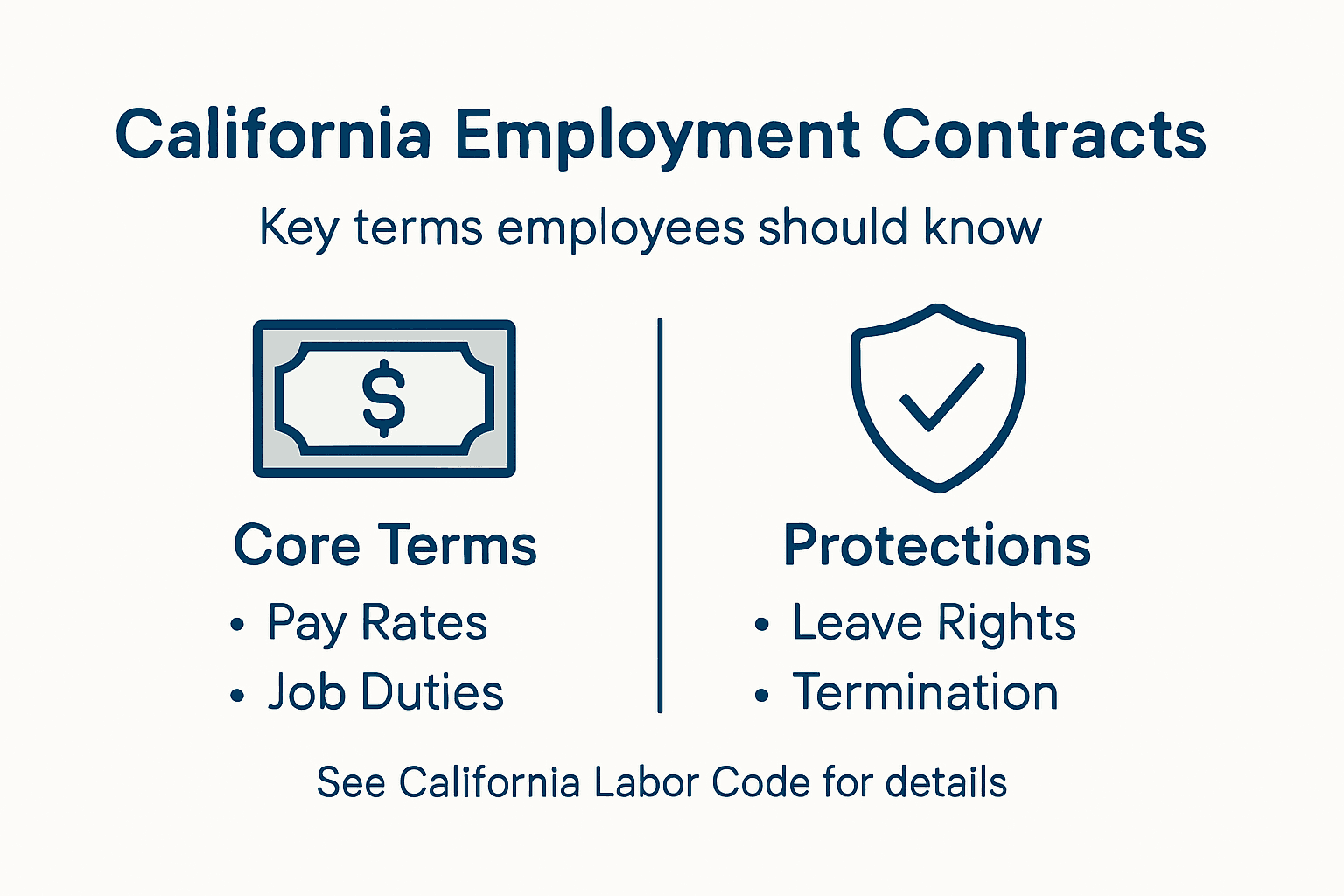
Key Terms and Provisions to Understand
Employment contracts in California contain numerous critical terms that define the working relationship between employers and employees. Key legal provisions for employment agreements establish the framework for workplace expectations, rights, and responsibilities.
Critical contract terms typically encompass:
- Compensation Details: Specific wage rates, payment schedules, and bonus structures
- Job Responsibilities: Comprehensive description of expected duties and performance standards
- Work Hours: Regular schedules, overtime policies, and flexibility arrangements
- Benefits Package: Health insurance, retirement plans, paid time off
- Termination Conditions: Grounds for dismissal, notice periods, severance provisions
- Confidentiality Clauses: Restrictions on sharing proprietary company information
California has unique legal protections that impact contract provisions. Non-compete agreements, for instance, are largely unenforceable in the state, providing employees significant professional mobility. The state mandates several key protections:
- Clear definition of employment status
- Explicit wage and hour terms
- Non-discrimination guarantees
- Dispute resolution mechanisms
- Workplace safety standards
Understanding these provisions is crucial for protecting your professional interests. Ambiguous or overly restrictive terms can significantly impact your career opportunities and workplace rights.
Pro tip: Carefully review every contract provision and consider consulting an employment attorney before signing any employment agreement.
In Edwards v. Arthur Andersen LLP (2008) 44 Cal.4th 937, the California Supreme Court reaffirmed that Business and Professions Code section 16600 prohibits employee non-compete agreements except in narrow circumstances involving the sale of a business, dissolution of a partnership, or sale of LLC interest. Courts will not enforce non-compete clauses that restrain employees from pursuing lawful professions, trades, or businesses after termination of employment.
California Labor Laws Governing Employment Agreements
California labor laws provide robust protections for employees through comprehensive regulations that govern employment agreements. Labor code requirements for employment contracts establish stringent standards to ensure fair workplace practices and employee rights.
Key legal requirements for employment agreements include:
- Wage Transparency: Mandatory disclosure of complete compensation details
- Workplace Safety: Compliance with occupational health and safety regulations
- Anti-Discrimination Provisions: Strict protections against workplace discrimination
- Minimum Wage Compliance: Adherence to state and local minimum wage standards
- Overtime Regulations: Clear guidelines for compensation beyond standard work hours
- Meal and Rest Break Requirements: Mandated intervals for employee breaks
The state enforces several critical legal provisions through the Division of Labor Standards Enforcement:
- Mandatory written notice of employment terms
- Explicit documentation of employment status
- Comprehensive wage and hour protections
- Clear termination conditions
- Mechanisms for dispute resolution
Employers must provide written notice to employees that includes specific details about employment, including pay rates, work locations, and employer information. Failure to comply can result in significant legal penalties and potential litigation.
This summary table highlights the essential legal requirements for employment agreements under California law:
| Requirement | Description | Impact for Employees |
|---|---|---|
| Wage Transparency | Full disclosure of compensation structure | Prevents wage disputes |
| Safety Regulations | Adherence to safety standards | Ensures safe working conditions |
| Anti-Discrimination | Protection from biased treatment | Promotes equality |
| Overtime Compliance | Clear overtime pay calculation | Guarantees fair extra pay |
| Written Notice | Documented terms provided to employees | Supports legal clarity |
| Break Requirements | Mandated meal/rest periods | Safeguards health |
Pro tip: Maintain detailed documentation of all employment terms and regularly review your contract to ensure ongoing compliance with California labor regulations.
Employee Rights, Obligations, and Risks
California workers are protected by comprehensive legal frameworks that define their rights, obligations, and potential workplace risks. Workers’ rights and employment protections establish a robust system of legal safeguards designed to ensure fair treatment and workplace safety.
Key employee rights in California encompass:
- Wage Protection: Right to fair compensation and timely payment
- Workplace Safety: Protection from hazardous working conditions
- Non-Discrimination: Freedom from discriminatory practices
- Family and Medical Leave: Guaranteed time off for critical personal situations
- Whistleblower Protections: Legal defense against retaliation
- Right to Organize: Freedom to form and join labor unions
Employees face several critical obligations and potential risks:
- Maintaining professional performance standards
- Adhering to confidentiality agreements
- Avoiding conflicts of interest
- Reporting workplace misconduct
- Complying with company policies
California follows the at-will employment doctrine, meaning that absent a contract or statute to the contrary, employers can terminate workers without specific cause. However, statutory exceptions protect employees from termination for unlawful reasons, including discrimination, retaliation, and violation of public policy.
The California Supreme Court recognized public policy exceptions to at-will employment in Tameny v. Atlantic Richfield Co. (1980) 27 Cal.3d 167, holding that an employer cannot discharge an employee for refusing to engage in criminal conduct. Subsequent cases expanded wrongful termination protections to include discharge for performing public obligations, exercising legal rights, and reporting illegal conduct.”
Workplace Risks include potential misclassification, wage disputes, and unauthorized termination. California law provides multiple layers of protection to mitigate these risks, ensuring employees have legal recourse when their rights are violated.
Pro tip: Document all workplace interactions and communications, as detailed records can be crucial evidence if employment disputes arise.
Avoiding Common Mistakes and Pitfalls
Employment contract negotiations require careful attention to detail and comprehensive understanding to prevent costly legal misunderstandings. Common contract mistakes in California can lead to significant workplace disputes and potential financial consequences.
Frequent pitfalls in employment agreements include:
- Vague Job Descriptions: Unclear roles and responsibilities
- Unenforceable Non-Compete Clauses: Overly restrictive provisions
- Incomplete Compensation Details: Ambiguous salary or bonus structures
- Overlooking Termination Conditions: Inadequate dismissal protections
- Ignoring State-Specific Regulations: Failing to comply with California labor laws
- Misclassifying Worker Status: Incorrectly defining employee versus contractor
Employees and employers should be particularly cautious about these critical areas:
- Thoroughly review all contract language
- Seek legal counsel before signing
- Understand state-specific employment regulations
- Clarify all compensation and benefit terms
- Document all agreements in writing
Legal Risks emerge when contracts contain unclear terms or fail to address specific workplace scenarios. Precise language and comprehensive documentation are essential to protecting both parties’ interests.
Pro tip: Always have a qualified employment attorney review your contract before signing, as professional legal insight can prevent future complications.
Protect Your Rights with Expert Help on Employment Contracts in California
“Employment contracts govern the fundamental relationship between employers and employees in California. This article has addressed important concepts including worker classification under the ABC test established in Dynamex Operations West, Inc. v. Superior Court (2018) 4 Cal.5th 903 and codified in AB-5, wage transparency requirements, termination conditions, and statutory protections under California Labor Code and the Fair Employment and Housing Act (FEHA).
If you have questions about your employment contract, worker classification, potential wrongful termination, or wage and hour violations, California United Law Group, P.C. represents employees in workplace disputes throughout California. Our practice areas include employment contract disputes, wrongful termination claims, discrimination and harassment cases, wage and hour violations, and retaliation claims.
For more information about employment law matters, visit https://calunitedlaw.com or contact our office.”
Frequently Asked Questions
What are the key elements of an employment contract?
An employment contract typically outlines job responsibilities, compensation structure, work schedule, termination conditions, confidentiality requirements, and dispute resolution mechanisms.
How does employee classification affect my rights in an employment contract?
Employee classification affects wage rates, tax obligations, benefit eligibility, and legal protections. Misclassification can lead to significant legal and financial repercussions for employers.
Are verbal agreements legally binding in employment contracts?
Yes, verbal agreements can be legally enforceable; however, they are harder to prove without documentation. It’s advisable to request a written contract to ensure clarity in obligations and rights.
What legal protections do California labor laws provide for employment agreements?
California labor laws enforce wage transparency, workplace safety, anti-discrimination provisions, overtime regulations, and mandatory written notice of employment terms to protect employee rights.
Recommended
- Wrongful Termination in California: What You Need to Know – Los Angeles Employment Lawyers | California United Law Group, P.C.
- Employment Law – Los Angeles Employment Lawyers | California United Law Group, P.C.
- Retaliation in the Workplace: Your Rights and Legal Options in California – Los Angeles Employment Lawyers | California United Law Group, P.C.
DISCLAIMER
*The information provided on this website and in this article is for general informational purposes only and does not constitute legal advice. No attorney-client relationship is created by reading this article or accessing this website. Legal outcomes depend on the specific facts and circumstances of each case, and California United Law Group, P.C. cannot guarantee any particular result or outcome. Past results do not guarantee or predict future outcomes.
If you need legal advice regarding an employment matter, please contact California United Law Group, P.C. to schedule a consultation. This article may constitute attorney advertising.*
California United Law Group, P.C.
453 South Spring Street, Suite 321
Los Angeles, California 90013
(310) 744-1449
© 2026 California United Law Group, P.C. All rights reserved.