
Snap Inc.’s high-profile gender discrimination lawsuits between 2017 and 2025 sent ripples through Santa Monica’s tech sector, but the outcomes were far more nuanced than most employees realize. While many assume these cases fundamentally transformed how local tech companies handle gender bias claims, the reality involves complex legal challenges, strategic policy adjustments, and persistent barriers to proving systemic discrimination. The California Civil Rights Department’s June 2024 settlement securing $15 million from Snap Inc. for systemic sex-based employment discrimination marked a significant enforcement action, though it proceeded through administrative channels rather than class action litigation. This guide clarifies what actually changed and what it means for California tech employees navigating workplace bias today.
In June 2024, the California Civil Rights Department announced a $15 million settlement agreement with Snap Inc. resolving allegations of sex-based employment discrimination. The settlement addressed claims that the company violated California’s Fair Employment and Housing Act through discriminatory employment practices affecting women employees.
Table of Contents
- Understanding Snap Inc.’s Gender Discrimination Lawsuits
- Impact On Gender Bias Claims Handling In Santa Monica Tech Companies
- Legal Challenges And Nuances In Gender Bias Lawsuits
- Practical Steps For Santa Monica Tech Employees Facing Gender Bias
- Get Expert Legal Help For Gender Bias Claims In California Tech
- Frequently Asked Questions About Snap Discrimination Lawsuits And Santa Monica Tech
Key takeaways
| Point | Details |
|---|---|
| Multiple lawsuits targeted Snap | Snap Inc. faced multiple gender discrimination lawsuits alleging systemic bias in pay, promotion, and workplace culture. |
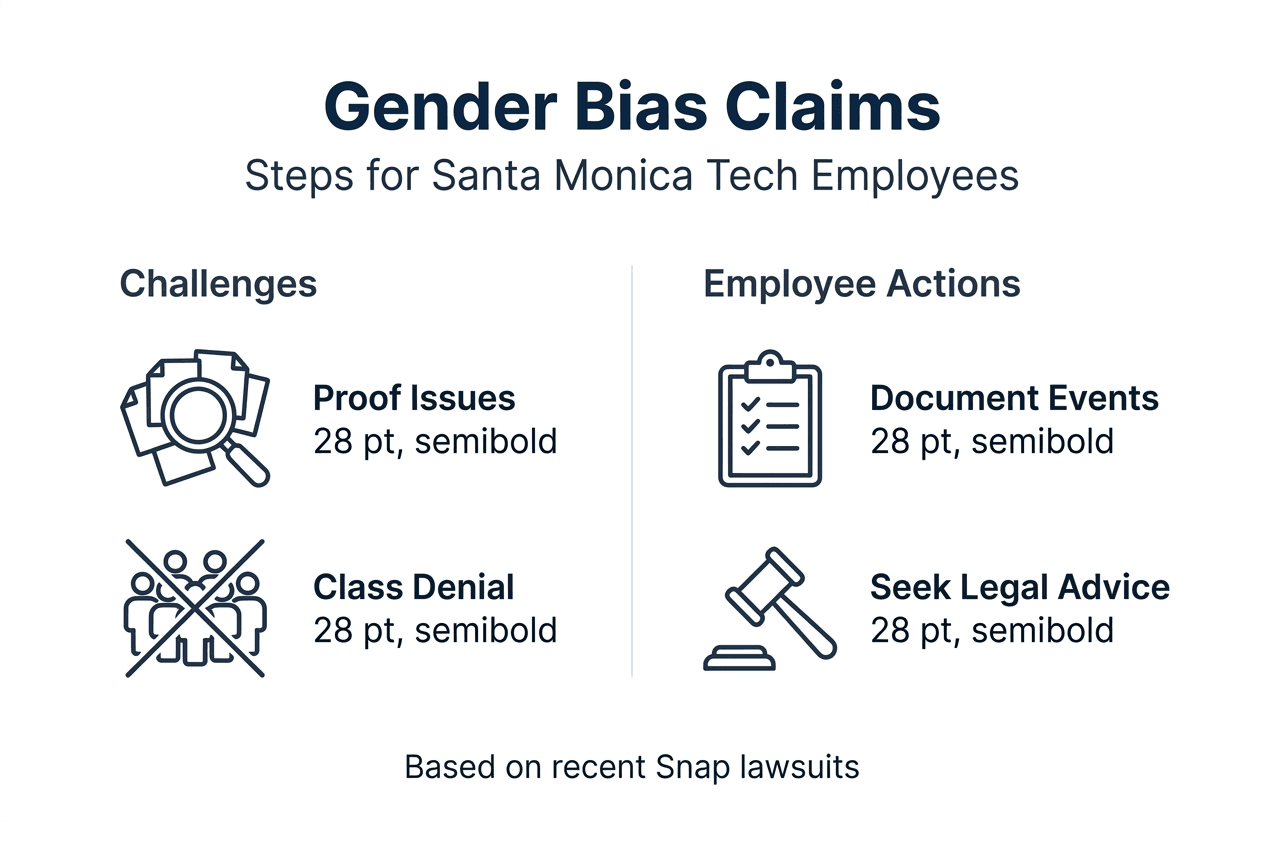
| Class certification repeatedly denied | Courts rejected class certification citing flawed expert evidence and lack of common experiences among employees. |
| Local tech companies adjusted policies | The settlement prompted companies to review gender bias protocols, though changes varied widely in scope and implementation. |
| Documentation became critical | Legal experts stress maintaining detailed records of employment decisions to defend against and pursue discrimination claims. |
| Legal obstacles remain significant | Proving systemic bias requires meeting rigorous evidentiary standards that challenge most class action attempts. |
Understanding Snap Inc.’s gender discrimination lawsuits
Female employees and former workers filed discrimination complaints with the California Civil Rights Department alleging Snap Inc. systematically underpaid women, retaliated against those who raised concerns, and fostered a hostile work environment dominated by a fraternity culture. The complaints claimed women were paid less than male counterparts in similar roles, passed over for promotions, and subjected to gender-based harassment that management failed to address adequately. In June 2024, the California Civil Rights Department announced a $15 million settlement agreement with Snap Inc. resolving allegations that the company violated California’s Fair Employment and Housing Act through systemic sex-based employment discrimination.
The legal journey proved exceptionally complex. Courts rejected class certification multiple times due to plaintiffs’ inability to demonstrate that discrimination affected all class members similarly. Judges found expert statistical analyses flawed and questioned whether individual experiences reflected company-wide practices. “These certification challenges reflect the rigorous standards established by the U.S. Supreme Court in Wal-Mart Stores, Inc. v. Dukes, 564 U.S. 338 (2011), which held that plaintiffs must demonstrate commonality—proof that class members’ claims depend upon a common contention capable of classwide resolution. This requirement proves particularly challenging when employment decisions involve decentralized, individualized processes rather than uniform discriminatory policies. These denials forced plaintiffs into individual settlements or case dismissals rather than large-scale class resolutions.
“The administrative settlement through the California Civil Rights Department represented an alternative enforcement pathway to private class action litigation. This outcome highlighted how discrimination complaints affecting multiple employees can be addressed through state agency investigation and enforcement, avoiding the evidentiary challenges that complicate class certification in private lawsuits. The resolution demonstrates critical challenges in employment discrimination enforcement that resonate throughout California’s tech sector. For legal insights into similar cases, understanding these hurdles helps employees set realistic expectations.
Key lawsuit milestones included:
- Discrimination complaints filed with California Civil Rights Department alleging systemic sex-based employment discrimination
- CRD investigation of employment practices, pay equity, and workplace culture
- Settlement negotiations between CRD and Snap Inc.
- June 2024: $15 million settlement agreement announced resolving systemic discrimination allegations
- Settlement includes monetary relief and policy change commitments
The difficulty of certifying discrimination classes in private lawsuits stems from courts requiring plaintiffs to show common policies that harmed everyone similarly—a nearly impossible standard when companies use decentralized decision-making. By contrast, administrative enforcement through the California Civil Rights Department allows state investigators to address systemic discrimination affecting multiple employees without meeting class certification requirements. This dual enforcement pathway shapes how gender bias claims proceed today.
Impact on gender bias claims handling in Santa Monica tech companies
Following the publicity around Snap’s $15 million settlement with the California Civil Rights Department, Santa Monica tech companies took varied approaches to mitigating discrimination risks. The settlement prompted local companies to reassess gender equity policies, though the depth of changes differed dramatically based on company size, culture, and legal resources. Some implemented comprehensive pay audits and revised promotion criteria, while others made superficial adjustments primarily for public relations purposes.

“The prevalence of class certification denials in private employment discrimination litigation has reinforced certain employer practices. Because courts emphasized the need to prove systemic bias affecting all employees uniformly, companies focused on documenting individualized performance evaluations and pay decisions. This strategic shift makes it harder for employees to demonstrate company-wide discrimination patterns, even when bias exists in localized teams or departments.
Awareness increased significantly across Santa Monica’s tech corridor. Firms invested more in anti-harassment training, established clearer complaint channels, and appointed diversity officers to monitor workplace equity. However, the legal landscape’s complexity meant these changes addressed appearance more than root causes in many cases. For insights on Santa Monica sexual harassment rights, employees should understand both their protections and practical limitations.
Practical policy adjustments included:
- Standardized performance review templates emphasizing objective criteria
- Regular pay equity analyses comparing compensation across gender lines
- Enhanced HR training on documenting legitimate business reasons for employment decisions
- Stricter oversight of promotion and hiring decisions to create defensible paper trails
Pro Tip: Employees should maintain personal records of performance reviews, compensation discussions, and any comments suggesting bias. These contemporaneous notes become critical evidence if you later pursue a claim through an employment lawyer Santa Monica specializes in.
This is general information and not legal advice for your specific situation.
The broader tech industry also watched closely. Studies show various types of sex discrimination cases follow similar patterns where individual claims succeed more often than class actions, pushing companies to adopt defensive documentation practices that can paradoxically make individual claims harder to prove without meticulous record-keeping.
Legal challenges and nuances in gender bias lawsuits
Class certification represents the primary battleground in employment discrimination litigation. Courts require plaintiffs to demonstrate that common questions of law or fact predominate over individual circumstances, a standard that proves exceptionally difficult when companies use decentralized hiring and promotion decisions. The certification denials in Snap’s case illustrated how expert statistical evidence must meet rigorous scientific standards to withstand judicial scrutiny. Courts scrutinize expert statistical evidence under rigorous reliability standards. As the Ninth Circuit explained in Stout v. Potter, 276 F.3d 1118, 1122 (9th Cir. 2002), ‘A prima facie case of disparate impact is usually accomplished by statistical evidence showing that an employment practice selects members of a protected class in a proportion smaller than their percentage in the pool of actual applicants.’ However, statistical disparities alone typically prove insufficient without additional evidence of discriminatory intent or specific instances supporting systemic bias claims.
Evidentiary challenges extend beyond statistics. Plaintiffs must present concrete proof that gender, not legitimate business factors, motivated adverse employment decisions. Courts demand evidence showing discriminatory intent or disparate impact that cannot be explained by performance differences, experience levels, or market conditions. This burden becomes heavier when companies maintain detailed documentation of non-discriminatory reasons for their decisions. California courts have emphasized that FEHA should be construed liberally to accomplish its remedial purposes. In Yanowitz v. L’Oreal USA, Inc., 36 Cal.4th 1028 (2005), the California Supreme Court established important principles for FEHA retaliation claims, holding that employers cannot retaliate against employees who refuse to engage in unlawful discrimination, even when framed as business directives.
California courts employ the McDonnell Douglas burden-shifting framework from McDonnell Douglas Corp. v. Green, 411 U.S. 792 (1973), in analyzing discrimination claims. Plaintiffs must first establish a prima facie case showing: (1) membership in a protected class; (2) qualification for the position; (3) adverse employment action; and (4) circumstances suggesting discrimination. The burden then shifts to employers to articulate legitimate, non-discriminatory reasons for their actions. If employers meet this burden, plaintiffs must prove the stated reasons are pretextual—a showing that requires substantial comparative and documentary evidence.
California’s labor laws provide stronger protections than federal standards in some respects. The state’s Fair Employment and Housing Act (Government Code § 12940 et seq.) prohibits discrimination based on sex, gender identity, and gender expression, and applies to employers with five or more employees compared to Title VII’s 15-employee threshold. California’s Equal Pay Act (Labor Code § 1197.5) requires equal compensation for ‘substantially similar work’ when considering skill, effort, and responsibility performed under similar working conditions. Employers can only justify pay differentials based on seniority systems, merit systems, systems measuring production quantity or quality, or bona fide factors other than sex. However, even these protections require employees to navigate complex procedural requirements and evidentiary standards.
| Legal Hurdle | Employee Strategy |
|---|---|
| Proving common discriminatory policy | Document patterns across multiple employees and departments |
| Meeting expert evidence standards | Engage qualified labor economists early in case development |
| Demonstrating causation between bias and harm | Collect emails, messages, and witness statements showing discriminatory intent |
| Overcoming individualized defenses | Show company explanations are pretextual through comparative evidence |
Understanding the employment lawsuit process overview helps employees recognize how these legal obstacles shape litigation strategy from initial filing through potential settlement or trial.
Pro Tip: Consult an employment attorney before filing administrative complaints with the Civil Rights Department. Early legal guidance helps you understand whether your evidence supports individual claims, potential class actions, or alternative dispute resolution approaches that might achieve better outcomes.
This is general information and not legal advice for your specific situation.
Practical steps for Santa Monica tech employees facing gender bias
Navigating gender discrimination requires strategic documentation and timely action. California law provides multiple avenues for addressing workplace bias, but success depends heavily on evidence quality and procedural compliance. Tech employees should understand both legal definitions and practical realities shaping discrimination claims in 2026.
Follow this step-by-step process when facing potential gender bias:
- Document every incident with dates, times, locations, witnesses, and exact quotes when possible
- Preserve all relevant emails, messages, performance reviews, and compensation communications
- Review your employee handbook and company discrimination policies to understand reporting requirements
- Report concerns through designated HR channels while keeping personal copies of all communications
- Consult an employment attorney before filing external complaints to evaluate evidence strength and strategic options
- File administrative charges with California’s Civil Rights Department within three years of the discriminatory act under FEHA (Government Code § 12960). You must exhaust administrative remedies by obtaining a right-to-sue notice from CRD before filing a lawsuit in court, unless CRD fails to act within certain timeframes.
- Preserve your right to sue by obtaining a right-to-sue notice if administrative resolution fails
Understanding Dual Enforcement Pathways
California employees can pursue discrimination claims through two primary avenues: (1) Administrative enforcement by filing complaints with the California Civil Rights Department, which can investigate and pursue enforcement actions on behalf of affected employees (as demonstrated by the $15 million Snap Inc. settlement); or (2) Private lawsuits filed in court after exhausting administrative remedies by obtaining a right-to-sue notice from CRD. Administrative enforcement allows the state to bear investigation costs and use subpoena power, while private litigation gives employees greater control over case strategy and settlement decisions but requires bearing litigation costs and meeting higher evidentiary burdens.
Understanding what constitutes actionable discrimination matters enormously. Under California law, prohibited conduct includes paying women less than men for substantially similar work, denying promotions based on gender stereotypes, retaliating against employees who complain about bias, and creating hostile work environments through gender-based harassment. For details on workplace harassment under California law, familiarize yourself with specific legal standards.
Key resources and support channels include:
- California Civil Rights Department for administrative complaint filing
- Equal Employment Opportunity Commission for federal discrimination claims
- California Employment Lawyers Association for attorney referrals
- Local bar association programs offering initial consultations
- Employee resource groups within your company for support and pattern documentation
The American Bar Association emphasizes that documenting employment decisions consistently helps both employers defend legitimate actions and employees identify suspicious patterns suggesting discriminatory motives. Maintain comprehensive records comparing your treatment to similarly situated male colleagues.
Gathering comparative evidence strengthens your position significantly. Track promotions, raises, and opportunities given to male peers with similar or lesser qualifications and performance. Note whether women face different standards for advancement or harsher consequences for identical mistakes. This comparative framework helps demonstrate disparate treatment that statistical analyses might miss. Resources on how to prove workplace harassment California standards apply equally to discrimination claims.
Get expert legal help for gender bias claims in California tech
Navigating employment discrimination claims requires specialized legal knowledge that combines California labor law expertise with practical understanding of tech industry dynamics. California United Law Group represents employees throughout Santa Monica and statewide in disputes involving gender discrimination, unequal pay, retaliation, and hostile work environments. Our attorneys understand both the legal complexities illustrated by cases like Snap’s lawsuits and the cultural factors unique to tech workplaces that shape discrimination patterns.
We assist clients through every stage of discrimination claims, from initial complaint evaluation through administrative proceedings, settlement negotiations, and litigation when necessary. Our employment law services address the full range of workplace rights violations that California tech employees face. As experienced employment lawyers in Santa Monica, we help clients build strong cases supported by thorough evidence and strategic legal positioning. Understanding the employment lawsuit process helps you make informed decisions about pursuing claims and achieving fair resolutions.
IMPORTANT DISCLAIMERS
Prior results do not guarantee a similar outcome. The outcome of each case depends on its specific facts and legal circumstances. No attorney-client relationship is created by reading this article.
Legal Disclaimer
This article provides general information about employment discrimination law in California and is not legal advice for your specific situation. The information may not reflect the most current legal developments. Reading this article does not create an attorney-client relationship. For advice about your particular circumstances, consult a qualified employment attorney.
Frequently asked questions about Snap discrimination lawsuits and Santa Monica tech
What was the main outcome of Snap Inc.’s gender discrimination lawsuits?
In June 2024, the California Civil Rights Department obtained a $15 million settlement agreement with Snap Inc. resolving allegations of systemic sex-based employment discrimination under California’s Fair Employment and Housing Act. This administrative enforcement action addressed discrimination complaints affecting multiple employees without requiring class certification or private class action litigation. The settlement demonstrates how the CRD can investigate and resolve systemic discrimination claims through administrative proceedings, avoiding the evidentiary challenges that often defeat class certification in private lawsuits where courts require plaintiffs to demonstrate common discriminatory policies affecting all class members uniformly.
How have Santa Monica tech companies adjusted policies since these lawsuits?
Following the high-profile $15 million settlement between Snap Inc. and the California Civil Rights Department, local tech firms increased focus on documenting employment decisions, conducting pay equity audits, and standardizing performance evaluation criteria to defend against potential claims. Many implemented enhanced anti-harassment training and established clearer complaint procedures. However, the depth of changes varied widely, with some companies making substantive cultural shifts while others adopted primarily defensive documentation practices designed to defeat future class actions.
What challenges do plaintiffs face in proving gender bias claims successfully?
Plaintiffs must overcome rigorous evidentiary standards requiring proof that gender, not legitimate business factors, motivated adverse decisions. Class certification demands showing common discriminatory policies affecting all class members similarly, which courts scrutinize intensely. The U.S. Supreme Court’s decision in Wal-Mart Stores, Inc. v. Dukes, 564 U.S. 338 (2011), established that plaintiffs must prove commonality through evidence of a uniform policy affecting all class members, which proves exceptionally difficult when employers use decentralized decision-making. Statistical expert evidence must meet scientific standards that judges often find flawed. These obstacles make individual claims with strong documentation more viable than broad class actions in most circumstances.
What can employees do to protect themselves from gender discrimination?
Maintain detailed contemporaneous records of all performance discussions, compensation decisions, promotion opportunities, and incidents suggesting bias. Preserve emails, messages, and documents comparing your treatment to male colleagues. Report concerns through proper HR channels while keeping personal copies of complaints and responses. Consult employment attorneys early to evaluate evidence strength before filing external claims. Understanding Santa Monica sexual harassment rights helps employees recognize when workplace conduct crosses legal lines.
Are there legal resources available locally for tech employees facing discrimination?
California Civil Rights Department offices throughout the state provide administrative complaint filing and investigation services at no cost to employees. Local bar associations offer referral programs and initial consultations with employment attorneys. Employee resource groups within tech companies can provide support and help identify patterns. Specialized employment law firms in Santa Monica understand both California labor law and tech industry dynamics that shape discrimination claims.
Do recent legal trends favor employees or employers in gender discrimination cases?
Current trends show courts setting higher evidentiary bars for class certification while individual claims with strong documentation continue succeeding. Employers increasingly use detailed performance documentation to defend decisions, making contemporaneous employee records more critical than ever. California’s strong labor protections provide advantages, but procedural requirements and proof burdens remain substantial. The landscape requires employees to build meticulous cases with legal guidance rather than relying on obvious discrimination alone to prevail.