
Facing unwelcome behavior at work can leave you feeling isolated and uncertain about the next steps. For employees in Santa Monica, sexual harassment goes beyond obvious physical acts or inappropriate comments—it covers a wide range of conduct that can disrupt your daily life and career. Understanding your protections under California law helps you recognize when your rights are being violated. While this article explains these protections, individual cases vary based on specific circumstances, and you should consult with an attorney to evaluate your particular situation. In this discussion, workplace sexual harassment is explained clearly so you know what to watch for and how to respond.
Table of Contents
- Defining Workplace Sexual Harassment
- Types of Sexual Harassment Claims
- California Laws Protecting Santa Monica Workers
- Employer Obligations and Employee Rights
- Reporting Harassment and Legal Remedies
Key Takeaways
| Point | Details |
|---|---|
| Understanding Sexual Harassment | California law protects against various unwelcome sexual behaviors, which can create a hostile work environment beyond just physical contact or propositions. |
| Types of Claims | Recognize the differences between quid pro quo and hostile work environment claims, as they have distinct legal implications and proof requirements. |
| Employer Responsibilities | Employers must actively prevent and respond to harassment through written policies and training, and they cannot retaliate against employees for reporting issues. |
| Legal Remedies | Victims of harassment can seek various remedies, including compensatory damages, policy changes, and the ability to file complaints with both state and federal agencies. |
Defining Workplace Sexual Harassment
Workplace sexual harassment under California law is broader than many people realize. It’s not limited to obvious physical contact or explicit propositions. The law protects you from unwelcome conduct of a sexual nature that affects your employment or creates a hostile work environment.
What qualifies as sexual harassment?
Unwelcome sexual advances, requests for sexual favors, and verbal or physical conduct of a sexual nature all fall under this definition. The conduct doesn’t need to be romantic or motivated by sexual desire—it can involve offensive comments, jokes, images, or unwanted touching based on sex.
The harasser can be anyone in your workplace. A supervisor, coworker, client, or vendor can engage in sexual harassment. The person harassing you doesn’t even need to work for your employer to create legal liability.
California courts have long recognized the breadth of FEHA’s protections. In Reno v. Baird (1998) 18 Cal.4th 640, the California Supreme Court defined harassment as ‘conduct outside the scope of necessary job performance, conduct presumably engaged in for personal gratification, because of meanness or bigotry, or for other personal motives.’ Similarly, in Fisher v. San Pedro Peninsula Hospital (1989) 214 Cal.App.3d 590, the court recognized both quid pro quo and hostile work environment claims as distinct categories under California law.
Key forms of sexual harassment include:
- Unwelcome sexual advances or propositions
- Requests for sexual favors as a condition of employment
- Sexual jokes, comments, or innuendo directed at you
- Displaying sexually explicit images or materials at work
- Unwanted touching of a sexual nature
- Leering, whistling, or catcalls
- Questions about your sexual history or preferences
- Spreading rumors about your sexual conduct
The hostile work environment standard
Harassing conduct creates legal liability when it’s frequent or severe enough to alter your working conditions. This means one isolated incident might not meet the legal threshold, but a pattern of behavior definitely does. Even a single severe incident—like a serious assault—can qualify.
California courts evaluate the “totality of circumstances.” They consider the frequency, severity, and whether a reasonable person would find the conduct offensive or abusive. Your subjective experience matters, but so does whether your reaction is objectively reasonable.
Sexual harassment becomes illegal when it’s unwelcome and severe or pervasive enough to affect your employment or create a hostile work environment.
Quid pro quo harassment
This occurs when employment benefits depend on submitting to sexual conduct. A supervisor conditioning a promotion, raise, or positive evaluation on sexual favors is the classic example. Even implied threats—like suggesting your job security depends on sexual compliance—constitute quid pro quo harassment.

Gender and the victim-harasser relationship
Both you and the harasser can be any gender. Sexual harassment isn’t limited to opposite-sex situations. Same-gender harassment is equally illegal under California law. The law protects everyone from unwelcome sexual conduct regardless of gender identity.
The California Court of Appeal confirmed in Lewis v. City of Benicia (2014) 224 Cal.App.4th 1519 that ‘sexual harassment can occur between members of the same gender as long as the plaintiff can establish the harassment amounted to discrimination because of sex.’
Why the definition matters for your case
Understanding what qualifies as sexual harassment helps you recognize harmful behavior early. It also strengthens your position if you file a complaint. Clear documentation of incidents matching California’s legal definition creates a stronger record for investigations or legal proceedings.
When behavior crosses the line from crude jokes or occasional comments into a pattern of unwelcome conduct, you have protections. The key is that the conduct is unwelcome and affects your work environment or employment status.
Pro tip: Document every incident with dates, times, who was present, and exactly what was said or done. Specific details matter more than vague descriptions when proving harassment occurred.
Types of Sexual Harassment Claims
Sexual harassment claims in California fall into two distinct legal categories. Understanding the difference matters because each type has different requirements for proving your case. Both are illegal, but they work differently in practice.
Quid pro quo harassment
Quid pro quo harassment occurs when employment benefits depend on sexual favors or submission to unwelcome conduct. The Latin phrase means “something for something”—your job advancement is traded for sexual compliance.
This type involves a direct power imbalance. A supervisor, manager, or someone with hiring authority conditions tangible job benefits on sexual conduct. These benefits include:
- Promotions or raises
- Favorable work schedules or assignments
- Performance evaluations or recommendations
- Continued employment
- Training opportunities or mentorship
You don’t need to prove the threat was explicit. Implied threats work too. If a supervisor suggests your job security depends on complying with sexual advances, that’s quid pro quo harassment.
Hostile work environment claims
Hostile work environment harassment is broader and more common. It occurs when unwelcome conduct creates an intimidating or offensive workplace based on sex or sexual nature.
Unlike quid pro quo, this doesn’t require a direct threat to your employment. Instead, the conduct makes working conditions so difficult or uncomfortable that a reasonable person would find them intolerable. The harasser doesn’t need supervisory authority—coworkers and even outside parties can create hostile environments.
Hostile work environment claims require proving the conduct was:
- Unwelcome to you
- Severe or pervasive (frequent enough or serious enough to affect your work)
- Offensive to a reasonable person
- Related to sex or sexual nature
While California law recognizes that a single incident of harassment may be sufficient if the conduct is severe enough to create an intimidating, hostile, or offensive work environment (Gov. Code § 12923), courts typically look at the totality of circumstances. In Beltran v. Hard Rock Hotel Licensing, Inc. (2023) 97 Cal.App.5th 865, the court emphasized that harassment cases involving patterns of conduct over time are rarely appropriate for summary judgment, as they require evaluation of the full context.
Why the distinction matters
Quid pro quo cases are often easier to prove. They involve a clear exchange: benefits for sexual conduct. Documentation of the threat or promise strengthens your claim significantly.
Hostile environment cases require showing a pattern. You’ll need multiple incidents or one severe incident. Courts look at the overall workplace atmosphere and whether the conduct unreasonably interfered with your work performance or emotional well-being.
To highlight the differences, here’s a comparison of Quid Pro Quo and Hostile Work Environment harassment claims:
| Aspect | Quid Pro Quo | Hostile Work Environment |
|---|---|---|
| Power Imbalance | Involves supervisor authority | Can be anyone, including coworkers |
| Proof Required | Single incident may suffice | Must show pattern or severity |
| Legal Focus | Exchange for job benefits | Workplace atmosphere and effect |
| Common Evidence | Emails, direct threats | Witness statements, ongoing incidents |
This helps clarify which type of claim fits your circumstances best.
Both quid pro quo and hostile work environment claims are illegal under California law and federal Title VII protections.
Real-world scenarios
A supervisor promising a promotion if you go on a date is quid pro quo. A coworker making daily sexual jokes and comments that offend you is hostile work environment. A client grabbing you inappropriately creates hostile environment liability for your employer if they knew and failed to stop it.
Pro tip: Identify which type of harassment you experienced early—this helps you understand what evidence you need and how to describe the behavior to investigators or attorneys.
California Laws Protecting Santa Monica Workers
Santa Monica workers enjoy robust legal protections under California state law. These laws go beyond federal protections and create stronger safeguards against sexual harassment. Understanding what California specifically requires helps you know your rights.
The California Fair Employment and Housing Act (FEHA)
The FEHA is your primary protection against sexual harassment in the workplace. This California state law prohibits discrimination and harassment based on sex, gender identity, gender expression, and sexual orientation. FEHA applies to most employers with five or more employees.
FEHA protections are stronger than federal Title VII protections. California courts interpret the law broadly to protect workers. Your employer cannot retaliate against you for reporting harassment or participating in investigations.
California Labor Code protections
Beyond FEHA, California Labor Code sections provide additional safeguards:
- Section 12953 prohibits retaliation against employees who report harassment
- Section 12965 requires employers to prevent harassment through policies and training
- Section 12953(h) extends protections to conduct outside the workplace in certain circumstances
These provisions mean your employer must actively prevent harassment, not just respond to complaints after the fact.
What makes California law stronger
California’s approach differs from federal law in meaningful ways. California employment law requires employers to take preventive measures before harassment occurs. They must provide harassment training and maintain clear reporting procedures.
The state also recognizes hostile work environment claims more readily than federal courts. A pattern of behavior that might not meet federal standards could still violate FEHA. California courts focus on the reasonableness of your experience, not just whether a hypothetical “reasonable person” would be offended.
Santa Monica-specific considerations
Santa Monica enforces both California state law and its own municipal ordinances. The city has strong labor protections and actively supports workers’ rights. Local enforcement agencies coordinate with state investigators to protect your rights.
Santa Monica’s business community is subject to the same FEHA requirements as all California employers. No employer in Santa Monica can escape these protections through local ordinances or industry exceptions.
Your rights under California law
You have the right to:
- A workplace free from sexual harassment
- File complaints with the California Civil Rights Department (CRD)
- Participate in investigations without fear of retaliation
- Request workplace accommodations related to harassment
- Sue your employer for damages if harassment occurs
- Attorney’s fees and costs if you win your case
- File an administrative complaint with the CRD within three years of the last act of harassment (Gov. Code § 12960(e))
California law protects you from retaliation for reporting harassment, making it safer to speak up about misconduct.
The role of your employer
Your Santa Monica employer must take specific actions under FEHA. They must have a written harassment policy, provide annual training, and respond promptly to complaints. Failure to do these things creates additional liability beyond the harassment itself.
Employers cannot force you to resolve harassment informally or pressure you to drop complaints. They also cannot assign you to work with your harasser as a “solution” without your consent.
Pro tip: Request your employer’s harassment policy and training records in writing—these documents strengthen your case if you later file a complaint or lawsuit.
Employer Obligations and Employee Rights
Your employer has clear legal obligations when it comes to sexual harassment. California law requires them to actively prevent harassment and respond swiftly to complaints. Understanding these obligations helps you hold your employer accountable.
What employers must do
Under FEHA, Santa Monica employers must establish and maintain policies that prevent harassment. These aren’t optional suggestions—they’re legal requirements. Your employer must:
- Adopt a written harassment prevention policy
- Provide harassment prevention training to all employees (at least one hour for non-supervisory employees and two hours for supervisory employees within six months of hire and every two years thereafter for employers with five or more employees, per Gov. Code § 12950.1)
- Designate someone to receive complaints
- Investigate complaints promptly and thoroughly
- Maintain confidentiality during investigations
- Take corrective action when harassment is found
- Prevent retaliation against reporters
Your employer cannot delegate these responsibilities. A small business or startup has the same obligations as a large corporation.
The investigation requirement
When you report harassment, your employer must investigate. This investigation must be timely and impartial. They cannot investigate their own harasser without oversight or bias.
The investigation should include interviews with you, the accused harasser, and any witnesses. Your employer must document everything in writing. They must then inform you of the results and any corrective action taken.
A failure to investigate properly is itself a violation of law, even if the harassment was minor.
Your right to report without retaliation
Workplace retaliation after reporting harassment is illegal. Your employer cannot fire you, demote you, cut your hours, or treat you badly because you reported. This protection applies whether your report is internal or external.
You’re also protected when participating in harassment investigations or lawsuits. Your employer cannot punish you for providing truthful testimony or cooperating with investigators.
Your rights as an employee
You have the right to work in an environment free from sexual harassment. You also have the right to:
- Know your employer’s harassment policy
- Report harassment without fear of retaliation
- Have complaints investigated promptly
- Receive interim protections during investigations
- Request workplace changes or accommodations
- File complaints with external agencies
- Sue your employer for damages
- Recover attorney’s fees if you win
What you can request during investigations
If reporting harassment, you can ask for reasonable accommodations. These might include:
- Modified work schedules to avoid your harasser
- Transfer to a different department or location
- Temporary suspension of the harasser pending investigation
- Changed reporting structures
- Counseling or mental health services
Your employer must consider these requests seriously and cannot deny them simply because they’re inconvenient.
Employers cannot force you to work with your harasser as a “reconciliation” solution without your consent—you have the right to demand distance or transfer.
Documentation and your protection
Keep your own records of harassment incidents and your reports. Write down dates, times, what happened, and who witnessed it. Save emails, text messages, or other communications related to harassment.
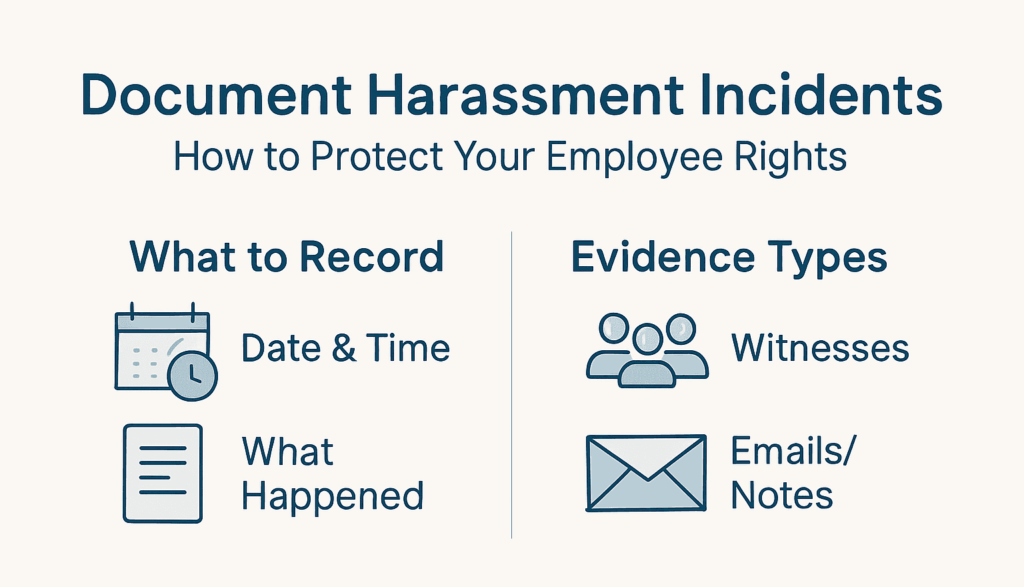
This documentation protects you because it creates an independent record. If your employer claims they didn’t know about harassment, your documentation proves otherwise.
Pro tip: Send yourself an email summarizing each harassment incident with details the same day it happens—this creates a timestamped record that’s harder to dispute later.
Here is a summary of key California workplace anti-harassment obligations and employee rights:
| Obligation/Right | Who Is Responsible | Why It Matters |
|---|---|---|
| Written policy | Employer | Sets clear rules and reporting steps |
| Harassment training | Employer | Prevents misconduct and raises awareness |
| Prompt investigation | Employer | Ensures fair process and remedies |
| No retaliation | Employer | Protects employees who speak up |
| Request accommodations | Employee | Enables safer, more comfortable work |
| File external complaints | Employee | Accesses state and federal protections |
Understanding these responsibilities empowers Santa Monica workers to enforce their rights effectively.
Reporting Harassment and Legal Remedies
You have multiple options for reporting sexual harassment and seeking legal remedies. Understanding your choices helps you take action that fits your situation. Each reporting path has different timelines and potential outcomes.
Internal reporting to your employer
Your first step can be reporting to your employer directly. Most companies have a designated HR contact or compliance officer. Report the harassment in writing whenever possible—email works well because it creates a timestamped record.
Include specific details: dates, times, what was said or done, and any witnesses. Be clear that you consider this sexual harassment and request an investigation. Keep a copy of your report for your records.
Internal reporting doesn’t prevent you from filing external complaints. You can report to your employer and government agencies simultaneously.
California Civil Rights Department (CRD)
The CRD (formerly known as the Department of Fair Employment and Housing) is California’s primary agency for harassment complaints. Before filing a lawsuit in court, you must first file a complaint with the CRD alleging sexual harassment under FEHA and obtain a right-to-sue notice. This administrative exhaustion requirement is mandatory under Government Code section 12960(b). Filing with the CRD is free and doesn’t require an attorney.
Filing with CRD is free and doesn’t require an attorney. The agency handles the investigation and can pressure your employer to settle. If mediation fails, CRD can authorize you to sue or file suit itself.
Federal EEOC complaints
You can also file a charge with the federal Equal Employment Opportunity Commission (EEOC). The EEOC investigates discrimination charges and works to resolve harassment complaints. Filing federally gives you additional legal options.
Federal and state complaints work together. Filing with one agency doesn’t prevent filing with the other. Both CRD and EEOC can investigate your harassment claim.
Legal remedies available to you
If harassment is proven, you’re entitled to various remedies:
- Back pay if you lost income due to harassment or retaliation
- Compensatory damages for emotional distress, medical costs, or lost wages
- Punitive damages to punish your employer for egregious conduct
- Injunctive relief requiring your employer to fix policies or separate you from your harasser
- Reinstatement if you were forced to resign
- Attorney’s fees and costs if you win your case
- Policy changes to prevent future harassment
Civil lawsuits
After exhausting your administrative remedies by filing with the CRD and receiving a right-to-sue notice, you can sue your employer in civil court under California law. The right-to-sue notice must be obtained before filing your lawsuit, as required by Government Code section 12960(b). A lawsuit gives you access to the discovery process—forcing your employer to produce documents and testimony. You can recover larger damages amounts through litigation than administrative complaints alone.
Private lawsuits also create public records and potentially jury verdicts that send stronger messages than settlements. However, lawsuits take longer and require more legal resources.
Remedies can include monetary damages for emotional suffering, back pay, reinstatement, and mandatory policy changes—your employer bears the cost of their harassment.
Combining remedies
You’re not limited to one path. You can file CRD and EEOC complaints, then follow with a lawsuit. Each avenue provides leverage and different potential outcomes. Many cases settle during administrative investigations because employers want to avoid litigation costs.
Pro tip: File your administrative complaint with the CRD within three years of the last act of harassment (Gov. Code § 12960(e)). Missing this deadline can bar your claims entirely. After receiving your right-to-sue notice from the CRD, you have one year to file a civil lawsuit. Don’t wait-deadlines matter for preserving all available remedies and options.
Protect Your Rights Against Sexual Harassment in Santa Monica
Navigating sexual harassment at work can feel overwhelming and isolating. The challenges of identifying unwelcome conduct, understanding the differences between quid pro quo and hostile work environment claims, and dealing with employer retaliation require experienced guidance. If you are facing these painful situations, you deserve strong legal support that knows California’s FEHA and labor laws inside and out.
At California United Law Group, P.C., we specialize in fighting for employees confronting harassment and discrimination. Our dedicated Discrimination & Harassment attorneys help you protect your workplace rights and hold employers accountable. Don’t wait until the harmful conduct affects your job or well-being even more. Take control now by visiting California United Law Group and discover how our legal team can guide you through reporting harassment, securing accommodations, and pursuing justice. Learn more about your protections and get the support you need to stand up against workplace harassment today.
Important Deadlines for Sexual Harassment Claims
California law imposes strict deadlines for pursuing sexual harassment claims. You must file an administrative complaint with the California Civil Rights Department within three years of the last act of harassment (Gov. Code § 12960(e)). After receiving a right-to-sue notice from the CRD, you have one year to file a civil lawsuit. Missing these deadlines can result in losing your legal claims entirely, so it’s important to act promptly and consult with an attorney as soon as possible after experiencing harassment.
Frequently Asked Questions
What constitutes sexual harassment in the workplace?
Sexual harassment includes unwelcome sexual advances, requests for sexual favors, verbal or physical conduct of a sexual nature, and anything that creates a hostile work environment.
What should I do if I experience sexual harassment at work?
Report the harassment to your employer’s HR or compliance officer in writing, providing specific details. You can also file a complaint with the California Civil Rights Department (CRD) or the federal Equal Employment Opportunity Commission (EEOC). You must file with the CRD and obtain a right-to-sue notice before you can file a lawsuit in court.
What are my rights as an employee regarding sexual harassment complaints?
You have the right to a workplace free from sexual harassment, to report incidents without fear of retaliation, to have complaints investigated promptly, and to seek legal remedies if harassment occurs.
How can I prove that a hostile work environment exists?
To prove a hostile work environment, you need to show that the conduct was unwelcome, severe or pervasive, offensive to a reasonable person, and related to sex or sexual nature. Keep detailed documentation of incidents to support your claim.
Recommended
- Employment Lawyer Santa Monica – Los Angeles Employment Lawyers | California United Law Group, P.C.
- What Counts as Workplace Harassment in California? – Los Angeles Employment Lawyers | California United Law Group, P.C.
- How to Prove Workplace Harassment in California: A Legal Guide for Employees – Los Angeles Employment Lawyers | California United Law Group, P.C.