
Yes. If you work in Long Beach and your company calls you an independent contractor, you can challenge that label. Under California law, a person who performs work for pay is generally presumed to be an employee. Your company has to prove otherwise, and a signed contractor agreement or a 1099 form does not settle the question. Depending on your situation, including whether you signed an arbitration agreement, you can file a wage claim with the state, bring a lawsuit or arbitration, or have an employment attorney do this for you. At California United Law Group, we represent California employees in wage and hour and misclassification disputes, and we take these cases on a contingency fee basis, so we collect attorney fees only if we obtain a recovery for you. Your written fee agreement explains how litigation costs are handled.
TL;DR
- You can challenge it. California’s ABC test presumes you are an employee unless the company proves all three parts of the test.
- The label does not decide. What matters is how the work actually happens: who controls it, what the business does, and whether you run an independent business of your own.
- Misclassification can cost you a lot. Minimum wage, overtime, meal and rest breaks, paid leave and protection from retaliation may all be missing.
- Deadlines apply. Most wage claims have a three-year window, and some penalties must be pursued within one year, so act early.
- Start documenting now. Keep your hours, pay records and messages with the company before you raise the issue.
Table of Contents
- What misclassification means for a Long Beach worker
- How California’s ABC test decides whether you are an employee
- Federal rules compare differently
- Signs you may be misclassified
- What you may have missed as a misclassified worker
- How to challenge misclassification: step by step
- What you can recover
- Talk to a Long Beach misclassification attorney
- FAQ
- Sources
What misclassification means for a Long Beach worker
Misclassification happens when a company treats a worker as an independent contractor even though the worker is legally an employee. The company saves money. It skips payroll taxes, overtime, workers’ compensation insurance and benefits, and it shifts business costs such as fuel, tools and insurance onto you.
Long Beach has plenty of work where this arises: port and logistics work, delivery driving, warehouse and distribution jobs, hotels, restaurants, healthcare support and gig-style app work. The job title varies. The question is the same each time: does the way you actually work fit the legal definition of an employee?
A 2023 news report described more than 20 truck drivers at the ports of Los Angeles and Long Beach who were awarded nearly $6 million by the California Labor Commissioner, which found they had been misclassified by their employers as independent contractors. Every case depends on its own facts, but the award shows that workers in the Long Beach area do challenge the label and that the state takes misclassification seriously.

How California’s ABC test decides whether you are an employee
California uses what is called the ABC test. Under Labor Code section 2775, a person who provides labor or services for pay is presumed to be an employee. The company can overcome that presumption only by proving all three of these conditions:
- A. Control. You are free from the company’s control and direction in how you do the work, both under your contract and in practice.
- B. Usual course of business. Your work is outside the usual course of the company’s business.
- C. Independent business. You are customarily engaged in an independently established trade, occupation or business of the same kind as the work you do for the company.
Where the ABC test applies, the company’s failure to prove any one of the three is enough to make you an employee. That is a demanding standard for the company, and it is a key reason the test generally favors workers.
The California Supreme Court adopted this test in Dynamex Operations West, Inc. v. Superior Court (2018) 4 Cal.5th 903, holding that drivers for a package delivery company were employees because the company could not satisfy prongs B and C. In Vazquez v. Jan-Pro Franchising International, Inc. (2021) 10 Cal.5th 944, the court held that Dynamex applies retroactively to cases that were not yet final when Dynamex became final. The Legislature then codified and expanded the test in Labor Code section 2775, effective September 4, 2020.
Why prong B trips up many companies
The state’s labor agency explains the second prong with examples. Workers who do the same kind of work as a company’s regular employees, such as work-at-home seamstresses for a clothing maker or regular cake decorators for a bakery, are likely working in the usual course of that business. A retail store’s outside plumber or electrician is not.
So if you drive for a delivery company, stock shelves for a distributor or handle freight for a logistics firm, ask yourself whether your work is the thing the company sells or depends on. If it is, the company may have difficulty satisfying prong B.
Why prong C matters too
The same state FAQ explains that prong C is not met when your work depends on a single hiring company. Its example is a taxi driver whose municipal permit can be used only while working for one taxi company. A real independent business usually has its own customers, its own licenses and the ability to work for others. It also says a company cannot simply label you an independent contractor or require a contract that says so.
When a different test applies
The ABC test has exceptions. The state notes that it does not apply where the Legislature or the Industrial Welfare Commission’s wage orders define the employment relationship in a specific way. It also does not apply where a court finds it preempted by federal law, in which case the older multifactor test from S.G. Borello & Sons, Inc. v. Department of Industrial Relations (1989) 48 Cal.3d 341 applies. Certain occupations listed in the Labor Code are also judged under Borello. Separately, Proposition 22, approved by voters in November 2020, classifies app-based rideshare and delivery drivers as independent contractors and sets out its own pay and benefit rules for those drivers. If you drive for an app-based company, your situation should be reviewed under those rules. If your job falls in one of these groups, the analysis is different, but you can still be an employee. An employment lawyer can help you figure out which test governs your work.
Federal rules compare differently
You may also hear about the federal test. Under the Fair Labor Standards Act, the U.S. Department of Labor looks at the economic realities of the whole working relationship using six factors:
- Your opportunity for profit or loss
- Your investments in equipment or materials
- How permanent the relationship is
- The nature and degree of the company’s control
- Whether your work is integral to the business
- Your skill and initiative
No single factor controls, and the Department of Labor states that a title, a 1099 or a signed contractor agreement does not decide status. The federal test weighs factors together. California’s ABC test starts from a presumption that you are an employee and puts the burden on the company. For Long Beach workers, the state test is usually the stronger tool for wage and benefit claims.
Because rules in this area have been revised in recent years, including federal rulemaking activity that the Department of Labor continues to post, check the current state and federal pages or speak with an attorney before relying on any summary, including this one.
Signs you may be misclassified
No checklist replaces a review of your actual situation, but these are common warning signs:
- The company sets your schedule, routes, quotas or methods of work.
- You wear a uniform, use company branding or must follow a company manual.
- You do the same work as people the company treats as employees.
- You work mostly or only for one company.
- You were never free to turn down work without consequences.
- You paid for your own equipment, fuel, insurance or training, with no reimbursement.
- You receive a 1099 instead of a W-2 and no overtime, even when you work long days.
- The company would not let you hire helpers or send a substitute.
One or two of these does not decide your case. Several together may suggest that the company will have trouble proving all three prongs.
What you may have missed as a misclassified worker
The cost of misclassification is rarely just the label. The U.S. Department of Labor lists benefits and protections a misclassified worker may be denied: minimum wage and overtime, job-protected family and medical leave, anti-discrimination and anti-retaliation protections, workers’ compensation, unemployment insurance, and the employer’s share of Social Security and Medicare taxes.
In California, the state labor agency adds that wage and hour laws on minimum wage, overtime, meal periods and rest breaks, as well as workplace safety and retaliation laws, protect employees but not independent contractors. Independent contractors are generally not eligible for regular unemployment, disability or Paid Family Leave benefits, though a misclassified worker may still qualify.
There is a tax side as well. The Franchise Tax Board explains that a worker classified as an employee receives a W-2 reporting all wages, compensation and fringe benefits. Contractors pay both halves of Social Security and Medicare taxes themselves. Speak with a tax professional about how a change in status affects your returns.
A worked example
Suppose a delivery driver in Long Beach works ten-hour days, five days a week, for one logistics company. The company sets routes and delivery windows, and the driver pays for fuel and vehicle insurance. The company calls the driver a contractor and pays a flat rate per delivery.
If the driver is an employee, then hours over eight in a workday or 40 in a workweek are generally overtime, the driver is generally entitled to meal and rest breaks, and the company may owe reimbursement for business expenses. Federal law sets overtime at at least 1.5 times the regular rate for hours over 40 a week, and California applies stricter daily rules. Flat per-delivery pay does not erase those rights. Over several years, the unpaid amounts can be substantial.
How to challenge misclassification: step by step
1. Gather your records
Start before you confront anyone. Write down your start and end times, meal and rest breaks and total hours. Keep every paystub, payment record, contract, text message and email about schedules, routes or rules. The Labor Commissioner’s guidance tells workers to track all hours worked and keep paystubs. A worker is not required to keep time records, because the employer must keep accurate time and payroll records, but your own notes and supporting documents help the agency evaluate a claim.
If you have already started, our guide to documenting hours for Long Beach overtime claims explains what to keep and how DLSE steps work.
2. Compare your work to the ABC test
Go through the three prongs honestly. Write one short paragraph for each, with specific facts. Our page on Long Beach employee misclassification walks through the test for local workers, and our overview of worker misclassification under the ABC test covers penalties and rights.
3. Choose where to raise it
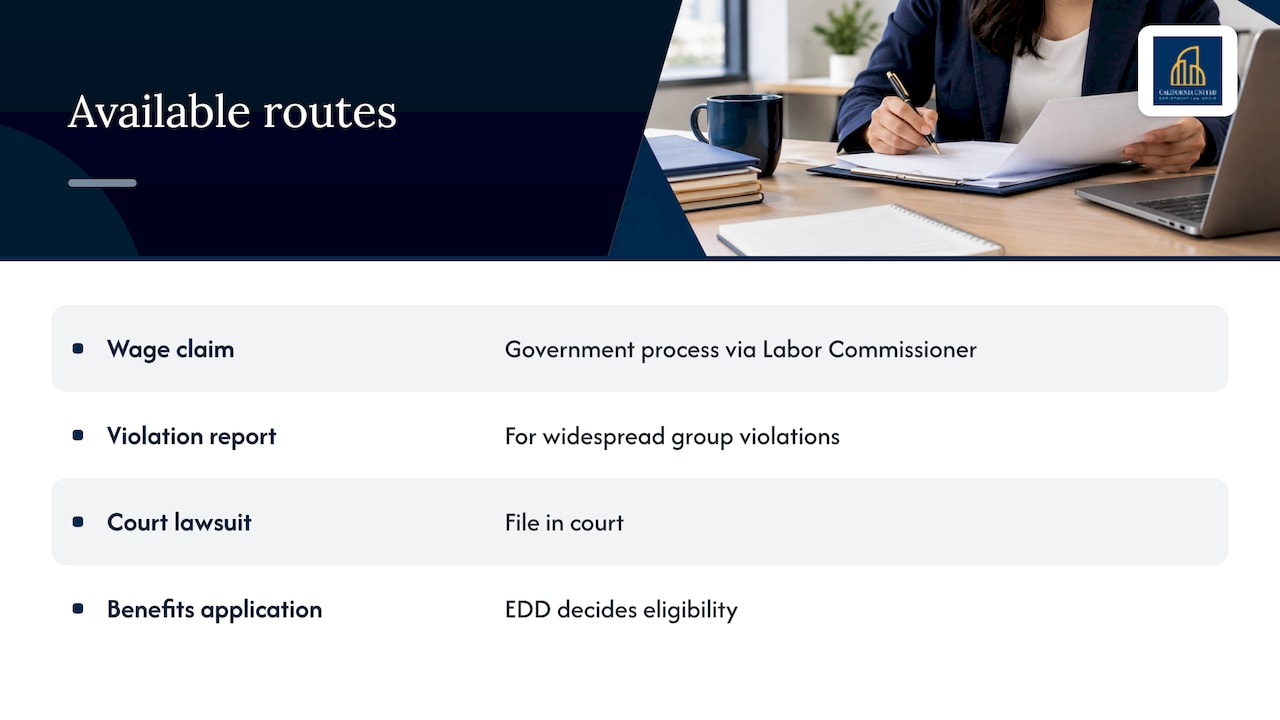
The state labor agency says workers who believe they were misclassified can file a wage claim, a Report of Labor Law Violation for widespread violations affecting a group, or a lawsuit in court. You can also apply for unemployment, disability or Paid Family Leave benefits through the Employment Development Department, which decides eligibility. A wage claim with the Labor Commissioner’s Office is a government process. We handle that process for clients, as well as litigation and arbitration. Which route fits depends on how much is owed, how many coworkers are affected, whether you still work there and whether you signed an arbitration agreement.
If many coworkers were treated the same way, a class or representative action may be possible. You can read about how we approach class actions.
4. Meet your deadline
The Labor Commissioner’s Office lists these filing windows for wage claims:
| Type of claim | Time limit |
|---|---|
| Bounced-check or record-access penalties | 1 year |
| Oral promise to pay more than minimum wage | 2 years |
| Minimum wage, overtime, unpaid rest and meal breaks, sick leave, illegal deductions, unpaid reimbursements | 3 years |
| Written contract | 4 years |
These come from the state’s wage claim guidance. The clock generally runs back from the date you file, so every month you wait can shrink what you recover. Late-payment penalties also have a one-year limit and set amounts: $100 for an initial failure to pay each employee and $200 for a subsequent or willful violation, plus 25% of the wages unlawfully withheld. Other claims and remedies can have different deadlines, so confirm yours with an attorney as early as possible.
5. Protect yourself from retaliation
It is natural to fear losing your work. California law provides important protections. Labor Code section 98.6 prohibits discharging or discriminating against an employee for filing a bona fide complaint with the Labor Commissioner or exercising rights under its jurisdiction. A retaliated-against employee is entitled to reinstatement and reimbursement for lost wages and work benefits. If the company fires you, cuts your hours or deactivates your account after you raise misclassification, tell an attorney right away, because that can be a separate claim. We also handle retaliation and wrongful termination claims.
What you can recover
A misclassification claim can include unpaid overtime and minimum wage, missed meal and rest break pay, unreimbursed business expenses, itemized wage statement violations and late-payment penalties. Which of these apply depends on your facts. Separately, Labor Code section 226.8 imposes substantial penalties on employers that voluntarily and knowingly misclassify workers as independent contractors. In Noe v. Superior Court (2015) 237 Cal.App.4th 316, a California Court of Appeal held that workers cannot sue directly for those penalties. They are generally pursued through the Labor Commissioner or a Private Attorneys General Act claim. If you never got proper paystubs, see how Los Angeles-area workers can challenge paystub violations under Labor Code section 226. Wage claims can also be paired with claims for unpaid overtime.
No lawyer can ethically promise a result or a dollar amount, and past results do not guarantee future outcomes. What we can say is that the amount depends on your hours, your pay rate, how long the problem lasted and what documents exist.
Our view: why the label should not decide your rights
We practice employment law for employees across California, and our attorneys include lawyers with prior employer-side experience. That background shows us how companies build contractor arrangements and which parts of them may be vulnerable under the ABC test.
Misclassification claims often turn on detail: the route schedule, the uniform, the app rules, the texts from a dispatcher. We start with your records and measure your work against each prong, then decide whether a wage claim, a lawsuit or a group action is the right path. We advocate diligently for our clients and keep them informed at every stage.
Because we work on a contingency fee basis, our attorney fees are paid only from a settlement or award. Your written fee agreement explains how litigation costs are handled. You should not have to fund a fight against a company that may have saved money by misclassifying you.
California United Law Group
Talk to a Long Beach misclassification attorney
If you work in Long Beach and suspect you are an employee in disguise, we offer free consultations and case evaluations. We represent employees in wage and hour disputes, wrongful termination, retaliation, discrimination and harassment claims, and class actions, from pre-litigation through litigation.
👉 Contact California United Law Group to talk through your work, your records and your options. Contacting us does not create an attorney-client relationship.
FAQ
Can my employer fire me for asking whether I am misclassified?
California law prohibits discharging or discriminating against an employee for filing a bona fide complaint with the Labor Commissioner or exercising rights under its jurisdiction. If you are fired, demoted or have your hours cut after raising the issue, you may have a retaliation claim in addition to your wage claim. Speak with an employment attorney quickly.
What if I signed an independent contractor agreement?
Signing does not decide your status. The state labor agency explains that a company cannot unilaterally label you an independent contractor or require a contract that designates you as one. Courts and agencies look at how the work is actually done under the ABC test.
How far back can I claim unpaid wages?
It depends on the claim. The Labor Commissioner lists one year for certain penalties, two years for an oral promise of higher pay, three years for minimum wage, overtime, meal and rest breaks and similar claims, and four years for a written contract. Because these windows run backward from the filing date, an early review protects more of your claim.
Do I need a lawyer to file a wage claim?
You can file a wage claim with the Labor Commissioner’s Office yourself, online, by email, by mail or in person. An attorney helps you decide which claims to bring, gather proof of your status and pursue the full amount, and a lawyer can also take your case to court or arbitration. Our firm handles misclassification cases on contingency.
Does the ABC test apply to every worker in Long Beach?
Not to every one. Some occupations and situations are governed by the Borello test or by specific wage orders, and where a court finds the ABC test cannot be applied, including on federal preemption grounds, the Borello test governs. App-based rideshare and delivery drivers may be covered by Proposition 22. Many workers in logistics, warehouse and similar jobs are analyzed under the ABC test, but every situation should be reviewed on its own facts.
This article provides general information only and is not legal advice. Laws change, and every case depends on its specific facts.
Sources
- California Labor Code section 2775
- LWDA: Workers and employment status
- LWDA: Employment status FAQ
- U.S. Department of Labor Fact Sheet 13
- U.S. Department of Labor: Myths About Misclassification
- Franchise Tax Board: Worker classification and AB 5 FAQ
- DLSE: How to file a wage claim
- DLSE: Supporting documents
- DLSE: Late payment of wages FAQ
- DIR: Labor Code excerpts
- Long Beach Post: Port truck drivers awarded nearly $6 million