
In many cases, yes. If you work in Monterey Park and your employer treats you differently, harasses you or punishes you because of your race or color, you can bring a claim under California law, federal law or both. California’s Fair Employment and Housing Act (FEHA) covers employers with five or more employees, which can include many workplaces in the city, from restaurants on Garvey Avenue to offices and warehouses along Atlantic Boulevard. An employment lawyer serving Monterey Park can help you evaluate which route may fit your facts. Our firm handles these cases on a contingency basis, which means we collect no attorney’s fees unless we obtain a recovery for you.
This guide explains who is covered, what conduct counts, how to document it, where to file and how long you have.
TL;DR
- FEHA protects employees and applicants of employers with five or more employees from race and color discrimination. Federal Title VII covers employers with 15 or more.
- Covered conduct goes beyond firing: hiring, pay, promotions, assignments, discipline, harassment and retaliation can all qualify.
- Start keeping dated notes, messages and witness names now, and report the problem to your employer in writing.
- Strict deadlines apply. Missing one can end a strong claim, so speak with an employment attorney early.
- Retaliation for complaining is a separate violation. You are generally protected if you reasonably and in good faith believed the conduct was unlawful, even if the underlying claim is later disputed.
Table of Contents
- Who can bring a race discrimination claim in Monterey Park
- What workplace actions are covered
- When racist comments become unlawful harassment
- How to document race discrimination at work
- What you have to show
- Retaliation: protection for speaking up
- Where to file and how long you have
- What you can recover
- Why having an employment lawyer in Monterey Park matters
- Our perspective
- Related situations in Monterey Park
- FAQ
- Sources
Who can bring a race discrimination claim in Monterey Park
Two main laws apply to a Monterey Park workplace.
California’s FEHA. The California Civil Rights Department (CRD), the state agency that enforces FEHA, explains that FEHA prohibits employers with five or more employees from discriminating against applicants and employees because of a protected category, including race and color. The same page says harassment based on a protected category is prohibited in all workplaces, including those with fewer than five employees. Under the same law, an employer can be held responsible for harassment by a supervisor, and for harassment by a coworker if the employer knew or should have known about it and did not act.
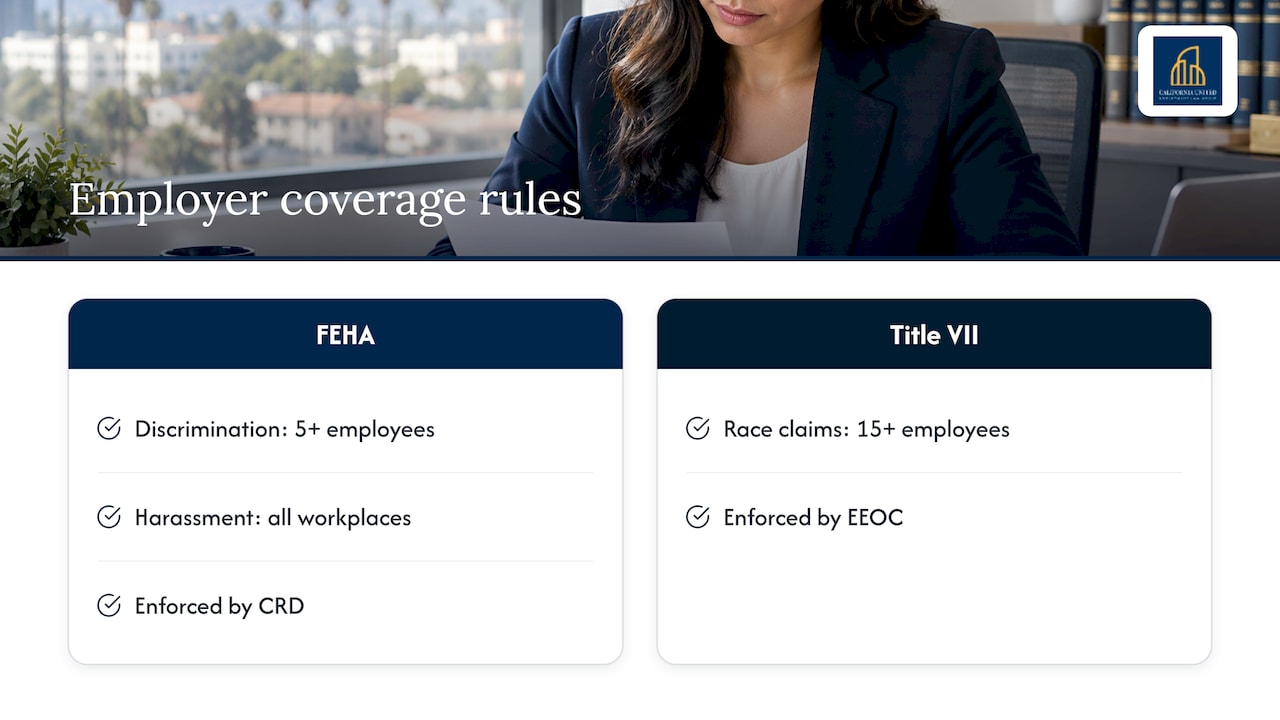
Federal Title VII. The U.S. Equal Employment Opportunity Commission (EEOC) is the federal agency that enforces this law. It says employees can bring race discrimination claims under Title VII if the employer has at least 15 employees.
Because FEHA reaches smaller employers, it is usually the stronger starting point for California workers. It also protects job applicants, not only current employees. Race is only one protected category. Ancestry and national origin are separate categories, and the facts of your case may fit more than one. We cover those in related guides on ancestry discrimination in Monterey Park and national origin discrimination in Monterey Park.
What workplace actions are covered
Race discrimination is not limited to being fired. California courts apply a similar approach under FEHA. The California Supreme Court held in Yanowitz v. L’Oreal USA, Inc. (2005) 36 Cal.4th 1028 that an adverse action must materially affect the terms, conditions, or privileges of employment, and that a series of smaller actions can be considered together. The EEOC explains that Title VII covers recruitment, hiring, promotion, wages, benefits, work assignments, performance evaluations, training, transfers, leave, discipline, layoffs, discharge and other terms and conditions of employment.
In practice, that means a claim may rest on situations like these:
- You are passed over for a promotion that goes to a less qualified coworker of a different race.
- Employees of one race get the better shifts, routes, accounts or overtime.
- You are disciplined for something coworkers of another race do without consequence.
- A manager makes hiring or layoff choices based on race or skin color.
- You are paid less than a comparable colleague for the same work.
- You are forced out through working conditions so intolerable that a reasonable person in your position would feel compelled to resign, which can be a constructive discharge.
Color discrimination, such as treating employees differently based on skin shade, can occur even among people of the same race or ethnicity. It is covered too.
When racist comments become unlawful harassment
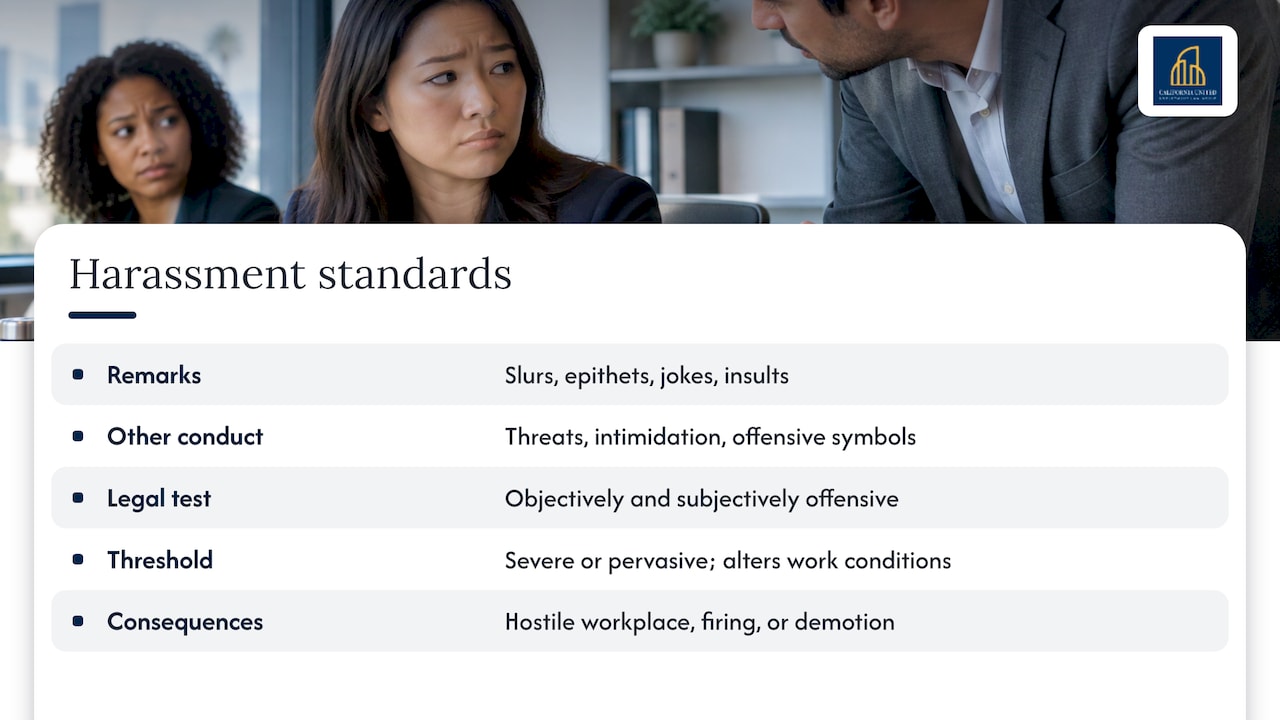
Not every rude remark is a lawsuit, but racial harassment is broader than many workers expect. According to the EEOC, racial harassment can include racial slurs, offensive or derogatory remarks about a person’s race or color, or racially offensive symbols. It becomes illegal when it is frequent or severe enough to create a hostile or offensive work environment, or when it leads to an adverse employment decision such as a firing or demotion.
Under federal law, the EEOC’s guidance says the conduct must be objectively and subjectively offensive and severe or pervasive enough to alter the conditions of employment. In plain terms: a reasonable person would find it hostile, you actually found it hostile, and it was more than occasional teasing. The same guidance lists examples of conduct that can create a hostile environment, including slurs, offensive jokes, epithets, physical threats, intimidation, insults and racially offensive symbols. California law can be more protective. Under Government Code section 12923, a single incident of harassing conduct can be enough to create a triable issue of a hostile work environment, and the Legislature has stated that harassment cases are rarely appropriate for summary judgment. In Beltran v. Hard Rock Hotel Licensing, Inc. (2023) 97 Cal.App.5th 865, the Court of Appeal reversed summary judgment for an employer in part because the trial court failed to consider that standard.
Harassment can come from a supervisor, a coworker or, in some situations, a customer or vendor your employer lets continue. If you want a deeper look at how harassment is proven, read our guide on how to prove workplace harassment in California.
A worked example
Suppose a Monterey Park warehouse employee hears a supervisor use a racial slur toward him, twice in one week, and then sees his hours cut after he objects. The slurs may support a harassment claim. The reduced hours after he objected may support a separate retaliation claim. Even if a jury later weighed the slurs differently, the cut in hours following his complaint stands as its own issue. Each piece needs documentation, which is why the next section matters.
How to document race discrimination at work
Strong claims are built on records created while events happen. The EEOC advises employees to keep records of what they experienced or witnessed, along with the names, phone numbers and addresses of other witnesses. Here is a practical routine:
- Write down each incident the same day. Note the date, time, place, who was present, and the exact words used as best you remember.
- Save written evidence. Keep emails, texts, chat messages, schedules, performance reviews and pay records. Store copies somewhere you control, and follow your employer’s rules about what company material you may copy.
- List witnesses. Include coworkers who saw or heard the conduct, with contact details.
- Track comparisons. Note how coworkers of a different race were treated in similar situations: discipline, assignments, pay, promotions.
- Report it in writing. The EEOC says employees should try to address concerns with the offender and, if that does not work, report the unfair or harassing treatment to the company. An email to HR or a manager creates a dated record.
- Keep a timeline. Mark when you complained and when anything changed afterward, such as discipline, schedule changes or a termination.
Our evidence checklist for Monterey Park race discrimination claims goes through these items in more detail, along with the state filing deadline.
What you have to show
Most race discrimination cases rely on indirect evidence, because employers rarely admit their motives. The EEOC’s guide for complainants explains that evidence may be direct or circumstantial, including proof that similarly situated employees of a different race were treated more favorably. Courts often use a three-step framework from McDonnell Douglas Corp. v. Green (1973) 411 U.S. 792, which the California Supreme Court adopted for FEHA claims in Guz v. Bechtel National, Inc. (2000) 24 Cal.4th 317:
- You present a basic (prima facie) case: you are in a protected group, you were qualified, you suffered an adverse action, and the circumstances suggest race played a role.
- The employer must state a legitimate, nondiscriminatory reason for what it did.
- You then show that reason is a pretext, meaning not the real reason.
Pretext is where documentation earns its keep. Shifting explanations, inconsistent discipline, sudden negative reviews after a complaint, or comments revealing bias all help show it. At trial under FEHA, a jury decides whether race was a substantial motivating reason for the employer’s decision. That means a reason that actually contributed to the decision. It does not have to be the only reason.
Retaliation: protection for speaking up
You do not have to be proven right to be protected, as long as you reasonably and in good faith believed the conduct you reported was unlawful. The EEOC states that employees are legally protected from being punished or fired for reporting or opposing job discrimination or taking part in an EEOC investigation.
Retaliation is not limited to termination. The Ninth Circuit, whose rulings govern federal cases in California, held in Ray v. Henderson that an adverse action in a retaliation claim is any action reasonably likely to deter an employee from engaging in protected activity. The U.S. Supreme Court adopted a similar test in Burlington Northern & Santa Fe Railway Co. v. White (2006) 548 U.S. 53. Under FEHA, California courts apply the materiality standard from Yanowitz instead, taking into account the employee’s circumstances and the workplace context. Examples can include a sudden schedule change, loss of duties, a poor review or a transfer to a worse position after you complained.
If you are facing this, our employment law practice includes retaliation, whistleblower claims and wrongful termination.
Where to file and how long you have
Deadlines are the most common way good cases are lost. Check them against your own dates as soon as possible.
| Step | Agency | Time limit |
|---|---|---|
| Administrative complaint (state) | CRD | Three years from the unlawful act (with a limited 90-day extension in some delayed-discovery situations) |
| Administrative charge (federal) | EEOC | 180 calendar days, extended to 300 days in California because the CRD enforces a similar law |
| Lawsuit after federal Notice of Right to Sue | Court | 90 days from receiving the notice |
| FEHA lawsuit after a CRD Right-to-Sue notice | Court | One year from the date of the notice |
For the state process, a complaint with the CRD is the usual first step before a FEHA lawsuit. Our firm’s guide to the three-year CRD filing deadline for Monterey Park race discrimination claims explains how that window works. Because the federal and state clocks differ, never assume the longer one applies to you. Each discriminatory act may have its own deadline, so count from the date of each act and have an attorney confirm the dates.
Rules and procedures can change, so confirm the current requirements on the CRD and EEOC websites or with an attorney before you rely on any date.
What you can recover
The CRD lists the remedies available for employment discrimination: back pay, front pay, hiring or reinstatement, damages for emotional distress and punitive damages. A prevailing employee may also be able to recover reasonable attorney’s fees and costs. Some remedies have limits; for example, punitive damages are generally not available against public employers, and federal Title VII damages are subject to caps based on employer size. Back pay covers wages you lost up to the resolution of your case. Front pay compensates for future lost earnings when returning to the job is not realistic. Emotional distress damages address the personal toll of discrimination, and punitive damages are meant to punish especially wrongful conduct.
No lawyer can promise an outcome. What a lawyer can do is evaluate your evidence, explain which remedies fit your facts and handle the filings to help avoid technical mistakes that could jeopardize the claim.
Why having an employment lawyer in Monterey Park matters
Race discrimination cases involve a mix of agency procedures, short deadlines, employer defenses and evidence gathering. An employer will usually have counsel or an HR team ready as soon as you complain. Having your own attorney from the start means your complaint is framed correctly, your records are organized, and communications with the employer are handled with the claim in mind.
It also matters what the attorney does all day. California United Law Group exclusively practices employment law for employees across California, and our attorneys include lawyers with prior employer-side experience, which helps us anticipate how the other side will respond. We represent employees from pre-litigation through litigation, including administrative complaint filings and arbitration.
👉 Ready to talk through your situation? Our page for employees in Monterey Park explains how we help local workers, and you can contact us for a free consultation. We work on contingency, so we collect no attorney’s fees unless we obtain a recovery for you.
Our perspective
Workers in Monterey Park often wait because they fear that speaking up will cost them their job, or because they are unsure whether what happened “counts.” We would rather you ask early. A conversation with an attorney costs you nothing, and it can protect you from the deadlines and retaliation risks that catch people off guard.
We practice only employment law, and only on the side of employees. That focus lets us look at your facts the way an employer’s lawyer will, because members of our team have worked on that side, and then prepare the case with those defenses in mind. Our approach is client-focused: we take on the investigation, the filings and the negotiation so you can concentrate on your work and your life.
Because our fees come from a recovery, our interests are tied to yours. If you believe your race or color played a part in how you were treated at work, we want to hear what happened.
California United Law Group
Related situations in Monterey Park
Workplace bias often overlaps. If your experience involves your accent, birthplace or family origin, see our guide on suing for national origin bias in Monterey Park. If religion or sexual orientation played a role, we have separate resources on religious discrimination and sexual orientation discrimination. For a similar race-focused guide covering a nearby community, see our page on race or color discrimination in Inglewood.
FAQ
Can I sue my Monterey Park employer for a single racist comment?
It depends on the comment and the context. Federal guidance requires conduct to be severe or pervasive. California law goes further: under Government Code section 12923, a single incident of harassing conduct can be enough to create a triable issue. Under either law, a single very serious incident, such as a slur from a supervisor or a threat, can sometimes meet that standard. A one-time comment may also matter as evidence of bias in a firing or promotion decision. An attorney can assess how your facts fit.
Does my employer have to be large for me to have a claim?
No. FEHA applies to employers with five or more employees, while Title VII applies to those with 15 or more. FEHA’s harassment protections apply to employers of any size, even those with fewer than five employees.
What should I do first if I am facing racist treatment at work?
Write down what happened, save messages and records, and list any witnesses. Then report the problem to your employer in writing, ideally to HR or a manager above the person involved. Contact an employment attorney soon after, because filing deadlines generally start running from the date of each discriminatory act.
Can I be fired for complaining about race discrimination?
It is illegal. Both federal and California law protect employees who report or oppose discrimination. If you are fired, demoted or otherwise treated worse after complaining, that may be a separate retaliation claim.
How much does it cost to hire a discrimination lawyer?
Our firm offers free consultations and case evaluations and represents employees on a contingency basis. We collect no attorney’s fees unless we obtain a recovery for you.
Sources
- Employment | California Civil Rights Department
- Questions and Answers about Race and Color Discrimination in Employment | EEOC
- Race/Color Discrimination | EEOC
- Section 15 Race and Color Discrimination | EEOC
- A Guide to Legal Standards for Unrepresented Complainants | EEOC
- Ray v. Henderson, 217 F.3d 1234 (9th Cir. 2000)
- How to File a Charge of Employment Discrimination | EEOC
- Filing a Lawsuit | EEOC
- Instructions for Obtaining a Right-to-Sue Notice | CRD