
California law generally prohibits workplace discrimination based on gender identity, gender expression, and perceived gender, subject to coverage requirements, deadlines, and case-specific facts. The Fair Employment and Housing Act (FEHA) and federal Title VII both bar employers from treating you differently because of your gender identity, gender expression, or how a manager or coworker perceives your gender. If you work in Santa Monica and believe you experienced this kind of treatment, you may have options, but the best next step depends on the facts, the employer’s size, your work relationship, and applicable filing deadlines.
Coverage extends beyond traditional employees. Coverage depends on the claim. Employees and applicants are generally protected against discrimination by covered employers, while FEHA harassment protections can also extend to unpaid interns, volunteers, and people providing services under a contract.
Here’s where to start:
- Document it. Write down dates, exact words used, and who witnessed what happened.
- Report internally. Notify HR or a designated manager in writing, and keep a copy.
- File externally if needed. The Civil Rights Department (DFEH/CRD) or the EEOC can open a formal case.
- Talk to someone who knows the law. California United Law Group, led by Kenneth A. Seligson, offers consultations for Santa Monica employees weighing their next move.
Key Takeaways
California’s FEHA and federal Title VII both prohibit gender identity discrimination at work, and Santa Monica employees can pursue protection through internal reporting, DFEH/CRD, the EEOC, or private counsel.
| Point | Details |
|---|---|
| Laws that protect you | FEHA and Title VII both bar gender identity and expression discrimination, with FEHA often reaching smaller employers. |
| Coverage is broad | Coverage varies by claim: discrimination protections generally focus on employees and applicants at covered employers, while harassment protections can extend more broadly to unpaid interns, volunteers, and people providing services under contract. |
| Documentation is critical | Written records with dates, exact language, and witnesses hold up far better than verbal-only accounts. |
| Filing deadlines apply | Filing deadlines apply. FEHA administrative complaints are generally subject to a three-year deadline, while EEOC deadlines are often shorter, commonly 300 days in California, depending on the claim and circumstances. |
| Retaliation is separately illegal | Demotion, exclusion, or termination after a complaint can support its own legal claim. |
| Getting guidance | California United Law Group, led by Kenneth A. Seligson, offers consultations for Santa Monica employees weighing next steps. |
Table of Contents
- What Laws Protect You From Gender Identity Discrimination at Work?
- What Does Gender Identity Discrimination Look Like at Work?
- Who Is Covered Under California’s Gender Identity Protections?
- How Should You Document and Report an Incident at Work?
- How Do You File a Complaint With DFEH/CRD or the EEOC?
- What Happens If Your Employer Retaliates?
- How Does California United Law Group Support Santa Monica Employees?
- Does Santa Monica Have Its Own Gender Identity Protections?
- Where Can You Find Support in Santa Monica?
- How Do You Request a Workplace Accommodation for Gender Identity?
- Are Your Complaint Records Kept Private?
- Get Legal Guidance From California United Law Group
- Sources
What Laws Protect You From Gender Identity Discrimination at Work?
Two statutes do the heavy lifting here, and they overlap more than most employees realize. FEHA explicitly lists gender identity and gender expression as protected characteristics, and California’s Civil Rights Department enforces it. Title VII, the federal law, also prohibits many forms of gender identity discrimination through its prohibition on sex discrimination, but its coverage rules and procedures differ from FEHA.
Several leading decisions help frame these claims. In Bostock v. Clayton County, the U.S. Supreme Court held that Title VII prohibits firing a worker merely for being gay or transgender. California courts also distinguish discrimination from harassment: discrimination usually involves official personnel actions such as hiring, firing, promotion, compensation, discipline, or assignments, while harassment often involves bias expressed through workplace interpersonal conduct. Rutter identifies Bostock as holding that Title VII protects gay and transgender workers from termination because of sex. Rutter summarizes Roby v. McKesson Corp. as distinguishing discrimination, which involves official personnel actions, from harassment, which involves bias expressed through interpersonal workplace relations.
The U.S. Supreme Court held in Bostock v. Clayton County that firing a person merely for being gay or transgender violates Title VII, and California authorities separately recognize gender identity and gender expression as protected under FEHA. Rutter identifies Bostock v. Clayton County and explains that FEHA includes gender identity and gender expression within sex discrimination.
The enforcement split matters in practice. DFEH/CRD handles state-level FEHA claims, while the EEOC processes federal Title VII charges. In many cases, workers can ask about dual filing so that a complaint filed with one agency may also be treated as filed with the other, but employees should confirm that both state and federal rights are actually preserved.
Employer size changes which law applies to you. For discrimination claims, FEHA generally applies to California employers with five or more employees, while Title VII generally applies to employers with fifteen or more employees. But here’s what surprises a lot of workers: harassment protections often apply regardless of company size, according to guidance from California’s Civil Rights Department. A five-person Santa Monica employer may still fall within FEHA’s discrimination coverage, and harassment protections can apply even more broadly.
Key legal point: FEHA can apply to smaller employers than Title VII, so some Santa Monica workers may have state-law protection even when federal law does not apply.
What Does Gender Identity Discrimination Look Like at Work?
Discrimination rarely announces itself with a slur or a formal memo. It usually shows up in smaller, repeated moments that add up. California regulators define gender identity as your internal sense of being male, female, or something else, and gender expression as how you outwardly present that identity through dress, mannerisms, or name.
Here’s what unlawful conduct commonly looks like on the ground:
- Refusal to use your chosen name or pronouns after notice, except where a legal obligation requires use of a government-issued name.
- Restroom or facility denial that doesn’t match your gender identity. State regulations generally require employers to permit facility access consistent with gender identity or gender expression, and employers should not demand medical proof of transition before honoring that access.
- Dress code enforcement that singles you out or forces conformity to stereotypes tied to sex assigned at birth.
- Discipline or demotion tied to transition-related leave or visible changes in presentation.
- Jokes, mockery, or hostile comments repeated often enough to create a hostile work environment.
Courts evaluate whether the conduct was severe or pervasive, meaning it altered the conditions of employment and created a hostile, intimidating, offensive, oppressive, or abusive work environment. A single incident may be enough if it is sufficiently severe.
Pro Tip: A single isolated comment may not always meet the legal standard, but one sufficiently severe incident can support a harassment claim. A documented pattern of comments, especially after you asked coworkers to stop, can also strengthen the record.
Who Is Covered Under California’s Gender Identity Protections?
Coverage is broader than most people assume, and narrower in a few specific spots.
- Employees at covered employers, subject to the specific claim, employer-size rules, and administrative requirements.
- Job applicants, who are protected from discriminatory hiring decisions before they’re even on payroll.
- Unpaid interns and volunteers, particularly for FEHA harassment protections in work-related settings.
- People providing services under a contract may be protected from harassment, but independent contractors generally are not treated the same as employees for FEHA discrimination claims.
Employer-size thresholds still matter for discrimination claims: generally five or more employees for FEHA and fifteen or more employees for Title VII. FEHA harassment protections can apply to all employers, regardless of size.
A few narrow exceptions exist. Employers may try to argue a bona fide occupational qualification in narrow circumstances, but that defense is limited and depends heavily on the specific job and facts. Religious entities also carry limited exemptions under specific circumstances. Neither exception is a blanket shield, and both get scrutinized closely by regulators.
How Should You Document and Report an Incident at Work?
Your documentation matters more than almost anything else if your case ever moves to a formal complaint. Memory fades, and verbal-only reports are the easiest thing for an employer to dispute later.
Start recording as soon as something happens:
- Write down the date, time, and exact words used, while it’s still fresh.
- Note witnesses by name, even if you’re not sure they’d testify.
- Save digital evidence. Screenshots of messages, emails, and calendar invites all count.
- Photograph anything relevant, like a posted schedule or a discriminatory sign.
- Report in writing, even if you’ve already raised it verbally with a supervisor.
- Request written acknowledgment from HR that they received your report.
Avoid confrontations that could escalate the situation further, and resist the urge to “let it go” after one informal conversation with a manager. A pattern of written reports, kept in your own lawful records rather than only on a company system you might lose access to, is usually more useful than relying on memory alone. For a deeper look at what qualifies as evidence in these cases, see this guide on proving workplace harassment.
Pro Tip: Email yourself a summary of any verbal conversation about the incident right after it happens. Time-stamped emails carry more weight than a recollection written weeks later.
How Do You File a Complaint With DFEH/CRD or the EEOC?
For many FEHA and Title VII employment claims, filing an administrative complaint and obtaining the required agency authorization is a prerequisite before filing a civil lawsuit.
- DFEH/CRD handles FEHA claims and provides complaint forms and procedural guidance directly through its website.
- The EEOC handles Title VII charges and outlines its own filing procedures for federal claims.
- Dual filing is common. Because the agencies have work-sharing procedures, filing with one agency may help preserve related state or federal claims, but workers should confirm that the complaint is properly cross-filed and timely under each law.
- Deadlines are critical, and missing them can seriously affect your ability to pursue a claim. FEHA claims generally must be filed within three years of the discriminatory act, while Title VII charges typically require filing within 300 days when a state agency also enforces the claim.
Statistic to know: Investigations can lead to several possible outcomes, including mediation, dismissal for insufficient evidence, or a right-to-sue notice that lets you take the matter to court, according to DFEH/CRD’s own complaint process description.
Depending on the claim and proof, remedies may include back pay, reinstatement, compensatory damages, injunctive relief, attorney fees, and in some cases punitive damages, though outcomes vary widely based on the specific facts and no result is guaranteed.
What Happens If Your Employer Retaliates?
Retaliation is illegal on its own, separate from the underlying discrimination claim. If your employer cuts your hours, demotes you, or fires you because you reported gender identity discrimination, that may support a separate retaliation claim.
Common retaliation patterns include:
- Sudden negative performance reviews after a complaint, with no prior documented issues.
- Exclusion from meetings, projects, or communications you were previously part of.
- Schedule changes that appear designed to push you out.
- Termination shortly after you file an internal or external complaint.
Remedies for retaliation often mirror those available for the underlying discrimination claim: reinstatement, back pay, injunctive relief, and damages in some cases. Timelines and results depend heavily on the specific facts, and no outcome is guaranteed. Retaliation claims also require proof that the protected activity was a substantial motivating reason for the employer’s adverse action. Early consultation with counsel helps preserve evidence before memories fade or records disappear, which is often the deciding factor in how strong a claim looks later. For more on retaliation specifically, see this resource on employee rights after reporting workplace discrimination.
How Does California United Law Group Support Santa Monica Employees?
California United Law Group represents California employees in FEHA and Labor Code disputes, including gender identity discrimination and retaliation claims. The firm’s work spans administrative filings, pre-litigation negotiation, and litigation when a case requires it.
- Contingency-fee representation may be available, meaning attorney fees are generally tied to a recovery; clients should review the fee agreement to understand whether they may be responsible for litigation costs or expenses.
- Direct attorney access through Kenneth A. Seligson for case consultations.
- Experience handling FEHA employment claims, including matters involving gender identity and gender expression protections.
This article is for general educational purposes only and is not legal advice. Reading it does not create an attorney-client relationship, and employment law outcomes depend on the specific facts, documents, deadlines, and applicable law.
Does Santa Monica Have Its Own Gender Identity Protections?
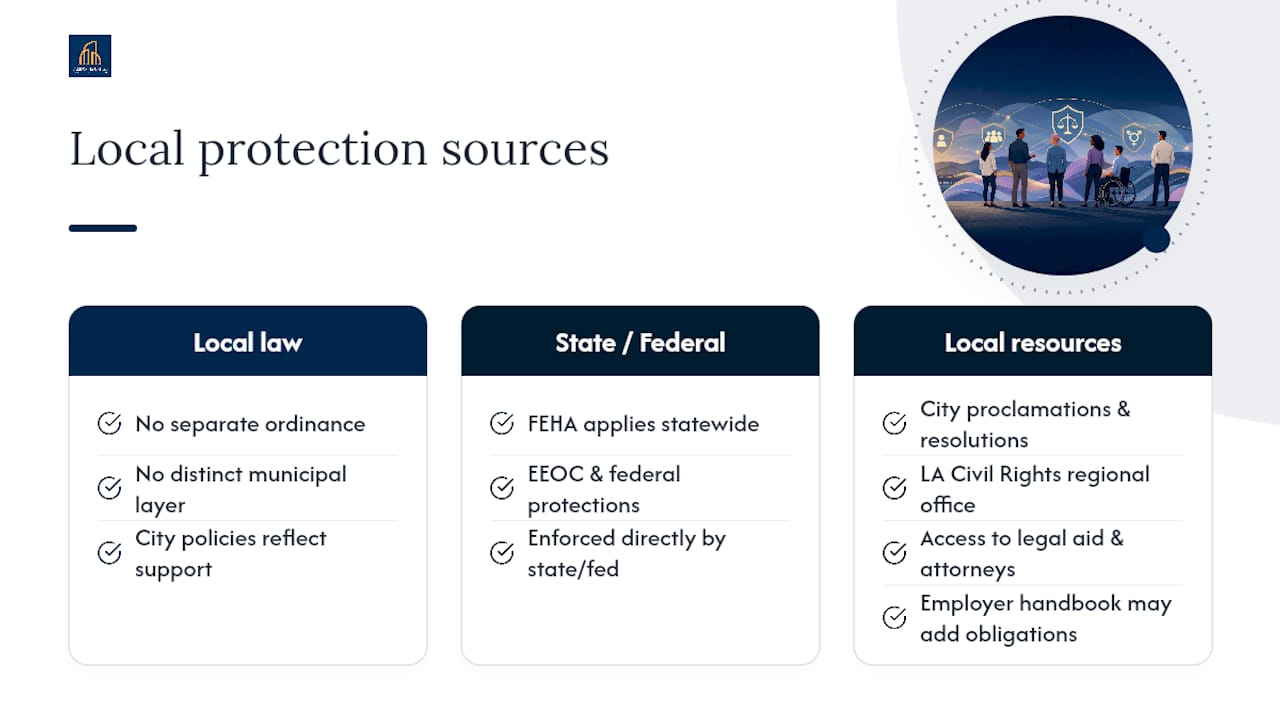
As of the sources linked for this article, Santa Monica does not appear to maintain a separate municipal employment-discrimination ordinance specifically focused on gender identity in the way some cities have created local human rights enforcement systems. Instead, the city functions primarily as a jurisdiction where state and federal protections apply directly, without a distinct local layer of employment discrimination law.
That doesn’t mean local context is irrelevant. Santa Monica’s public policies and civic messaging may reflect support for nondiscrimination, but those materials should not be treated as a substitute for enforceable state or federal employment rights unless a specific ordinance, policy, or contract applies. Local employers in Santa Monica, particularly those in hospitality, retail, and the city’s substantial nonprofit and tech sectors, are still bound by FEHA’s statewide standards regardless of any city-specific ordinance.
What actually functions as your local protection layer is the strength of state enforcement combined with your practical access to nearby resources. The Civil Rights Department maintains a Los Angeles regional presence that serves Santa Monica-area complaints, and Santa Monica’s proximity to Los Angeles gives residents relatively easy access to legal aid organizations, the EEOC’s regional office, and employment attorneys familiar with both West Los Angeles and coastal California employment patterns.
If a Santa Monica employer’s handbook or written policy promises broader nondiscrimination protections than the law requires, that language may matter. Review the exact wording with counsel before assuming it creates enforceable contractual rights.
Where Can You Find Support in Santa Monica?
Facing discrimination at work is isolating, and knowing where to turn matters as much as knowing your legal rights.
Legal aid and advocacy organizations serving the Santa Monica area include Legal Aid at Work, which publishes detailed fact sheets on gender identity discrimination and offers direct assistance to workers who can’t afford private counsel. The ACLU of Southern California also maintains active outreach and know-your-rights materials specific to California employees.
Community and identity-based resources in the broader Los Angeles area, which Santa Monica residents can access, include LGBTQ centers offering counseling, peer support groups, and referrals to employment attorneys who handle these cases regularly.
State enforcement resources remain your most direct path to a formal remedy. DFEH/CRD’s regional offices process complaints from Santa Monica residents, and their staff can walk you through the mediation process if your case reaches that stage.
Private attorneys who focus specifically on FEHA claims, like California United Law Group, offer a middle path between filing alone and relying solely on an overburdened government agency’s timeline. A consultation may help clarify whether your situation has legal traction before you commit to a formal filing. If representation is offered on a contingency-fee basis, ask whether you may be responsible for any costs or expenses.
Don’t underestimate informal workplace resources either. Some Santa Monica employers maintain internal diversity or employee resource groups that, while not a substitute for legal protection, can sometimes resolve smaller issues before they escalate.
How Do You Request a Workplace Accommodation for Gender Identity?
Workplace requests related to gender identity or expression often differ from medical or disability accommodations, and understanding that distinction can avoid unnecessary confusion with your employer.
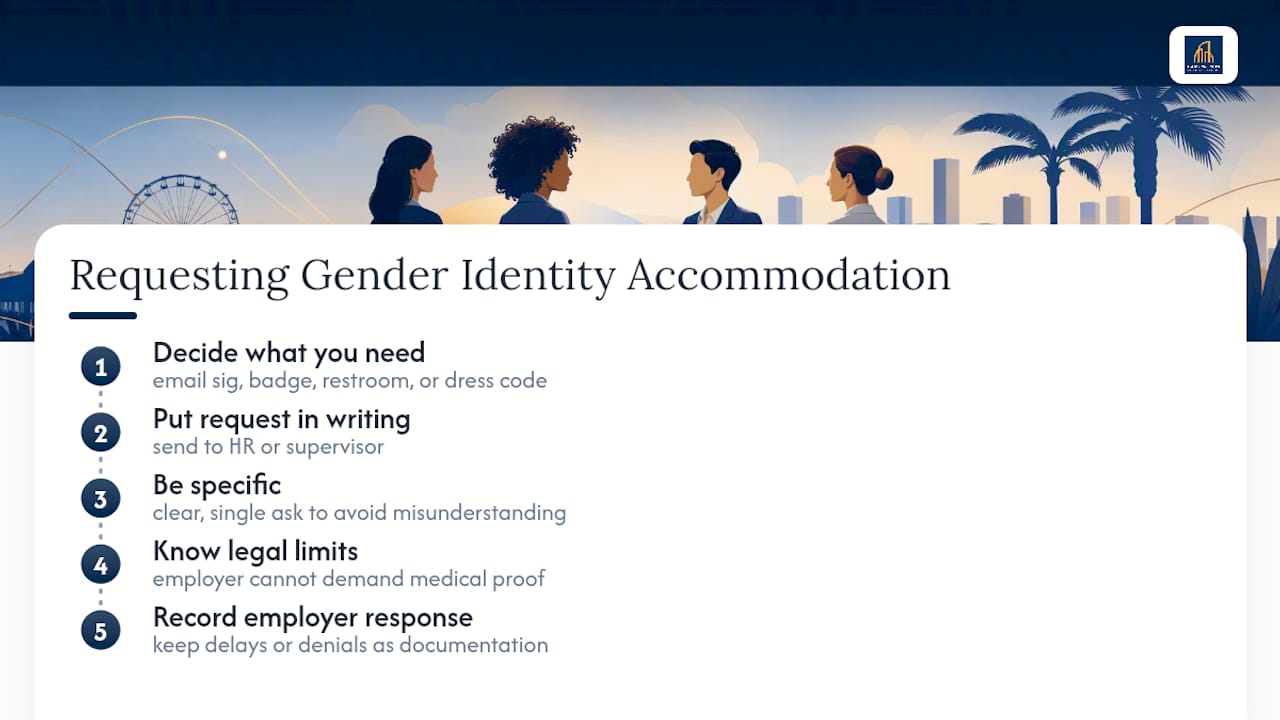
California regulations generally require employers to identify employees by their preferred name and pronouns, except where a legal obligation requires use of a government-issued name, and employers generally should not demand proof of transition, surgery, or hormone therapy before honoring facility access or presentation-related requests. This applies whether or not you’ve legally changed your name.
A practical approach starts with a written request to HR or your direct supervisor, stating clearly what you’re asking for, whether that’s updated email signatures, a corrected name on your badge, or restroom access consistent with your gender identity. Putting it in writing does two things: it creates a paper trail, and it gives your employer a clear, specific request that may reduce later disputes about what you asked for.
Dress code adjustments fall into a similar category. If a company dress code enforces gendered standards, you can request modification to align with your gender expression, and blanket refusal without individualized justification often runs into FEHA problems.
Employers sometimes push back by citing “business necessity” or customer preference. Customer preference is generally a weak justification for differential treatment, and business-necessity arguments depend on specific facts and the legal standard being applied. If your employer denies a reasonable request outright or drags out a response for weeks without explanation, that delay itself becomes part of your documentation record.
Are Your Complaint Records Kept Private?
Confidentiality concerns stop a lot of employees from reporting at all, and that hesitation is understandable but often based on incomplete information.
Internal HR investigations typically operate under a “need to know” standard, meaning your employer should limit disclosure of your complaint to people directly involved in investigating or resolving it. That said, complete secrecy is not realistic once an investigation begins, because witnesses may need to be interviewed and the employer may need to disclose enough information to investigate and respond fairly.
Administrative filings with DFEH/CRD or the EEOC carry their own confidentiality structure. These agencies generally do not publicize the identity of complainants during an active investigation, though your employer will be notified once a formal charge is filed, since they need the opportunity to respond.
If your case proceeds to litigation, confidentiality becomes more limited. Court filings are generally public unless a judge orders them sealed, and sealing depends on the applicable legal standard and the specific facts. Settlement agreements, by contrast, frequently include confidentiality clauses that both sides negotiate.
Pro Tip: If privacy is a major concern for you, raise it directly with whoever you’re consulting early in the process. It affects how a complaint gets structured and what your options look like at each stage.
Practitioner Note: Avoid These Common Pitfalls
The employees who struggle most are usually the ones who waited months to write anything down or reported only verbally to a manager who never followed up. Document early, report in writing, and talk to counsel before the trail goes cold. California law provides significant workplace protections, but deadlines, evidence, employer coverage, and the specific facts still matter.
— California United Law Group
Get Legal Guidance From California United Law Group
If you’re a Santa Monica employee weighing whether to file with DFEH/CRD, the EEOC, or move straight into a consultation with an attorney, California United Law Group can help you evaluate your options before you decide whether and how to proceed with an agency complaint or legal claim. Before filing, an attorney can review your specific facts, documents, deadlines, and possible claims. If the firm offers contingency-fee representation, review the fee agreement carefully so you understand how attorney fees and case costs are handled. The firm’s practice centers on FEHA and California Labor Code claims, including gender identity discrimination, harassment, and retaliation matters. If you’re also facing related harassment, this related guide on Santa Monica sexual harassment rights may add useful context. To discuss where your situation may stand, reach out to schedule a consultation with Kenneth A. Seligson or the firm.
Sources
- Employment | Civil Rights Department (CRD)
- California LGBTQ Employment Rights – ACLU SoCal
- DFEH/CRD complaint process
- How to file a charge of employment discrimination | EEOC
Recommended
- Santa Monica Religious Discrimination at Work: Know Your Rights – California United Law Group –
- West Hollywood Gender Identity Discrimination: Know Your Rights – California United Law Group –
- Santa Monica Sexual Harassment Laws: Employee Rights – California United Law Group
- Sexual Orientation Discrimination: West Hollywood Employee Rights – California United Law Group