
California Labor Code Section 2802 defines employer reimbursement as a mandatory, non-waivable obligation. Every Pasadena employee who spends money to do their job has the legal right to get that money back. Pasadena failure to reimburse employee expenses is not a minor HR oversight. It is a violation of California labor law that can expose employers to significant penalties, interest, and attorney fees. This article explains what expenses are covered, what your rights are when a claim is denied, and how to document and submit a proper request.
What types of employee expenses are reimbursable in Pasadena?
California Labor Code Section 2802 requires employers to reimburse all necessary expenditures employees incur in direct service of their job duties. The law covers a broader range of costs than most Pasadena employees realize.
Traditional business expenses covered under Section 2802 include:
- Business travel, mileage, and parking
- Work supplies and equipment purchased for job duties
- Required uniforms or safety gear not provided by the employer
- Professional licenses and dues required for the position
- Client meals or entertainment directly tied to job performance
Remote and home office costs are equally protected. When employees are required to work remotely, employers must reimburse the business-use portion of home internet, cell phone usage, and increased electricity costs. Employees who telecommute voluntarily may face a different analysis, and the specific facts of the arrangement matter. If your employer directed or required remote work — including during periods covered by a stay-at-home order — your right to reimbursement is well established under California law. Typical cell phone stipends range from $30 to $50 per month. Internet reimbursement generally falls between $25 and $50 per month. These are not optional benefits. They are legal obligations.
| Expense Category | Common Examples |
|---|---|
| Travel and transportation | Mileage, parking, rideshare, flights |
| Home office costs | Internet, cell phone, electricity portion |
| Equipment and supplies | Laptop accessories, office supplies, headsets |
| Professional requirements | Licenses, certifications, required dues |
| Uniforms and safety gear | Work attire, protective equipment |

The right to reimbursement under Section 2802 cannot be waived by contract or employer policy. A signed agreement that says you accept no reimbursement does not override California law. Pasadena employees who signed such agreements still retain their full legal rights under the Labor Code.
Pro Tip: Keep a separate folder, physical or digital, for every work-related receipt. Even small purchases add up over time, and documentation is your strongest defense if a claim is disputed.
What are your rights if a Pasadena employer fails to reimburse expenses?
Employees who experience Pasadena failure to reimburse employee expenses have clear legal remedies under California law. The consequences for employers who refuse or delay reimbursement go well beyond simply paying back the original amount.
Under California law, you can recover:
- The full amount of all necessary and reasonable unreimbursed expenses
- Interest on the unpaid amount from the date the expense was incurred
- Attorney fees and court costs if you pursue a legal claim
PAGA claims add another layer of exposure for employers. The Private Attorneys General Act allows employees to act as private attorneys general and pursue civil penalties of $100 per aggrieved employee per pay period for an initial Labor Code violation, and $200 per employee per pay period for subsequent or willful violations. Employees retain 25% of any PAGA civil penalty recovery; the remaining 75% goes to the California Labor and Workforce Development Agency. For employers with multiple workers facing the same reimbursement issues, those penalties accumulate quickly. PAGA litigation has become a significant driver of employer compliance in the Pasadena area.
California courts have repeatedly enforced these reimbursement rights. In Cochran v. Schwan’s Home Service, Inc. (2014) 228 Cal.App.4th 1137, 1144, the Court of Appeal held that an employer must always reimburse an employee for the reasonable expense of mandatory personal cell phone use for work — reimbursement is not limited to situations where the employee incurred extra charges beyond their existing plan. The court reasoned that to hold otherwise “would receive a windfall because it would be passing its operating expenses on to the employee.” In Gattuso v. Harte-Hanks Shoppers, Inc. (2007) 42 Cal.4th 554, 562, the California Supreme Court confirmed that the fundamental purpose of Section 2802 is “to prevent employers from passing their operating expenses on to their employees.” More recently, in Thai v. International Business Machines Corp. (2023) 93 Cal.App.5th 364, 369–372, the Court of Appeal held that expenses incurred by employees required to work from home during the COVID-19 pandemic were reimbursable under Section 2802 because the employer’s reimbursement obligation turns on whether the expenses were actually due to the performance of the employee’s duties.
Employers do have recognized defenses. Reimbursement refusals are generally only defensible when the expense was unreasonable, excessive, or not incurred in direct job performance. An employer cannot refuse reimbursement simply because no formal policy exists or because the employee did not get prior approval for a routine work expense.
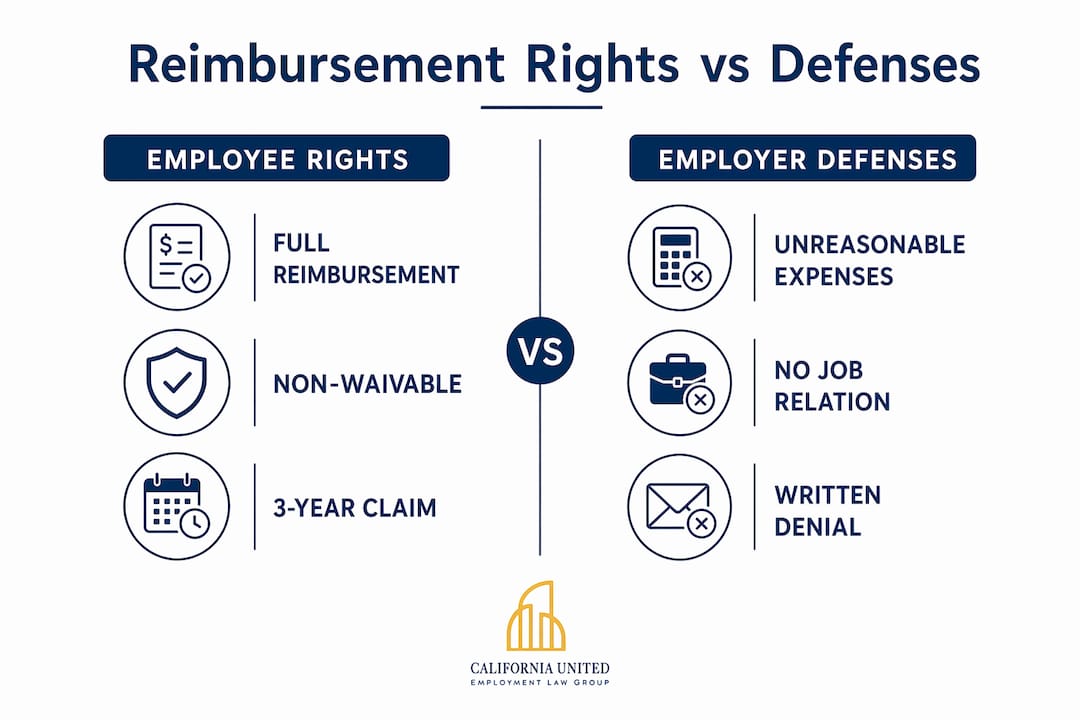
Time limits apply to these claims. Employees generally have three years under California law to file claims for unpaid wages and reimbursement. Waiting too long can limit what you can recover, so acting promptly after a dispute arises matters.
Pro Tip: If your employer denies a reimbursement claim, ask for the denial in writing. A written record of the refusal is far more useful than a verbal conversation if the dispute escalates.
How do Pasadena employees document and submit expense reimbursement claims?
Proper documentation is the foundation of any successful Pasadena employee expense reimbursement claim. Without records, even a legitimate claim becomes difficult to support.
- Save every receipt. Collect receipts at the time of purchase, whether paper or digital. For mileage, log the date, starting point, destination, and business purpose for each trip.
- Record the business purpose. A receipt alone is not always enough. Note why the expense was necessary and how it related to your job duties.
- Submit claims promptly. Do not wait months to submit a batch of expenses. Submit claims as they occur or on a regular schedule consistent with your employer’s policy.
- Follow your employer’s submission process. Some Pasadena workplaces use tools like Chrome River to manage expense reports, which typically involve pre-approval steps and post-travel documentation. Follow the required process exactly.
- Keep a copy of everything you submit. Retain copies of all submitted claims, approval emails, and any communication about the status of your request.
California law requires employers to reimburse expenses within a reasonable time, typically within 30 days of receiving a properly submitted claim. If your employer misses that window without explanation, that delay itself may constitute a violation. If your claim is denied, request a written explanation and review whether the denial falls within the narrow defenses the law allows.
How Pasadena Employers Handle Reimbursement And What Employees Should Watch For
Many Pasadena employers lack formal written reimbursement policies. Employers without documented policies expose themselves to unexpected liability and create confusion for employees who do not know what to submit or how. The absence of a policy does not reduce your rights. It simply makes disputes more likely.
Common employer compliance failures in Pasadena include:
- No written policy covering remote work expenses
- Cell phone or internet stipends set below actual cost without a reasonable calculation
- Requiring employees to absorb costs for required uniforms or tools
- Delaying reimbursement well beyond 30 days without justification
- Denying claims because no prior approval was obtained for routine expenses
The table below compares compliant and non-compliant employer practices:
| Practice | Compliant | Non-Compliant |
|---|---|---|
| Remote work expenses | Written policy with defined stipend amounts | No policy; employees absorb costs |
| Cell phone reimbursement | $30–$50 monthly stipend based on usage | No reimbursement or flat denial |
| Claim processing time | Reimbursement within 30 days of submission | Delays of 60 or 90 days with no explanation |
| Expense documentation | Clear submission process with receipts | No process; verbal approvals only |
| Policy transparency | Written policy distributed to all employees | Unwritten, inconsistently applied rules |
Pasadena employees working remotely are especially at risk of being underpaid on reimbursements. Many employers set cell phone and internet stipends without calculating the actual business-use portion of those costs. California law requires the reimbursement to reflect the actual expense incurred, not a token amount. If your stipend does not cover your real costs, the shortfall may still be recoverable.
You can review your California Labor Code rights to understand the full scope of what your employer owes you beyond just expense reimbursement.
Key Takeaways
California Labor Code Section 2802 gives Pasadena employees a non-waivable right to full reimbursement for all necessary work expenses, including remote work costs, and employers who fail to comply face interest, attorney fees, and PAGA penalties.
| Point | Details |
|---|---|
| Section 2802 is non-waivable | No contract or policy can strip your right to reimbursement under California law. |
| Remote work costs are covered | Internet, cell phone, and electricity portions are reimbursable, not optional benefits. |
| Penalties for non-compliance are significant | PAGA civil penalties of $100 per aggrieved employee per pay period (initial violation) can accumulate quickly across all affected employees. Employees retain 25% of any PAGA penalty recovery; 75% goes to the California Labor and Workforce Development Agency. |
| Documentation is critical | Receipts, logs, and written denials are your strongest tools in any reimbursement dispute. |
| Time limits apply | California employees generally have three years to file reimbursement claims. |
What I Have Seen Employers Get Wrong In Pasadena
The most consistent pattern I observe in Pasadena reimbursement disputes is not outright refusal. It is quiet neglect. Employers simply never build a policy, never communicate expectations, and then act surprised when a demand letter arrives. In practice, many California employers only begin complying with reimbursement obligations after receiving a formal demand letter. That reactive posture is expensive and entirely avoidable.
Remote work has made this worse. Before 2020, most Pasadena employers only had to think about mileage and travel. Now, every remote employee represents a potential reimbursement obligation for internet, phone, and home office costs. Many employers have not updated their policies to reflect that shift. Employees are absorbing costs that the law clearly places on the employer.
PAGA litigation is reshaping employer behavior locally. The threat of per-pay-period penalties for every affected employee has pushed more Pasadena companies to review their policies. But the employees who already absorbed unreimbursed costs during years of non-compliance still have claims worth pursuing.
My honest observation is that employees often underestimate what they are owed. A $40 monthly phone stipend shortfall seems minor. Over two years with interest and potential penalties, it is not. Keep records from day one, submit claims consistently, and do not accept a verbal denial as the final word.
Pasadena Employees With Reimbursement Disputes Deserve Real Answers
If your employer has refused, delayed, or underpaid your expense reimbursement claims in Pasadena, you have legal options worth understanding. California United Law Group represents California employees in wage and hour disputes, including claims under Labor Code Section 2802. The firm handles cases from early evaluation through litigation and has experience with the specific reimbursement issues Pasadena workers face, including remote work costs and PAGA claims.
Contact California United Law Group to speak with a Pasadena employment attorney about your reimbursement situation. Early evaluation matters. The sooner you understand your rights, the better positioned you are to act within California’s claim deadlines.
You can also learn more about Pasadena employment law issues the firm handles for local workers.
The information provided in this article is for general informational purposes only and does not constitute legal advice. Every case involves unique facts and circumstances. Reading this article does not create an attorney-client relationship with California United Law Group. Results in any prior matter do not guarantee or predict the outcome of any future case.
FAQ
What does California Labor Code Section 2802 require?
California Labor Code Section 2802 requires employers to reimburse employees for all necessary expenses incurred while performing their job duties. This obligation cannot be waived by contract or company policy.
Does my Pasadena employer have to reimburse my home internet and cell phone?
Yes. California law requires employers to reimburse the business-use portion of home internet, cell phone, and electricity costs when employees work remotely. Typical reimbursements range from $25 to $50 per month for internet and $30 to $50 per month for cell phone use.
How long do I have to file a reimbursement claim in California?
California employees generally have three years to file claims for unpaid wages and unreimbursed expenses. Acting promptly after a dispute arises protects the full value of your potential recovery.
Can my employer deny a reimbursement claim?
An employer can only lawfully deny a claim if the expense was unreasonable, excessive, or not incurred in direct job performance. The absence of a prior approval or a written policy is not a valid legal defense.
What happens if my employer refuses to reimburse me?
You may be entitled to recover the full amount of all necessary and reasonable unreimbursed expenses, plus interest and attorney fees. Repeated or willful violations can also trigger PAGA civil penalties of $100 per aggrieved employee per pay period for an initial violation and $200 for subsequent violations, which accumulate across all affected employees. Employees retain 25% of any PAGA civil penalty recovery, with the remaining 75% going to the California Labor and Workforce Development Agency.