
TL;DR:
- Most private-sector employees in Los Angeles are legally entitled to reimbursement for necessary work-related expenses under California law. If a claim is denied, thorough documentation, persistence, and understanding of legal deadlines can help employees recover what they are owed. Working with experienced employment attorneys increases the likelihood of securing proper reimbursement and addressing broader workplace rights.
Many Los Angeles employees spend their own money on work-related costs every week and simply assume their employer might pay them back someday, or that there’s nothing they can do if reimbursement is refused. That assumption can be costly. California law is actually quite clear on this issue, and it strongly favors employees. Under California Labor Code section 2802, most private-sector workers have a legal right to reimbursement for necessary work-related expenses, whether they work in Santa Monica, Long Beach, Torrance, or downtown Los Angeles. This guide explains who is protected, what expenses qualify, and what you can do when a legitimate claim is denied.
Table of Contents
- Who is protected by California work expense reimbursement law?
- What kinds of work expenses must Los Angeles employers reimburse?
- How do you claim reimbursement—and what if your expense is denied?
- Deadlines, policies, and exceptions: Your rights if you miss a deadline
- Why most employees don’t get reimbursed—and what actually works
- How California United Law Group can help you get paid what you’re owed
- Frequently asked questions
Key Takeaways
| Point | Details |
|---|---|
| Most private employees are protected | California law requires most private employers in Los Angeles to reimburse you for necessary work-related expenses. |
| Work portion of mixed expenses covered | If you use your cell phone or internet for work, your employer must pay for the work-related part. |
| You have rights even after missing deadlines | Late claims can still be valid if filed within the general statutory period, despite company reporting policies. |
| Document and escalate if denied | Strong documentation and persistence are key to successfully claiming reimbursement for work expenses. |
Who is protected by California work expense reimbursement law?
With so much confusion around this topic, it helps to start with the basics: who does the law actually protect?
Most private-sector employers in Los Angeles are generally required to reimburse employees for necessary work-related expenses under California Labor Code section 2802. This is not optional, and it is not left up to company policy. It is a statutory right that applies broadly across industries, job titles, and income levels.
That said, not every worker in California falls under this protection.
Who is covered
- Private-sector employees working for businesses of any size
- Full-time and part-time employees who incur necessary work expenses
- Remote and hybrid workers who use personal equipment or internet for work
- Hourly workers and salaried employees alike
- Workers in cities across Los Angeles County, including Glendale, Burbank, Culver City, and Inglewood
Who is NOT covered
Important: Section 2802 does not apply to public employers, which means employees of certain public entities may have different rules or must look to other legal frameworks for reimbursement rights.
This is a significant distinction. If you work for a state agency, a city government, a public university, or another public entity, Labor Code section 2802 may not be your source of protection. You may still have rights under collective bargaining agreements or other statutes, but the analysis is different.
Independent contractors are also not covered. If your employer has properly classified you as an independent contractor, section 2802 does not apply. However, if you believe you have been misclassified as a contractor when you function as an employee, that is a separate legal issue worth exploring. California applies a rigorous ‘ABC test’ under Labor Code section 2775 to determine whether a worker is truly an independent contractor. Workers are presumed to be employees, and the burden falls on the employer to prove independent contractor status by satisfying all three statutory conditions. Misclassification is a serious legal violation that can trigger significant liability.
| Worker type | Covered by Labor Code § 2802? |
|---|---|
| Private-sector employee | Yes |
| Public-sector employee | Generally no |
| True independent contractor | No |
| Misclassified contractor (actually employee) | Potentially yes |
| Part-time or seasonal employee | Yes |
For employees working throughout Los Angeles County, including those in Torrance, the same statewide protections apply regardless of city boundaries.
What kinds of work expenses must Los Angeles employers reimburse?
Now that you know who is covered, it is time to understand which expenses are legally protected. The key phrase in the law is “necessary expenditures or losses.” That language does a lot of work.

Defining “Necessary” And “Work-Related”
An expense is reimbursable under California Labor Code section 2802 when it was incurred as a direct consequence of discharging your job duties or following your employer’s directions, and the expense was both necessary and reasonable. The law does not require your employer to have explicitly directed you to incur the expense, provided the cost arose directly from your job duties.
California law ties reimbursement to the necessary and work-related nature of the expense. Mixed-use costs, such as a phone or home internet plan that you use for both personal and professional purposes, are typically reimbursed for the work portion only.
California courts have interpreted section 2802 broadly in favor of employees. In Gattuso v. Harte-Hanks Shoppers, Inc. (2007) 42 Cal.4th 554, 562, the California Supreme Court explained that the purpose of section 2802 is ‘to prevent employers from passing their operating expenses on to their employees.’ In Cochran v. Schwan’s Home Service, Inc. (2014) 228 Cal.App.4th 1137, 1144, the Court of Appeal held that when an employee is required to make work-related calls on a personal cell phone, reimbursement is ‘always required’—the employer must pay ‘some reasonable percentage of the employee’s cell phone bill.’ And in Thai v. International Business Machines Corp. (2023) 93 Cal.App.5th 364, 369–372, the court confirmed that expenses incurred while working from home must be reimbursed because the statutory obligation turns on ‘whether expenses were actually due to performance of employee’s duties,’ not whether the employer explicitly ordered the expenditure. These decisions reflect California’s strong public policy of protecting employees from bearing their employer’s operating costs.
Common Reimbursable Expenses
Work-related mileage, travel, and job-required supplies are among the most frequently discussed reimbursable costs under this standard. Here is a broader look at what typically qualifies:
- Mileage and vehicle costs when you drive your personal car for work errands, client visits, or deliveries
- Work travel expenses including airfare, hotels, and meals for business trips
- Cell phone bills: When your employer requires use of your personal phone for work, California courts have held that some reimbursement is always owed—even if your plan does not charge extra for work-related calls. Your employer must pay a reasonable percentage of your bill regardless of whether work usage resulted in additional charges.
- Home internet costs for remote workers who must stay connected for job duties
- Uniforms and protective gear that your employer requires and that you cannot wear as regular clothing
- Tools and equipment required for your job that you purchase personally
- Office supplies bought out of pocket when working remotely or in the field
- Parking and tolls incurred while performing work duties
Pro Tip: Keep a simple log of any personal expense you make for work purposes, even before you know whether your employer will cover it. Note the date, the business reason, and the amount. This takes minutes and can make a significant difference if you ever need to support a reimbursement claim.
What Is NOT Covered
Not every expense you prefer to use for work is reimbursable. The following generally fall outside the scope of section 2802:
- Personal choices that happen to benefit your work (such as upgrading your personal laptop when a functional one already exists)
- Expenses with no clear connection to your job duties
- Expenses that an employer has arranged to address through a properly structured alternative method—such as enhanced wages or commissions—provided the arrangement clearly apportions what amount is compensation and what amount is reimbursement. However, no company policy or agreement can waive your statutory right to reimbursement under Labor Code section 2802.
- Voluntary purchases that were never required or expected by your employer
Employers sometimes try to argue that an expense was “voluntary.” Whether that argument holds up depends heavily on the facts. If your job realistically could not be done without the expense, courts and regulators tend to view it as necessary.
The line between personal choice and job necessity is not always obvious. Employment contracts can sometimes affect what is agreed upon, so it helps to understand how employment contracts interact with reimbursement rights.
| Expense | Generally Reimbursable? |
|---|---|
| Mileage for work errands | Yes |
| Personal car for commuting | No |
| Work portion of cell phone bill | Yes |
| Full personal phone plan (mixed use) | Partial only |
| Required uniform | Yes |
| Preferred clothing for client meetings | No |
| Home internet (remote work required) | Partial/Yes |
| Upgraded personal laptop (not required) | No |
How do you claim reimbursement—and what if your expense is denied?
Understanding what qualifies is essential. But knowing how to actually secure your reimbursement is just as important.
Step-by-step process for submitting a claim
Document the expense immediately. Save receipts, take screenshots of digital purchases, and note the business purpose for each item. For mileage, use a mileage tracking app or maintain a written log with dates, destinations, and distances.
Review your company’s reimbursement policy. Most employers have a written policy outlining how to submit expenses, what documentation is required, and what deadlines apply. Follow these procedures carefully.
Submit your claim in writing. Even if your workplace accepts verbal or informal requests, putting your claim in writing creates a clear record. Email works well for this.
Include all supporting documentation. Attach receipts, mileage logs, invoices, or any other evidence that ties the expense to your job duties.
Follow up consistently. If you do not receive a timely response, send a polite written follow-up. Documenting your follow-up efforts matters.
Escalate if necessary. If your employer ignores or denies a legitimate claim, you have legal options.
Practical methodology for disputed claims involves documenting expenses thoroughly, submitting through company processes, and escalating through wage claims or litigation if denied.
When your claim is denied
A denial is not the end of the road. Here are your options:
- Talk to HR or your manager’s supervisor. Sometimes a denial is a miscommunication or a policy misapplication.
- File a wage claim with the California Labor Commissioner’s Office (also called the Division of Labor Standards Enforcement, or DLSE). This is a free, accessible process.
- Consult a local employment lawyer. An attorney can evaluate whether your claim has merit and advise you on next steps.
- Consider civil litigation. If the amount is significant and the employer’s refusal is clear-cut, filing a lawsuit may be appropriate. Understanding the employment lawsuit process can help you weigh that option.
Pro Tip: Do not throw away any records of your expenses or any written communications with your employer about the claim, even if you think the matter is resolved. These records become critical if the dispute is revisited later.
Deadlines, policies, and exceptions: Your rights if you miss a deadline
Some employees get nervous about timing. You may have already spent the money months ago, or you may have missed your company’s internal deadline for submitting expenses. Here is what you need to know.
The statute of limitations
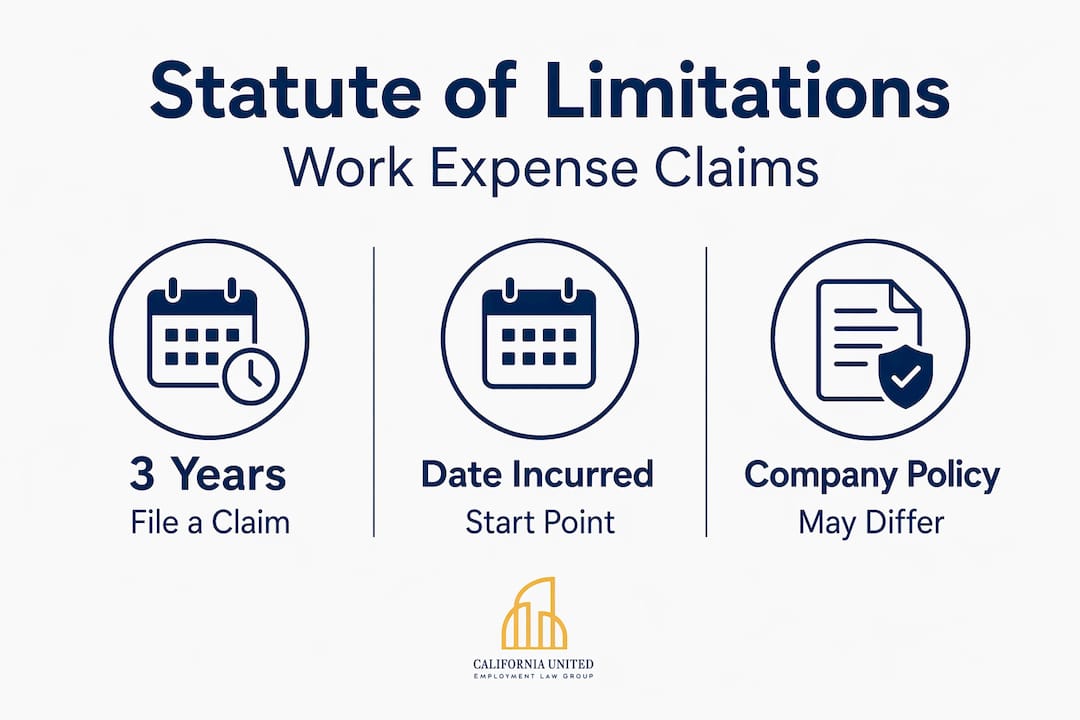
Under California law, you generally have three years from the date the expense was incurred to bring a reimbursement claim. This applies to claims under Labor Code section 2802. Three years is a meaningful window, but it is not unlimited. Waiting too long can eliminate your ability to recover what you are owed. In some circumstances, reimbursement claims may also be pursued under California’s Unfair Competition Law (Bus. & Prof. Code § 17200), which carries a four-year statute of limitations—providing an additional avenue in cases where the direct statutory claim would otherwise be time-barred. An experienced employment attorney can evaluate which limitations period applies to your specific situation.
Company policies versus statutory rights
Many employers set their own internal deadlines for expense reporting, such as 30 days or 90 days from the date of the expense. These policies are legitimate, and you should follow them.
However, reimbursement claim timing is impacted by both the statute of limitations and company reporting policy, but late reporting under policy does not necessarily eliminate the statutory obligation to reimburse. In other words, missing your company’s internal deadline does not automatically mean you forfeit your legal rights under section 2802.
| Deadline type | What it means for you |
|---|---|
| Statutory (3-year limit) | Hard deadline for legal action |
| Company internal deadline (30 or 90 days) | Missing it may reduce leverage but does not always eliminate the right |
| Prior agreement in writing | Cannot waive your statutory right to reimbursement; may only affect the method by which the employer satisfies the obligation (e.g., through enhanced compensation) |
Specific situations to know
- If your employer retaliates against you for submitting a late expense claim, that retaliation may itself be a separate legal violation.
- If you recently left the job, the clock is still running. Former employees can still bring reimbursement claims within the statutory period.
- If you are unsure whether your claim is still timely, consult a legal resource rather than assuming it is too late. Many employees give up unnecessarily. Explore your rights and legal deadlines before deciding your claim has expired.
Why most employees don’t get reimbursed—and what actually works
After mapping out the rules and processes, here is a candid observation from years of seeing these disputes play out in California.
Most employees who go uncompensated do not lose because the law is unclear or because their claim was genuinely invalid. They lose because they give up too early or because they never documented well enough to prove what they spent.
Company expense policies are often written in ways that feel final and authoritative. When an employer sends a denial letter citing its own internal policy, many employees read that as the last word. It is not. An internal company policy cannot override a statutory right. What the employer tells you and what the law requires are sometimes two very different things.
We have also seen situations where employees with valid claims simply assumed the dispute was not worth the effort. That instinct is understandable, but it leads to real financial loss. An employer that routinely denies small reimbursement claims across a workforce can accumulate significant savings at employees’ expense. Sometimes these situations lead to class or representative actions.
What actually works in these disputes is straightforward: organized records, persistent follow-through, and a clear understanding that the statutory right exists regardless of what company policy says. If you can show that an expense was necessary for your job, that you incurred it, and that you requested reimbursement and were denied, you have the foundation of a strong claim.
Real-world employment law insights reinforce this consistently. Employees who document carefully and do not accept the first “no” as the final answer tend to fare better in these disputes.
How California United Law Group Can Help You Understand and Pursue Your Rights
👉 If your employer has denied a valid reimbursement claim, you have options. Working with an experienced employment law team can clarify whether your rights have been violated and what remedies may be available to you.
At California United Law Group, P.C., we represent employees throughout Los Angeles County in wage and hour disputes, including reimbursement claims under Labor Code section 2802. We also handle matters involving wrongful termination, discrimination, harassment, and retaliation. Our team includes attorneys who regularly represent workers in Glendale, Burbank, and Long Beach, as well as across the greater Los Angeles area. If your denied reimbursement is connected to broader workplace problems, such as a pattern of unlawful conduct or wrongful termination, we can evaluate the full picture.
Reach out today to discuss your situation with our team. We are here to help you understand your rights clearly and without pressure.
Frequently asked questions
What are common examples of reimbursable work expenses in Los Angeles?
Mileage, work travel, personal cell phone use for work, home internet costs, tools, uniforms, and required supplies are among the most common reimbursable work expenses for California employees.
Do I need to submit receipts for every expense?
Receipts or written records are strongly recommended, especially for larger expenses. Documenting the expense with receipts, mileage logs, and a clear record of the business purpose is standard practice for disputed claims.
Is my employer allowed to pay only a portion of my cell phone or internet bill?
Yes, with an important nuance. Your employer is not required to pay your entire bill, but California law requires reimbursement of a reasonable percentage of it whenever you are required to use your personal device for work. Critically, this obligation applies even if your plan does not charge you extra for work-related calls—reimbursement is always owed in that scenario. You cannot recover the purely personal portion, but the calculation typically involves determining a reasonable percentage based on your actual work usage.
What if I filed my claim after my company deadline?
Even if you miss a company’s internal reporting deadline, California law may still require reimbursement within the statutory period. A company policy deadline does not automatically override the statutory obligation to reimburse employees.
Are public sector employees in Los Angeles covered by Labor Code section 2802?
No. Labor Code section 2802 does not apply to most public employers, and their employees must look to other legal frameworks for potential reimbursement protections.
Disclaimer: This article is for general informational purposes only and does not constitute legal advice. Reading this article does not create an attorney-client relationship with California United Law Group, P.C. Laws change, and the information provided may not apply to your specific circumstances. For advice about your individual situation, please consult a qualified employment attorney.