
TL;DR:
- Many California workers discover they have been unpaid for hours worked, including off-the-clock tasks and missed breaks. Workers must document their hours and understand that California law protects all work hours, including overtime, even if unpaid, with enforcement strengthened in 2026. Filing a claim involves gathering evidence promptly and may lead to meaningful recovery of wages owed through the DLSE, especially under new legal penalties and enforcement measures.
Thousands of California workers are surprised to discover they’ve been shortchanged for hours they actually worked. Many assume their employer is handling payroll correctly, only to later find out that off-the-clock tasks, missed breaks, or unpaid overtime added up to hundreds or even thousands of dollars over time. If you work in Long Beach, California law is clear: you must be paid for every hour you work, and California requires employers to pay non-exempt employees at least the minimum wage for all hours worked, including applicable overtime. This article explains who qualifies, what counts, how the process works, and what changed in 2026.
Table Of Contents
- Who can claim unpaid wages in Long Beach?
- What counts as unpaid wages? Key examples
- How to file an unpaid wage claim: Steps and timelines
- 2026 enforcement changes: Stronger penalties and what to expect
- Why gathering evidence is your strongest move — what most workers miss
- Need help recovering unpaid wages? Experienced legal support is available
- Frequently asked questions
Key Takeaways
| Point | Details |
|---|---|
| Full payment required | California law requires you to be paid for every hour worked, including overtime and required breaks. |
| Clear deadlines | Statutes of limitations for wage claims vary by claim type. Most statutory wage and overtime claims are subject to a three-year deadline. Written contract claims and claims brought under California’s Unfair Competition Law may extend to four years. Certain wage penalty claims carry a shorter one-year deadline. Consult a qualified employment attorney promptly to confirm the deadline applicable to your situation. |
| 2026 enforcement | New laws in 2026 have increased penalties, making it easier to recover unpaid wages. |
| Evidence is critical | Gathering documentation early gives you a stronger case and strengthens your position for recovery. |
Who can claim unpaid wages in Long Beach?
Now that you know you can claim unpaid wages, let’s clarify who specifically qualifies in Long Beach and under California law.
California’s worker protections cover a wide range of employees. The most important concept here is “non-exempt” status. A non-exempt worker is someone who is entitled to minimum wage and overtime pay under California law. Most hourly workers fall into this category, but many salaried employees do too, depending on their job duties and actual pay rate.
Here’s who is typically covered:
- Hourly workers in retail, food service, warehousing, healthcare, and other industries
- Salaried workers who earn below California’s salary threshold for exemption or whose duties don’t meet strict exemption criteria
- Gig workers and independent contractors may have additional protections if they are misclassified and actually function as employees under California’s ABC test
- Tipped employees who are entitled to full minimum wage regardless of tips received
- Undocumented workers, because California explicitly extends wage protections regardless of immigration or documentation status
Important note for undocumented workers: While California’s wage protections are broad, under Salas v. Sierra Chemical Co. (2014) 59 Cal.4th 407, certain lost pay remedies may be limited for periods after an employer discovers an employee’s undocumented immigration status. Undocumented workers should consult a qualified employment attorney to understand how these protections apply to their specific circumstances.
“All hours worked” has a specific legal meaning under California law. It includes:
- Regular scheduled work hours
- Overtime hours (any time over 8 hours in a workday or 40 hours in a workweek)
- Work performed before clocking in or after clocking out
- Denied or interrupted rest and meal periods (which entitle you to one hour of premium pay per violation, not additional hours worked)
- Time spent on mandatory training or required meetings
The critical point is that off-the-clock work rights are fully protected in California, meaning your employer cannot legally require you to perform any work for which you are not paid, even if it seems minor in the moment.
Pro Tip: Start collecting your evidence immediately. Save timecards, screenshots of schedules, text messages from supervisors about work tasks, and any paystubs you have. As illegal off-the-clock work is unfortunately common, the more records you hold, the stronger your position becomes. California law recognizes compensable hours including off-the-clock work when supported by evidence, so a paper trail can make the difference.
What Counts As Unpaid Wages? Key examples
Once you know you’re eligible, the next challenge is to recognize what actually counts as unpaid wages under California law.
Workers are often surprised by how many different situations qualify. It’s not just about missing a paycheck entirely. Even small, repeated shortfalls add up significantly over weeks and months.
Here are common types of unpaid wages recognized under California law:
- Shorted regular hours — Your employer recorded fewer hours than you actually worked
- Missed overtime — You worked more than 8 hours in a day or 40 hours in a week but were paid at your regular rate instead of 1.5x or 2x
- Off-the-clock tasks — Pre-shift setup, post-shift cleanup, or responding to work messages after hours
- Denied meal and rest breaks — California requires a 30-minute unpaid meal break for work periods of more than five hours (which may be waived by mutual consent for shifts of six hours or fewer) and a paid 10-minute rest break for every four hours worked or major fraction thereof; violations entitle you to premium pay
- Missed final paycheck amounts — Wages owed at termination or resignation must be paid promptly; late final pay carries additional penalties
- Bounced or delayed paychecks — A paycheck that doesn’t clear still counts as unpaid wages
Here is a quick reference table showing wage rates and overtime rules that apply to Long Beach workers in 2026:
| Worker type | Base wage rate | Overtime rate |
|---|---|---|
| General California workers | $16.90/hour (2026) | 1.5x after 8 hrs/day or 40 hrs/week; 2x after 12 hrs/day; 1.5x for first 8 hrs on the 7th consecutive workday; 2x after 8 hrs on the 7th consecutive workday |
| Hotel workers (Long Beach) | $25.00/hour | Same overtime rules apply |
| Concession workers (airport) | Higher sector rate | Same overtime rules apply |
| Fast food workers | Sector-specific higher rate | Same overtime rules apply |
California courts have consistently reinforced the broad scope of wage protections available to workers. In Davis v. Farmers Insurance Exchange (2016) 245 Cal.App.4th 1302, the Court of Appeal confirmed that the Labor Code’s wage protections “are applicable not only to hourly employees, but to highly compensated executives and salespeople,” and that wages encompass not just hourly salaries but also bonuses, profit-sharing plans, and commissions. In Flowers v. Los Angeles County Metropolitan Transportation Authority (2015) 243 Cal.App.4th 66, the court held that Labor Code section 1194 gives every employee a direct statutory right to recover unpaid wages from an employer who fails to pay the minimum wage — a right that exists regardless of any contrary agreement between the parties.
Pro Tip: If you work in hospitality, at the port, or in a specialized industry in Long Beach, check whether a sector-specific rate applies to your job. The key issue is not just whether you were paid something, but whether you were paid the correct rate for every hour. Issues around meal and rest break pay are especially common in retail and service sectors and are often overlooked by workers who don’t realize denied breaks have a monetary remedy.
Port workers also face specific challenges. Long Beach is home to one of the busiest ports in the country, and workers in that environment frequently encounter complex scheduling situations. Understanding port worker break rights can reveal claims you didn’t know you had.
How To File An Unpaid Wage Claim: Steps And Timelines
With these examples in mind, let’s walk through exactly how you can start a claim and why acting promptly matters under the law.
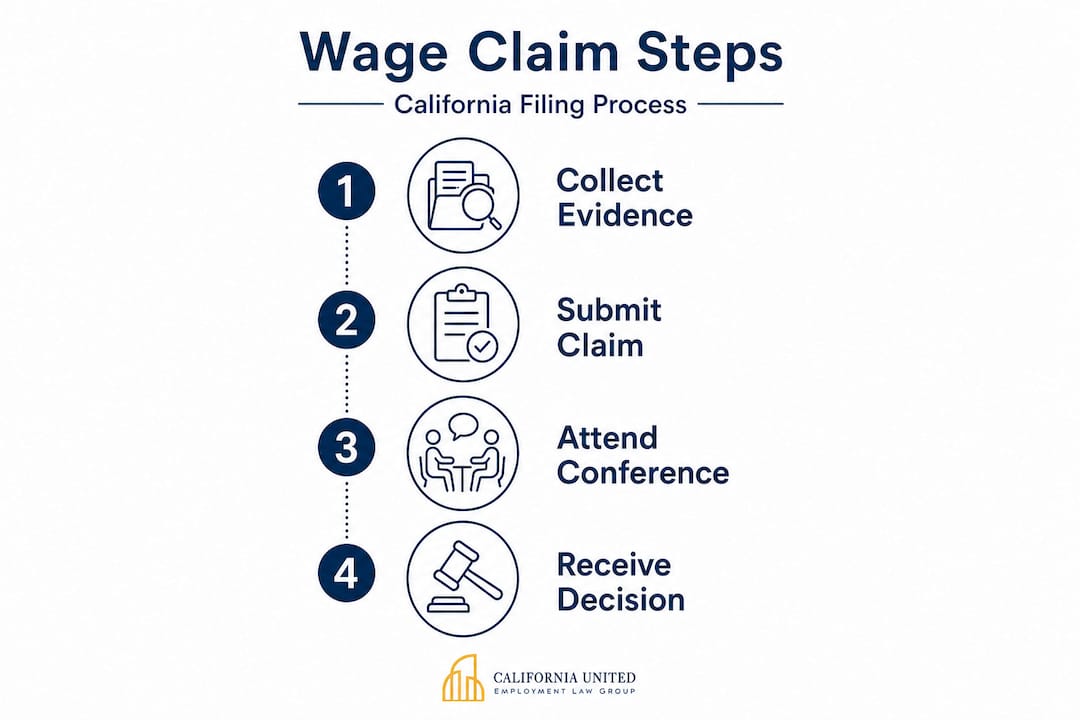
Filing a wage claim in California involves a clear process through the Division of Labor Standards Enforcement (known as the DLSE), which is part of the California Department of Industrial Relations. Here’s how it generally works:
Gather your evidence first. Before you file anything, collect every piece of documentation you can. This includes paystubs, timecards, bank records, work schedules, text messages, emails, and contact information for coworkers who witnessed the same conditions.
Complete the Initial Report or Claim form. Workers file claims with the DLSE using an Initial Report or Claim form, which can be submitted to the local DLSE office that covers the Long Beach area. The form asks for basic information about you, your employer, and the wages you believe are owed.
The DLSE investigates. A deputy labor commissioner will review your claim. They may contact your employer, request payroll records, and interview witnesses. This process can take weeks or several months depending on the complexity of your case.
Attend a settlement conference. The DLSE often schedules a conference to see if the matter can be resolved without a hearing. Both sides present their positions, and a resolution is sometimes reached at this stage.
Attend a formal hearing if needed. If no agreement is reached, a hearing is scheduled before a hearing officer who acts like a judge. Evidence is presented, witnesses can testify, and a decision is issued.
Collect your award. If you win, the employer must pay the wages owed, plus interest and potentially additional penalties.
Important note on deadlines: California law sets different time limits depending on the nature of your claim. These deadlines vary based on the specific facts of your situation, including the type of violation and whether a written contract was involved. Statutes of limitations for wage claims differ by claim type, so you should consult a qualified employment attorney promptly to understand the deadline that applies to your specific circumstances. Waiting can permanently affect your ability to recover wages you are owed.
The DLSE receives thousands of wage claims across California every year, reflecting how widespread wage theft actually is. You are not alone, and the process exists precisely to help workers in your situation.
Pro Tip: If your case is disputed, involves multiple pay periods, or your employer is challenging your status as a non-exempt worker, it’s worth consulting an attorney. You can get local legal help from an employment lawyer familiar with Long Beach employers and DLSE procedures. Understanding the lawsuit process overview can also help you know what to expect if your claim escalates.
2026 enforcement changes: Stronger penalties and what to expect
After understanding the process, it’s important you know about major legal updates that took effect in 2026 and how they affect your claim.
California has consistently strengthened wage enforcement over the years, and 2026 brought meaningful changes that directly benefit workers.
Key 2026 changes include:
- SB 261 triple penalties: Recent 2026 laws strengthen enforcement through triple penalties for unsatisfied wage judgments, meaning if an employer does not pay a judgment owed to you, the amount owed can multiply significantly.
- Stronger state oversight: California’s DLSE has expanded its enforcement capacity, and employers face greater scrutiny of their payroll practices.
- No local exceptions for general workers: Long Beach does not override state wage payment laws for most workers, meaning the DLSE’s authority applies directly in Long Beach without local carveouts that would weaken your protections.
Here is a summary of how the 2026 enforcement environment compares to prior years:
| Enforcement factor | Before 2026 | 2026 and beyond |
|---|---|---|
| Penalty multiplier for unpaid judgments | Standard penalties | Triple penalties under SB 261 |
| DLSE enforcement activity | Active | Expanded and strengthened |
| Employer compliance pressure | Moderate | Higher, due to increased penalties |
| Worker recovery rates | Consistent | Trending upward |
What this means for you: In 2026, employers who ignore wage judgments face significantly higher financial consequences. This creates a stronger incentive for employers to settle claims and pay what is owed. If you have a valid claim, the 2026 legal environment provides stronger enforcement tools and greater financial consequences for employers who fail to pay what is owed.
Staying informed about California paystub law changes is also worthwhile. Paystub violations often accompany wage theft and can be an additional source of penalties against your employer.
Why gathering evidence is your strongest move — what most workers miss
You’ve seen how the law works. Let’s get real about what gives you an edge in these cases, because this is where most workers either win or lose their claim before it even gets heard.
Here’s what we’ve observed repeatedly: the workers who recover the most wages are not necessarily those with the most obvious violations. They are the workers who documented their situation thoroughly and early.
Employers almost always dispute the number of hours claimed. They rely on their own payroll records, which may be incomplete, inaccurate, or outright manipulated. When your evidence contradicts theirs, the case becomes a factual dispute and the outcome depends on who has more supporting documentation.
Common mistakes workers make that hurt their claims:
- No paper trail at all. Relying entirely on memory is risky. Even a handwritten log kept at home is better than nothing.
- Missing small amounts. Workers often think it’s not worth claiming a few missed minutes per shift, but those amounts compound. Ten minutes a day, five days a week, over two years adds up to over 80 hours of unpaid work.
- Waiting too long to collect evidence. Once you leave a job, access to records disappears fast. Employers are not required to keep all records indefinitely, and your access to their systems ends the moment your employment does.
- Not talking to coworkers. If your employer shorted your pay, they likely shorted others too. Coworker witness statements are powerful corroborating evidence.
What smart workers do instead:
- Take photos of posted schedules and your timecard entries regularly
- Forward work-related emails or texts to a personal account so they aren’t lost
- Keep a daily log, even brief notes on your phone, of your actual start and end times
- Note every missed break and whether you were able to leave during meal periods
The documentation process for legal cases may feel like extra work, but it is the single most reliable way to strengthen your position. California law is on your side, but the law can only work for you when you give it something to work with.
Need help recovering unpaid wages? Experienced legal support is available
If you’ve read this far, you already understand that California law offers real, meaningful protections for Long Beach workers dealing with unpaid wages. But knowing your rights and successfully recovering what you’re owed are two different things.
👉 California United Law Group, P.C. represents employees in wage and hour disputes across California, including Long Beach. Our team handles complex wage claims involving overtime, off-the-clock work, break violations, and misclassification. If your situation involves a disputed claim, a large amount owed, or an employer who has already pushed back, having experienced legal support on your side matters.
You can learn more about wage and hour claim help or connect directly with our Long Beach employment attorneys to discuss your situation. Initial consultations for wage and hour claims are available at no charge, so reaching out to explore your options is a practical, low-risk first step.
Frequently asked questions
Do I need a lawyer to file an unpaid wage claim in Long Beach?
No lawyer is required to file a claim with the DLSE, but having one can make the process significantly easier, particularly in disputed or factually complex cases where your employer challenges the hours or your employment classification.
What is the deadline to file a claim for unpaid wages in California?
Deadlines for wage claims vary depending on the specific type of violation and the facts of your situation. Because missing a deadline can permanently bar your recovery, you should consult a qualified employment attorney as soon as possible to determine what applies to your case.
Can I still claim wages if I don’t have written proof of all hours?
Yes, but you should provide as much supporting evidence as possible. Claims for compensable hours including off-the-clock work can succeed when supported by witness statements, emails, calendars, or other corroborating materials even without perfect written records.
If my employer paid part but not all overtime, can I still claim?
Yes. California requires employers to pay the full overtime rate for all qualifying hours, and you may file for any portion that was calculated or paid incorrectly, even if you received some overtime compensation.
Recommended
- Long Beach Port Workers’ Meal & Rest Break Rights Explained – California United Law Group
- Employment Lawyer Long Beach – California United Law Group
- Rest break rights for Long Beach retail workers explained – California United Law Group
- Long Beach Workers Reporting Safety Violations: Your Rights – California United Law Group