
California law generally entitles nonexempt employees who work at least 3.5 hours in a workday to paid, duty-free 10-minute rest breaks based on the length of the shift, and when an employer fails to authorize and permit a compliant rest break, Labor Code §226.7 may require one additional hour of pay for that workday. If this may have happened to you, start by writing down what occurred, checking your pay stubs for any rest-break premium, preserving schedules and messages, reporting the issue internally if you feel safe doing so, and considering whether to file a Labor Commissioner claim or speak with an employment attorney.
TL;DR:
- A valid rest break generally must be paid, duty-free, and uninterrupted for at least 10 minutes; work calls, customer requests, or supervisor check-ins during the break may make it noncompliant.
- For rest-break violations, the premium generally applies once per workday with one or more rest-break violations, not once per missed rest break; unpaid premiums may also create wage-statement or waiting-time issues depending on the facts.
- Record each incident that day, including its date, approximate time, supervisor, and witnesses; preserve pay stubs, schedules, timecards, and messages requesting an early return.
- Employees can file with the Labor Commissioner without counsel, but wage and retaliation complaints have deadlines, which may run from the retaliatory act.
- Repeated violations affecting coworkers may support a class action or a PAGA representative claim, but eligibility depends on how consistent and widespread the practice was.
Table of Contents
- What California Law Requires for Rest Breaks
- Concrete Examples of Rest Break Violations in the Workplace
- What You May Be Owed and Related Employer Liabilities
- How to Document and Preserve Evidence of Missed or Interrupted Breaks
- Practical Next Steps: Reporting, Filing a Claim, or Contacting a Lawyer
- How to Preserve Retaliation Claims and Understand Relevant Deadlines
- How the Labor Commissioner Investigates Rest Break Complaints
- Filing a Complaint With the California Labor Commissioner
- What Happens After a Claim: Settlements and Awards
- When Rest Break Violations Become Class or Representative Actions
- Rest Break Rights Across Different Industries
- Our Perspective on Rest Break Claims for Inglewood Employees
- Contact California United Law Group for a Confidential Review
- FAQ
What California Law Requires for Rest Breaks
California’s rest break rule is simple in structure but easy for employers to get wrong in practice. Nonexempt employees are generally entitled to 10 minutes of paid rest time for shifts of 3.5 to 6 hours, 20 minutes for shifts of more than 6 hours up to 10 hours, 30 minutes for shifts of more than 10 hours up to 14 hours, and additional rest time as hours increase.
To comply with California rest-break law, the employer generally must authorize and permit a paid 10-minute break and relieve the employee of work duties and employer control during that time.
- It must be paid, meaning your hourly wage continues during those 10 minutes.
- It must be duty-free, meaning you are relieved of all work responsibilities.
- It must be uninterrupted, meaning no calls, texts, customer requests, or supervisor check-ins during the break. Employers generally do not have to record rest breaks or force employees to take them, but they cannot require employees to remain on duty or on call during legally required rest periods.
Most hourly, nonexempt workers in Inglewood are covered by this rule, including retail associates, warehouse staff, restaurant workers, and many healthcare and administrative employees. Exempt employees, such as certain salaried managers, administrative employees, and professionals who satisfy California’s salary and duties tests, are generally not covered by these rest-break requirements. If you’re unsure whether your role qualifies as exempt, that classification itself is often worth reviewing, since misclassification is a separate and common wage issue.
Concrete Examples of Rest Break Violations in the Workplace
Rest break violations rarely look like an employer announcing “no breaks today.” They tend to show up as quieter, repeated patterns that add up over weeks or months. Recognizing them is the first step toward documenting a potential claim.
- Outright denial. A warehouse supervisor tells a crew to “push through” during a rush and skips the scheduled break entirely.
- Interrupted breaks. A retail employee sits down for a break, then gets paged back to the floor to help a customer before the 10 minutes are up.
- On-duty breaks disguised as rest. A restaurant server is told to take their break “at the host stand” where they’re expected to answer questions or seat guests.
- Noncompliant timing or discouragement. A manager schedules breaks in a way that makes employees feel pressured to skip them, delays breaks without a practical reason, or makes taking the break seem discouraged.
- Understaffing that prevents coverage. A shift with no relief worker available means breaks get pushed later and later until they disappear.
Each of these may violate the duty-free, employer-control, timing, or authorization standards, depending on the facts. The common thread is whether you were truly relieved of duty for the full 10 minutes.
California courts have emphasized that rest breaks must be real breaks, not on-duty pauses. In Brinker Restaurant Corp. v. Superior Court, the California Supreme Court explained that an employer violates the wage order when it fails to authorize the required amount of rest-break time. In Augustus v. ABM Security Services, Inc., the Court held that employers must relieve employees of all duties and relinquish control over how employees spend rest-break time. In Ferra v. Loews Hollywood Hotel, LLC, the Court held that rest-break premium pay must be calculated using the employee’s regular rate of pay, including nondiscretionary compensation where applicable.
Pro Tip: Write down the date, time, and what happened as soon as possible after each missed or interrupted break. A note typed into your phone that day carries more weight later than a memory reconstructed months afterward.
What You May Be Owed and Related Employer Liabilities
When an employer fails to authorize and permit a compliant rest break, the remedy is generally one additional hour of pay at the employee’s regular rate of pay for each workday with one or more rest-break violations.
That premium is treated as wages for many purposes, which creates ripple effects when employers get it wrong:
- Unpaid premiums may support wage-statement claims under Labor Code §226 if the required statutory elements are met.
- If rest-break premiums remain unpaid when employment ends, they may also support waiting-time penalties under Labor Code § 203 if the failure to pay was willful.
- Patterns of violations across a workforce can fall under the Private Attorneys General Act (PAGA), which allows employees to seek civil penalties on behalf of the state when violations are widespread rather than isolated.
A proven rest-break violation generally entitles an employee to one extra hour of pay at the regular rate for that workday. When premiums go unpaid across many employees or pay periods, the employer’s potential exposure can include premium pay, related statutory penalties, and, in some cases, representative or classwide claims. When that premium goes unpaid across many employees or many pay periods, the exposure for an employer can grow well beyond a single missed break.
How to Document and Preserve Evidence of Missed or Interrupted Breaks
Good documentation does the heavy lifting in any wage claim, and it costs you nothing but a few minutes a day. The goal is to create a record that exists independently of your memory.
- Write it down the same day. Note the date, the approximate time, your supervisor’s name, and a short description of what happened.
- Save your pay stubs. Compare them against your actual hours worked to see whether premium pay shows up when it should.
- Keep copies of your schedule and timecards. These show the shifts worked and can reveal patterns of understaffing or back-to-back assignments with no break window.
- Preserve relevant text messages or emails. A message asking you to “come back early” from a break is direct evidence.
- Note witnesses. If a coworker saw or experienced the same issue, jot down their name and what they observed.
Keep originals rather than summaries where possible, and note where each piece of evidence came from and when you obtained it.
Pro Tip: If your employer uses an electronic time clock, ask for an export of your punch records periodically. Digital timestamps are harder to dispute than a handwritten schedule.
Practical Next Steps: Reporting, Filing a Claim, or Contacting a Lawyer
Once you have some documentation, you generally have three paths, and they aren’t mutually exclusive.
- Report internally first, if you feel safe doing so, and keep a copy of that report, whether it’s an email to HR or a note from a conversation with a manager.
- File a claim with the Labor Commissioner’s Office for unpaid rest-break premiums if an administrative claim fits your situation.
Wage claims and retaliation complaints are subject to filing deadlines, so acting promptly preserves your options even if you haven’t decided which path to pursue.
How to Preserve Retaliation Claims and Understand Relevant Deadlines
Retaliation for raising a good-faith rest-break concern, making an internal complaint, or filing a Labor Commissioner claim may be unlawful, and employees who experience retaliation may have a separate retaliation complaint. Specific deadlines apply to these complaints, and they tend to run from the date of the retaliatory act rather than the original break violation.
Preserving a retaliation claim starts with the same habits that preserve a wage claim: write down what happened, when, and who was involved, including any change in treatment that followed your complaint. A schedule cut, a sudden write-up, or a demotion that follows closely after you raised a concern about breaks is worth documenting with the same care as the original violation.
Because these timelines are fact-specific and can be shorter than people expect, treating a possible retaliation issue with urgency rather than waiting to see how things unfold tends to protect your options better. If you believe retaliation has already started, documenting it from day one, rather than after a pattern has fully formed, strengthens your position whether you ultimately file internally, with the state, or with the help of an employment lawyer in Inglewood.
How the Labor Commissioner Investigates Rest Break Complaints
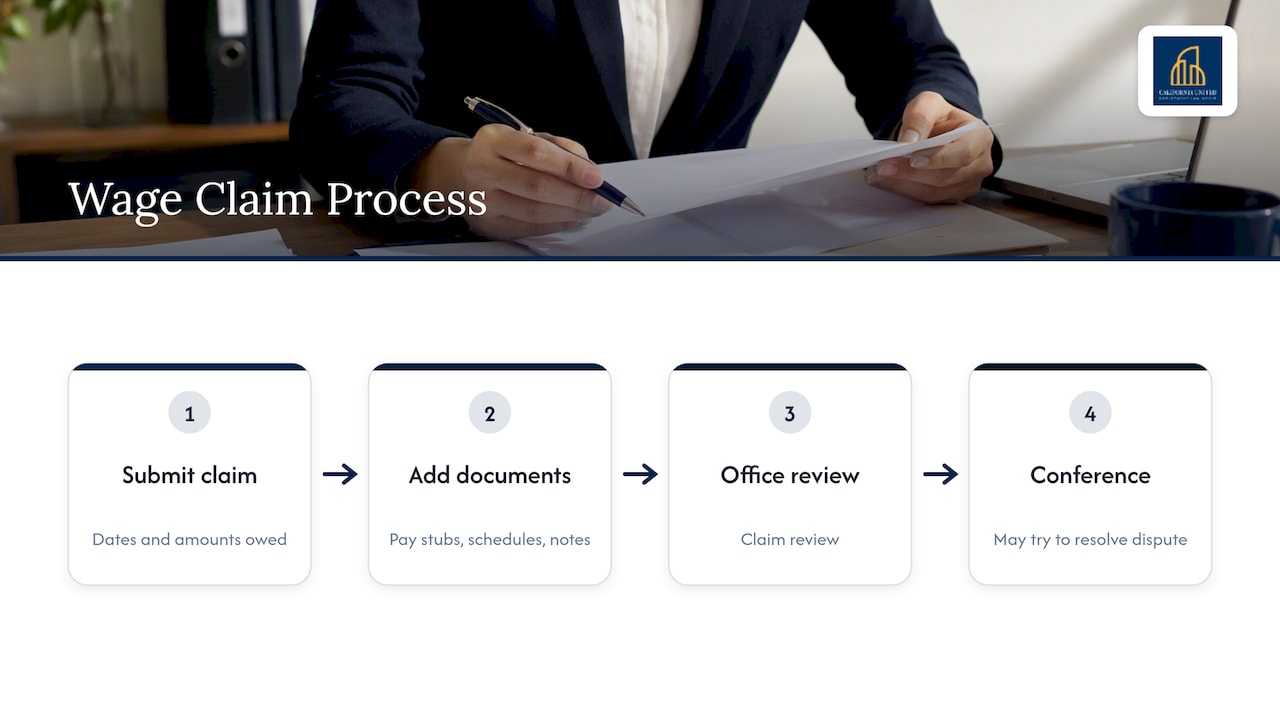
Once a wage claim is filed, the Labor Commissioner’s Office generally reviews the written claim, may schedule a settlement conference, and can proceed to a hearing if the matter is not resolved informally. The process is designed to let employees present their case without necessarily hiring counsel, though the facts of each claim shape how it unfolds.
During this review, the deputy assigned to the case may ask for supporting records such as pay stubs, schedules, or written statements, which is exactly why contemporaneous documentation matters so much before a claim is even filed. An employer has the opportunity to respond to the allegations, and the hearing officer weighs both sides’ evidence before issuing a decision, called an Order, Decision, or Award.
Outcomes vary based on the strength of the documentation on both sides and the specific facts of each workweek in question. Because assessments turn on individual records and testimony, there’s no single timeline or result that applies to every rest break claim.
Filing a Complaint With the California Labor Commissioner
Employees who want to pursue an administrative remedy can file a wage claim directly with the Labor Commissioner’s Office, which handles unpaid rest break premiums alongside other wage and hour issues. The process generally starts with submitting a claim form describing the unpaid wages, including the dates and amounts you believe are owed.
Supporting documents, such as pay stubs, schedules, and any written notes about the missed or interrupted breaks, strengthen the claim at the point of filing rather than after the fact. Once submitted, the office reviews the claim and may schedule a conference, as described above, to try to resolve the dispute before it proceeds further.
This path is built to be navigable without an attorney, but the facts of your situation, including whether retaliation occurred or whether the violations extended to other coworkers, can shape whether an administrative claim alone addresses the full scope of what you’re owed. Reviewing your documentation with an employment lawyer in Inglewood before filing, or at any point during the process, can help you understand how your specific facts fit the available remedies.
What Happens After a Claim: Settlements and Awards
Wage claims resolve in different ways depending on the facts and the parties involved. Some claims settle during the Labor Commissioner’s conference stage, where the employer may agree to pay some or all claimed amounts without a formal hearing. Others proceed to a hearing, where the deputy issues a written Order, Decision, or Award based on the evidence presented.
When a claim becomes a lawsuit instead of or alongside an administrative filing, outcomes can include a negotiated settlement, a court judgment, or a jury verdict, depending on how the case develops. Because every outcome depends on the specific facts, the quality of the documentation, and the applicable law, there’s no fixed formula for what a given rest break claim will yield.
The potential legal exposure may include premium pay owed under Labor Code § 226.7, plus wage-statement or waiting-time penalties when the facts support those additional claims. How those amounts are ultimately resolved, through settlement, administrative award, or litigation, depends on the specifics of each case.
When Rest Break Violations Become Class or Representative Actions
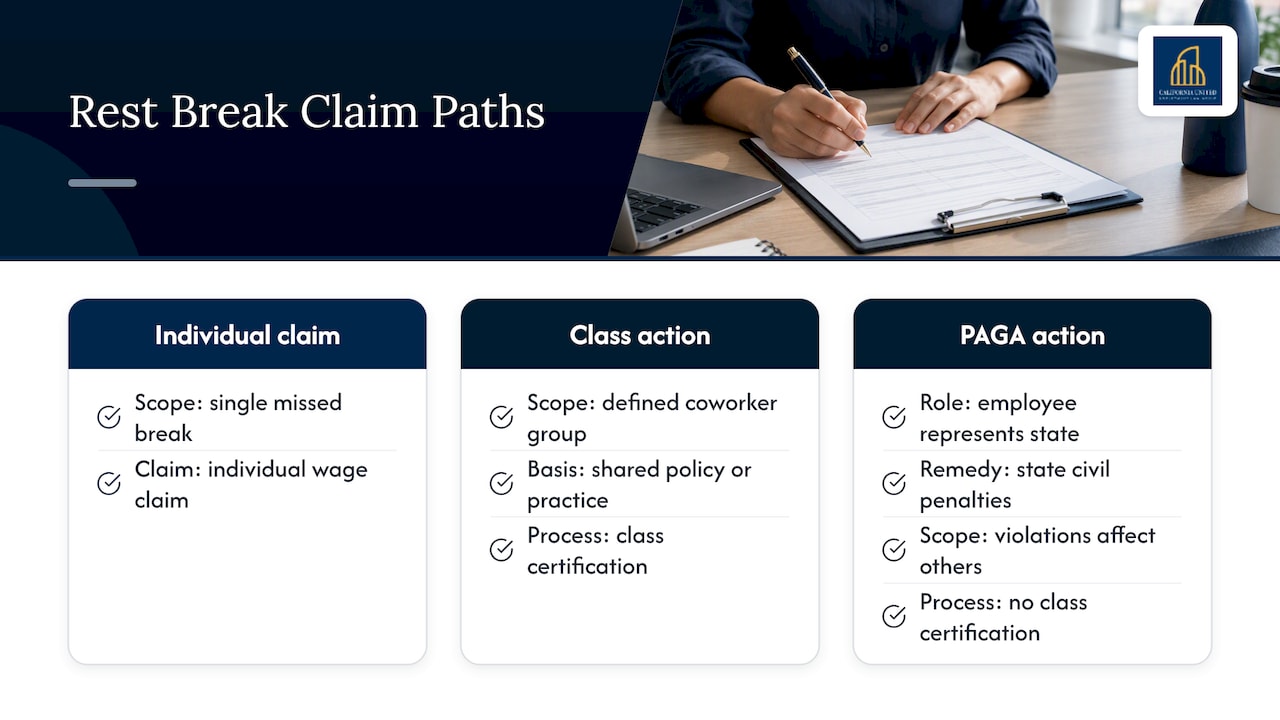
A single missed break is often an individual wage claim, but when the same violation affects many employees across a location or a company, the facts can support a broader action. California wage-and-hour claims may proceed as class actions when the legal requirements for class certification are met, including where a common policy or practice affects a defined group of employees in a similar way.
Separately, PAGA may allow an aggrieved employee to seek civil penalties for Labor Code violations affecting other employees, subject to procedural requirements and limits that should be reviewed before filing. This route doesn’t require the same class certification process as a traditional class action, though it carries its own procedural requirements.
Whether a pattern of rest break denials at a specific workplace rises to a class or representative claim depends on how widespread and consistent the practice was, which is one more reason detailed, dated documentation matters from the start.
Rest Break Rights Across Different Industries
The 10-minute rest break rule applies broadly to nonexempt employees, but how it plays out looks different depending on the industry. Retail and restaurant workers often face break timing pressure during rushes, while warehouse and logistics employees may encounter productivity quotas that make it harder to step away. Healthcare workers sometimes face on-call expectations during what should be duty-free time, and some industries are governed by additional wage orders issued by California’s Industrial Welfare Commission that add detail specific to that sector.
Some cities and counties may impose additional labor standards, but the baseline California rest-break requirement applies statewide to covered nonexempt employees. If your workplace has a specific policy that seems to conflict with the uninterrupted standard, that conflict itself is worth documenting and raising, whether informally or through a formal claim.
Our Perspective on Rest Break Claims for Inglewood Employees
California United Law Group represents employees in wage-and-hour disputes, including rest-break violations, wrongful termination, discrimination, and retaliation matters, from initial case evaluation through litigation when appropriate. Our work spans individual claims and class and representative actions under PAGA, which means we evaluate not just whether a single break was missed, but whether a broader pattern may be affecting coworkers in the same role.
Free consultations may be available, and qualifying cases may proceed on a contingency fee basis, meaning attorney’s fees are charged only if there is a recovery; clients should review the fee agreement to understand any responsibility for litigation costs or case expenses. For employees considering pursuing claims related to missed breaks, the evaluation often starts with an initial conversation rather than a formal commitment.
— California United Law Group
Contact California United Law Group for a Confidential Review
If you believe your rest breaks have been denied, shortened, interrupted, or discouraged, California United Law Group may be able to review your situation and discuss options, including an administrative wage claim, an individual wage-and-hour case, or a potential class or representative action. Qualifying cases may proceed on a contingency fee basis, but any fee agreement should explain whether the client may be responsible for costs or expenses.
You can reach our team through our contact page or learn more about how we handle wage and hour claims, including unpaid overtime and rest-break premium claims.
This article is for general informational purposes only and is not legal advice; employment-law outcomes depend on the specific facts of each situation, so consult a qualified lawyer about your circumstances before acting.
FAQ
What Are the Lunch Break Laws in California?
Meal breaks are separate from 10-minute rest breaks and generally involve different timing, duration, waiver, and recordkeeping rules.
Do You Legally Have to Have a Break on a 5-Hour Shift?
A 5-hour shift generally requires at least one paid 10-minute rest break, while meal-break rights depend on the shift length and whether any lawful waiver applies. The exact timing within the shift can depend on when the work period starts and how the hours are structured.
What Is the 72-Hour Rule in California?
In general, when an employee quits without giving at least 72 hours’ notice, final wages are due within 72 hours; this is separate from the waiting-time penalty analysis that may apply when final wages, including unpaid rest-break premiums, are not timely paid. This differs from the waiting-time penalty framework that applies when final wages, including unpaid rest break premiums, go unpaid at termination.
Are Breaks an OSHA Requirement?
Rest and meal break requirements in California primarily come from state wage-and-hour law and applicable wage orders, not federal OSHA. California’s rest-break rules may apply even when no federal OSHA break rule applies. California’s rest break rules apply regardless of federal OSHA standards, since they’re a state labor law protection rather than a workplace safety requirement.
How Do I Know if My Employer Owes Me Rest Break Premium Pay?
Compare your pay stubs against your actual schedule and notes to see whether an extra hour of pay appears for workdays when a rest break was denied, shortened, interrupted, or not authorized. If you do not see premium pay for a day when you believe a violation occurred, consider raising the issue internally, filing with the Labor Commissioner’s Office, or speaking with an employment lawyer in Inglewood.