
TL;DR:
- California law requires employers to pay employees for all hours worked, regardless of timesheet errors or lateness.
- Workers should carefully review and document paystubs and work hours to protect their rights in wage disputes.
- Employees can seek remedies through the DLSE or legal action to recover unpaid wages and penalties.
Many workers in Glendale assume that if their timesheet is late or wrong, their employer has a built-in excuse to reduce or withhold pay. That assumption is simply incorrect under California law. The state places the burden of accurate wage payment squarely on the employer, not the employee. Whether you missed a clock-in punch, submitted your timesheet a day late, or made a math error, your employer is still legally required to pay you for every hour you worked. This article explains how California’s wage laws apply to timesheet disputes, when employers face liability, and what you can do to protect your earnings.
Table Of Contents
- Understanding timesheet accuracy and California wage law
- When are Glendale employers liable for inaccurate timesheets?
- How to spot and document discrepancies in your pay
- Your options and rights when wage records are wrong
- Why pay record accuracy is a make-or-break issue in Glendale workplaces
- Get help with wage violations and inaccurate timesheets
- Frequently asked questions
Key Takeaways
| Point | Details |
|---|---|
| Employers must pay for all work | You are entitled to wages even if your timesheet is late or inaccurate. |
| State law rules apply | Glendale employees follow California wage laws with no unique local rules. |
| Keep detailed records | Maintaining your own records helps if you need to prove unpaid wages or errors. |
| Legal claims are available | You can file a DLSE wage claim if your pay and time records do not match up. |
| Employers risk penalties | Employers face strict penalties for wage statement errors and unpaid wages in California. |
Understanding Timesheet Accuracy And California Wage Law
California takes wage protection seriously, and the rules around timesheets reflect that commitment. As an employee, you have a legal right to be paid for all hours you work, full stop.
The core legal principle is straightforward. Employers cannot withhold wages solely because an employee submitted an inaccurate or late timesheet. If your employer knows, or can reasonably estimate, that you worked certain hours, they must pay you for those hours regardless of any timesheet issues.
This means the responsibility for accurate wage payment does not shift to the employee just because a timesheet has errors. California Labor Code §226(a) requires employers to maintain and provide accurate, itemized wage statements showing total hours worked, pay rates, and gross and net wages. The law is designed to give workers a clear and verifiable record of their compensation, and inaccurate records can expose employers to penalties.
What counts as a timesheet error? Errors are more common than most people realize, and they can take many forms:
- Missed clock-in or clock-out punches
- Late timesheet submission (whether by hours or days)
- Incorrect rounding of hours worked
- Math mistakes in manual time records
- Missing entries for breaks, overtime, or split shifts
- Manager-altered time entries that reduce recorded hours
Any of these issues can lead to a discrepancy between what was recorded and what was actually worked. The legal question California law asks is not whether the timesheet was perfect, but whether the employer paid you for all the time you actually put in.
Off-the-clock work violations often start exactly this way. An employee works through a lunch break, stays late to finish a task, or clocks out before completing required duties. If those hours are not captured on the timesheet, an employer who knew — or reasonably should have known — that work occurred is still required to pay for it.
The California Supreme Court confirmed this standard in Morillion v. Royal Packing Co. (2000) 22 Cal.4th 575, 585, holding that employers must compensate nonexempt employees for off-the-clock work if the employer knew or should have known the employees were working those hours. Note, however, that where an employee deliberately prevents the employer from learning about the off-clock work, liability may not attach under the same principle.
Important: California law does not let employers use administrative errors as a legal shield. If they knew — or reasonably should have known — that you worked those hours, California law generally requires them to pay you for that time, regardless of what any timesheet shows.
Pro Tip: Keep a personal written or digital log of your actual start and end times each day. Note any overtime, missed breaks, or after-hours work. This personal record can become critical evidence if a dispute arises over paystub law violations.
When Are Glendale Employers Liable For Inaccurate Timesheets?
Now that we know the state sets the rules, how do specific liability triggers work for Glendale employers?
First, an important clarification: Glendale follows statewide rules for wage and hour claims rather than any special city-level ordinance. The legal question is whether an employer’s timekeeping practices cause underpayment of wages. If they do, the employer faces exposure under California state law.
Types of employer liability from inaccurate timesheets:
| Type Of Violation | Potential Liability |
|---|---|
| Unpaid wages (underpayment) | Back pay for all hours worked |
| Incorrect wage statements (paystubs) | Statutory penalties up to $4,000 per employee |
| Waiting time penalties | Up to 30 days of additional daily wages when an employer willfully fails to pay final wages upon termination or resignation |
| PAGA claims | Civil penalties for each pay period affected |
| Class action exposure | Systemic violations affecting multiple employees |
Inaccurate wage statements and paystubs are a major target in California employment lawsuits. An employer who issues a paystub that does not accurately reflect hours worked or the correct wage rate can face not just back pay claims, but separate statutory penalties. California courts have confirmed this exposure. In Dunlap v. Superior Court (Bank of America, N.A.) (2006) 142 Cal.App.4th 330, 335, the court affirmed that an employer who violates Labor Code section 226(a)’s wage statement requirements owes $100 per pay period in statutory penalties, up to a maximum of $4,000 per employee.

Most wage claims in California trace back to timekeeping problems. Whether it is missed overtime, altered punches, or records that do not match actual work schedules, recordkeeping failures trigger the most common enforcement actions brought before the California Labor Commissioner.
Here is how a typical liability scenario unfolds for a Glendale employer:
- Discovery of error: An employee notices that hours on their paystub do not match time actually worked or kept in their own personal log.
- Internal notice: The employee notifies HR or a supervisor about the discrepancy. The employer is now on notice.
- Employer response (or lack thereof): If the employer corrects the error promptly, potential liability may be reduced. If not, ongoing violations accumulate.
- Regulatory complaint: The employee may file a wage claim with the California Labor Commissioner’s Office (Division of Labor Standards Enforcement, or DLSE).
- Investigation and hearing: The DLSE reviews records, interviews parties, and determines whether wages were properly paid.
- Enforcement outcome: Remedies can include back pay, penalties for inaccurate wage statements, and additional damages depending on the facts.
If you are dealing with overtime pay disputes in Glendale, the pattern above is one we see frequently. Employers sometimes characterize missing overtime hours as “timesheet errors” rather than wage violations. Under California law, that distinction rarely holds up when the employer knew work was being performed.
For broader context on your rights in this situation, Glendale employment law guidance can help you understand the full scope of what employers are required to do and what you can claim when they fall short.
How To Spot And Document Discrepancies In Your Pay
Understanding the risks is part one. Knowing how to catch and prove inaccuracies is just as important.
Start by reviewing every paystub carefully. California workers often receive wage statements every pay period but rarely scrutinize them. Here is what to check:
- Total hours listed: Do they match your own records for that pay period?
- Pay rate shown: Is it your correct base rate, including any agreed-upon adjustments?
- Overtime hours: Were any overtime hours recorded? California law generally requires overtime pay at one and one-half times your regular rate for hours worked beyond 8 in a day (up to 12 hours) or beyond 40 in a week. Double-time pay applies for any hours worked beyond 12 in a single workday. Additional overtime rules apply when you work seven consecutive days in one workweek.
- Deductions: Are any deductions explained and authorized?
- Gross vs. net pay: Do the math on the hours and rates shown and verify the gross pay figure is correct.
If something does not add up, start documenting immediately. Employees can pursue wage claims in California when pay and time records do not match actual work time. The DLSE wage claim process is one of the primary enforcement routes available to you.
Best practices for documenting your hours:
- Keep a daily time log in a notebook, app, or calendar. Note exact start and end times.
- Save any work-related emails or messages sent or received outside scheduled hours. These serve as independent proof you were working.
- Retain every pay stub you receive, whether electronic or paper. Do not delete digital wage statements.
- If your employer uses a physical time clock or a digital punch system, take note of any error messages or forced manual adjustments you observe.
- If you work through a meal break or stay after your shift at a manager’s request, note it with the date and the name of the person who asked you to stay.
Pro Tip: Even if you are a salaried employee, document any significant off-the-clock work that may entitle you to additional pay. Misclassification of employees as salaried to avoid overtime liability is a known practice in several industries, and documentation protects you regardless of how your employer categorizes your role.
The most valuable evidence in a California wage claim typically includes personal time logs, original pay stubs, written communications about work hours, and records showing employer awareness of your actual schedule. The stronger and more consistent your documentation, the more clearly it tells the story of what you worked and what you were paid. Your employee legal remedies depend heavily on the evidence you are able to present.
California courts have reinforced the power of your personal records in cases where employer timekeeping is deficient. In Furry v. East Bay Publishing, LLC (2018) 30 Cal.App.5th 1072, 1079, the California Court of Appeal held that where an employer fails to maintain accurate time records, even imprecise evidence from an employee is sufficient to establish a basis for damages in a wage or overtime claim. Once an employee presents that foundational evidence, the burden shifts to the employer to produce specific evidence of the precise amount of work performed — or to demonstrate that the employee’s evidence is unreasonable. If the employer fails to meet that burden, a court may award damages even though the amount is only approximate. (Anderson v. Mt. Clemens Pottery Co. (1946) 328 U.S. 680, 687–688.) In short, your personal time log can be the single most important document in your wage dispute.
Your Options And Rights When Wage Records Are Wrong
Once a problem is found and documented, what can Glendale employees do next?
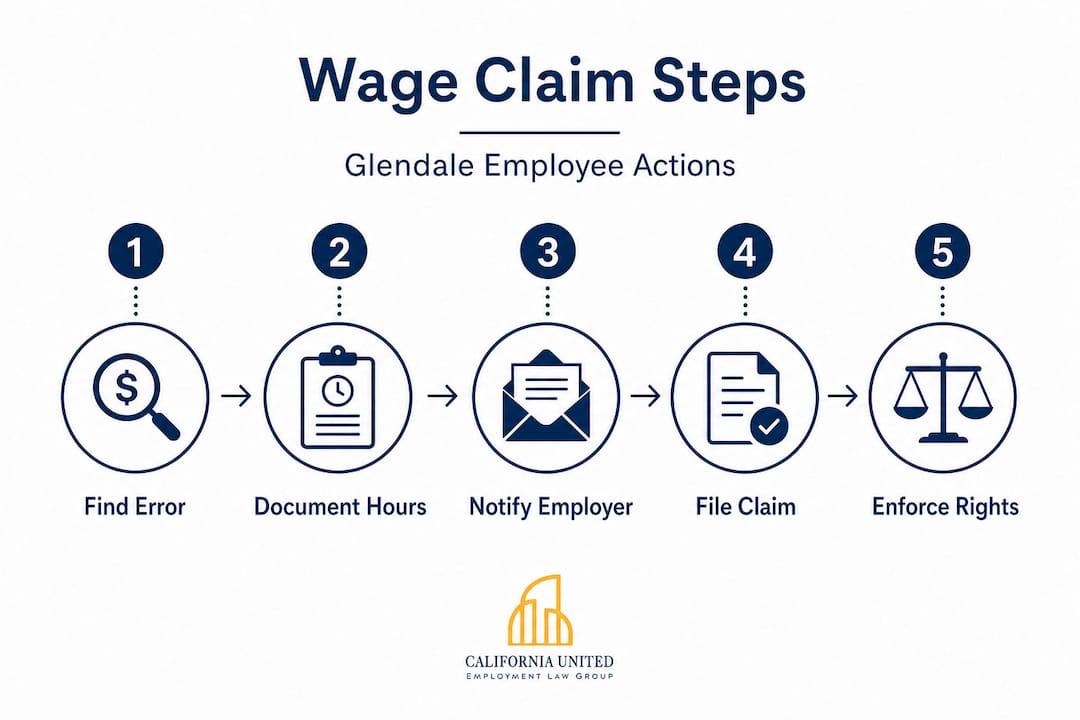
You generally have two paths: informal resolution through your employer, and formal enforcement through the DLSE or the courts. Most employment attorneys recommend starting internally while preserving your right to escalate.
Step-by-step approach for addressing pay discrepancies:
- Review your documentation and confirm the discrepancy is real before taking any action.
- Raise the issue in writing to HR or your direct supervisor. A written record of your complaint creates an important paper trail.
- Allow a reasonable response time. Employers sometimes correct genuine errors quickly when put on notice. Document any corrections made and confirm they are reflected in the next pay period.
- If the employer does not correct the issue, prepare to escalate by gathering all supporting evidence (personal logs, pay stubs, emails).
- File a wage claim with the DLSE or consult an employment attorney about your options, including civil litigation or a PAGA representative action.
Comparing your two main options:
| Factor | Informal HR Route | DLSE Wage Claim |
|---|---|---|
| Cost | None | None (state process) |
| Timeline | Days to weeks | Weeks to months |
| Employer involvement | Yes, employer controls response | State agency investigates |
| Potential outcomes | Corrected paycheck, adjusted records | Back pay, penalties, corrected records |
| Escalation available | Yes, if unresolved | Yes, to civil court |
Wage claim enforcement through the DLSE is a real and accessible tool for California workers. The process exists specifically to address situations where an employer has not properly paid for hours worked.
One critical protection to keep in mind: California law prohibits retaliation against employees who file wage complaints. If your employer demotes you, cuts your hours, or terminates you after you raise a wage concern, that retaliation is itself an unlawful act under the California Labor Code. Reporting wage violations is a protected activity, and you should not let fear of retaliation stop you from asserting your rights.
Potential remedies you may recover include back pay for underpaid wages, paystub violation penalties under Labor Code §226, waiting time penalties if your final pay was delayed, and in some cases, attorney’s fees.
California courts have given firm judicial backing to these remedies. On waiting time penalties, the California Court of Appeal explained in Diaz v. Grill Concepts Services, Inc. (2018) 23 Cal.App.5th 859, 867 that Labor Code section 203 ’empowers a court to award an employee who is discharged or who quits a penalty equal to up to 30 days’ worth of the employee’s wages if an employer willfully fails to pay the employee his full wages.’ The California Supreme Court has further emphasized that ‘the public policy in favor of full and prompt payment of an employee’s earned wages is fundamental and well established’ and that the failure to timely pay wages ‘injures not only the employee, but the public at large.’ (Pineda v. Bank of America, N.A. (2010) 50 Cal.4th 1389, 1400.)
For deadlines to file claims, facts matter enormously. Do not assume your situation is time-barred or that it is too late. Consult a qualified employment attorney about the statute of limitations that applies to your specific circumstances.
Why Pay Record Accuracy Is A Make-Or-Break Issue In Glendale Workplaces
With these practical steps laid out, it is worth stepping back to share a broader perspective on why this issue matters so much in Glendale’s working environment.
There is a pattern we see repeatedly. An employer discovers a timesheet error and treats it as an opportunity to avoid a payroll correction. They assume the employee will not push back, that the amounts are too small to pursue, or that pointing to an administrative mistake will end the conversation. Under California law, that reasoning fails at every level.
Many Glendale employers are in high-turnover, shift-based industries: healthcare, hospitality, retail, and warehousing. These are exactly the environments where timesheet errors are most likely to occur and most likely to go unchallenged. Workers in these industries often lack stable employment relationships that would encourage them to raise concerns. Some fear losing their jobs. Others simply do not know their rights.
The uncomfortable truth is that repeat violations happen because they go unaddressed. When employees accept incorrect pay without question, employers who operate in bad faith have little reason to change their practices. Those practices then affect every worker in that environment, not just the individual who first noticed the discrepancy.
Accurate wage records benefit everyone. Honest employers who maintain precise timekeeping systems avoid liability and build trust with their workforce. Employees who document their hours protect themselves from undercompensation and contribute to a record that can hold bad actors accountable. The California legal framework around at-will status and wage risks means workers can still be dismissed for many reasons, but being paid correctly for time already worked is a right that cannot be taken away.
If you see an error, act on it. Early documentation and prompt notification to your employer are your strongest positions. Waiting creates practical challenges in proving the extent of a violation.
Get Help With Wage Violations And Inaccurate Timesheets
If you believe your pay records are inaccurate or that you have been underpaid for hours worked, the right time to get answers is now, not after another pay period passes.
👉 California United Law Group, P.C. represents California employees in wage and hour disputes. We can help you review your wage statements, understand whether your employer may be liable, and evaluate the options available to you under state law.
Whether your concern involves a single underpaid paycheck or a pattern of record-keeping violations, getting expert guidance matters. Visit our wage and hour law help page to learn about the types of claims we handle. For broader questions about employee rights in California, our California employment law resources page offers an overview of the full range of protections available to you.
This article is for general educational purposes only and does not constitute legal advice. Employment law issues are fact-specific and outcomes vary. Consult a qualified employment attorney regarding your individual situation.
Frequently Asked Questions
Can my employer refuse to pay me because my timesheet was late or incorrect?
No. California law requires employers to pay all wages owed for hours actually worked, even if your timesheet was late or contained errors. A timesheet mistake is not a lawful basis for withholding or reducing pay.
What if my employer gives me a paystub that doesn’t match the hours I worked?
You should document the discrepancy carefully and consider filing a DLSE wage claim to recover unpaid wages. Inaccurate wage statements can also trigger separate statutory penalties for the employer.
Are there extra protections for Glendale employees under city law?
No. Glendale follows California’s statewide wage and hour laws for these types of claims. There are no additional city-level protections specific to Glendale that apply to timesheet or wage record disputes.
How long must my employer keep wage statements and time records?
California requires employers to retain itemized wage statements for at least three years. This record-keeping obligation supports employees who need to review past pay periods when identifying potential underpayments.