
TL;DR:
- Most layoffs in California are lawful if conducted following legal procedures and based on legitimate reasons.
- Violations occur if layoffs involve discrimination, retaliation, or procedural failures like inadequate notice or bypassing union negotiations.
- Employees should gather documentation, consult unions or attorneys, and act quickly if they suspect wrongful layoff practices.
If you’ve recently received a layoff notice from Pasadena Unified School District or another Pasadena employer, you’re probably asking a very reasonable question: was this legal? The confusion is understandable. Losing your job feels wrong, and it’s natural to wonder if your rights were violated. The reality is that most large-scale layoffs in California, including recent Pasadena Unified layoffs, are budget-driven processes governed by strict state law and collective bargaining agreements, not arbitrary firings. But that doesn’t mean every layoff is automatically clean. This article walks you through what separates a lawful layoff from a wrongful termination, what the law actually requires, and how to spot a real violation.
Table Of Contents
- How California law distinguishes layoffs from wrongful termination
- Are Pasadena Unified layoffs following proper legal processes?
- Common violations: How discrimination or retaliation can sneak into layoff decisions
- What employees can do if they suspect a layoff violated their rights
- Most Pasadena layoffs are legal, but vigilance is essential: What employees often miss
- Need experienced help with Pasadena layoffs or wrongful termination?
- Frequently asked questions
Key Takeaways
| Point | Details |
|---|---|
| Layoffs are not always illegal | Most Pasadena layoffs follow budget and state law processes, not ad hoc firings. |
| Discrimination is still a risk | Choosing who gets laid off based on protected traits is prohibited and actionable. |
| Unions and notice matter | School layoffs must involve proper notice and union bargaining; missing these can create legal violations. |
| Individual facts drive claims | Successful wrongful termination cases depend on individual circumstances, not just suffering a layoff. |
| Legal help is available | Employees concerned about their layoff should consult an employment attorney for tailored guidance. |
How California Law Distinguishes Layoffs From Wrongful Termination
With the context set, it’s crucial to understand what actually separates a lawful layoff from wrongful termination under California law.
California is an at-will employment state. That means most employers can end employment for almost any reason, or no reason at all, as long as the reason isn’t illegal. A layoff is generally treated as a business decision, not a personal one. That said, public school district employees — including Pasadena Unified teachers and staff — are not at-will employees; they hold statutory protections under the California Education Code that require specific procedures before a layoff can lawfully occur. Budget shortfalls, restructuring, declining enrollment, and funding cuts are all recognized as legitimate reasons to reduce a workforce.
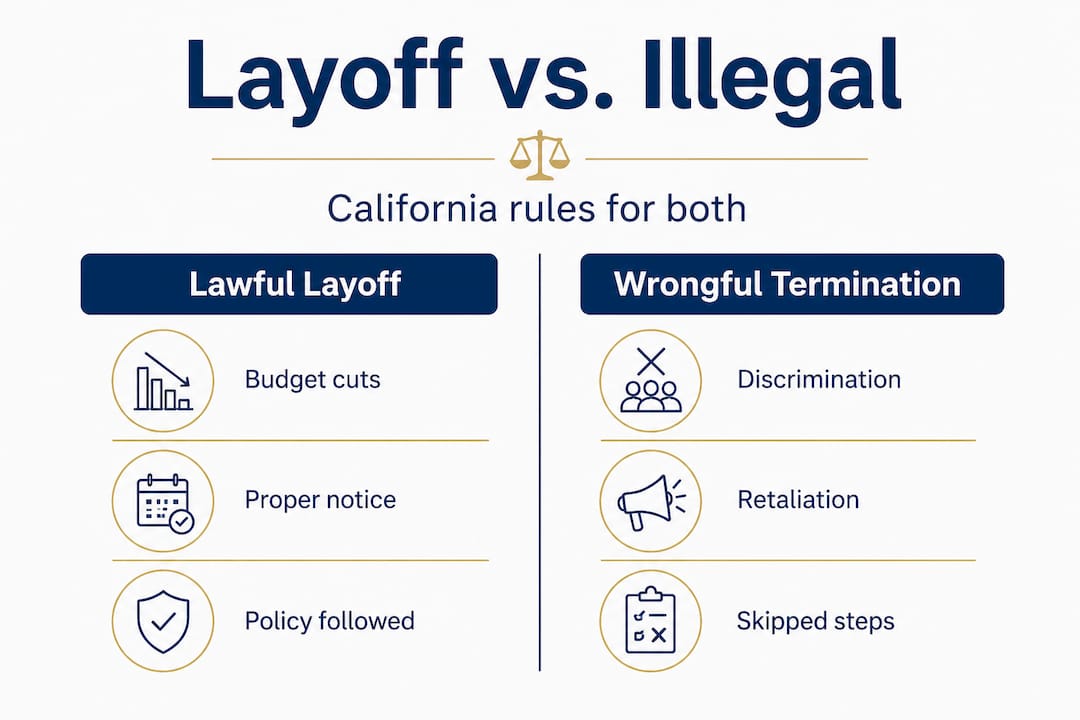
So what makes a layoff wrongful? The line gets crossed when the employer’s decision or process violates a protected right. Understanding your employee termination rights in California is the first step in knowing whether that line was crossed in your situation.
Here’s a quick comparison to clarify the difference:
| Factor | Lawful Layoff | Wrongful Termination |
|---|---|---|
| Reason | Budget cuts, restructuring, enrollment decline | Discrimination, retaliation, illegal motive |
| Selection process | Seniority, position elimination, neutral criteria | Based on race, age, gender, disability, sexual orientation, national origin, religious creed, or other protected activity — FEHA protects many additional categories |
| Notice | Proper advance notice given | No notice or notice designed to circumvent rights |
| Collective bargaining | Union consulted and bargained with | Union bypassed or contract violated |
| Documentation | Written, consistent, and policy-driven | Vague, inconsistent, or pretextual |
California courts have long grappled with where the line falls between a lawful business decision and an illegal firing. In Tameny v. Atlantic Richfield Co. (1980) 27 Cal.3d 167, the California Supreme Court established that employees may pursue tort remedies when a termination violates fundamental public policy — a protection that applies even when the decision appears budget-driven on the surface. In Guz v. Bechtel National, Inc. (2000) 24 Cal.4th 317, the Court reaffirmed that while the at-will doctrine is the default rule for private employees, employers must still comply with anti-discrimination laws and any implied contractual obligations created by their own policies and practices. These landmark decisions illustrate why the legality of a termination often turns not on the label an employer applies to it, but on the actual factors that drove the decision.
As CalChamber’s HR guidance makes clear, employees generally cannot assume a layoff is automatically illegal in California. The key legal risk is whether the employer’s selection or implementation process violates anti-discrimination or anti-retaliation laws.
That’s a critical distinction. A painful layoff is not the same as an illegal one. But the process matters enormously.
Pro Tip: Before concluding your layoff was wrongful, ask yourself: was I selected because of a protected characteristic, or because of recent protected activity I engaged in? Those are the questions that drive most valid legal claims, not the layoff itself.
Learning more about wrongful termination in California can help you frame your situation against the right legal standard before drawing any conclusions.
Are Pasadena Unified layoffs following proper legal processes?
Understanding that not all layoffs break the law, how do Pasadena Unified’s practices measure up to these legal standards?
Pasadena Unified School District has faced significant budget pressures, and in early 2026, the board voted to approve layoffs affecting dozens of teachers and staff. These are not casual firings. They are formal Reduction in Force (RIF) actions, which are governed by the California Education Code and subject to collective bargaining obligations under the Educational Employment Relations Act (EERA).
According to reporting from LAist, the Pasadena Unified board’s layoffs appear to follow a state-law and collective-bargaining governed Reduction in Force process, rather than ad hoc wrongful termination actions.
For school districts, the legal bar for layoffs is actually quite high. Here’s how the required steps for public school layoffs compare to private company layoffs:

| Step | Public School District | Private Company |
|---|---|---|
| Advance notice | Legally required (March 15 deadline for certificated staff) | At least 60 days required under the California WARN Act (Lab. Code § 1400 et seq.) for layoffs of 50+ employees; the federal WARN Act applies to employers with 100+ employees |
| Union notification | Mandatory before implementation | Required if unionized |
| Bargaining obligation | Must bargain over impacts and implementation | Required if unionized |
| Seniority rules | Strictly governed by Education Code | Varies by policy and contract |
| Governing board approval | Required by law | Not required |
| Anti-discrimination compliance | Required under FEHA and federal law | Required under FEHA and federal law |
When reviewing whether Pasadena Unified’s current layoffs are lawful, the key compliance areas to evaluate include:
- Proper notice: Were affected employees notified within the legally required timeframe?
- Collective bargaining: Was the union given the opportunity to negotiate over the impacts of the layoffs?
- Non-discriminatory selection: Were employees selected based on seniority and legitimate criteria, not protected characteristics?
- Board approval: Did the governing board formally vote to authorize the layoffs?
- Consistency: Were the same standards applied to all similarly situated employees?
If you are covered by a union contract and believe any of these steps were skipped or mishandled, you may have grounds to pursue a grievance or an unfair practice charge. Reviewing your situation against the standards for illegal termination under Pasadena California law is a smart starting point.
Common Violations: How Discrimination Or Retaliation Can Sneak Into Layoff Decisions
Even if the process generally follows the law, there are common ways employees’ rights can still be violated, especially around selection, notice, and retaliation.
Here’s the reality: a school district or employer can follow every formal step of a RIF and still violate the law if the selection of who gets laid off is tainted by illegal motives. This is where many employees miss the real legal issue. The paperwork can look clean while the decision underneath it is discriminatory.
The selection process can be scrutinized under federal and state laws that prohibit unlawful discrimination and retaliation. That means even a formally approved layoff can expose an employer to liability if the wrong factors drove the decision.
Here are the most common signs that a layoff may cross a legal line:
- You recently engaged in protected activity. If you filed a complaint, reported harassment, requested a disability accommodation, or took protected leave shortly before being selected for layoff, that timing is a significant red flag for retaliation.
- Employees in your protected class were disproportionately selected. If the layoffs seem to fall heavily on older workers, women, employees of a particular race, or people with disabilities, that pattern could support a discrimination claim under the Fair Employment and Housing Act (FEHA).
- Your seniority or contract rights were ignored. For school district employees, seniority is a cornerstone of RIF procedures. Being laid off out of order without explanation is a serious procedural concern.
- You received no written notice or an inadequate one. California law requires specific notice timelines and content. A defective notice can be both a procedural violation and evidence of a broader problem.
- Your union was not properly consulted. In a 2019 case, PERB Decision 2968E found that Pasadena Unified School District violated the Educational Employment Relations Act by unilaterally approving a reduction in hours without providing the union prior notice and an opportunity to bargain. This is exactly the kind of procedural failure that can turn an otherwise lawful layoff into a legal violation.
- Your position was eliminated but quickly refilled. If your job was supposedly eliminated but the same or very similar role was posted shortly after, that raises questions about whether the “layoff” was actually a pretext for something else.
Pro Tip: Start a written log as soon as you receive a layoff notice. Document dates, names, conversations, and any reasons given. This contemporaneous record can be invaluable if you later pursue a legal claim. Ask your employer in writing for the specific criteria used to select employees for layoff.
Looking at layoff discrimination protections in similar California cases can give you a clearer picture of what courts and agencies look for when evaluating these claims.
What Employees Can Do If They Suspect A Layoff Violated Their Rights
If you’re worried your layoff went beyond normal legal practice, here’s what you can do to protect your rights.
The most important thing to understand is that wrongful termination claims typically depend on individualized facts, such as protected activity, disparate treatment, disparate impact, or procedural notice failures, not just the fact that a layoff occurred. That means your specific circumstances matter far more than the general news coverage of a large-scale RIF.
Here are the concrete steps you should take immediately:
- Collect all documents. Gather your layoff notice, any written communications from HR or management, your employment contract or collective bargaining agreement, performance reviews, and any records of complaints or accommodation requests you made.
- Request written reasons. Ask your employer or HR department in writing to explain the specific criteria used to select you for layoff. Their response, or their silence, can be telling.
- Contact your union representative. If you are a member of a union, your representative can review whether the district followed proper bargaining and notice procedures. They can also file a grievance or unfair practice charge on your behalf.
- Note all relevant dates. Timing is everything in retaliation cases. Write down when you engaged in any protected activity and when the layoff decision was communicated to you.
- Consult an employment attorney. A California employment lawyer can evaluate whether the facts of your situation support a legal claim. Many offer free consultations, and this step costs you nothing but time.
- File a complaint if warranted. Depending on your situation, you may be able to file a complaint with the California Civil Rights Department (CRD), the Public Employment Relations Board (PERB) if you are a public employee, or pursue a civil lawsuit.
Understanding the full employment lawsuit process in California can help you set realistic expectations about timelines, costs, and outcomes before you decide how to proceed.
Time matters here. California has strict deadlines at every stage of a discrimination or retaliation claim. Under FEHA, you generally have up to three years from the date of the alleged violation to file an administrative complaint with the California Civil Rights Department (CRD). But that is only the first deadline. Once the CRD issues a right-to-sue notice, you have just one year from the date of that notice to file a civil lawsuit in court. Missing either deadline can bar your claim entirely, regardless of how strong the underlying facts are. Moreover, the clock for a wrongful termination claim starts running on your actual last day of employment, not the earlier date you received notice of the layoff. Act promptly and consult an attorney before time expires. Importantly, under Romano v. Rockwell Int’l, Inc. (1996) 14 Cal.4th 479, California courts have confirmed that the deadline begins running on your actual last day of work, not the date you received your layoff notice — giving some employees more time than they realize, but not a reason to delay.
Most Pasadena Layoffs Are Legal, But Vigilance Is Essential: What Employees Often Miss
Taking all the facts together, it’s worth sharing what many employees miss when thinking about the legality of layoffs.
The biggest misconception we see is this: people focus on the headline, not the details. A school board voting to approve dozens of layoffs sounds alarming. But the existence of a large, formal RIF process is actually evidence of compliance, not a red flag. Public employers that follow Education Code procedures, notify unions, and obtain board approval are doing exactly what the law requires.
What employees miss is the layer underneath the formal process. The real legal risks are often buried in the specifics: who was selected and why, whether a particular employee was targeted after raising a concern, whether the union was given a genuine opportunity to bargain rather than a rubber-stamp notification. These are the details that determine whether a lawful-looking layoff is actually unlawful.
We also see employees who wait too long. They assume the union will handle everything, or they hope the situation resolves itself. But union grievances and individual legal claims are different tools that serve different purposes. A union grievance may address contract violations, while a personal discrimination or retaliation claim under FEHA is yours alone to pursue. Passivity can let real violations go unchallenged.
The employees who protect themselves best are the ones who act quickly, document everything, and get a personalized legal review early. They don’t assume the worst, but they don’t assume the best either. They look at the specific facts of their own situation.
Our employment law insights cover many of the patterns we see in California layoff cases, and the lesson is consistent: the details always matter more than the headlines.
Need Experienced Help With Pasadena Layoffs Or Wrongful Termination?
If any of the warning signs in this article apply to your situation, consider taking the next step with professional help.
At California United Law Group, P.C., we represent California employees who have faced wrongful termination, discrimination, retaliation, and unlawful layoff practices. We understand how stressful and disorienting a sudden job loss can be, especially when you’re not sure whether your rights were respected. 👉 We offer free case evaluations so you can get a clear, honest assessment of your situation without any financial commitment. Whether you need help understanding your wrongful termination options or want to speak with a Pasadena employment lawyer who knows local employer practices, we’re here to help you understand your legal options and make informed decisions about your next steps.
Frequently Asked Questions
What makes a layoff illegal in California?
A layoff violates California law if it is based on discrimination, retaliation, or does not follow proper notice and collective bargaining requirements. As CalChamber confirms, the selection process itself can be scrutinized under state and federal anti-discrimination laws even when the layoff appears formally compliant.
Do budget-related layoffs still require employee notice?
Yes, public employers and many private ones must provide advance notice and follow specific legal steps, even when layoffs are purely budget-driven. The Pasadena Unified RIF process illustrates how state law and collective bargaining rules govern even budget-necessity layoffs in public school settings.
Can you sue if you suspect retaliation in your layoff?
It depends on the type of retaliation claim. If you are a public school employee and believe you were retaliated against for union-related activity, the Public Employment Relations Board (PERB) is the agency that adjudicates those claims through an unfair practice charge process — as illustrated by PERB Decision 2968E, in which PERB found that Pasadena Unified violated the EERA and ordered a make-whole remedy. If your retaliation claim is based on a protected characteristic under FEHA — such as disability, age, or race — you would need to file an administrative complaint with the California Civil Rights Department (CRD) first and obtain a right-to-sue notice before filing a civil lawsuit. An employment attorney can help you identify which path applies to your specific situation.
Who investigates school layoff violations in Pasadena?
Union representatives, the Public Employment Relations Board (PERB), and sometimes the courts review school layoff violations. PERB Decision 2968E involving Pasadena Unified is a real example of how PERB adjudicates unfair practice charges against school districts that bypass bargaining obligations.