
TL;DR:
- California law requires payment for all time under an employer’s control, including pre-shift, post-shift, and setup time.
- Common violations include unpaid early arrivals, skipped breaks, and off-the-clock cleanup at stadium events.
- Workers should document shifts and file claims within three years to recover unpaid wages and protect their rights.
If you work at SoFi Stadium, you may have noticed something frustrating: your paycheck doesn’t always seem to match the time you actually spent working. Maybe you arrived early for a briefing, stayed late for cleanup, or had a break cut short during a packed event night. These situations are more common than most workers realize, and they’re not just inconvenient. Under California law, every one of those minutes may be owed to you. This guide breaks down what the law requires, what violations look like at stadium venues, and exactly what you can do if you believe you’re being shortchanged.
Table of Contents
- What the law says about ‘all hours worked’
- Common wage and hour violations in stadium event work
- Is this happening at SoFi Stadium? Evidence and challenges
- What you can do if you aren’t paid for all hours worked
- What most stadium workers and employers miss about wage claims
- Get help with wage and hour issues at SoFi Stadium
- Frequently asked questions
Key Takeaways
| Point | Details |
|---|---|
| Pay for all hours required | California law says SoFi Stadium workers must be paid for every minute they’re on duty, including setup and cleanup. |
| Common violations | Unpaid off-the-clock work, missed breaks, and misclassification are typical problems in stadium jobs. |
| Document and act | Keeping records and acting early protects your rights and strengthens your position and makes violations easier to document and prove. |
| Legal support is available | Free consultations are available with employment attorneys who handle wage and hour claims on a contingency basis — you owe no attorney’s fees unless there is a recovery, though you may still be responsible for certain costs. |
What the law says about ‘all hours worked’
Let’s start by clarifying what the law means when it says “all hours worked.”
California has some of the strongest wage protections in the country. Under the California Labor Code and the Industrial Welfare Commission (IWC) Wage Orders, employers must pay workers for every minute they are required to be on duty or under the employer’s control. This is not limited to the hours on your official schedule.
The legal definition of “hours worked” covers far more than most employees expect. Here’s what must be compensated under California law:
- Pre-shift activities: Arriving early for mandatory briefings, safety checks, or uniform inspections
- Post-shift activities: Staying after your shift for cleanup, closing duties, or equipment returns
- Setup and breakdown time: Any work done before or after the main event that your employer requires
- Mandatory meetings: Team huddles, training sessions, or safety meetings held before or after your shift
- Rest breaks: California law requires a paid 10-minute rest break for every four hours worked (or major fraction thereof — meaning the entitlement begins after 3.5 hours). If a rest break is not provided, the employer owes one additional hour of pay at your regular rate of pay for that workday — not per missed break, but once per day for rest break violations.
- Meal periods: A 30-minute unpaid meal break is required for shifts over five hours. If you’re interrupted or required to stay on duty, that time becomes compensable.
As a key legal standard, California law entitles workers to pay for every minute they’re required to be on duty, including pre-shift, post-shift, and setup time. This applies to all employees regardless of how sporadic or event-based their schedule is.
“Hours worked” means the time during which an employee is subject to the control of an employer, including all the time the employee is suffered or permitted to work, whether or not required to do so.
— California IWC Wage Order Definition
Many workers at event venues are confused because their employer only counts time from when the event officially starts to when it ends. That’s not how California law works. Your SoFi Stadium worker pay rights extend to every controlled minute, not just the visible ones.
If you’ve been told that early arrival or post-event cleanup is “just part of the job” and not paid, that could be a violation worth investigating. Understanding this distinction is your first step toward knowing whether you’re being paid fairly.
Common wage and hour violations in stadium event work
But what kinds of violations are most common at stadiums and event venues like SoFi?
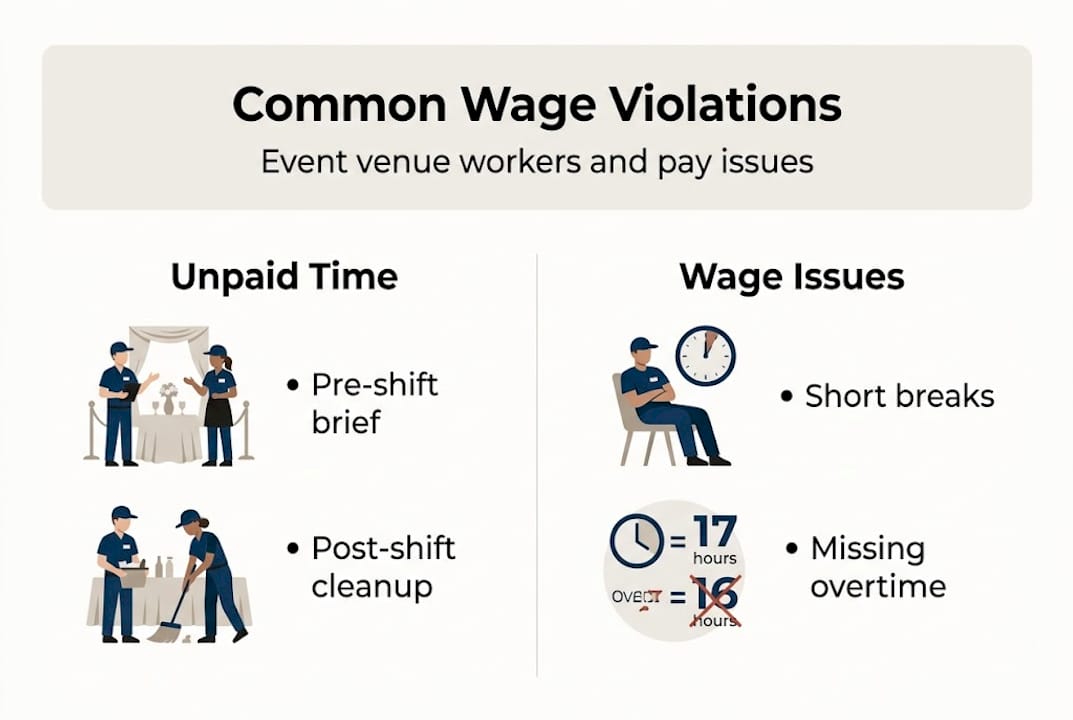
Event-based workplaces create unique conditions that make wage theft easier to hide. Shifts are irregular, staffing levels change with each event, and workers often don’t know each other well enough to compare notes. These factors create cover for pay practices that would be harder to sustain in a traditional workplace.
Unpaid pre- and post-shift work, missed breaks, and off-the-clock time are among the most common sources of wage theft in event settings. Here’s what each looks like in practice:
- Off-the-clock early arrivals: You’re told to show up 30 minutes before your shift starts for a team briefing, but the clock doesn’t start until the event begins.
- Security screening time: You wait in line to pass through security before entering the venue. If your employer controls that process, that wait time may be compensable.
- Unpaid cleanup: After an event ends, you’re required to break down equipment or clean your station, but your pay stops when the event clock does.
- Skipped or shortened breaks: During a high-traffic game night, your supervisor tells you to skip your rest break. That’s a violation.
- Misclassification as an independent contractor: If you’re labeled an independent contractor, California law — under what is known as the ‘ABC test’ — presumes you are actually an employee unless your employer can prove three things: (A) that you are free from the employer’s control in how you perform the work; (B) that the work you do is outside the usual course of the employer’s business; and (C) that you are engaged in an independently established trade or business. If the employer cannot prove all three, you are likely an employee entitled to overtime, break protections, and other wage rights. (Dynamex Operations West, Inc. v. Sup.Ct. (2018) 4 Cal.5th 903; Labor Code § 2775(b).)
California courts have confirmed these principles in real cases. In Brinker Restaurant Corp. v. Superior Court (2012) 53 Cal.4th 1004, the California Supreme Court held that employers must affirmatively relieve employees of all duties during meal periods — a standard directly applicable to stadium workers who are interrupted or kept on duty during supposed breaks. On the question of who qualifies as an employee entitled to these protections, the California Supreme Court in Dynamex Operations West, Inc. v. Superior Court (2018) 4 Cal.5th 903 established the ‘ABC test,’ which presumes a worker is an employee and places the burden on the employer to prove otherwise. And when employers fail to pay premium wages owed for break violations, Naranjo v. Spectrum Security Services, Inc. (2022) 13 Cal.5th 93 confirmed that workers are also entitled to waiting time penalties and wage statement penalties — adding further exposure for employers who ignore these obligations.
| Violation type | What it looks like | Sample scenario |
|---|---|---|
| Unpaid pre-shift time | Mandatory briefing before clock-in | Arriving 20 min early for required staff meeting |
| Missed rest break | No 10-min break in a 4-hour shift | Busy game night, no break given or paid |
| Off-the-clock cleanup | Post-event duties after clock-out | Breaking down concession stand after final whistle |
| Contractor misclassification | No overtime or break rights | Labeled “gig worker” but given set schedule and uniform |
| Interrupted meal period | On-duty during supposed unpaid break | Answering questions or serving customers during break |
For a broader look at how these issues affect similar workers, hospitality worker wage claims in the Inglewood area follow similar patterns.
Pro Tip: Start keeping a personal work log for every shift. Write down when you arrive, when you actually clock in, when breaks happen (or don’t), and when you leave. This simple habit can reveal patterns you might otherwise miss and becomes critical evidence if you ever file a claim.
Large events like the Super Bowl have drawn attention to how stadium workers earning as little as $12 an hour often face these exact issues while the events generate billions in revenue.
Is this happening at SoFi Stadium? Evidence and challenges
So how does all of this play out at SoFi Stadium? Let’s look at what the facts show and don’t show.
As of 2026, there are no confirmed wage citations specifically against SoFi Stadium on public record. No major lawsuits or state Labor Commissioner enforcement actions have been publicly reported against the venue’s management. That doesn’t mean violations aren’t happening. It may simply mean they’re underreported.
Why might issues go unreported? Several reasons:
- Fear of retaliation: Workers worry about losing shifts or being blacklisted if they raise concerns.
- Belief that small amounts aren’t worth it: Losing 20 minutes of pay per shift feels minor until you calculate it across a full season.
- Lack of awareness: Many workers don’t know their rights or what counts as compensable time.
- Irregular scheduling: When you work sporadically, it’s harder to track patterns or connect with coworkers who share the same experience.
On the union side, Unite HERE Local 11 represents about 2,000 food service workers at SoFi Stadium but had no labor contract as of April 2026. Without a collective bargaining agreement, workers have fewer formal protections and less leverage to push back on pay practices.
The absence of a union contract means individual workers carry more of the burden when it comes to identifying and reporting wage violations.
| Factor | Current status |
|---|---|
| Public wage citations against SoFi | None confirmed as of 2026 |
| Union representation | Unite HERE Local 11 (no contract as of April 2026) |
| Industry-wide wage theft documentation | Well-documented in event/hospitality sector |
| Worker retaliation protections | Strong under California law |
If you suspect a violation but can’t find official reports, here’s what to do:
- Document your own experience with dates, times, and specific incidents.
- Talk quietly with trusted coworkers to see if others share the same experience.
- Contact an employment attorney to review your situation before filing anything official.
- Learn how wage lawsuits work in California so you understand your options.
- Review the labor commissioner enforcement process to understand what a formal complaint involves.
What you can do if you aren’t paid for all hours worked
If you think you’re missing pay for all your hours at SoFi Stadium, here’s how you can take action safely.
The good news is that California gives workers real tools to recover unpaid wages. California workers can file claims with the Labor Commissioner for up to three years of back pay and can pursue class actions if multiple workers share the same issue. Here’s a step-by-step approach:
- Start documenting immediately. Write down your schedule, actual start and end times, breaks taken, and any instructions that kept you working off the clock. Do this for every shift going forward.
- Gather your pay stubs and time records. Request copies of your time records from your employer. California law gives you the right to access these.
- Calculate what you may be owed. Add up unpaid pre-shift time, break premiums (one additional hour of pay at your regular rate for each workday a rest break was not provided, and one additional hour for each workday a meal period was not provided — meaning up to two additional hours per day if both were missed), and any off-the-clock hours. Note that your ‘regular rate’ includes not just your hourly pay, but also nondiscretionary bonuses and other performance-based pay you received for that period.
- Report internally first (if safe). Notify HR or your supervisor in writing. Keep a copy. This creates a paper trail and gives the employer a chance to correct the issue.
- File a claim with the California Labor Commissioner. If the issue isn’t resolved, you can file a Berman hearing claim or a civil lawsuit. There’s no filing fee for Labor Commissioner claims.
- Consult an employment attorney. An attorney can evaluate whether your situation qualifies for a class action, which can significantly increase your recovery.
Key documents to gather:
- Personal shift logs with actual hours
- Pay stubs showing hours paid vs. hours worked
- Text messages or emails about early arrivals or off-the-clock requests
- Witness statements from coworkers
- Any written policies from your employer about breaks or scheduling
Your retaliation protections under California law are strong. It’s illegal for your employer to cut your hours, fire you, or treat you differently because you asked about your pay or filed a claim. Review your wage complaint rights so you know exactly what’s protected.
Pro Tip: Don’t wait until the end of a season to start documenting. The sooner you begin, the stronger your evidence will be. Even a simple notes app on your phone works as a starting point.
What most stadium workers and employers miss about wage claims
Even with these resources, a lot of wage violations go unchallenged. Why?
The honest answer is that the system works in favor of employers who stay quiet. When workers lose 15 or 20 minutes per shift, it feels too small to fight. But multiply that by 30 events a year, across hundreds of workers, and you’re looking at significant wage theft that nobody is reporting.
Employers in event-based industries often rely on this math. Sporadic schedules, rotating staff, and high turnover make it difficult for workers to compare experiences or build a case. Many employees also fear that raising concerns will cost them future shifts, which in a gig-adjacent environment feels like a real and immediate risk.
What we’ve seen in practice is that documentation changes everything. One worker’s shift log, kept consistently over a few months, can expose a pattern that affects dozens of coworkers. That’s how individual claims become class actions. The smallest record can uncover the largest problem.
If you’re hesitant because the amount seems small or the process seems complicated, consider this: California law was designed specifically to make it accessible for individual workers to bring claims without needing to pay upfront legal fees. Understanding at-will employment pitfalls and how they intersect with wage violations can also help you see the full picture of your rights.
Get help with wage and hour issues at SoFi Stadium
If you work at SoFi Stadium and believe you’re not being paid for every hour you work, you don’t have to figure this out alone. At California United Law Group, P.C., we represent employees in wage and hour disputes across California, including workers at event venues and hospitality settings.
👉 We offer free consultations. Our firm handles these cases on a contingency fee basis, meaning you owe no attorney’s fees unless we recover for you. Please note that certain litigation costs and expenses may be your responsibility regardless of outcome; we will discuss these in detail during your consultation.
Our team can review your situation, help you understand what evidence you need, and guide you through the claims process from start to finish. Explore our wage and hour legal help resources or learn more about the full scope of our employment law support services. Your rights matter, and we’re here to help you protect them.
Frequently asked questions
What should I do if my paycheck is missing hours at SoFi Stadium?
Document each shift carefully, notify HR in writing, and file a Labor Commissioner claim if the issue isn’t corrected. Workers can file claims for missing pay going back up to three years.
Are unpaid setup or cleanup times legal for stadium workers?
No. California law requires wages for pre-shift and post-shift activities when your employer requires or controls that time.
Can I be fired for asking about unpaid hours at SoFi Stadium?
No. Retaliation for raising wage concerns or filing a claim is illegal under California law, and you have the right to pursue your claim without fear of losing your job.
Is there a time limit to claim back pay for missed hours?
Yes. For most wage claims based on California statutes, the limitations period is three years. However, if your attorney also pursues a claim under California’s Unfair Competition Law, a four-year limitations period may apply — potentially allowing recovery of an additional year of unpaid wages. Because the applicable period depends on how the claim is structured, it is important to consult an attorney promptly. Acting sooner always protects more of what you’re owed.
Recommended
- Are SoFi Stadium Event Workers Paid For All Hours Worked? – California United Law Group
- Off-the-clock work in El Monte warehouses: Know your rights – California United Law Group
- Do Pasadena Employees Face Pay Gaps Like Google? Rights Explained – California United Law Group
- Inglewood Hospitality Worker Wages: What You Need to Know – California United Law Group