
In September 2025, Orange County Superior Court approved a $233 million settlement in Grace et al v. Walt Disney Co. et al (Case No. 30-2019-01116850), one of California’s largest wage and hour class action settlements. While the lawsuit didn’t change California’s overtime laws themselves, it forced Disney to overhaul its overtime policies and correct widespread misclassification issues affecting thousands of employees. This article explains what the lawsuit revealed about common overtime violations, how Disney changed its compliance practices, and what employees at large California corporations should know about their overtime rights. These legal battles clarified gray areas in California labor law, reshaped corporate policies, and gave employees stronger protections. This article explains exactly what changed, how the lawsuit influenced overtime regulations, and what you need to know to ensure you’re paid correctly under the new rules.
—
LEGAL DISCLAIMER: This article provides general information about California overtime law and the Grace v. Disney lawsuit. It does not constitute legal advice and should not be relied upon as such. Reading this article does not create an attorney-client relationship with California United Law Group, P.C. or any of its attorneys. For advice about your specific employment situation, please consult a qualified California employment attorney.
Table of Contents
- Key takeaways
- Background on the Walt Disney Company wage lawsuit in Burbank
- How the lawsuit influenced changes in overtime regulations for Burbank employees
- Practical implications for Disney employees and similar corporations in California
- Comparing overtime protections at Disney with other California employers
- How California United Law Group can help you
- Did the Walt Disney Company wage lawsuit change overtime rules for Burbank employees?
Key Takeaways
| Point | Details |
|---|---|
| Overtime policy updates | The Grace lawsuit resulted in improved overtime compliance at Disney and heightened awareness among similar employers about California’s strict requirements. |
| Exemption misclassification corrected | Many workers previously labeled exempt did not meet California criteria, resulting in unpaid overtime. |
| Daily overtime rules | California requires daily overtime calculations for hours over eight per day rather than relying only on weekly totals. |
| Time tracking strengthened | Disney implemented stronger time tracking to capture off the clock work and ensure proper pay. |
| Know overtime rights | Assess whether your duties meet exemption tests and ensure daily overtime pay is properly applied. |
Background on the Walt Disney Company wage lawsuit in Burbank
While the lawsuit was filed in Orange County Superior Court and involved Disney employees throughout Southern California, many class members worked at Disney’s Burbank facilities, which house major animation and production operations.
Case Details: Grace v. Walt Disney Co.
In 2019, Disney employees filed a class action lawsuit in Orange County Superior Court (Case No. 30-2019-01116850) alleging systematic wage and hour violations affecting thousands of workers throughout Disney’s California operations. The plaintiffs claimed Disney:
- Misclassified employees as exempt from overtime when their actual job duties didn’t meet California’s strict exemption tests
- Failed to provide required meal and rest breaks or pay premium compensation for missed breaks
- Didn’t properly track or compensate off-the-clock work
- Incorrectly calculated the regular rate of pay for overtime purposes
After years of litigation, the court approved a $233 million settlement in September 2025, requiring Disney to pay class members and implement significant policy reforms.
What the Settlement Required
The settlement didn’t just compensate affected employees—it required Disney to revise overtime compliance practices across its California operations. While settlement terms typically remain confidential regarding specific policy changes, the lawsuit exposed common compliance failures that Disney and similar employers have since addressed.
The Walt Disney Company faced multiple lawsuits alleging wage and hour violations that directly impacted overtime pay for employees working at the Burbank headquarters. Workers claimed they were denied proper overtime compensation despite working beyond standard hours. Some employees were misclassified as exempt from overtime when their job duties didn’t meet California’s strict exemption criteria. Others reported off-the-clock work that went uncompensated.
The Walt Disney Company was sued over alleged wage and hour violations impacting overtime pay for Burbank employees. These lawsuits typically involved several categories of workers. Creative staff, production assistants, and administrative employees all filed claims. Many worked in roles where overtime was common but not properly tracked or compensated. California labor laws require employers to pay overtime at one and a half times the regular rate for hours worked beyond eight in a day or 40 in a week. Double time applies for hours beyond 12 in a single day or beyond eight on the seventh consecutive workday.
Large corporations like Disney must comply with both federal Fair Labor Standards Act requirements and California’s more protective labor code. California rules are stricter. They mandate daily overtime calculations, not just weekly totals. This distinction matters enormously for employees who work long shifts.
Common violations alleged in the Disney lawsuits included:
- Misclassifying employees as exempt to avoid paying overtime
- Failing to track and compensate off-the-clock work
- Incorrectly calculating the regular rate of pay for overtime purposes
- Not providing required meal and rest breaks, which can trigger premium pay
Pro Tip: If you’re unsure whether your job qualifies for overtime exemption, examine whether you spend more than 50% of your time on exempt duties like management or creative work requiring independent judgment. Under Ramirez v. Yosemite Water Co. (1999) 20 Cal.4th 785, California courts narrowly construe exemptions and place the burden on employers to prove exemption status. Simply having a salary doesn’t automatically make you exempt under California law.
Understanding the employment lawsuit process in California helps employees recognize when violations occur and what legal options exist. Proper wage and hour compliance isn’t optional. It protects workers and reduces legal risk for employers who follow the rules correctly.
How the lawsuit influenced changes in overtime regulations for Burbank employees
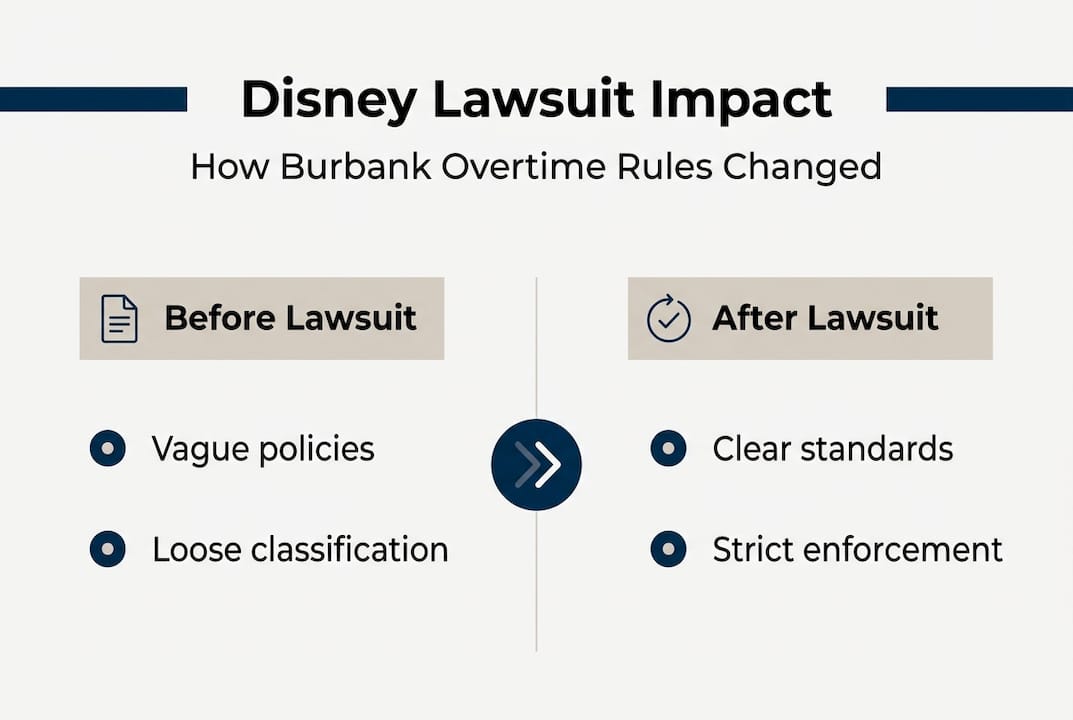
Before the lawsuit settlements, Disney’s overtime policies contained ambiguities that left some employees underpaid. Salaried workers often assumed they weren’t eligible for overtime, even when their duties didn’t meet exemption tests. Hourly employees sometimes worked through breaks or performed tasks outside their scheduled shifts without proper compensation. The lawsuit settlement required Disney to implement stronger compliance systems and influenced other California employers to review their own overtime practices to avoid similar litigation.

The lawsuit outcomes forced Disney to revise internal policies and implement stronger tracking systems.
Common Issues the Lawsuit Exposed
The Grace lawsuit highlighted overtime compliance failures common among large California employers:
- Overbroad exemption classifications: Many salaried employees were classified as exempt despite spending most of their time on non-exempt duties
- Inconsistent time tracking: Off-the-clock work and extended shifts weren’t consistently recorded
- Daily overtime miscalculation: Some employees received weekly overtime only, missing California’s daily overtime requirement
- Break violations: Meal and rest breaks were missed without proper premium pay
These issues aren’t unique to Disney. They reflect challenges many large California employers face in complying with the state’s strict wage and hour laws.
These changes reflect California’s demanding wage and hour standards. The state requires employers to pay overtime based on daily hours worked, not just weekly totals. If you work 10 hours on Monday, you earn two hours of overtime that day, regardless of your total weekly hours. This differs from federal law, which only mandates overtime after 40 hours per week.
California courts have long enforced the state’s daily overtime requirement as distinct from federal law. In Mendiola v. CPS Security Solutions, Inc. (2015) 60 Cal.4th 833, 841, the California Supreme Court emphasized that California’s overtime law ‘is more generous to employees than its federal counterpart’ and ‘requires daily as well as weekly overtime.’ This means California employees earn overtime ‘for work in excess of eight hours per day as well as for work in excess of 40 hours per week.’
Several common misunderstandings were clarified by the lawsuit results:
- Having a salary doesn’t automatically exempt you from overtime if your job duties are primarily non-exempt
- Employers must include certain bonuses and shift differentials when calculating your regular rate for overtime purposes
- Working through lunch or arriving early counts as compensable time if the employer knew or should have known about it
- Creative titles like coordinator or specialist don’t determine exemption status, actual job duties do
Pro Tip: Review your job description and compare it to California’s exemption tests for executive, administrative, and professional employees. If your primary duties don’t involve management, discretion, or specialized knowledge, you likely qualify for overtime even with a fancy title.
The regulatory changes also emphasized that employers can’t simply rename positions to avoid overtime obligations. A production assistant who primarily performs clerical tasks can’t be classified as exempt just because the company calls them a coordinator. Real job duties determine classification, not titles or labels.
California courts strictly construe overtime exemptions. As the court explained in Ramirez v. Yosemite Water Co. (1999) 20 Cal.4th 785, 794-795, ‘exemptions from the overtime law are to be narrowly construed’ and ‘an employer bears the burden of proving’ an employee qualifies for exemption. Job titles and salary alone cannot establish exempt status—actual duties must meet exemption criteria more than 50% of the time.
Practical implications for Disney employees and similar corporations in California
If you work for Disney in Burbank or a similar corporation, these overtime rule changes directly affect your paycheck. Here’s how to verify you’re being paid correctly and what to do if something looks wrong.
First, check your pay stubs carefully. Look for these elements:
- Separate line items for regular hours, overtime hours, and double time hours
- Correct overtime rate showing 1.5 times your regular rate
- Proper calculation of your regular rate if you receive bonuses or shift differentials
- Premium pay for missed meal or rest breaks
- Accurate reflection of all hours you actually worked, including any pre-shift or post-shift time
If you notice discrepancies, document everything. Keep detailed records of your actual work hours, including:
- Clock-in and clock-out times for every shift
- Any work performed before or after your scheduled shift
- Emails or messages sent outside regular hours that required substantive work
- Missed meal breaks or rest periods
- Any instructions from supervisors to work off the clock
Pro Tip: Take photos of your time records and pay stubs regularly. If you need to file a claim later, contemporaneous documentation is far more credible than trying to reconstruct hours from memory months after the fact.
Employees have options to address potential wage violations, including consulting specialized employment lawyers and understanding your rights under California law. Don’t assume small discrepancies don’t matter. Unpaid overtime adds up quickly, and California allows you to recover up to three years of back wages in some cases.
Steps to take if you suspect overtime violations:
- Gather all available documentation of hours worked and wages paid
- Compare your actual duties to California’s overtime exemption criteria
- Consult with a California employment attorney
- Consider whether coworkers face similar issues, which might support a class action
- Understand the employment lawsuit process in California to know what to expect
California law protects you from retaliation if you raise wage concerns or participate in an investigation. Your employer can’t fire, demote, or otherwise punish you for asserting your right to proper overtime pay. If retaliation occurs, that creates a separate legal claim with additional damages available.
Staying informed matters too. Labor laws evolve, and corporations sometimes test the boundaries of compliance. Reading resources about pay gaps at Disney and Warner Bros in Burbank helps you understand broader patterns and recognize when your situation fits a larger problem. Knowledge empowers you to spot violations early and take action before you lose significant compensation.
Comparing overtime protections at Disney with other California employers
Disney’s wage lawsuit wasn’t an isolated incident. Many large California employers face similar challenges complying with the state’s complex overtime rules. Understanding how Disney’s case compares to other corporations helps you recognize whether your employer’s practices align with industry standards or fall short.
Disney’s case highlights broader trends in wage and hour disputes faced by large employers in California, influencing statewide labor practices. Entertainment companies, tech firms, and other corporations with large California workforces all grapple with proper classification and overtime calculation. The Disney lawsuit set precedents that influenced how other companies review their policies.
Here’s how overtime practices compare across industries:
| Industry | Common overtime issues | Typical resolution approach |
|---|---|---|
| Entertainment | Misclassification of creative staff, off-the-clock work during productions | Policy revisions, reclassification audits, settlement agreements |
| Technology | Exempt classification of engineers and product staff, unpaid on-call time | Stricter duty tests, compensation for standby time |
| Retail | Managers performing non-exempt tasks, unpaid opening/closing duties | Clearer role definitions, time-tracking improvements |
| Healthcare | Nurses and staff working through breaks, automatic meal break deductions | Break attestation systems, premium pay enforcement |
Several patterns emerge across these industries:
- Employers often over-rely on exemptions and underestimate the strictness of California’s duty tests
- Large organizations struggle with consistent policy implementation across multiple locations and departments
- Technology-driven time tracking helps but doesn’t eliminate the need for manager training and employee awareness
- Class action lawsuits drive more comprehensive reforms than individual complaints
The Grace settlement, as one of California’s largest wage and hour class actions, prompted many entertainment companies and other large employers to audit their own classification practices and overtime policies to reduce litigation risk. Some proactively reclassified employees to avoid similar lawsuits. Tech companies in California took note too, recognizing that creative or specialized work doesn’t automatically qualify for exemption.
Comparing Disney’s overtime rules to similar employers reveals important insights. Warner Bros., Universal, and other studios face identical California law requirements. When one company changes practices due to litigation, others often follow to reduce their own legal risk. This creates a ripple effect that improves protections for workers across entire industries.
If you work for a large California employer, check whether your company has faced at-will employment wage violations or similar claims. Public lawsuits and settlements provide clues about common problems in your industry. Understanding these patterns helps you identify whether your own pay practices raise red flags.
About California United Law Group, P.C.
The following section contains information about our law firm’s services. This is attorney advertising.
California United Law Group, P.C. represents employees in wage and hour disputes, including overtime violations, misclassification, and unpaid wages. Our attorneys understand California Labor Code requirements and how large corporations structure compensation systems.
If you believe you may have experienced overtime violations, we can:
- Evaluate whether your job duties meet California’s exemption tests
- Calculate potential unpaid overtime and penalties
- Explain your legal options under California law
- Represent you in negotiations or litigation if appropriate
We handle wage and hour cases on a contingency fee basis, meaning you pay no attorney fees unless we recover compensation for you.
Contact us for a consultation.
Consultation does not create an attorney-client relationship. We will evaluate your situation and advise whether we can assist.
Did the Walt Disney Company wage lawsuit change overtime rules for Burbank employees?
Did the Grace v. Disney lawsuit change California’s overtime laws?
No. California’s overtime statutes (Labor Code § 510 and applicable Wage Orders) remained unchanged. The lawsuit enforced existing California law and required Disney to correct violations of those existing requirements. However, the case’s prominence and large settlement ($233 million) prompted many California employers to review their own practices, creating industry-wide compliance improvements.
How do I know if I’m correctly classified for overtime purposes?
Examine your actual job duties, not your title. California requires that exempt employees spend more than 50% of their time on exempt tasks like management or specialized professional work. If you primarily perform routine tasks, you likely qualify for overtime regardless of your salary or title. Review the specific exemption tests or consult an attorney for a detailed analysis.
When should I seek legal advice about unpaid overtime?
Consult an attorney if you notice consistent discrepancies between hours worked and hours paid, if your employer pressures you to work off the clock, or if you were reclassified in ways that reduced your pay. Don’t wait until you leave the company. Understanding the employment lawsuit process in California early helps you preserve evidence and meet deadlines.
Does the Disney lawsuit affect all employees or just certain groups?
The lawsuit primarily impacted non-exempt employees who were misclassified or whose overtime wasn’t properly calculated. If you’re correctly classified as exempt under California’s strict tests and your duties genuinely meet exemption criteria, the lawsuit likely didn’t change your situation. However, many employees previously assumed exempt were reclassified as non-exempt, making them newly eligible for overtime.
What did the settlement require Disney to change?
While specific settlement terms are often confidential, the lawsuit resulted in Disney implementing stronger compliance systems for overtime tracking, employee classification review, and meal/rest break monitoring. These changes reflect existing California law requirements that Disney agreed to apply more rigorously. The settlement didn’t create new legal obligations—it enforced compliance with longstanding California wage and hour protections.
Recommended
- Pay gaps at Disney and Warner Bros. in Burbank: What California employees need to know in 2026 – California United Law Group
- Glendale Healthcare Overtime Pay Disputes Explained – California United Law Group
This article discusses the $233 million settlement in Grace v. Walt Disney Co. (Orange County Superior Court Case No. 30-2019-01116850), approved in September 2025. The information reflects California wage and hour law as of March 2026. Labor laws and court interpretations may change. Consult current legal resources and an attorney for the most up-to-date information.