
In many cases, yes. If you work in El Monte and your employer treats you unfairly because of your religion, you may have a claim under California’s Fair Employment and Housing Act (FEHA) and, at larger employers, under federal law as well. Protection covers more than a firm’s choice to fire or not hire you. It reaches harassment, retaliation and a refusal to make a reasonable adjustment for your religious practice. California United Law Group’s employment attorneys represent El Monte employees in these claims and offer a free consultation to review your situation.
TL;DR
- FEHA bars religious discrimination by private employers with 5 or more employees and by public employers. Harassment rules apply to every employer.
- “Religion” includes traditional faiths and sincerely held beliefs that play a similar role in your life, plus dress, grooming and holy-day practices.
- Your employer must reasonably accommodate your religious practice unless it can show an undue hardship, and it cannot punish you for asking.
- Write down what happened and keep your requests and the replies. California complaints generally must be received within 3 years of the harm. If you get a Right to Sue letter, you generally have 1 year from that notice to file a FEHA lawsuit.
- A free consultation with an employment attorney can help you understand whether your facts may support a claim.
Table of Contents
- What counts as religious discrimination at work
- Which beliefs and practices are protected
- Which employers must follow the law
- Religious accommodations: what you can ask for
- Retaliation is its own violation
- Evidence that supports a claim
- Deadlines and where to file
- Promo: talk to an El Monte employment attorney
- Our perspective
- Related reading
- FAQ
- Sources
What counts as religious discrimination at work
The California Civil Rights Department (CRD) explains that discrimination means treating a person unfairly because of their religious creed. Harassment means unwelcome words or actions aimed at you because of your creed that are severe or pervasive. California law also states that a single incident of harassing conduct can be enough to create a triable issue of a hostile work environment, and courts look at all the circumstances, including how often the conduct happened, how severe it was, and whether it was threatening or humiliating (Miller v. Department of Corrections (2005) 36 Cal.4th 446, 462). Employers may not use religion in decisions about promotions, raises, benefits or firing.
Examples the CRD gives:
- Passing over a qualified employee for promotion based on stereotypes about their faith, such as assumptions about Latter-day Saints and large families.
- Mocking an employee who prays silently in the breakroom.
- Changing a Jehovah’s Witness employee’s shift after a complaint about music at work.
- Refusing to consider a shift change so an employee can attend a Native American spiritual ceremony.
Federal examples are similar. The U.S. Department of Justice describes a Jewish physical therapist denied a Shabbat schedule adjustment while enduring antisemitic jokes, and a transit system that barred Sikh drivers from wearing turbans while allowing baseball caps.
Which beliefs and practices are protected
You do not need to belong to a large or recognized religion. The CRD states that religion includes traditionally recognized religions plus beliefs, observances or practices you sincerely hold that parallel them. That covers dress, grooming and holy days. California also protects you for perceived beliefs, meaning those your employer only assumes you hold.
The EEOC, the federal agency that enforces Title VII of the Civil Rights Act, takes the same broad view. Its guidance says religion includes beliefs that are new, uncommon or not part of a formal church, and protects people who profess no religion. Religious observance can include praying, wearing religious garb or symbols, following dietary rules, attending services or refraining from certain activities. Your own sincere motivation is what makes a practice religious. An atheist can also be protected: a non-religious employer cannot force employees to wear religious garb over their objection.
Which employers must follow the law
| Law | Who is covered | Who is protected |
|---|---|---|
| FEHA (California) | Private employers with 5+ employees and public employers for discrimination; all employers for harassment | Applicants, employees, interns, volunteers |
| Title VII (federal) | Employers with 15+ employees, employment agencies, unions | Applicants and employees |
Sources: California CRD and EEOC.
Because FEHA reaches smaller businesses, many El Monte workplaces, from restaurants and shops to small manufacturers and offices, fall under it even when federal law does not.
Religious accommodations: what you can ask for
A claim often starts with a request. Under California regulation, employers must accommodate a known religious creed unless they show it is unreasonable because of undue hardship. Accommodations can include:
- Time off for a holy day, or a schedule change
- Religious clothing or grooming, such as a long skirt instead of pants
- Interview times that work around prayer
- Job restructuring, reassignment or modified work practices
- Being excused from opening prayers if you are an atheist
The same regulation says an accommodation that segregates you from customers or the public is not reasonable unless you ask for it. Your employer must also keep talking with you. The CRD says that even when an employer shows hardship, it must keep exploring alternatives and cannot ignore or stall your request hoping you will quit. California courts put the burden on the employer. In Soldinger v. Northwest Airlines, Inc. (1996) 51 Cal.App.4th 345, the court explained that once an employee shows a conflict between religious practice and a job requirement and the employer does not start an accommodation, the employer must prove undue hardship. The Ninth Circuit, whose rulings federal courts in California follow, has likewise held that an employer is excused only if it shows no accommodation was possible without undue hardship (Opuku-Boateng v. State of California (9th Cir. 1996) 95 F.3d 1461).
When an employer can say no
The standard is undue hardship, and it is stricter on employers than it used to be. In 2023, the U.S. Supreme Court in Groff v. DeJoy (2023) 600 U.S. 447 rejected reading Title VII’s undue hardship standard as anything “more than de minimis.” An employer must now show substantial increased costs in relation to its particular business. California’s FEHA already used the “significant difficulty or expense” standard from disability law. Business size, cost and available alternatives all matter. Under Groff, a mild inconvenience is generally not enough, and coworker hostility toward a religion or toward accommodating it does not by itself count as undue hardship. Whether the standard is met depends on the facts.
Can my employer deny a day off or limit what I say?
An employer can refuse a religious day off only if it can show undue hardship after a real effort to find options. Religious expression is also part of protected observance. But harassment of coworkers or customers is judged under the same “severe or pervasive” rules as other conduct, so the facts matter. Bring your specific situation to an attorney rather than guessing.
Retaliation is its own violation
It is unlawful to retaliate against you for requesting an accommodation, whether or not the request was granted, under the same California regulation. Retaliation can look like reduced hours, a poor review, a demotion or a sudden discipline record after you spoke up. You can complain about religious harassment or ask for a change and still be protected if the employer later says no.
Evidence that supports a claim
Strong claims are built on records made at the time. The EEOC advises employees to keep notes of what they experienced or witnessed, and to record the names and contact details of witnesses. Build your file like this:
- Date every incident. Note who said or did what, where, and who was there.
- Put requests in writing. An email asking for a schedule change or dress exception shows the employer was on notice.
- Save the replies. Denials, silence and delays all matter.
- Save policies. Dress codes, scheduling rules and handbooks show how rules were applied to you compared with others.
- Report it internally. Tell HR or a manager in writing about harassment or unfair treatment.
- Compare treatment. Note coworkers who got exceptions you were refused.
Deadlines and where to file
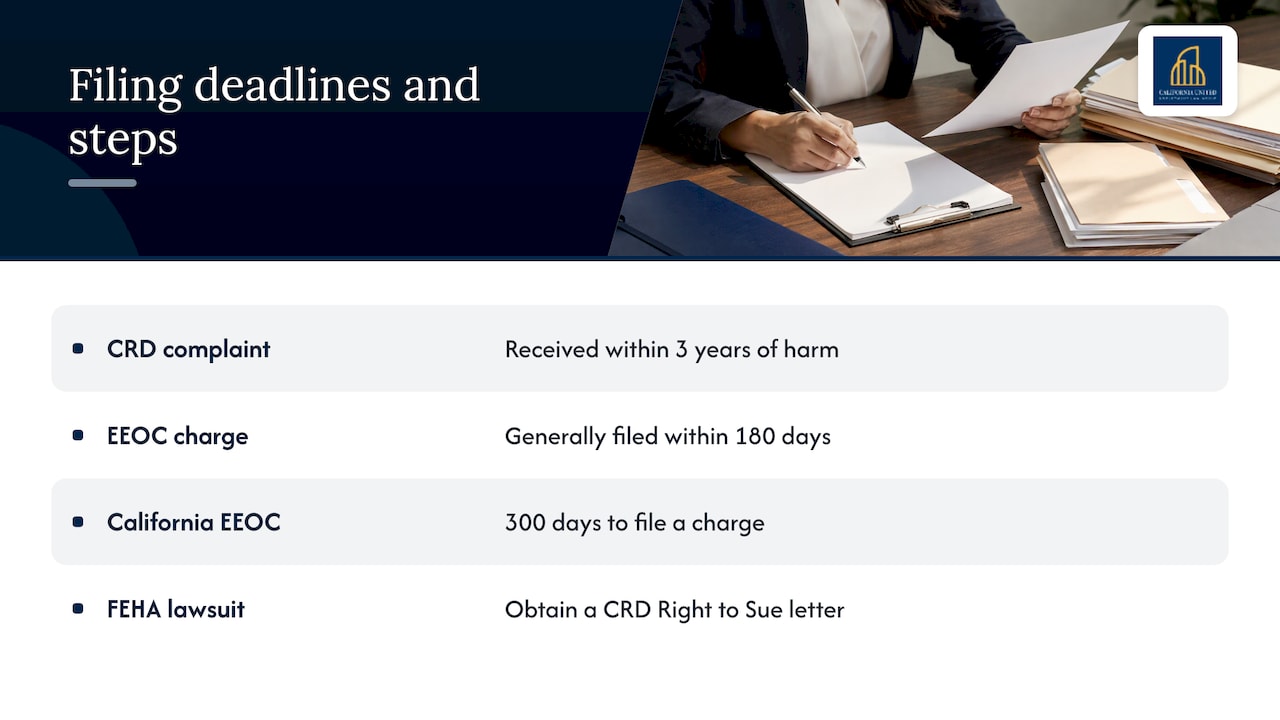
In California, complaints go to the CRD and generally must be filed within 3 years of when the harm occurred. To sue under FEHA, you first obtain a Right to Sue letter from the CRD. You then generally have 1 year from the date of that notice to file your lawsuit in court. Exceptions and tolling rules can change these deadlines, so confirm your dates with an attorney.
Federal charges move faster. The EEOC says a charge generally must be filed within 180 days, or 300 days where a state agency enforces a similar law. California qualifies for the longer period. Charges can be started through the EEOC Public Portal, and filing with a state agency is automatically dual-filed with the EEOC when federal laws apply.
Deadlines can be missed in the time spent hoping a problem will fix itself. If you have been fired, disciplined or pushed out, do not wait.
Promo: talk to an El Monte employment attorney
California United Law Group practices employment law for employees across California and handles discrimination, harassment, retaliation, wrongful termination and failure-to-accommodate claims. We handle cases on a contingency fee basis, which means attorney fees are paid only from a settlement or award. Whether you are responsible for costs, and how costs are handled, is explained in our written fee agreement. Each case is different, and no particular result can be guaranteed. 👉 Request a free consultation or see our employment law services. If you are in El Monte, our page on an employment lawyer in El Monte explains how we help local workers.
Our perspective
Many employees who contact us after a religious accommodation was refused did the right thing early: they asked politely and in writing. Then the schedule quietly changed, the reviews got worse, or a manager began treating them as a problem.
That pattern matters. Religious discrimination claims are often not about one dramatic remark. They are built from a request, a response and what happened next, and a lawyer who knows FEHA can line those events up into a clear timeline.
Our firm practices only employment law for employees, and our attorneys include lawyers with prior employer-side experience. We know how companies defend these claims, and we prepare for those defenses from the first day. We handle matters from pre-litigation through litigation, and we take cases on contingency.
If you are unsure whether what you experienced is legally actionable, that is exactly what the free consultation is for.
This article provides general information only and is not legal advice. Reading it or contacting our firm does not create an attorney-client relationship. Past results do not guarantee a similar outcome in any future case.
California United Law Group
Related reading
Neighboring communities face the same law. See how it applies in Monterey Park, Alhambra and Glendale. Workers in El Monte facing other problems may also want to read about pregnancy discrimination or meal period violations.
FAQ
What qualifies as religious discrimination in the workplace?
It is unfair treatment because of your religious creed, including firing, demotion, denial of a promotion, harassment, or refusing a reasonable accommodation. It also covers retaliation for asking. Beliefs you sincerely hold can qualify even if they are not part of a formal religion.
What evidence do I need for a religious discrimination claim?
Dated notes, written accommodation requests, employer replies, witness names, relevant policies and any messages showing comments or changes in treatment. You do not need all of it to talk to an attorney. A consultation can help identify what is missing.
Can my employer deny me a day off for religious reasons?
Only if it can show that the accommodation creates an undue hardship, and it must keep exploring alternatives. Under federal law that now means substantial increased costs to the business. A simple refusal without discussing options may be unlawful. Courts have found, for example, that offering an employee less desirable Sabbath shifts did not reasonably accommodate the employee’s religious belief that they must not work on the Sabbath (Baker v. Home Depot (2d Cir. 2006) 445 F.3d 541).
Can my employer stop me from stating my religious beliefs at work?
Religious expression is part of protected observance, and employers must accommodate it unless there is an undue hardship. Employers are generally not required to allow expression that demeans or harasses coworkers. For example, the Ninth Circuit held an employer did not have to let an employee post anti-gay messages at work (Peterson v. Hewlett-Packard Co. (9th Cir. 2004) 358 F.3d 599). The answer turns on your facts, so speak with an employment attorney.
Sources
- Religious Discrimination and Accommodations at Work, California Civil Rights Department
- Civil Rights Department announcement, May 20, 2026
- Combating Religious Discrimination, U.S. Department of Justice
- EEOC Questions and Answers: Religious Discrimination in the Workplace
- EEOC Religious Garb and Grooming in the Workplace
- Cal. Code Regs. Tit. 2, § 11062
- Cal-Peculiarities 2025 Edition
- U.S. Department of Labor, Workforce Discrimination Resources by State
- EEOC, Employment Discrimination based on Religion, Ethnicity, or Country of Origin
- EEOC, Filing a Charge of Discrimination