
Yes, in many cases they can. California requires employers to pay a split shift premium to qualifying employees, and a Glendale worker whose employer left it off the paycheck may be able to pursue the unpaid amount. Whether you are owed anything depends on your pay rate, your schedule and the facts of your workplace. This guide explains the rule, works through the math with real numbers, and covers documentation, claims and retaliation protections. It is general education, not legal advice.
TL;DR
- A split shift is a workday interrupted by an unpaid, non-working break set by your employer that is longer than a meal period. The premium is one hour of pay at the minimum wage.
- The premium is mostly a concern for workers paid at or near minimum wage. This rule comes from most of California’s industry Wage Orders, so check which order covers your job. Higher earners may already be paid enough that nothing extra is owed.
- Premiums should appear as a separate line on your pay stub. A missing line is worth a closer look.
- California law protects you from retaliation for complaining about unpaid wages.
- Every situation is fact-specific, and outcomes vary. A conversation with an employment attorney can clarify where you stand.
Table of Contents
- What counts as a split shift in California
- When the premium is owed, and the exceptions
- How much the premium is
- What the premium is not
- Documenting a possible split shift claim
- Where split shift claims are pursued
- Protection from retaliation
- Our perspective
- Talking with a Glendale wage and hour attorney
- FAQ
- Sources
What counts as a split shift in California
The California Department of Industrial Relations (DIR) describes a split shift as a work schedule interrupted by non-paid, non-working periods that the employer establishes. The interruption has to be longer than a bona fide meal period, and it has to fall within the same workday. A meal or rest break does not count. add: California courts have also held that employees working an uninterrupted shift that spans two workdays do not work a split shift. (Securitas Security Services USA, Inc. v. Superior Court (2011) 197 Cal.App.4th 115.)
In practice, a Glendale employee might see this in several settings:
- A restaurant server who works the lunch rush, goes home for a few hours, and returns for dinner.
- A retail or hospitality employee scheduled for a morning block and an evening block.
- A home health aide or behavioral therapist with appointments separated by long gaps.
- A school or after-school program worker covering morning drop-off and afternoon pickup.
A 2002 opinion letter from the Labor Commissioner’s office treated a non-working interruption longer than one hour as a split-shift situation. The key test is who controls the gap and whether you are free of work during it. A gap you asked for, for your own convenience, is treated differently, as explained below.
When the premium is owed, and the exceptions
The DIR explains that minimum-wage workers are entitled to additional pay when their schedule includes a split shift. That is the baseline rule under most California Wage Orders. Two exceptions come up most often:
- You live where you work. Employees who reside on the employer’s premises are not covered by the premium.
- You requested the break. If the split schedule was set up at your own request for your own convenience, the premium is generally not owed.
Employers sometimes argue that an unpaid gap was really a long meal break. The DIR’s description focuses on whether the break was a meal or rest period and whether it benefits the employer. A four-hour gap between a lunch shift and a dinner shift is hard to describe as a meal period.
The California Employers Association notes that split shifts can reduce labor costs, and it advises employers to understand California’s split-shift pay requirements before building schedules. Scheduling that is cheap on paper can become costly when the premium is skipped.
How much the premium is
The premium equals one hour of pay at the higher of the state or local minimum wage. The statewide minimum wage was $16.90 per hour as of January 1, 2026, and some cities and counties set higher rates. Glendale has a city ordinance with a separate wage floor for certain hotel workers at larger hotels. If you work in that industry, ask which rate applies to you.
The calculation when you earn more than minimum wage
You do not automatically receive a flat extra hour at your regular rate. The DIR explains that pay above minimum wage for the day is credited against the premium. In effect, you compare two numbers:
- What you were paid for the day.
- Your hours worked multiplied by minimum wage, plus one extra hour at minimum wage.
If your pay falls short of the second number, the difference is the premium. In Aleman v. AirTouch Cellular (2012) 209 Cal.App.4th 556, the California Court of Appeal confirmed that employees paid more than minimum wage are only entitled to the difference between what they actually earned and what they would have earned at minimum wage for the entire shift plus an extra hour.
Three worked examples
These use the statewide rate of $16.90 and an 8-hour day (4 hours in the morning, 4 in the evening, with an unpaid gap between them). They are illustrations, not predictions about your case.
| Hourly rate | Pay for 8 hours | Threshold (9 × $16.90 = $152.10) | Premium owed |
|---|---|---|---|
| $16.90 | $135.20 | Below threshold | $16.90 |
| $18.00 | $144.00 | Below threshold | $8.10 |
| $20.00 | $160.00 | Above threshold | $0 |
A missing $8.10 or $16.90 looks small. Over a year of regular split shifts, though, it adds up. A worker with three split shifts a week at the first rate could be missing more than $2,600 over a year. That figure is arithmetic on assumed facts, not a promise of recovery.
Higher earners are less likely to be owed anything. Employment lawyers writing for employers have observed that the issue mainly affects workers paid near the minimum. Even so, a worker with a long gap, extra unpaid time or a reduced shift rate may still have a question worth asking.
What the premium is not
People often confuse split shift pay with other scheduling and wage rules. They are different claims with different elements:
- Rest and meal break premiums. These apply when required breaks are missed or cut short. Our article on missed rest breaks and extra pay covers that rule.
- Reporting time pay. This applies when you report to work and are sent home early.
- Clopening. Closing late and opening early the next day is a back-to-back scheduling pattern, not a split shift. The two can overlap in one schedule but are separate questions. A single, continuous overnight shift is also not a split shift.
- Off-the-clock work. Unpaid pre-shift or post-shift tasks are a separate wage issue. See our overview of unpaid work before and after shifts.
It is common for a workplace with one pay problem to have another. A scheduling practice that skips split shift premiums may also affect breaks or recordkeeping.
Documenting a possible split shift claim
Employers are legally responsible for keeping accurate time and payroll records. The DIR also says the premium must appear as its own line item on your pay stub. That makes your wage statements a useful starting point.
Records many employees find useful to gather:
- Pay stubs showing hours and rates, and whether a split shift premium line ever appears.
- Work schedules, whether posted, texted or in a scheduling app.
- Your own notes of clock-in and clock-out times, including the length of the gaps.
- Messages with managers about the schedule.
- Any document showing your job classification and pay rate.
If you want to know how incomplete stubs can create their own claims, see our piece on itemized pay stub rights.
The Labor Commissioner has also shown that business structure does not shield an employer. In 2021 it cited restaurant companies that shared employees among locations and did not pay split shift premiums, finding the entities jointly liable. If you work across several locations or companies under common management, that may matter to your claim.
Where split shift claims are pursued
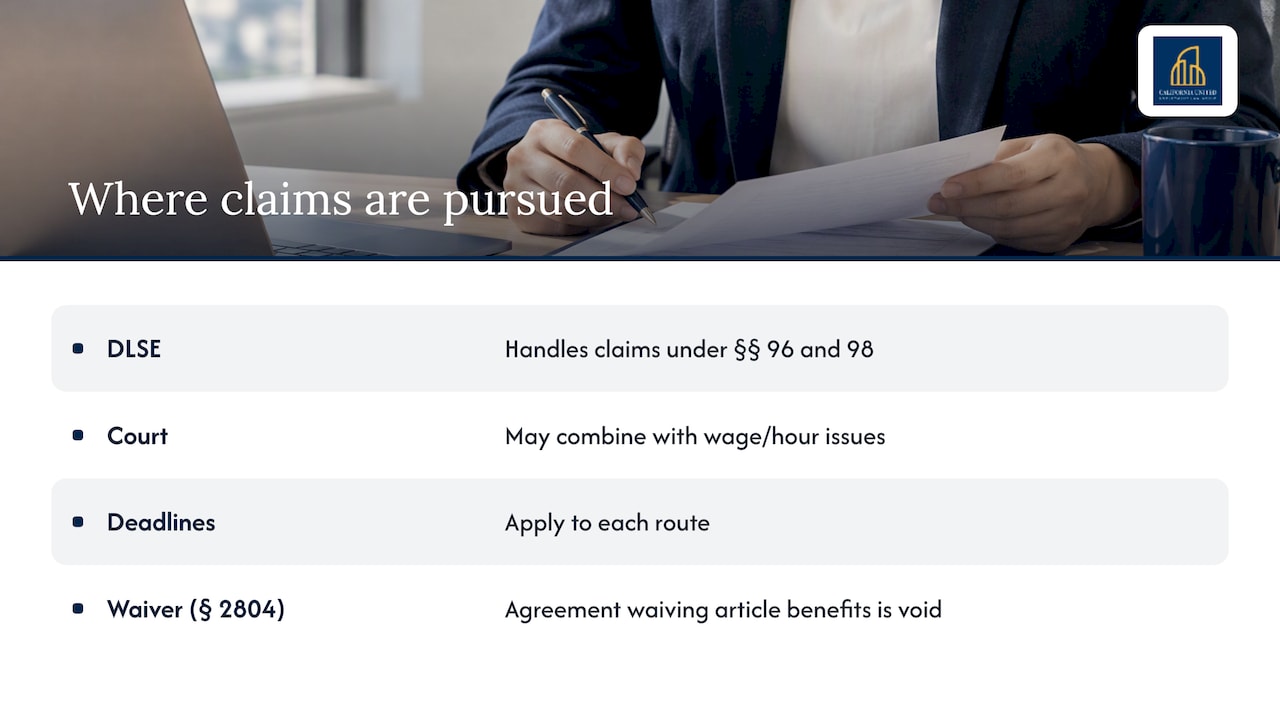
Unpaid wage claims can be filed with the Division of Labor Standards Enforcement (DLSE), which handles them under Labor Code sections 96 and 98. Some employees also pursue wage claims in court, sometimes together with other wage and hour issues. Which route fits depends on your facts, and deadlines apply to each. Waiting can reduce what can be recovered, so ask about timing early.
One point worth knowing: California Labor Code section 219 generally provides that the state’s wage protections cannot be set aside by a private agreement, whether written, oral, or implied. However, one California appellate decision, Leighton v. Old Heidelberg, Ltd. (1990) 219 Cal.App.3d 1062, held that an employee may waive split-shift premium pay, even when the employer requires the waiver as a condition of employment. Whether any agreement you signed affects your claim, for example a waiver or an arbitration clause, is a question for an attorney who can read the document.
For a plain-language walk-through of what litigation involves, see our employment lawsuit process overview. For a broader look at your protections, read common Labor Code rights. Workers in other industries face similar issues, as shown in our article on split shift premiums for restaurant and service workers and our look at whether workers can sue for unpaid split shift premiums.
Protection from retaliation
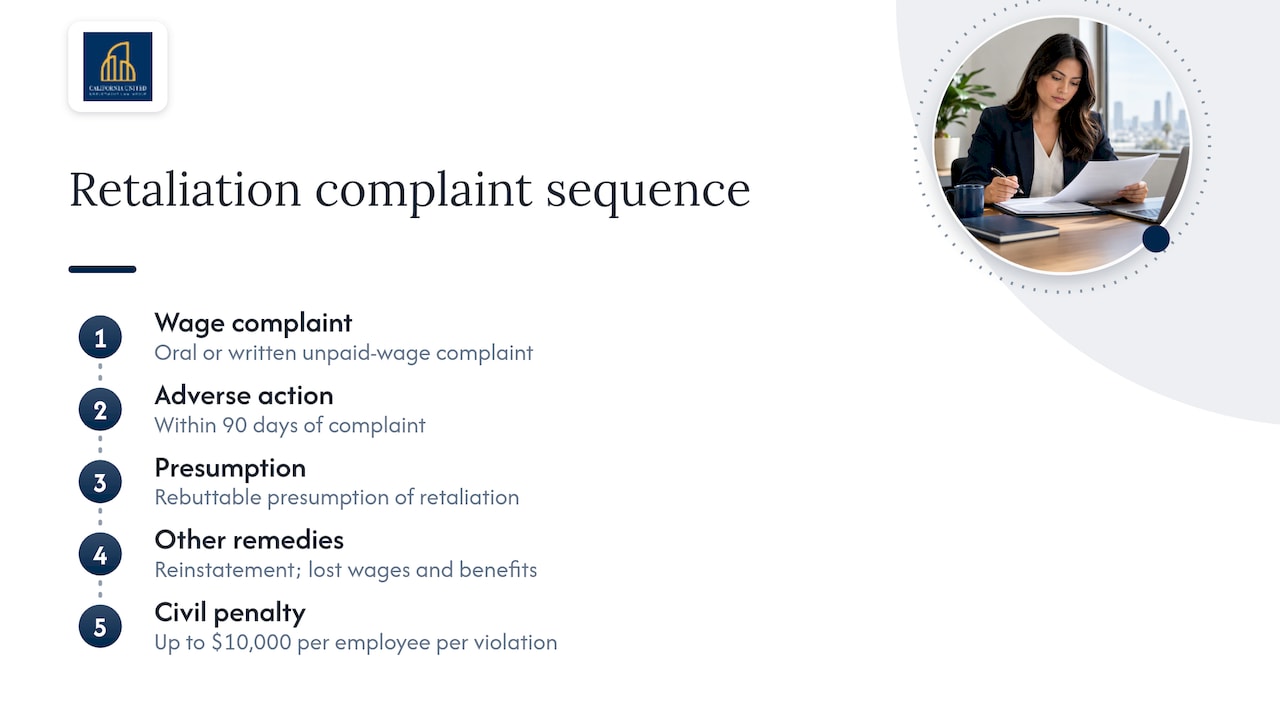
Many employees hesitate to raise pay questions because they fear losing hours or their job. California law speaks to this directly. Labor Code section 98.6 prohibits discharge, discrimination, retaliation or other adverse action because an employee made an oral or written complaint about unpaid wages or exercised Labor Code rights. This presumption was added by amendment effective January 1, 2024.
The DIR’s summary of the law says that an adverse action within 90 days creates a rebuttable presumption of retaliation. Remedies can include reinstatement and reimbursement of lost wages and benefits, and the statute authorizes a civil penalty of up to $10,000 per employee for each violation. Whether those remedies apply depends on the facts.
Federal law adds another layer. The U.S. Department of Labor explains that retaliation includes firing or any other action that would discourage a reasonable employee from raising a concern. The National Labor Relations Board says covered employees may discuss wages with coworkers without being punished or threatened for it. Comparing notes with coworkers about whether anyone receives the premium is a reasonable way to see whether a pattern exists.
For more on this protection, read our article on wage complaint rights and retaliation protections. If you have been fired or had your hours cut after raising a pay issue, our guide to termination rights in California may help you understand the legal context.
Our perspective
Split shift premiums are among the quieter wage problems we see. Employees rarely notice them missing, because the amount on any one paycheck is small and the rule is not widely known. Employers sometimes miss it too, particularly when scheduling software builds in gaps without anyone checking the pay effect.
We focus exclusively on employment law for employees in California, and several of our attorneys have prior employer-side experience. That helps us understand how a payroll department reads a schedule and where errors tend to arise. Our wage and hour work often starts with a simple question: do the pay stubs match the hours actually worked?
We also know that a split shift claim is rarely the only issue. Missed breaks, unpaid overtime and inaccurate wage statements often travel together, and a single claim may be small while the combined picture is more significant. Individual results always depend on the facts, and no one can promise an outcome.
— California United Law Group
Talking with a Glendale wage and hour attorney
If your schedule has long unpaid gaps and you have never seen a split shift line on your pay stub, a consultation can help you sort out whether the rule applies. We represent employees on a contingency fee basis, which generally means attorney fees are paid only if there is a recovery through settlement or award. Responsibility for costs is explained in our written fee agreement.
👉 Learn about our wage and hour representation, or contact us to discuss your situation.
FAQ
Do Glendale employees get a split shift premium if they earn more than minimum wage?
Sometimes, but less often. The premium is measured against minimum wage, and pay above minimum for the day is credited toward it. If your total daily pay is already above your hours times minimum wage plus one extra hour at minimum wage, nothing more is owed. The California Court of Appeal applied this calculation in Aleman v. AirTouch Cellular (2012).
Can I lose the premium if I asked for the split schedule?
Potentially. The DIR notes that the premium is not owed when the employee requested the break for their own convenience. Employers sometimes claim this after the fact, so the details matter: who proposed the schedule, and whether the gap was really your choice. A signed waiver may also affect the premium, so have an attorney review any scheduling agreement you signed.
Is the premium the same as a meal break premium?
No. A split shift premium applies to an employer-set interruption in the workday that is longer than a meal period. Meal and rest break premiums apply when required breaks are missed or shortened. A single schedule can raise both questions.
Can my employer punish me for asking about it?
California Labor Code section 98.6 prohibits retaliation for complaining about unpaid wages or exercising Labor Code rights. An adverse action within 90 days of protected activity creates a rebuttable presumption of retaliation. If you think this has happened, speak with an employment attorney about your specific facts.
Sources
- Split Shift, California Department of Industrial Relations
- Labor Commissioner opinion letter on split shifts, 2002
- Minimum Wage Frequently Asked Questions, DIR
- Hotel Workers Protection Ordinance, City of Glendale
- Understanding the Pros and Cons of Split Shifts, California Employers Association
- Appellate Court Clarifies Employer Reporting Time Pay and Split Shift Obligations
- California Labor Commissioner Cites Restaurant Companies, 2021
- Division of Labor Standards Enforcement, wage claims
- California Labor Code section 2804
- California Labor Code section 98.6
- Laws that Prohibit Retaliation and Discrimination, DIR
- Retaliation, U.S. Department of Labor
- Your Right to Discuss Wages, National Labor Relations Board