
Yes, in some situations. A severance agreement is a contract, and a contract can be challenged if it was not entered into knowingly and voluntarily, if it gave you nothing beyond what you were already owed, if it was signed under fraud or pressure, or if it asks you to give up rights the law does not let you give up. Whether any of that applies to you depends on the exact wording of your agreement and the facts of your job and your exit. This article explains the general rules for employees who work in West Hollywood, from the nightlife and hospitality venues on Sunset Boulevard to the entertainment, media and design offices around the city.
This article is general education, not legal advice. Employment law is fact-specific and outcomes vary. Reading this article or contacting the firm does not create an attorney-client relationship. Deadlines may apply to employment claims, so employees should seek advice promptly.
TL;DR
- A severance agreement usually asks you to release legal claims in exchange for money or benefits. Once you sign, challenging it is harder, but not always impossible.
- Federal guidance generally requires a waiver of discrimination claims to be knowing and voluntary, supported by something of value beyond what you were already owed, and not written to waive future claims or block agency rights.
- If you are 40 or older, federal law adds minimum review and revocation periods. California also requires employers to give notice of your right to consult an attorney on certain separation agreements.
- California has no law requiring an employer to offer severance, so the terms are often open to negotiation.
- An employment attorney can review your specific agreement and tell you which of these rules, if any, apply.
Table of Contents
- What a severance agreement actually does
- When can a severance agreement be challenged?
- Extra protections if you are 40 or older
- California’s own rule on separation agreements
- Can you challenge it after you have signed?
- West Hollywood workplaces and why severance questions come up
- Clauses worth a closer look
- Can you negotiate, and can it backfire?
- Our perspective
- Talk to us about your severance agreement
- FAQ
- Sources
What a severance agreement actually does
A severance agreement, sometimes called a separation agreement or release, is an offer. The employer proposes to pay you something, such as a lump sum, continued pay, or benefits, and in return you agree to give up claims you might have against the company. Those claims can include wrongful termination, discrimination, harassment, retaliation and others. A severance agreement may also include confidentiality, non-disparagement, cooperation, return-of-property, tax, reference, and repayment provisions, each of which should be reviewed separately.
The California Division of Labor Standards Enforcement states that California law does not require employers to provide severance pay on termination. That matters in two ways. First, there is no legal formula for how much severance should be, so any figure is whatever the employer offers or you negotiate. Second, because the employer is not obligated to pay it, the employer can attach conditions to it. The release is the usual condition.
Some severance plans are governed by a federal law called ERISA, and the same state guidance notes that such plans fall under federal rules. If your employer has a written severance plan, that is worth mentioning to whoever reviews your documents.
What you are owed regardless of any agreement
Severance is different from the pay you have already earned. Under California Labor Code section 206.5, an employer generally may not require a release of a claim or right on account of wages due unless those wages have been paid. The Division of Labor Standards Enforcement likewise explains that an employer must pay undisputed final wages, including earned but unused vacation, without requiring you to sign a release.
In plain terms, an employer generally cannot hold your final paycheck hostage to get your signature. If an offer treats wages you already earned as if they were severance, that is one of the things a lawyer would look at closely. Earned wages, accrued vacation where applicable, commissions, bonuses, and other compensation may raise different timing and proof issues, so employees should separate what they are already owed from any new severance consideration.
When can a severance agreement be challenged?
The U.S. Equal Employment Opportunity Commission (EEOC) publishes guidance on waivers of discrimination claims. It says a waiver is generally enforceable only when the employee agrees knowingly and voluntarily, receives consideration beyond what was already owed, does not waive future rights, and the agreement complies with applicable law. Each of those is a possible point of challenge. California courts also evaluate employment claims under specific legal elements. For example, CACI recognizes FEHA retaliation claims where protected activity is a substantial motivating reason for an adverse employment action, and CACI recognizes wage claims such as nonpayment of overtime, meal break violations, and rest break violations. A severance review should therefore consider both the release language and the claims the employee may be giving up.
1. The agreement was not knowing and voluntary
For discrimination claims that are not about age, the EEOC explains that courts may look at several factors: how clearly the agreement is written, whether there was fraud, duress or undue influence, how much time you had to consider it, whether you had the chance to consult an attorney, whether you had input in negotiating the terms, and whether the payment exceeds what you were already entitled to. No single factor decides the question. Courts weigh the circumstances. In Oubre v. Entergy Operations, the U.S. Supreme Court held that a release that failed the federal age-waiver requirements could not bar an ADEA claim. In California employment cases, courts also look closely at whether the challenged employment action meets the governing claim elements, such as the CACI standards for retaliation, harassment, constructive discharge, overtime, and meal and rest break claims.
This is why a termination meeting matters. Employers often present agreements at the moment of termination and expect a fast answer. Pressure alone does not make an agreement invalid, but the timing, the explanations given and the time you were allowed can all become part of the picture.
2. You received nothing new
A release needs consideration, meaning something of value. If the “severance” is only pay or benefits you were already entitled to, such as earned wages or a payout your contract already promised, the exchange may be hollow. The EEOC advises employees to confirm that the payment is something to which they are not already entitled.
3. It waives rights you cannot waive
An employer may offer severance in exchange for a release, but the EEOC says a waiver cannot require you to give up future claims or stop you from filing an EEOC charge or taking part in an EEOC proceeding. The same guidance tells employees to check whether the agreement purports to release rights that cannot be waived, including:
- The right to file a charge, testify, assist or cooperate with the EEOC
- Claims that arise after you sign
- Unemployment or workers’ compensation benefits
- Certain rights under the federal Fair Labor Standards Act, depending on the claim and procedure used
- COBRA health-coverage rights
- Vested retirement-plan benefits
A clause that overreaches does not always sink the whole agreement, but it is a sign the document deserves a careful read.
4. Wage claims were released without payment
As noted above, Labor Code section 206.5 voids a release of wages due unless they have been paid. Employees who suspect unpaid overtime, missed meal or rest period premiums, unpaid commissions, unpaid bonuses, or unreimbursed business expenses should be especially careful about broad language releasing wage and hour claims. Our team handles wage and hour matters for California employees and sees this language often.
5. Fraud, misrepresentation or duress
If you signed because the employer misstated a material fact, such as claiming a position was eliminated when it was immediately refilled, or used improper pressure that deprived you of a meaningful choice, those facts can bear on whether your agreement was truly voluntary. These claims are fact-intensive and depend on evidence such as emails, notes and witnesses.
Extra protections if you are 40 or older
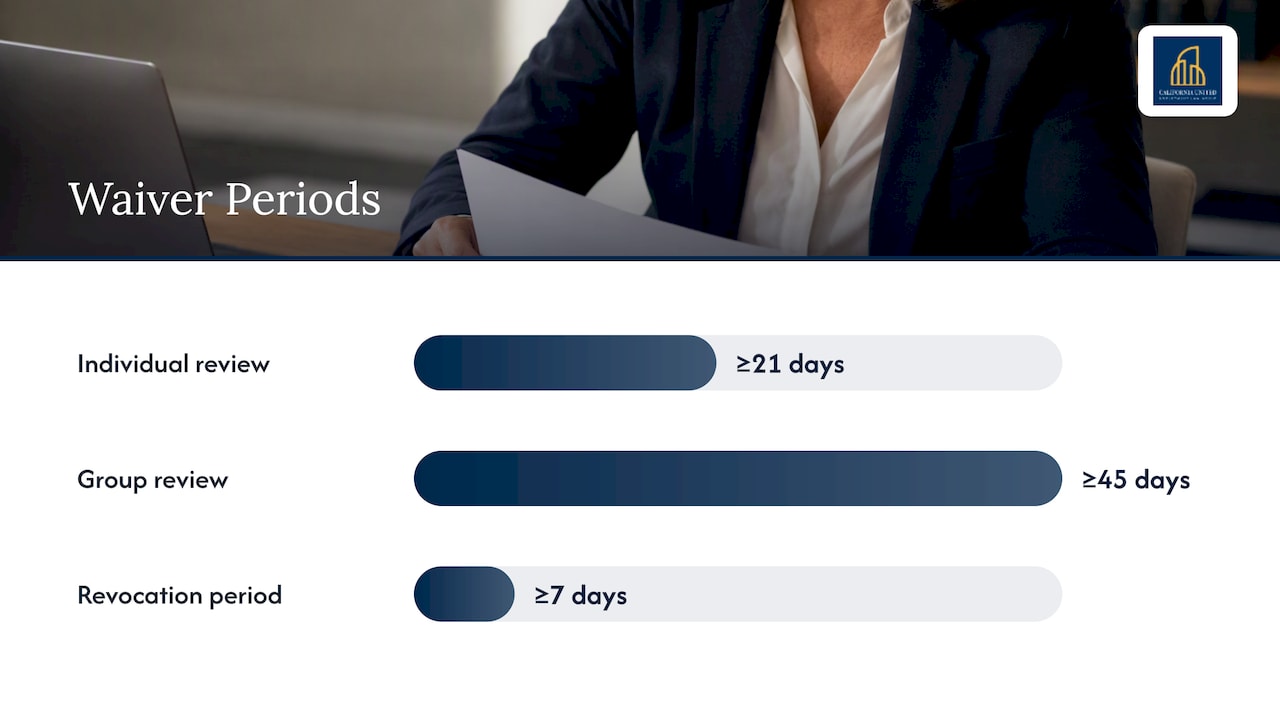
Federal law gives workers 40 and older additional protections when they waive age discrimination claims. These come from the Older Workers Benefit Protection Act (OWBPA), which amended the Age Discrimination in Employment Act (ADEA). The EEOC’s regulation says an individual employee age 40 or older generally must receive at least 21 days to consider the waiver, and at least 45 days if the waiver is part of a group termination or exit-incentive program.
The same regulation sets out these related rules:
- The agreement must give you at least seven days after signing to revoke it, and it cannot become effective until that period ends. That seven-day period cannot be shortened or waived.
- The consideration and revocation periods run one after the other if you use your full review time. You may choose to sign earlier, which starts the revocation period sooner.
- In a group program, the employer must provide written information about the covered group, eligibility factors, time limits, and the job titles and ages of those selected and of those not selected in the same job classification or unit.
The U.S. Supreme Court decided in Oubre v. Entergy Operations that a release failing these requirements cannot bar an age discrimination claim. In that case, the release did not give enough time to consider, did not offer seven days to revoke, and did not specifically refer to age claims. The Court also held that keeping the severance money did not, by itself, ratify the defective release. That rule is specific to the federal age-discrimination waiver requirements and should not be treated as a general rule for every severance dispute. In disputes over these requirements, the party relying on the waiver carries the burden of showing it was knowing and voluntary.
These rules apply to age claims. They do not mean every other claim in the same agreement is automatically revived, and the details turn on the document.
California’s own rule on separation agreements
California adds its own requirement. Under Government Code section 12964.5, an employer offering certain separation agreements must notify the employee of the right to consult an attorney and give a reasonable period of not less than five business days to do so. An employee may sign sooner, but only if the decision to shorten the time is knowing and voluntary and not induced by fraud, misrepresentation, or a threat to withdraw or change the offer.
The statute applies to particular separation agreements involving releases of specified employment-related claims, so whether it reaches yours depends on the wording, the claims being released, and the circumstances. If your offer came with a same-day deadline and no mention of your right to consult an attorney, that is worth raising with a lawyer.
For more background on how these questions play out in mass layoffs, see our discussion of severance agreements in layoff situations. For the broader picture of your rights at termination, our overview of California employee termination rights is a good companion.
Can you challenge it after you have signed?
Sometimes. A signed release is often treated as enforceable unless the employee can identify a legal basis to challenge it, but enforceability depends on the agreement, the claims released, and the facts surrounding signature. The EEOC notes that a court normally decides whether a waiver is valid before it decides the underlying discrimination claim. That means a dispute about the release often comes first, and it can be a significant fight.
Reasons that have been recognized in general terms include lack of knowing and voluntary consent, lack of consideration, fraud or duress, waiver of future rights, and noncompliance with a statute such as OWBPA. Whether one fits your situation depends on documents and timing. Time limits for bringing claims also continue to run, so waiting can create its own problems.
If you have already signed, avoid assuming the matter is closed in either direction. Do not assume it is unchallengeable, and do not assume you can simply keep the money and sue anyway. Under Oubre, keeping payment did not ratify a release that failed the age-waiver rules, but that holding is specific to that statute. Other claims may be treated differently, and some agreements require repayment or have other terms. Do not ignore administrative filing deadlines, statutes of limitation, or contractual notice provisions while evaluating the release.
West Hollywood workplaces and why severance questions come up
West Hollywood’s economy includes restaurants, bars, hotels, retail businesses, talent and production offices, design firms, and small creative companies. Those workplaces often have features that can complicate a separation:
- Small and fast-moving employers. Exits can happen quickly, with an agreement drafted from a template.
- Tipped, hourly and shift-based roles. Wage and hour issues such as unpaid overtime or missed breaks can sit alongside a severance offer.
- Close professional networks. Non-disparagement and confidentiality terms can feel especially weighty when your reputation in a small industry matters.
- Project-based or contract work. Whether you were an employee or labeled something else can change which protections apply.
None of these facts decides a case. They are reasons to read the offer carefully rather than assume it is standard.
Clauses worth a closer look
When an employee brings us an agreement, certain terms tend to prompt questions. Reading for them is not legal strategy, just a way to organize your own questions for an attorney.
| Clause | What it usually does | Why it may deserve review |
|---|---|---|
| General release | Gives up all claims against the employer | May sweep in claims you did not know you had, including wage claims |
| Non-disparagement | Limits what you can say about the employer | Scope and duration vary; some restrictions may conflict with the law |
| Confidentiality | Keeps terms or underlying facts private | May affect what you can discuss, but cannot lawfully block certain agency communications or protected rights. |
| Non-compete or non-solicitation | Restricts future work or contacts | California sharply limits many post-employment restraints on competition, but non-solicitation, confidentiality, trade secret, and customer-contact provisions require separate review. |
| Cooperation clause | Requires help with future company matters | May be open-ended |
| Repayment or clawback | Requires return of money in some events | Can undercut the value of the offer |
| Agency-rights carveout | Preserves the right to file charges or participate in agency proceedings | Helps avoid language that improperly suggests you cannot contact government agencies. |
| Reference and neutral-letter terms | Controls what the employer says about you | Often negotiable |
Can you negotiate, and can it backfire?
Because California does not require severance, many offers are negotiable. Items employees commonly ask about include the amount, extended health coverage, treatment of accrued paid time off, bonus or commission payouts, references, and the scope of the release. The EEOC notes that courts may consider whether you had input in negotiating the agreement, so a documented back-and-forth can matter.
Can negotiating backfire? Depending on the offer terms and timing, an employer may try to withdraw or change an offer, and there is no guarantee that negotiation will produce a better result. That risk is one reason to talk with an attorney first. A lawyer can weigh what you might be giving up against what is offered, based on the facts. The EEOC’s guidance suggests employees read the agreement for clarity, check deadlines, obtain prompt legal advice, confirm the payment is additional consideration, and assess any existing discrimination, retaliation, wrongful-termination, wage or benefit claims against the value of the offer.
Our perspective
California United Law Group represents employees in California employment matters, and some of the firm’s attorneys have prior experience with employer-side issues. In our experience, the most common mistake is treating a severance offer as a form to be signed at the termination meeting. It is a legal exchange. The part employees often underestimate is what they are releasing: not only the claims they know about, but ones they may not yet have recognized.
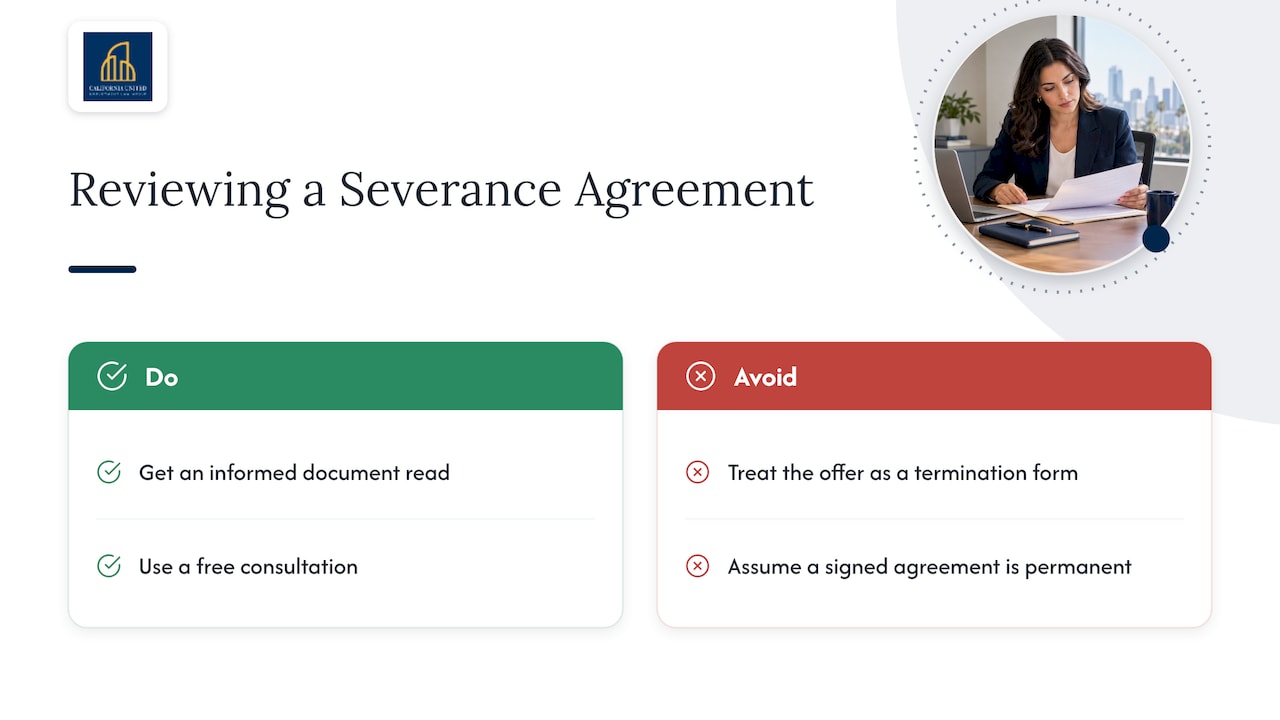
We also see the opposite problem. Employees sometimes assume a signed agreement is permanent and give up without asking anyone. Neither assumption is safe. Every agreement, and every termination, has its own facts. A practical first step is an informed review of the document by an attorney who handles severance and employment matters.
In cases the firm accepts on a contingency fee basis, attorney’s fees are paid from a settlement or award only if there is a recovery. Cost responsibility depends on the fee agreement. A free consultation can help you understand whether the firm may be able to assist. We cannot promise any result, and what is right for one employee may not be right for another.
— California United Law Group
Talk to us about your severance agreement
If you work or worked in West Hollywood and received a severance or separation agreement, or already signed one and have questions, our team can review the agreement and discuss potential next steps. We represent California employees in wrongful termination, discrimination, retaliation and severance matters, from pre-litigation through litigation.
👉 Contact California United Law Group for a free consultation
Bring the agreement, any emails about your termination, and your pay records if you have them. If you are 40 or older, also bring any documents describing the decision group, eligibility factors, job titles, ages, or employees selected and not selected for the program. If you are weighing whether your separation was lawful at all, our guide on how to recognize wrongful termination in California explains the general categories.
FAQ
Can I challenge a severance package?
Potentially. A release may be challenged if it was not knowing and voluntary, lacked real consideration, was signed through fraud or duress, waived rights that cannot be waived, or failed a statutory requirement such as the OWBPA rules for workers 40 and older. Whether a challenge is realistic depends on the document and your facts, so an attorney should review it.
What can make a severance agreement or clause unenforceable?
No single event automatically voids every agreement. Problems that can make an agreement or a clause unenforceable include an attempted release of unpaid wages, waivers of future claims, interference with the right to file an agency charge or participate in an agency proceeding, and age waivers that lack required review and revocation periods. A court looks at the agreement as a whole.
Does California require employers to pay severance?
No. State labor guidance says there is no legal requirement under California law to provide severance pay. Your employer’s policy, an employment contract, a written plan or a collective agreement may still create an obligation, so check those documents.
How long do I have to decide if I am over 40?
For a waiver of federal age-discrimination claims, federal rules generally require at least 21 days to consider an individual agreement, or 45 days in a group termination or exit-incentive program, plus seven days after signing to revoke. Other claims in the agreement may be governed by different rules, such as California’s requirement of at least five business days to consult an attorney on certain separation agreements.
Can negotiating severance backfire?
It can, depending on the offer terms and timing, because an employer is not always obligated to improve or keep an offer open. That is a reason to get advice before responding, not a reason to avoid asking. An attorney can help you understand what is realistic for your circumstances.
This article is for general informational purposes only and is not legal advice. No attorney-client relationship is created by reading this article or contacting the firm. Prior results do not guarantee a similar outcome. Every severance agreement and employment dispute depends on its own facts, deadlines, documents, and applicable law.
Sources
- Q&A: Understanding Waivers of Discrimination Claims in Employee Severance Agreements (EEOC)
- Waivers and Claims Under the ADEA, 29 C.F.R. 1625.22 (EEOC)
- Oubre v. Entergy Operations, Inc., 522 U.S. 422 (1998)
- Oubre v. Entergy Operations, Inc., Supreme Court text
- California Labor Code section 206.5
- California Government Code section 12964.5
- Final Pay (California Division of Labor Standards Enforcement)