
If you work in Glendale and you have reported, or are thinking about reporting, something unlawful at your job, California law protects you from retaliation. Under Labor Code section 1102.5, an employer cannot punish you for disclosing information you reasonably believe shows a violation of a law or regulation. The details matter, though: who you told, what you believed, and how your employer responded all shape whether a claim exists.
This guide explains how whistleblower protection works for Glendale employees, where reports can go, and what retaliation can look like. It is general education, not legal advice. Employment law is fact-specific, and outcomes vary. Past results and general examples do not predict the outcome of any particular matter.
TL;DR
- Whistleblowing generally means reporting suspected unlawful conduct, not simply voicing dissatisfaction with a boss or a policy.
- Protection can apply whether you report to a government agency, law enforcement, or a person at work with authority to investigate or correct the problem.
- Retaliation is not limited to firing. Discipline, schedule cuts, transfers, and lost opportunities can also count.
- Different laws have different agencies and deadlines. Contacting HR or a hotline does not automatically preserve every possible claim.
- A lawyer can review your specific facts, applicable deadlines, and available forums. We offer free consultations to Glendale employees.
Table of Contents
- What counts as whistleblowing in California
- Grievance or whistleblowing: why the difference matters
- Who you can report to
- What retaliation looks like
- How California proves a whistleblower claim
- Possible remedies
- Agencies, forums, and deadlines
- Our perspective: what we see with Glendale employees
- Talk to us about your situation
- FAQ
- Sources
What counts as whistleblowing in California
Whistleblowing is more specific than most people expect. The core idea in section 1102.5 is that you disclosed information, or refused to take part in conduct, because you had reasonable cause to believe it involved a violation of a state or federal statute, or noncompliance with a local, state, or federal rule or regulation.
Two points surprise many Glendale workers:
- You do not need to be right. The standard is reasonable cause to believe, not proof. The statute also covers employers who act on a perception that you are a whistleblower. A protected disclosure may still qualify even if the employer or agency already knew about the issue; California courts have rejected a rule limiting protection only to first-time disclosures.
- It does not have to be your job. The protection applies regardless of whether the disclosure is part of your job duties, which matters for compliance staff, accountants, and HR employees. Courts have also recognized that an employee’s report may be protected even when reporting concerns is part of the employee’s ordinary work.
The law also reaches beyond the person who speaks up. California protects an employee because they are a family member of someone who engaged in, or is perceived to have engaged in, protected activity. It separately protects an employee who refuses to participate in conduct that would violate specified laws or regulations.
Common examples of reportable misconduct include:
- Wage theft, off-the-clock work, or misclassification
- Safety violations or falsified safety records
- Billing or accounting fraud
- Discrimination or harassment that violates the law
- Violations of licensing, environmental, or consumer protection rules
If your concern involves unpaid wages specifically, see our wage and hour practice.
Grievance or whistleblowing: why the difference matters
A grievance is a workplace complaint about unfair treatment or a personnel problem: a bad review, a scheduling dispute, a coworker you cannot get along with. Grievances are real concerns, but not every grievance is legally protected.
A complaint becomes potentially protected whistleblowing when it communicates suspected legal or regulatory misconduct to someone who can investigate or correct it. The label your employer puts on it does not decide the question. What matters is whether you had reasonable cause to believe the information disclosed a violation, and whether your employer’s later action was motivated at least in part by that report. In Ross v. County of Riverside, the court explained that an employee does not have to identify a specific statute in the report itself if the employee disclosed information and reasonably believed it showed unlawful activity. In People ex rel. Garcia-Brower v. Kolla’s Inc., the California Supreme Court held that Labor Code section 1102.5 can protect disclosures even when the recipient already knows about the violation. In Lawson v. PPG Architectural Finishes, Inc., the California Supreme Court confirmed that Labor Code section 1102.6 supplies the burden-shifting framework for Labor Code section 1102.5 retaliation claims.
Discrimination and harassment complaints sit on a related track. The Fair Employment and Housing Act (FEHA) protects employees who complain about discrimination, harassment, and related civil-rights violations, and California employers with five or more employees generally may not retaliate for those complaints. The Civil Rights Department (CRD) describes retaliation through three components: protected activity, work-related harm, and a causal connection between the two.
| Grievance | Whistleblower report | FEHA complaint | |
|---|---|---|---|
| Typical subject | Unfair treatment, personnel dispute | Suspected violation of a statute, rule, or regulation | Discrimination, harassment, related civil-rights violations |
| Main law | Depends on the facts | Labor Code section 1102.5 and related statutes | FEHA |
| Who may receive it | Supervisor, HR | Government or law enforcement agency, a person with authority over the employee, an employee with authority to investigate, discover, or correct the issue, or a public body conducting an investigation, hearing, or inquiry | Employer, or CRD |
| Protected from retaliation | Not automatically | Yes, when the legal standard is met | Yes, when the legal standard is met |
One set of workplace events can touch more than one of these categories. That overlap is a big reason a fact-specific review helps.
Who you can report to
Section 1102.5 covers disclosures to several audiences. According to California’s official whistleblower notice, protected employees include private- and public-sector workers, and protected disclosures include reports to:
- A government or law enforcement agency
- A person with authority over you at work
- Another employee with authority to investigate, discover, or correct the problem
- A public body conducting an investigation, hearing, or inquiry, including through testimony
An employer also may not make or enforce a rule or policy that prevents you from disclosing information to a government or law enforcement agency. A confidentiality clause or handbook policy does not erase that right. However, employees should get legal advice before using or retaining confidential, privileged, trade secret, or proprietary documents, because separate legal limits may apply.
The Attorney General whistleblower hotline
The state Attorney General maintains a hotline at 1-800-952-5225 for people with information about possible violations of state or federal law, as the official notice lists. Calls are referred to the appropriate authority, and the statute says the information is initially held confidential.
Two cautions apply. The hotline is not a guarantee that an investigation or lawsuit will follow. And a hotline call does not, by itself, file or preserve a civil, administrative, or agency claim, toll a deadline, or change existing limitation rules, so it should not be treated as the step that protects your own claim.
Reporting internally
Many Glendale employees first raise a concern with a supervisor, HR, or a compliance officer. That can be protected activity. It is also worth remembering that an internal report is not a government filing. If your employer responds badly, a separate agency filing, administrative process, or court action may be needed to preserve a claim.
What retaliation looks like
Most people picture retaliation as a firing. The CRD framework is broader. Work-related harm can include discipline, denial of a promotion, removal from the schedule, a transfer, threats (including threats involving immigration authorities), or exclusion from professional development, when those things happen because of protected activity.
Because of that, it helps to look at the whole sequence of events rather than only the final decision. Questions that often matter:
- When did you make the report, and to whom?
- What changed at work afterward: hours, duties, reviews, tone from management?
- How much time passed between the report and the change?
- Did the employer give a reason, and has that reason shifted over time?
For more examples, see our overview of signs of employer retaliation in California. If you were let go after speaking up, our page on being fired after reporting violations covers the topic in more depth.
How a California whistleblower claim is proven
California uses a burden-shifting rule under Labor Code section 1102.6. First, the employee must show by a preponderance of the evidence that protected activity was a contributing factor in the challenged employment action. Then the burden moves to the employer, which must prove by clear and convincing evidence that the same action would have occurred for legitimate, independent reasons even if the employee had not engaged in protected activity.
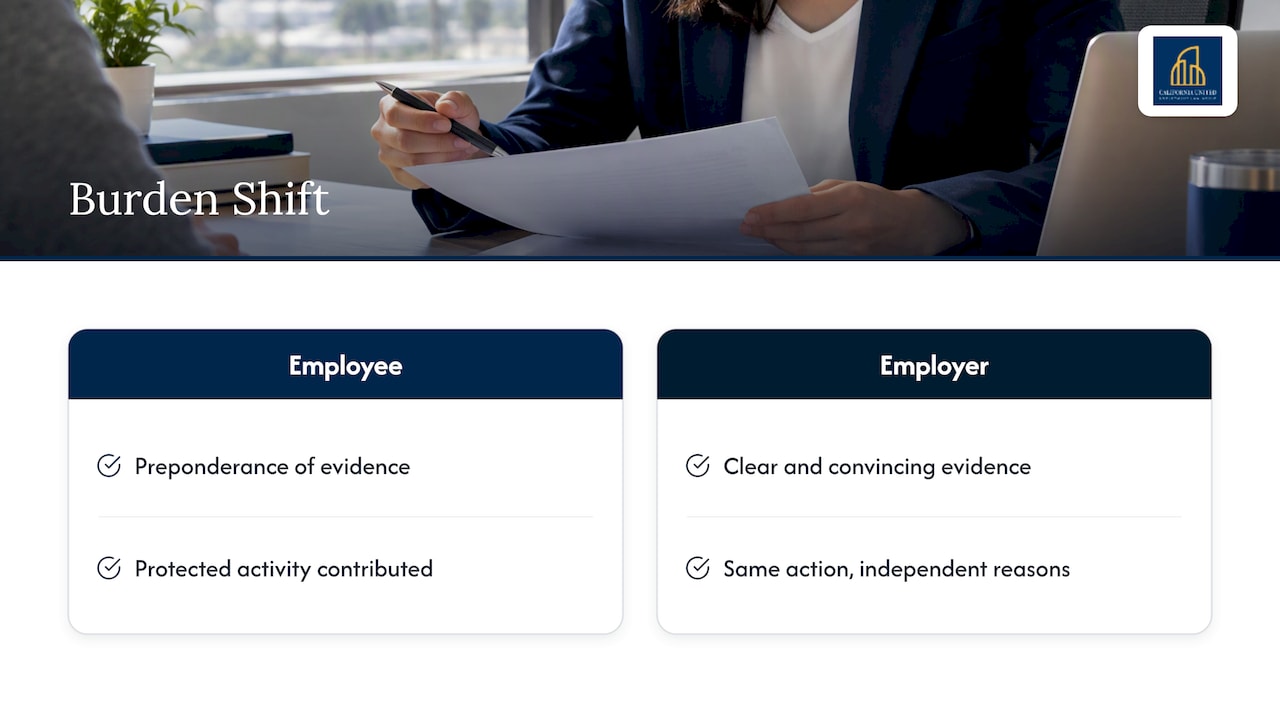
That second standard is demanding. It also explains why causation is so central in these disputes. Your employer may point to performance, restructuring, or attendance. Whether those reasons are independent of your report is usually the heart of the case.
This is a description of the legal standard, not a prediction. Evidence, timing, and the employer’s explanation vary widely from one workplace to another.
Possible remedies
If retaliation is proven under section 1102.5, the statute allows remedies that include:
- Lost wages
- Reinstatement
- Other appropriate relief
- A civil penalty of up to $10,000 per employee for each violation
- Reasonable attorney’s fees for a successful plaintiff
- Actual damages, depending on the claim and proof
No number applies to every case. The value of an individual claim depends on provable harm, the remedies available, and the facts. Be cautious of anyone who promises a specific result or quotes a case value before reviewing your situation. For a closer look at one remedy area, see our guide to reinstatement, back pay, and filing deadlines.
Agencies, forums, and deadlines
The route depends on the legal theory behind your claim. Agencies are specialized and limited in jurisdiction, so the right one is the one that matches your protected activity, not the one with the most familiar name.
- California Labor Commissioner. The Division of Labor Standards Enforcement investigates retaliation complaints for activity protected by laws under the Labor Commissioner’s jurisdiction. When it finds a violation, the employer is given 30 days to comply with the order.
- Civil Rights Department. CRD handles FEHA discrimination, harassment, and retaliation. Per its fact sheet, a complaint must be filed within three years of the alleged incident.
- Attorney General hotline. A referral channel, not a civil complaint, agency charge, or filing that preserves every possible claim.
The three-year CRD window applies to FEHA complaints. It is not a universal deadline for every whistleblower claim. Because different statutes can apply to the same events, do not assume that contacting HR, a hotline, the Labor Commissioner, or CRD preserves every possible claim. A deadline can be missed simply because the wrong door was used.
Our Glendale pages on whistleblower claims and legal protections and whistleblower rights for employees give more local context.
Our perspective: what we see with Glendale employees
We represent employees only, and our work centers on the California Labor Code and FEHA. Some of our attorneys have prior employer-side experience, which helps us understand how a company is likely to document and explain its decisions.
A few things we want employees to know before they decide what to do:
- Reporting and retaliation are separate events. Many people wait to see how things go. We understand that, but facts such as dates, who was told, and what changed afterward are easier to reconstruct when they are fresh.
- A bad outcome does not always look like a firing. Reduced hours, a sudden poor review, or a quiet transfer can be part of the same story.
- Every claim is different. The statute, the agency, and the deadline depend on what you reported and what happened next. We would rather review the specifics than give a one-size answer.
- Cost should not be the barrier. Our fee structure is contingency-based, which means attorney’s fees are owed only if there is a recovery. Whether case costs are owed or reimbursed depends on the fee agreement.
None of this guarantees a result, and every matter turns on its facts. What we can offer is a candid review of your facts, deadlines, and options.
— California United Law Group
Talk to us about your situation
If you reported suspected misconduct and things changed at work, we can review what happened, identify the deadlines that may apply, and explain the options available under California law. We handle employment law matters including retaliation, whistleblower claims, and wrongful termination for employees, and consultations are free.
👉 Contact California United Law Group to discuss your Glendale workplace situation.
FAQ
What is the difference between a grievance and whistleblowing?
A grievance is a complaint about unfair treatment or a personnel problem. Whistleblowing involves communicating suspected legal or regulatory misconduct to someone authorized to investigate or correct it. A grievance can overlap with whistleblowing if it also describes a suspected legal violation, which is why the content of the report matters more than what it is called.
Who is protected under California’s whistleblower law?
Private- and public-sector employees are covered, according to California’s official notice. Protection extends to employees who are perceived to be whistleblowers, who refuse to join unlawful conduct, or who are family members of someone who engaged in protected activity. Whether a particular person qualifies depends on the facts.
How much is a whistleblower lawsuit worth?
There is no fixed amount. Available remedies can include lost wages, reinstatement, other relief, attorney’s fees, and a civil penalty of up to $10,000 per employee for each violation. The actual value depends on provable harm, available remedies, liability evidence, defenses, and the facts of the case, and no lawyer can responsibly promise a figure in advance.
What qualifies as retaliation from an employer?
Retaliation generally requires protected activity, work-related harm, and a causal link between them. Harm can include firing, discipline, denied promotions, schedule removal, transfers, threats, or exclusion from professional development. A lawyer can evaluate whether your sequence of events fits that framework.
Does calling the Attorney General hotline protect my deadline?
No. A hotline call may be referred to the appropriate authority, but it does not, by itself, file or preserve a civil, administrative, or agency claim, toll a deadline, or change existing limitation rules. If you believe you have a claim, speak with an employment attorney about the deadline and forum that apply to your situation.
Sources
- California Labor Code section 1102.5
- California Labor Code sections 1102.5 to 1102.7, full text
- California Labor Code section 1102.7
- Whistleblowers Are Protected, California Department of Industrial Relations
- Workplace retaliation is against the law, Civil Rights Department fact sheet
- Retaliation and Discrimination Complaints, Division of Labor Standards Enforcement